6 Free Astronomy Tools That Will Make You Fall in Love with Stargazing
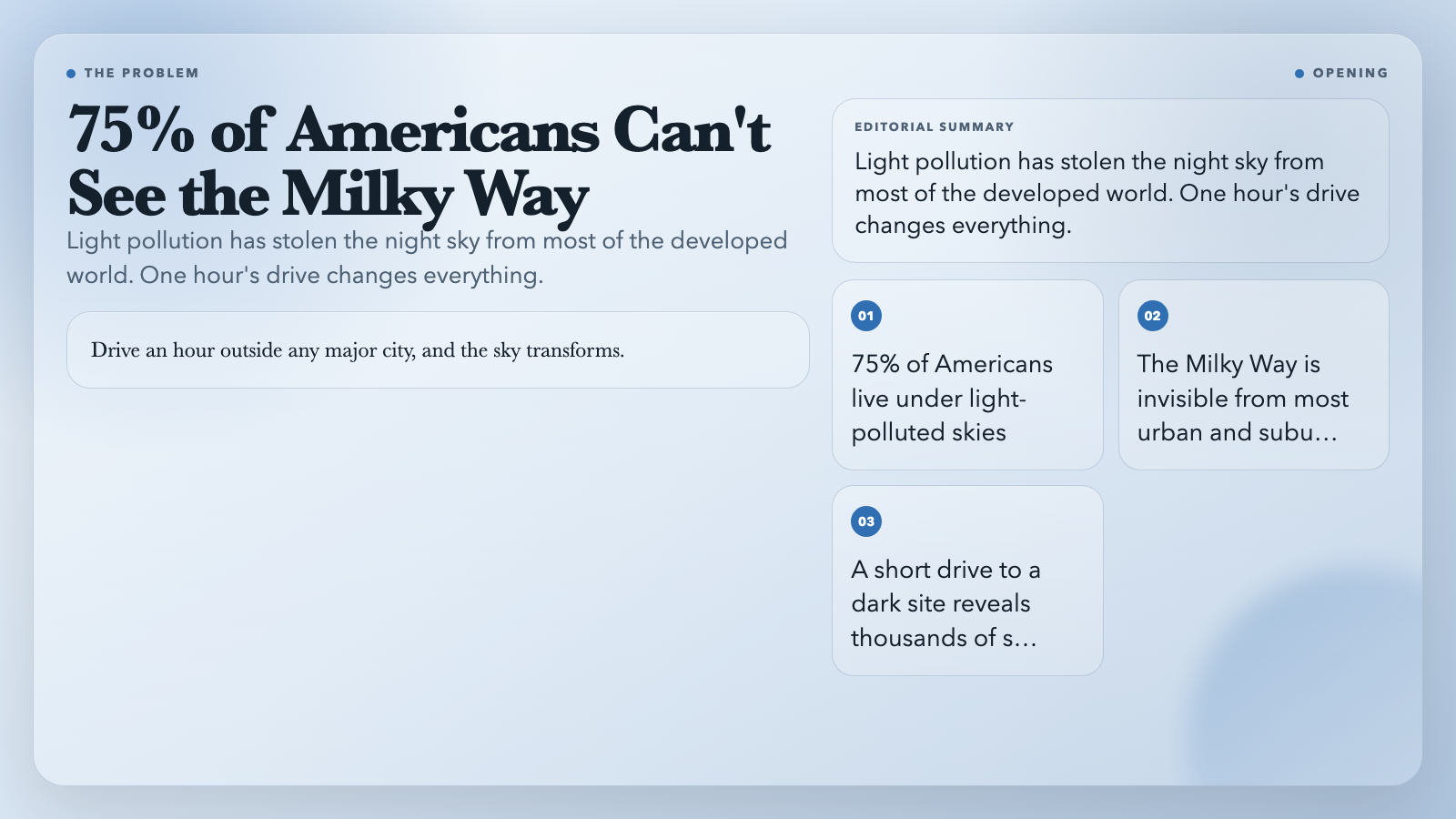
The Milky Way is invisible to roughly 75% of Americans because of light pollution. Drive an hour outside any major city, though, and the sky transforms — thousands of stars, the band of our galaxy, planets as bright as anything on your phone screen.
The tools to understand what you’re looking at have never been more accessible.
Whether you glance up occasionally or plan dedicated stargazing sessions, these six free tools from ElysiaTools cover almost everything you need to navigate the night sky in 2026.
#
1. Sunrise-Sunset Calculator
Timing is everything in astronomy. The best stargazing happens during astronomical twilight — when the sky is dark enough to see faint objects but the horizon still holds traces of color.
The Sunrise-Sunset Calculator gives exact sunrise and sunset times for any location on any date. Enter coordinates (or any city), pick a day, and it tells you when the sun rises, sets, and how many hours of daylight you’ll have.
This means you plan your stargazing sessions around true darkness instead of guessing. Know when astronomical twilight ends, and you know exactly when to step outside with your best chance of seeing faint deep-sky objects like the Orion Nebula or the Andromeda Galaxy.
Use it for: Planning observation sessions, calculating daylight duration for photography, tracking seasonal changes in daylight.
#
2. Moon Phase Calculator
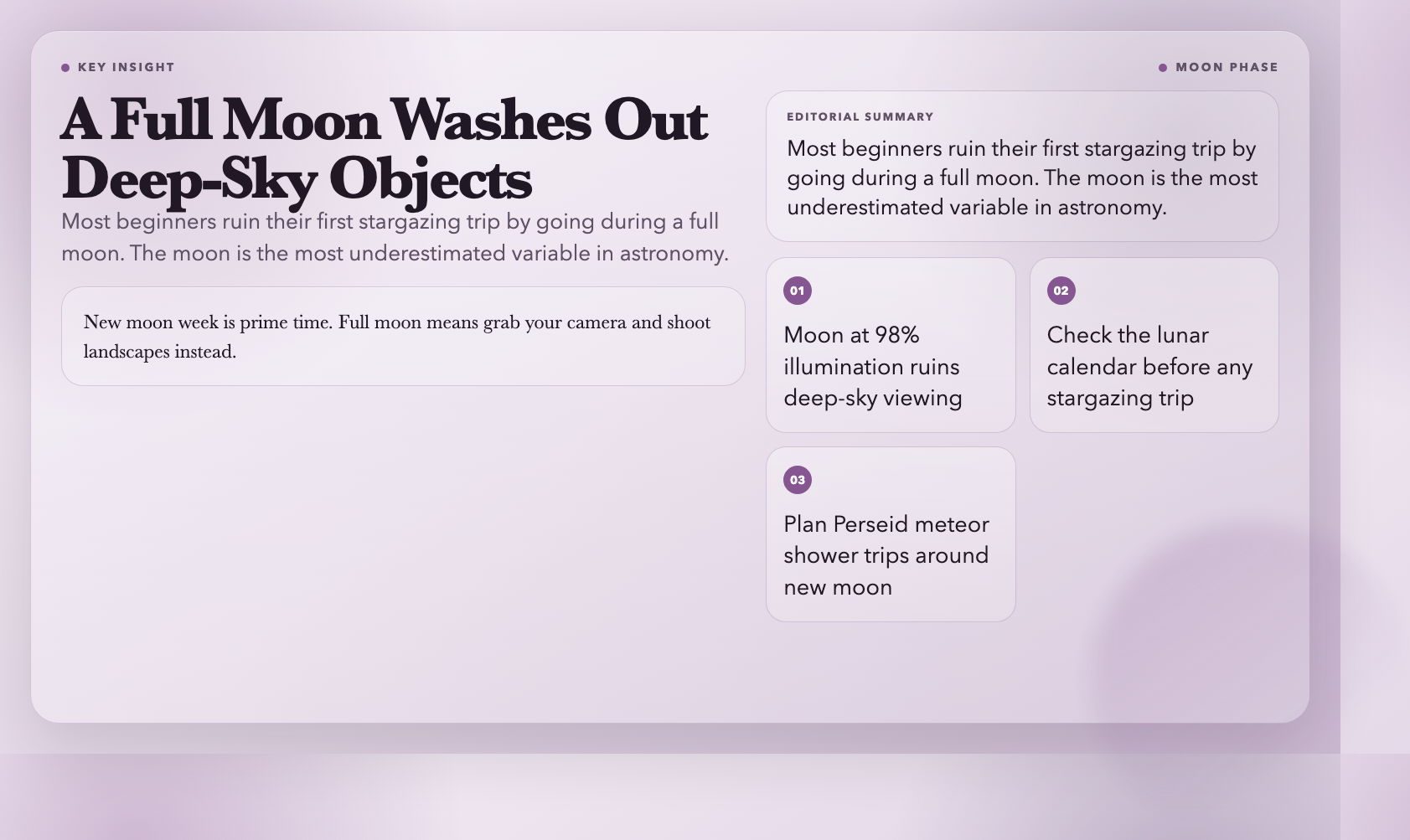
A full moon is beautiful. It’s also the worst time to go deep-sky observing — the moon’s brightness washes out everything except the brightest stars and planets. I’ve watched beginners drive an hour to a dark site only to find the moon at 98% illumination, ruining their first attempt at galaxy viewing.
The Moon Phase Calculator tells you the current moon phase, its illumination percentage, and how many days into the lunar cycle you are. Check the moon phase before any deep-sky session. New moon week is prime time. Full moon means grab your camera and shoot landscapes instead.
The tool also calculates the moon phase for any future date. For example, if you’re planning a trip for the Perseid meteor shower in August, you can check whether the moon will interfere — a new moon means optimal viewing, while even a quarter moon significantly reduces the number of visible meteors.
Use it for: Planning deep-sky observation sessions, astrophotography timing, understanding tidal patterns.
#
3. Planet Position
Eight planets orbit the sun. On any given night, most are invisible — too close to the sun’s glare to observe. But several are bright enough to see with the naked eye, and knowing where to look changes everything.
The Planet Position tool tells you the current position of any planet — which constellation it’s in, its right ascension and declination coordinates, and its apparent magnitude (brightness). Select a planet and a date, and it gives you the celestial coordinates you need to find it in the sky.
Jupiter reaches opposition roughly every 13 months, when Earth passes directly between Jupiter and the Sun, making it brightest and visible all night. In 2026, Jupiter is well-positioned for evening observation through much of the spring. Without knowing where to look, you might see a brilliant “star” and not realize you’re looking at a world with 95 known moons.
Use it for: Identifying planets in the night sky, planning observation sessions, educational use in classrooms.
#
4. Solar Eclipse Calculator
Solar eclipses are rare enough that when one happens, they dominate headlines for weeks. The next total solar eclipses visible from populated areas aren’t until 2027 — but partial and annular eclipses happen every year, and many go unwatched because people don’t know they’re happening.
The Solar Eclipse Calculator tells you the dates and types of all solar eclipses for any given year. Select a year and it lists every eclipse — total, partial, or annular — along with where on Earth it will be visible.
This means you can see at a glance whether there’s an eclipse happening this year worth traveling to observe. For instance, an annular solar eclipse crossed parts of Africa and Asia in January 2026. Without a tool like this, you’d miss these events entirely.
Use it for: Planning eclipse-chasing trips, understanding global eclipse frequency, educational demonstrations.
#
5. Lunar Eclipse Calculator
Lunar eclipses are the more accessible cousin of solar eclipses. They last for hours, are visible across an entire hemisphere, and require no special equipment — just clear skies and somewhere dark. No glasses needed. No risk to your eyes.
The Lunar Eclipse Calculator works the same way as the solar version but for lunar eclipses. Enter any year and it lists every lunar eclipse — total, partial, and penumbral — along with the date and type. A total lunar eclipse, or “blood moon,” occurs when the Earth passes directly between the sun and moon, casting a reddish shadow across the lunar surface.
In 2026, there are several penumbral eclipses visible from Asia and Europe. Penumbral eclipses are subtle — the moon dims only slightly — but they’re worth knowing about. More dramatic total lunar eclipses, where the moon turns fully red, happen roughly two to four times per year globally.
Use it for: Planning observation sessions, tracking eclipse frequency, understanding Earth’s shadow geometry.
#
6. Solstice & Equinox Calculator
The solstices and equinoxes mark the skeleton of the astronomical year — the moments when Earth’s axial tilt aligns most and least with the sun. They’re not just calendar dates. They represent fundamental shifts in daylight, seasonal weather patterns, and the overall rhythm of life on Earth.
The Solstice & Equinox Calculator gives the exact dates and times of all four events — March equinox, June solstice, September equinox, and December solstice — for any year. It also tells you which hemisphere experiences Summer versus Winter at each event.
The March 2026 equinox fell on March 20. From that point forward, days in the Northern Hemisphere grow shorter toward the June solstice in June, then lengthen again. Winter nights in the Northern Hemisphere stretch to 15+ hours in December — the longest dark-sky windows of the year. Plan your deep-sky trips for midwinter to maximize your time under dark skies.
Use it for: Understanding seasonal sky changes, planning trips around optimal dark-sky seasons, educational use.
#
The Bigger Picture
These six tools share one thing: they remove friction from stargazing. You don’t need an expensive telescope, a power user account, or years of experience. You need to know when to look, where to look, and what the moon is doing.
The night sky is one of the last free experiences on Earth. No subscription. No account. Step outside, look up, and know what you’re seeing.
The question isn’t whether the sky is worth watching. It’s whether you’ve been missing it because you didn’t know when to look.