Most resume reviewers say “show impact.” Almost none tell you how. The phrase is broken — it sits in career advice columns, in LinkedIn comments, in the rejection emails you don’t reply to — and it leaves candidates stranded, because impact is invisible until you can name the lens that reveals it. A bullet doesn’t read as “impactful” because of the verb; it reads that way because 4 scoring dimensions line up: strong opening action, quantified outcome, believable scope, and absence of words hiring managers now hear as filler. Score those 4 lenses separately, and the rewrite almost writes itself. The question isn’t whether your bullets have impact. It’s whether you’ve measured it.
A team I worked with once ran the same twenty resumes through two reviewers and got disagreeing verdicts on seventeen. The disagreement wasn’t taste — it was that each reviewer was silently weighting a different scoring lens. One cared about verbs, another about metrics, a third about repetition, a fourth about buzzwords. Seventeen disagreements, four lenses, one resume. Does the math actually work? It does — but only when you name the lenses and score them separately. The Resume Bullet Impact Meter at Elysia Tools does exactly that: a 0–100 score per bullet, broken out by verb strength, quantified metrics, length and repetition, and buzzword load.
Why “Add Metrics” Advice Usually Fails
The standard career advice is “add numbers.” It sounds concrete. It isn’t. Candidates who try to comply shove percentages into sentences that don’t measure anything: “Improved user experience by 200%.” That’s not a metric — that’s a number with nowhere to land. The four-lens audit forces a cleaner sequence:
1. Pick a verb from the strong-verb set: Implemented, Led, Owned, Built, Migrated, Reduced, Cut, Shipped. Avoid Worked on, Helped with, Was responsible for — these dilute the action by spreading credit. 2. Name the object the verb acted on: a system, a migration, a pipeline, a backlog, a SLA breach. 3. Attach a number that survives a follow-up question: tickets closed, dollars saved, latency cut, deployments per day. If you can’t defend the number in an interview, it’s a decoration. 4. Cite the frame of reference: per week, per quarter, versus last quarter, versus the SLA. Numbers without comparison read like guesses.
Why does the order matter? Because the first three steps can be done in any order — but if you skip the fourth, the bullet passes the “looks quantified” smell test and fails the “sounds real” test. Hiring managers don’t ask for proof on every bullet, but they sniff-test a few, and a decoration percentage costs you the rest of the resume.
The Four Lenses, Audited One At A Time
Run your bullet through the meter and you’ll see four independent scores, not one composite. That separation is the whole point — it tells you which rewrite will move the needle.
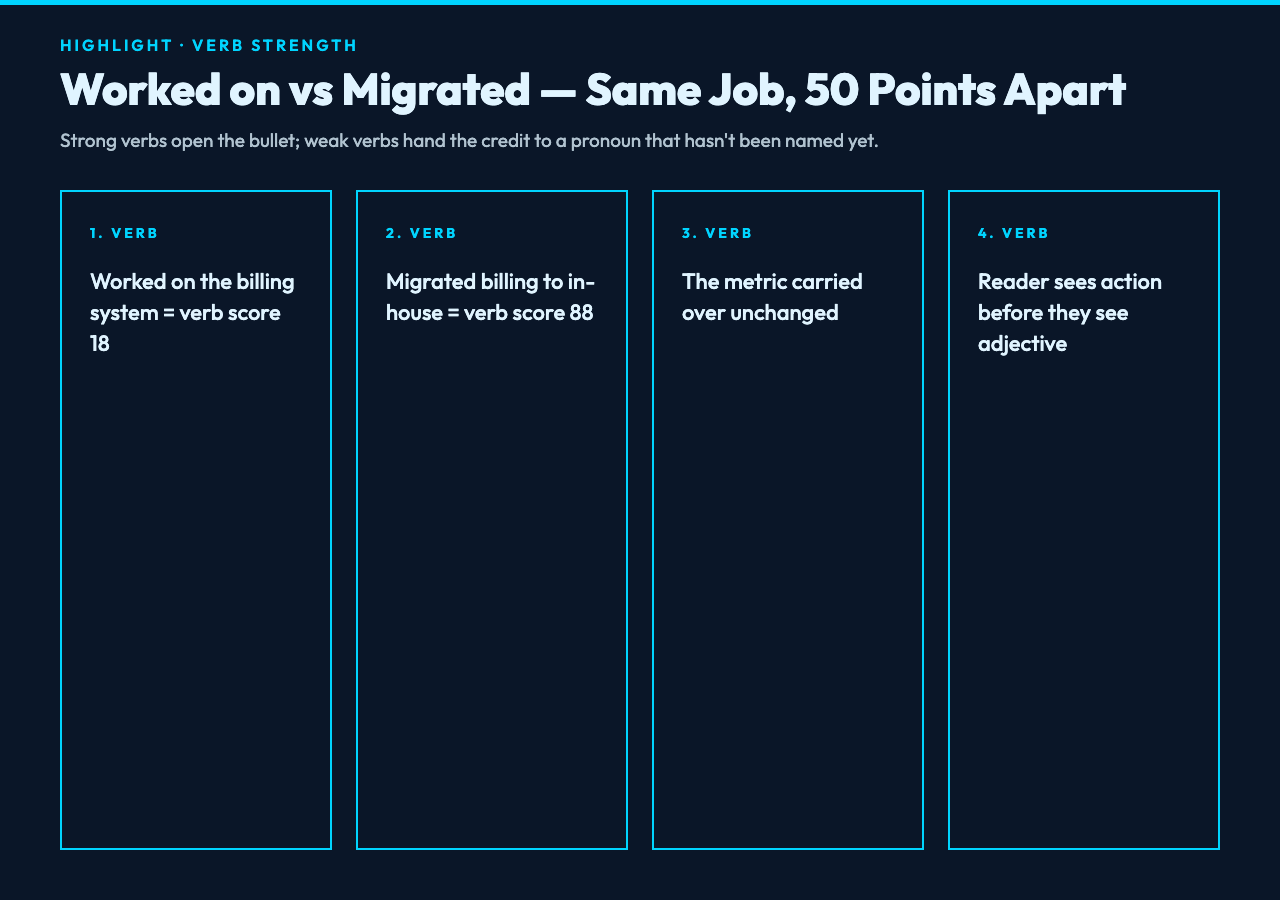
Verb strength. The meter scores strong verbs (Implemented, Led, Owned, Migrated, Reduced, Shipped) and downgrades weak ones (Worked, Helped, Assisted, Was responsible for, Handled). A bullet that opens with “Worked on the billing migration” lands around 35 even if the rest is perfect. “Migrated billing from Stripe to in-house and cut chargeback rate 42%” lands near 90. The same metric, the same outcome — but the verb carries half the score.
Quantified metrics. It looks for digits, percentages, currency symbols, time windows, and counts. “Cut chargeback rate 42%” registers. “Cut chargeback rate significantly” does not. “Saved the company a lot of money” definitely does not. The lens is binary at the token level but weighted at the bullet level: a bullet with two quantified signals (a percentage AND a time window) outscores a bullet with one.
Length and repetition. Bullets over 28 words get penalized for losing the scan reader. Bullets that repeat the same opening verb as the previous bullet get penalized for reading like a list compiled by a template. This is the lens candidates complain about most, because their resumes “look fine” — but a screener reading 80 bullets in eight minutes flags the repetition long before the candidate sees the rejection.
Buzzword blacklist. Synergy, leverage, rockstar, ninja, guru, results-driven, best-in-class, thought leader, go-getter. The meter tags every occurrence. A single buzzword costs about eight points. Two in the same bullet cost fifteen. Three effectively zero the bullet’s chances, because the reader stops believing the candidate wrote it.
A Real Bullet, Scored And Rewritten
Take this line from a mid-level backend engineer:

Worked on the auth system and helped improve performance for end users.
The meter scores it: verb 18, metrics 0, length 62 (penalized), buzzword 0, repetition neutral. Final: 31 / 100. The rewrite prompt the tool offers: replace Worked on with Migrated or Rebuilt; attach a number; tighten the object. Result:
Migrated legacy session auth to JWT, cutting average login latency from 1.4s to 220ms across 2.1M monthly active users.
Verb Migrated (strong), two metrics (1.4s, 220ms, 2.1M users), length 18 words, zero buzzwords. Final: 88 / 100. The candidate didn’t add a skill — they added specificity.
The Three Resets That Move Almost Any Bullet
When a bullet scores in the 40s and won’t climb, the failure is usually one of three patterns, and each has a deterministic fix.
The pronoun bullet. “Worked on X” / “Helped with Y” / “Was responsible for Z.” The pronoun is doing the work the verb should be doing. Fix: name the verb first (Led, Owned, Shipped), then the object. The pronoun almost always disappears on its own.
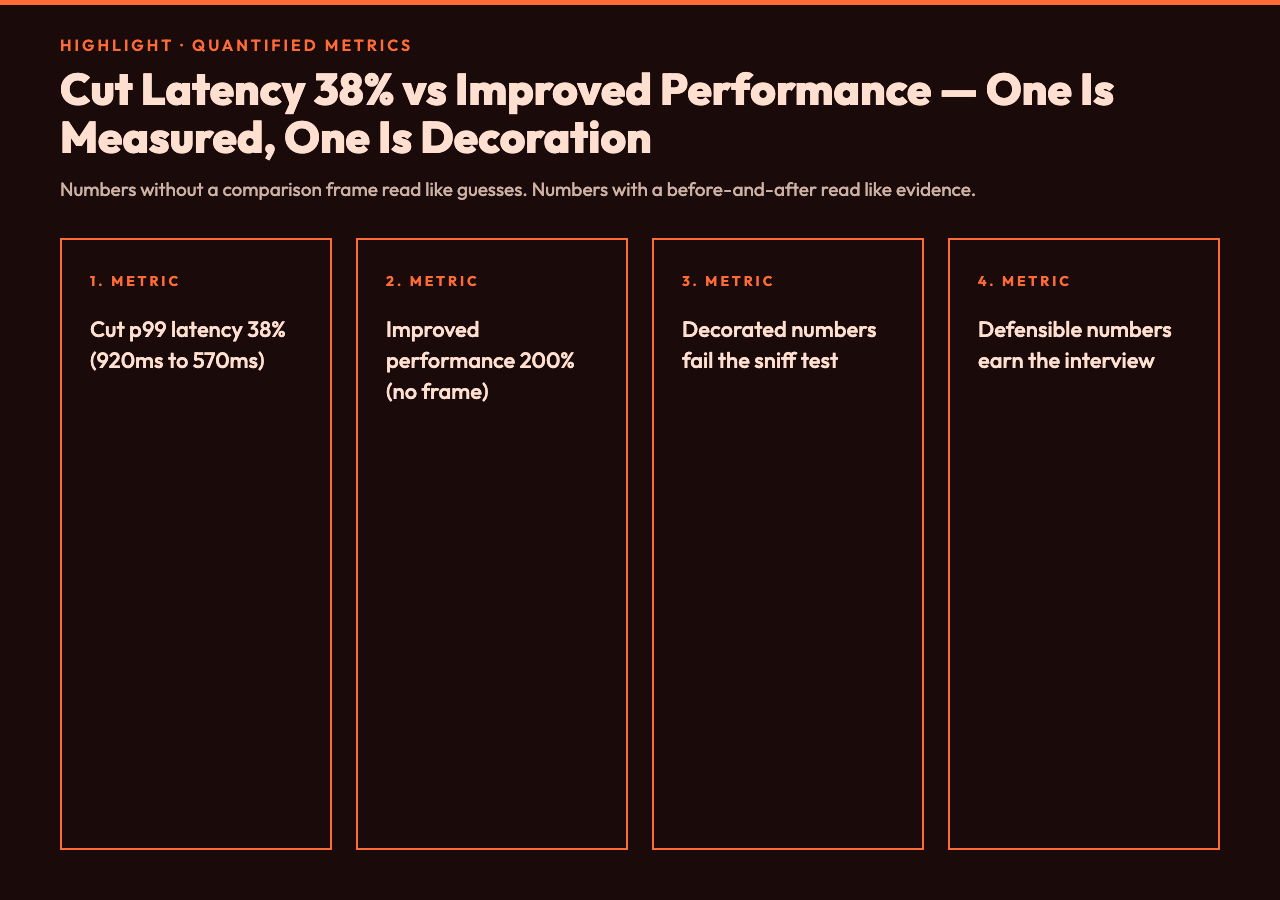
The decoration bullet. “Improved X by 200%” with no comparison frame. Fix: replace the bare percentage with a before-and-after pair, or attach a denominator. Cut p99 latency 38%, from 920ms to 570ms reads as measured; Improved performance 200% reads as filler.
The activity bullet. “Built dashboards for the analytics team.” The verb is strong but the object is generic. Fix: name the stack and the consumer. Built Looker dashboards for the analytics team, surfacing 14 weekly KPIs and reducing ad-hoc SQL requests 60%. Now the dashboard is a thing someone used, not a thing someone made.
You can run all three resets on the same bullet, and the meter will score the cumulative effect — each fix unlocks points the previous fix couldn’t reach, because the four lenses aren’t independent. A strong verb makes the metric believable. A believable metric makes the scope believable. Scope is what the length lens rewards.
What The Meter Won’t Do
It won’t fix a resume that’s structurally wrong. If you have three years of experience and one page of bullets, the meter won’t manufacture depth. It won’t save a resume with a bad summary, a vague skills section, or a job title that doesn’t match the work. It scores bullets — that’s the entire contract. Treat it as the proofreading pass after the writing is done, not as a substitute for figuring out what you actually did at your last job.
It also won’t catch lies. The synonym swap the meter offers — “Worked on auth” → “Migrated legacy auth to JWT” — is a structural rewrite, not a fact checker. If the original bullet was about adding a single OAuth provider, the rewrite shouldn’t claim a full migration. Use the rewrite as a template for the truth, not as a substitute for it.
Closing: The Lens You Score Is The Lens You Write
Most resume feedback is a vibe. “Add impact.” “Be more specific.” “Sound more senior.” Each phrase is a lens the reviewer didn’t name. The Resume Bullet Impact Meter at Elysia Tools names all four — verb, metric, length, buzzword — and weights them per bullet. That turns “I think this is weak” into “this scores 34 because verb carries 18 and metric carries 0,” which turns into a rewrite in one pass instead of three.
Run twenty bullets through it. Sort by score. Rewrite the four lowest scorers using the three resets — pronoun, decoration, activity. You’ll move the bottom quartile of your resume by 25–40 points without touching a word in the top half. Then look at the bullets you thought were your strongest and ask whether they were strongest by feeling or by score. If by feeling, run them through again. Some of them will land at 52 and you’ll understand why the callback rate has been quiet.
The candidates who get hired aren’t the ones with longer resumes. They’re the ones whose bullets survived all four lenses at once. The meter is the smallest auditor that catches all four. Try it on the worst bullet in your resume first — the one you’ve been avoiding — and see what score it actually earns. The next question is whether you’ll trust the number, or whether you’ll write it off as just another metric.
Explore more tools at elysiatools.com — what you find there next is up to which resume problem you’ll tackle after this one.