There is a particular kind of quiet that only happens when a 9×9 grid is on the table and a pencil is in your hand. It is the quiet of a single problem, well-defined, and small enough to hold in working memory. Every morning newspaper used to deliver that quiet. Now the equivalent is a single click on a tool like the Sudoku Generator at Elysia Tools, and the question is no longer whether a puzzle exists but whether the puzzle you got is actually a good one.
What the generator actually does
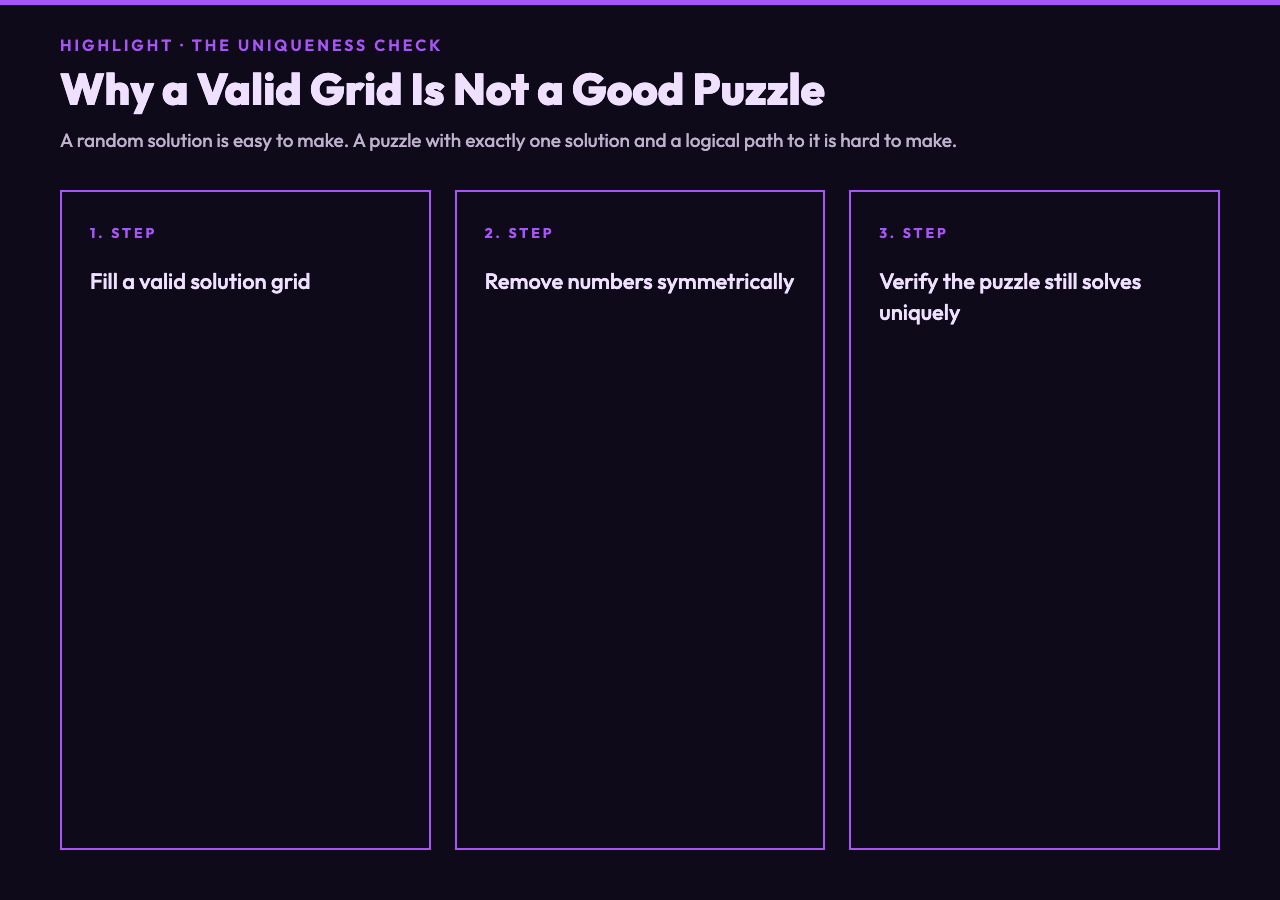
A Sudoku generator has one job, and the job is older than the web: produce a valid 9×9 puzzle with exactly one solution. That sentence hides three separate problems. Producing a valid filled grid is easy — random backtracking solves it in milliseconds. Producing a valid filled grid that is also aesthetic — symmetrical, balanced, with a reasonable number of givens — is much harder. And producing a filled grid that, after you delete a chosen subset of cells, still yields exactly one solution is the real work. The generator you use is hiding all three of those problems behind a single button.
If you want to see the difference, run the same tool twice in a row and compare the puzzles. A weak generator hands you grids that solve on the first guess in three places. A good generator hands you grids where every move earns the next move. The reason most free puzzles feel random in a bad way is that the generator skipped the uniqueness check.
Why difficulty is harder than it sounds
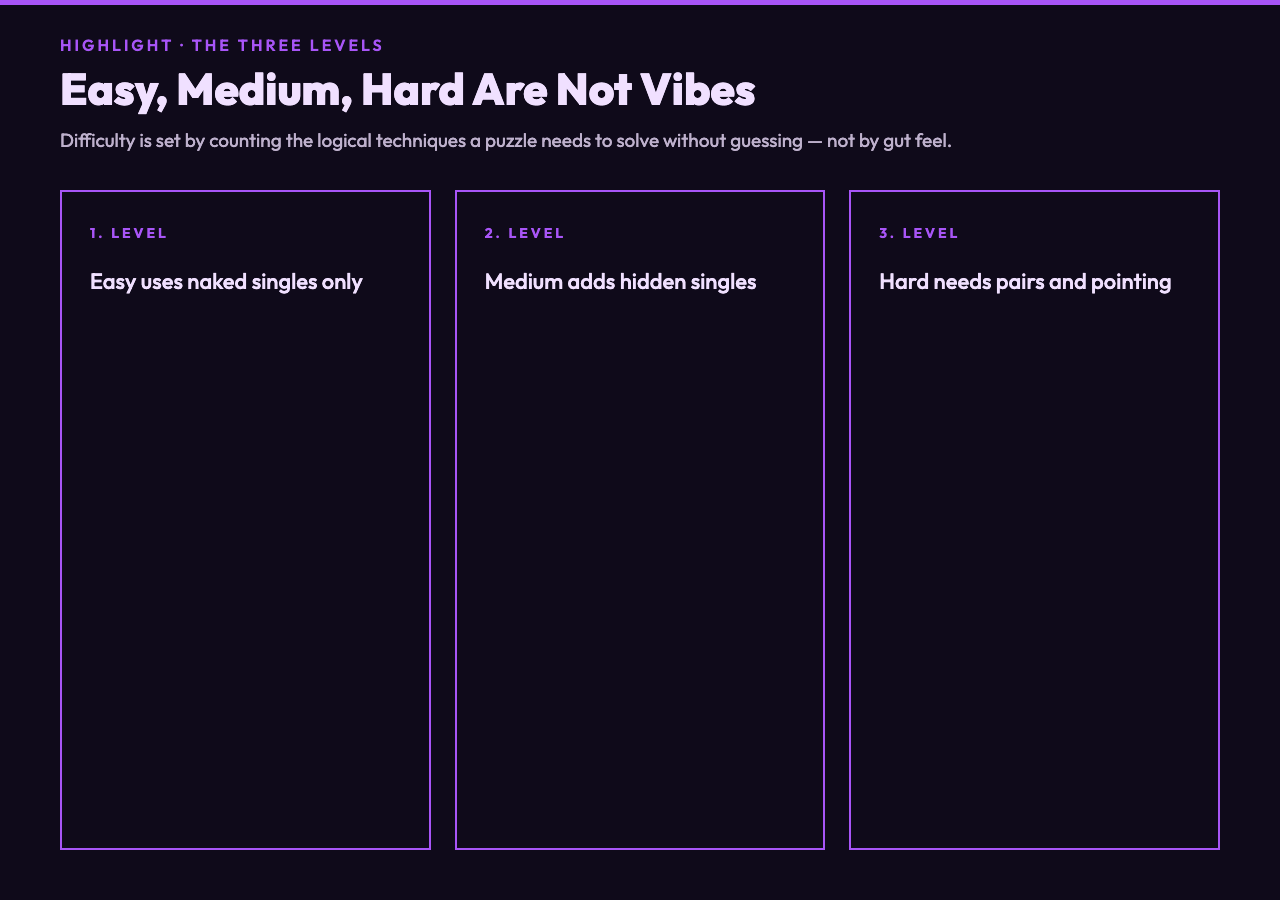
The single most underrated label on any Sudoku tool is the difficulty dropdown. Easy, Medium, Hard is not a vibes meter. It is a statement about which logical techniques the puzzle demands. Easy puzzles solve with naked singles — a cell where only one digit can possibly fit. Medium puzzles add hidden singles — a digit that appears in only one place within a row, column, or box, even though the cell itself has many candidates. Hard puzzles require pairs, pointing, and box-line reduction. The same 81 cells become a different problem at each level.
When the difficulty setting is honest, you can predict the experience. Easy should never make you write candidate numbers in pencil. Medium should never make you backtrack. Hard should never need a guess-and-check branch. If any of those rules break, the puzzle was mislabeled. The fix is not to power through; the fix is to switch tools. The Sudoku Generator at Elysia Tools handles this honestly because it picks the difficulty from the techniques the puzzle actually needs, not from the count of givens alone.
The hidden job: uniqueness
Uniqueness is the invisible specification. A grid with two solutions is not a harder puzzle — it is a broken one, because two solutions mean the rules alone do not pin down the answer. A well-built generator removes givens one at a time and re-solves the puzzle after each removal to make sure uniqueness survives. That is the slow part of the work. It is why a 9×9 grid takes milliseconds to fill and seconds to grade. The slowness is the proof that you are getting a real puzzle.
There is a useful mental model here. Treat every given cell as a hypothesis about the puzzle. The fewer hypotheses you need, the harder the puzzle is. The more redundant the hypotheses — givens that are forced even without the rest of the grid — the easier it feels. A good generator balances both: enough given cells to make the puzzle feel bounded, and not so many that the logic collapses into a parade of naked singles.
Symmetry, seed, and the case for a clean board
Symmetry is the second invisible specification. Symmetric puzzles — where givens mirror across the center — look calmer. Asymmetric puzzles look busier even when they are equally valid. Most newspapers default to rotational symmetry because human eyes prefer it, and most generators copy that convention. If you generate ten puzzles in a row and the symmetry feels off, the generator is probably sampling givens randomly without enforcing the mirror constraint. That is not a deal-breaker, but it is a tell.
Seeding matters too. A generator that re-uses the same handful of templates will eventually hand you a puzzle you have seen before, and the surprise that makes the morning ritual work goes away. A seeded generator — one that pulls from a wider library of valid solution grids — keeps the puzzles feeling new even after months of daily use. The Elysia Tools generator picks from a fresh seed each run, which is the practical reason it does not feel stale by the second week.

How to read the puzzle the tool gives you
Read the puzzle the tool hands you the way you would read a chess position. Start by scanning rows, columns, and boxes that already have five or six digits filled. A row with eight digits has one cell left, and that one cell is forced. Always fill the forced cells first; they cost no thinking and they unlock the next layer. Only after the forced cells are gone should you start writing candidate numbers in pencil.
The candidate pass is the work itself, not a setup for the work. If you find yourself writing candidates in more than four cells at once, you are solving the wrong puzzle — that is a Hard puzzle disguised as Medium, and the honest move is to switch levels rather than push through. Most “stuck” moments in Sudoku are mislabeled difficulty, not solver failure.
When to switch levels (and when not to)
The honest rule for switching levels is this: switch up when the current level feels mechanical, and switch down when it feels impossible. Easy is not a downgrade. Easy is the level where you can practice the logic without the bookkeeping. Hard is not an upgrade. Hard is the level where bookkeeping starts to dominate logic. Most adults solve better at Medium most days, because Medium is the band where logic and bookkeeping are roughly balanced.
If you are training a beginner, keep them on Easy until they can finish five in a row without writing any candidates. If you are training yourself toward Hard, step up only after a month of clean Medium solves. Sudoku is one of the few skills where the deliberate ladder is right there in the difficulty menu. Use it.
The shortest path between an empty grid and a satisfying solve is one good generator, a difficulty setting you actually trust, and ten quiet minutes. The puzzle itself is the same 81 cells it has always been, and the rules have not changed in forty years. What changes is whether the puzzle you meet tonight is a chore or a craft, whether it rewards the technique you practiced yesterday or punishes you for skipping steps. Open the generator, pick a level that matches the time you actually have, and let the grid teach you something about the way your own mind hunts for patterns when nothing else is asking for its attention.
Explore more puzzle and logic tools at elysiatools.com.