
Have you ever opened a JavaScript, Python, or Java file and found 40 lines of comments but no quick way to see what they document? I treat that gap as a broken handoff: the source may be readable, but the knowledge is still trapped in syntax. Docstring Extractor gives that hidden layer a shape, pulling documentation from multiple languages so teams can inspect, compare, and reuse it before a review turns into archaeology.
Documentation is a second interface
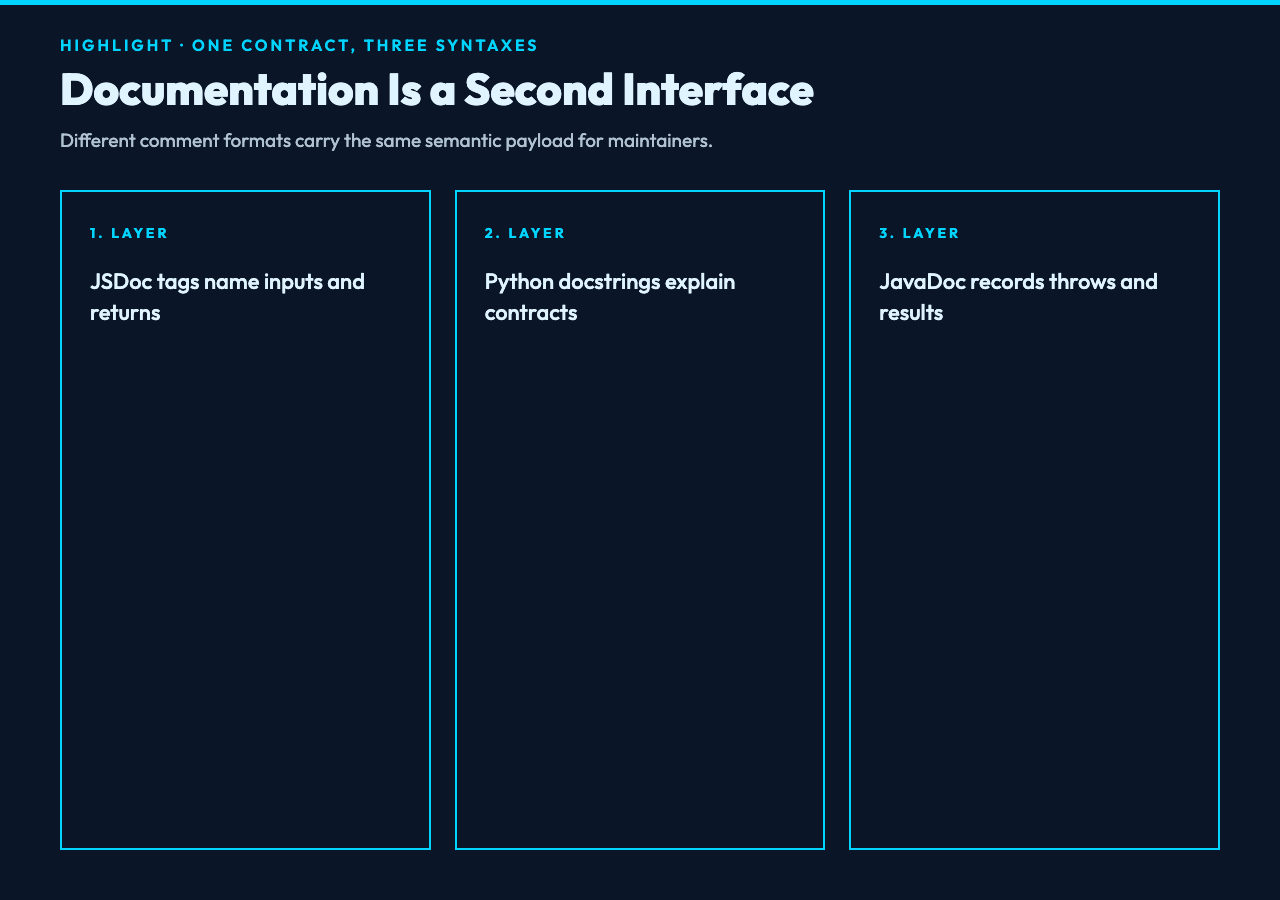
A function has an interface for the runtime and another interface for the humans who maintain it. The first is made of parameters, return values, exceptions, and types. The second is made of explanations: what the function assumes, what it guarantees, and why a surprising edge case exists.
Those explanations are often present, but scattered across JSDoc blocks, Python docstrings, JavaDoc comments, and ordinary line comments. A developer can read them one file at a time. The friction appears when someone needs to answer a larger question: Which public methods are documented? Where are the descriptions inconsistent? Can a release note or API review be assembled without opening every source file?
That is the useful boundary for Docstring Extractor. Its stated job is to extract and parse documentation from JavaScript/TypeScript, Python, and Java source code. The value is not that comments become magically correct. The value is that documentation stops being invisible until a person happens to visit the exact file that contains it.
Three languages, one extraction problem
The syntax changes from ecosystem to ecosystem, but the maintenance problem is familiar.
A JavaScript function might carry a JSDoc block with @param and @returns tags. A Python function may put its contract inside an indented triple-quoted docstring. A Java class can use JavaDoc tags such as @param, @return, and @throws. These formats are not interchangeable, yet each is an attempt to answer the same questions about code.
For example, a small JavaScript annotation might look like this:
/**
 * Find the first matching account.
 * @param {string} email - Account email to search for.
 * @returns {Account | null} The match, or null when absent.
 */
function findAccount(email) {
  // implementation
}
A Python version may express the same contract in a different shape:
def find_account(email: str) -> Account | None:
    """Find the first matching account.

    Args:
        email: Account email to search for.

    Returns:
        The match, or None when absent.
    """
The important detail is not the punctuation. It is the semantic payload: a name, a description, inputs, and an expected result. An extractor gives a team a way to bring those payloads together before deciding what to do with them.
The first practical win is comparison
Documentation tools are most helpful when they expose unevenness. One module may carefully explain every parameter while its neighboring module says only “handles data.” One method may document an exception that three similar methods can also raise. A TypeScript interface may describe a field that the Java implementation never mentions.
An extracted view makes those gaps easier to spot. You can use it as a lightweight inventory before a refactor, a review aid before publishing an API, or a starting point for generating internal reference material. It also helps new contributors orient themselves: instead of reading implementation details in arbitrary order, they can begin with the promises the code makes to its callers.
The accompanying Code Documentation Samples page is useful for testing that workflow across styles. Its sample collection includes JavaScript functions and classes with JSDoc, TypeScript interfaces and classes, Python functions and classes with docstrings, and Java classes and methods with JavaDoc. That range matters because a parser that looks convincing on one comment style may still fail on the next language boundary.
A four-pass workflow for a real repository
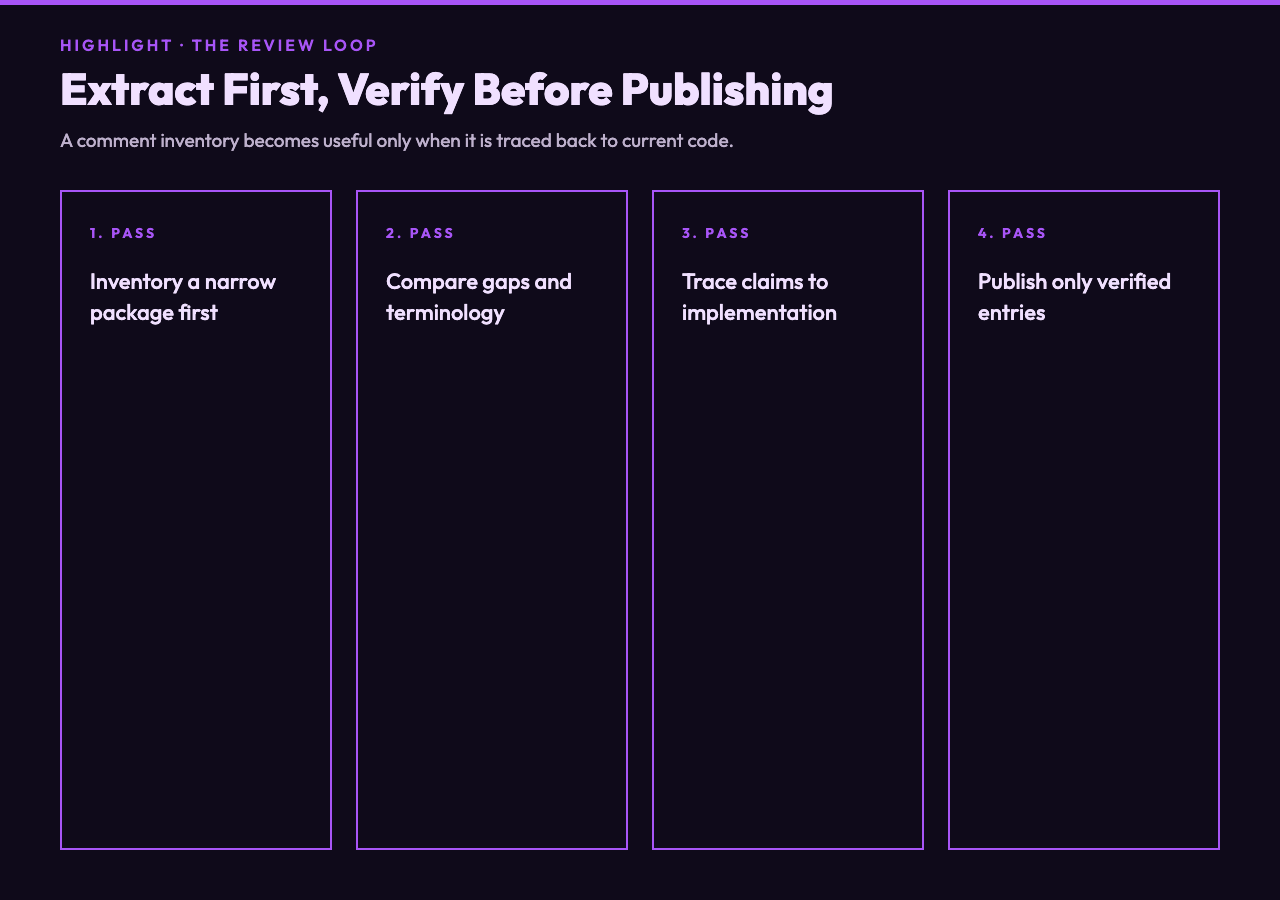
I would use the extractor in four passes rather than treating it as a one-click documentation generator.
- 1. Inventory. Extract the documentation from the files or modules in scope. Start with a narrow package, not an entire monorepo, so the result remains reviewable.
- 2. Compare. Look for missing descriptions, inconsistent terminology, undocumented inputs, and tags that appear in one language but not another. These are signals for human review, not automatic defects.
- 3. Trace. Open the source behind each important entry. Confirm that the prose still matches the implementation, especially after a signature or error-handling change.
- 4. Publish selectively. Turn the verified subset into an API reference, migration note, or team checklist. Keep generated material close to the source, where the next change can update it.
The “trace” step is the safeguard. Extraction can organize what exists, but it cannot prove that a comment is true. A polished description of an obsolete behavior is more dangerous than an obviously missing one.
What parsing can—and cannot—tell you
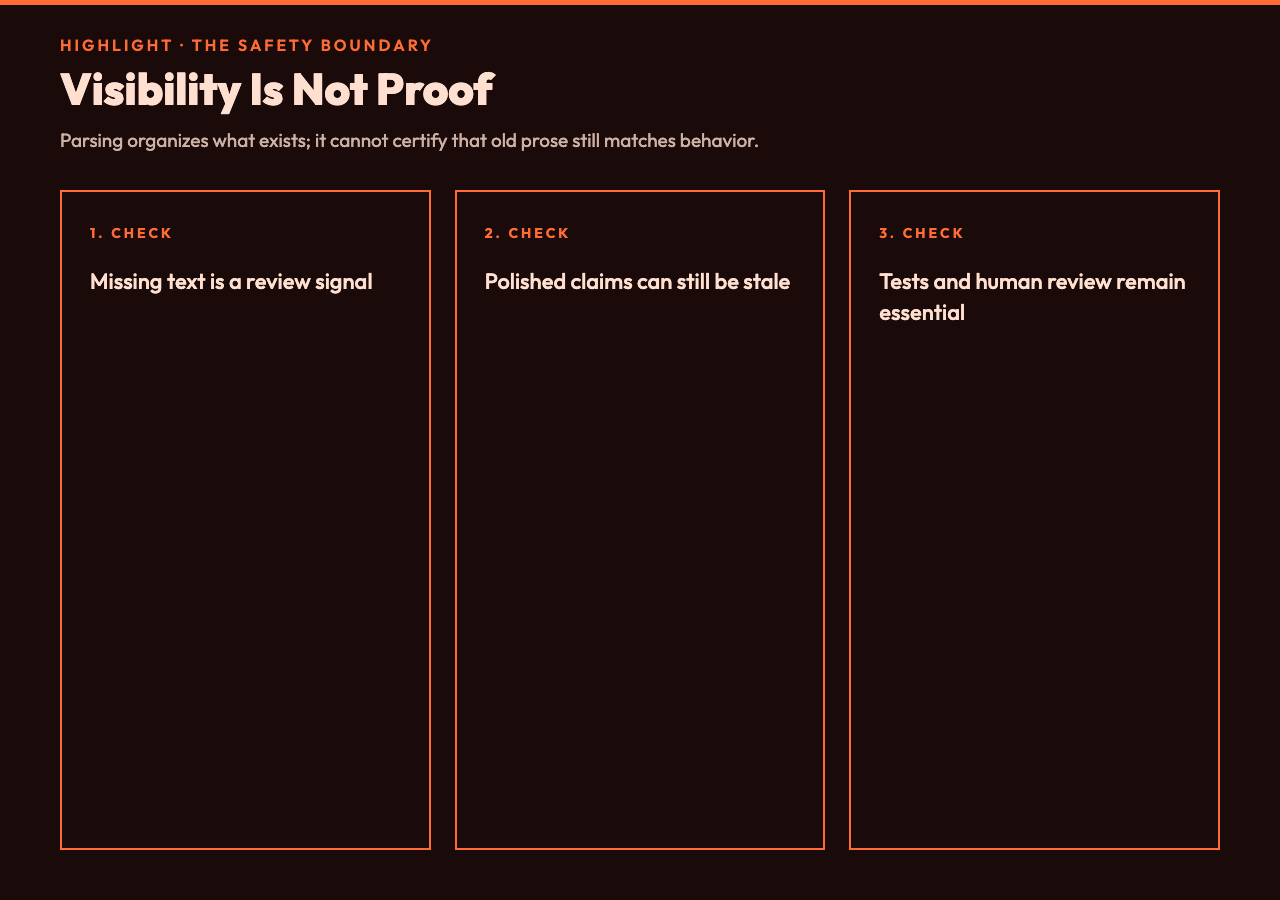
A structured documentation view can reveal that a method has no explanation, that a tag is malformed, or that several files use different names for the same concept. It cannot decide whether “fast,” “safe,” or “supports all inputs” is a defensible claim. Nor can it infer intent from a comment that the code no longer follows.
That distinction keeps the tool in the right role. Docstring Extractor is a visibility layer and a review accelerator. It is not a substitute for tests, type checking, or a human reading the implementation when the stakes are high. Used that way, it turns comments from passive decoration into an auditable surface.
In the end, good documentation is not the text beside a function; it is the shared expectation that survives when the original author is gone. Extraction makes that expectation easier to inspect, but the next question is whether your repository can keep those promises current. That is why the best workflow ends with verification, not generation. Explore more tools at elysiatools.com.