
Most barcode rejection failures are not scanner problems. They are not POS misconfigurations. They are eight-digit typos — and the EAN-8 format is uniquely fragile because it has no slack to absorb a single wrong character.
The 8-digit EAN-8 barcode is the format small retail products have to print on tight packaging: lip balm tubes, spice jars, single-serve cosmetics. It looks identical to a regular 13-digit EAN-13, just shorter. But the math behind the check digit is not the same math, and the country prefix is read differently. That is why your brand-new product gets rejected at the register even though the barcode scans cleanly in your warehouse.
For example: a sticker says `73513537`. You scan it in the office and hear the beep. You ship a thousand units to a retailer. The point-of-sale terminal shows `Invalid check digit` for every single one. What changed? Nothing about the barcode itself — the validation logic at the till is stricter than the validation logic in your office, and the difference is exactly one digit.
In our case, the EAN-8 spec defines the check digit as a weighted sum of the first seven digits multiplied alternately by 3 and 1, summed, then the smallest number that makes the total a multiple of 10. Get any one of those seven digits wrong and the last digit must change too — or the barcode is invalid. That is by design. It is also the rule most hand-typed barcodes break.
Why EAN-8 Is Harder Than EAN-13
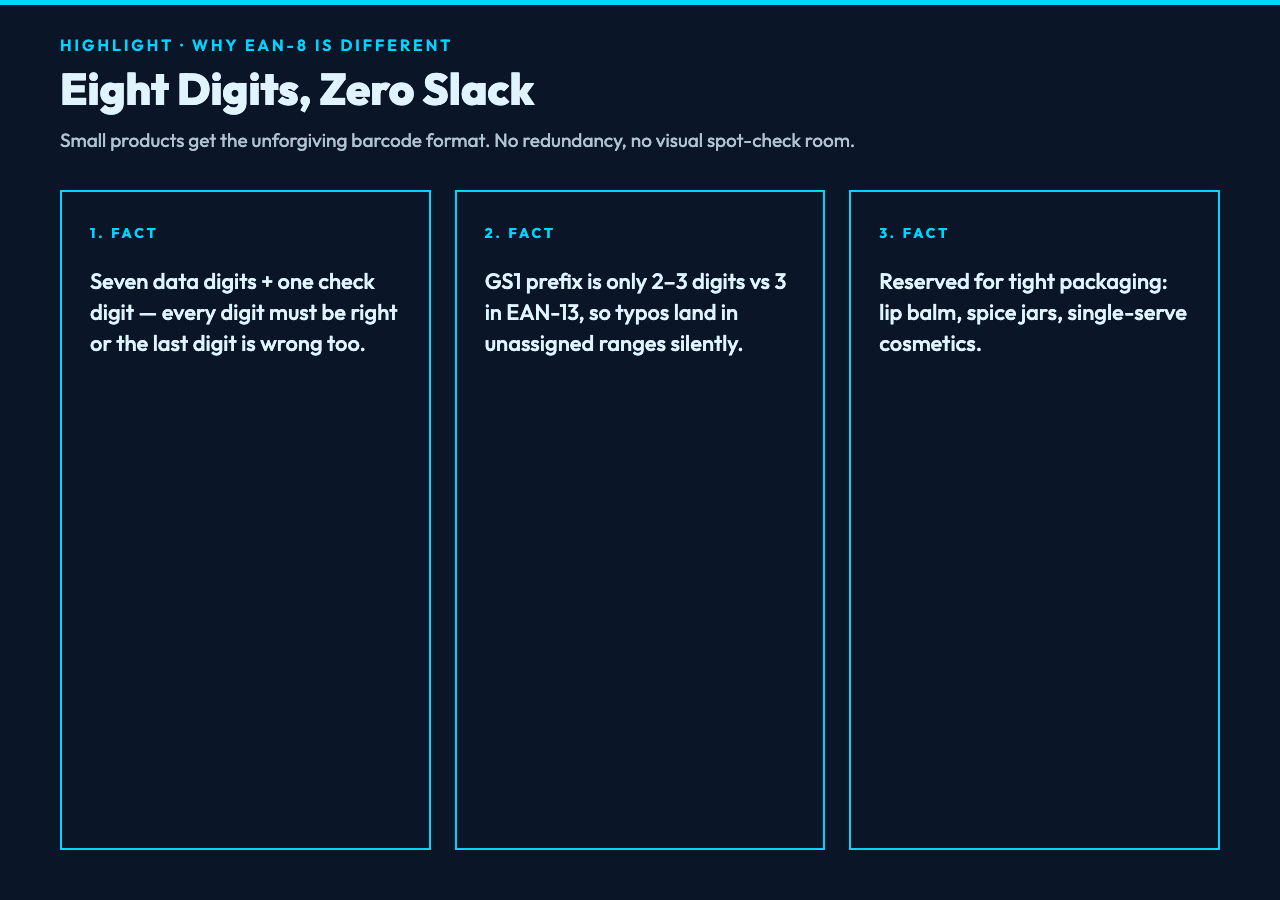
EAN-13 has redundancy. A 13-digit number carries 12 data digits plus a check digit, and the GS1 country prefix is read from the first three digits combined with the next group. If you miskey one digit in the middle, the check digit will catch you — but you also have visual space to spot the error.
EAN-8 has none of that. Seven data digits. One check digit. The country prefix is only two digits, encoded differently than in EAN-13. You cannot catch an error visually because the barcode is so short. The check digit is doing all the work.
According to the GS1 General Specifications, EAN-8 is reserved for very small packaging where there is physically no room for a 13-digit barcode. That means the format is used disproportionately by products that ship to retailers who scan thousands of units per day — exactly the environment where a single bad check digit costs you a chargeback.
For instance, a US-origin EAN-8 starts with `000–019`, a French-origin starts with `300–379`, a German-origin starts with `400–440`. These ranges are narrower than in EAN-13, which means a typo is more likely to land in an unassigned prefix and silently fail validation rather than producing a useful error message.
The Three Mistakes That Look Correct but Fail Validation
The validator on Elysia Tools catches all three.
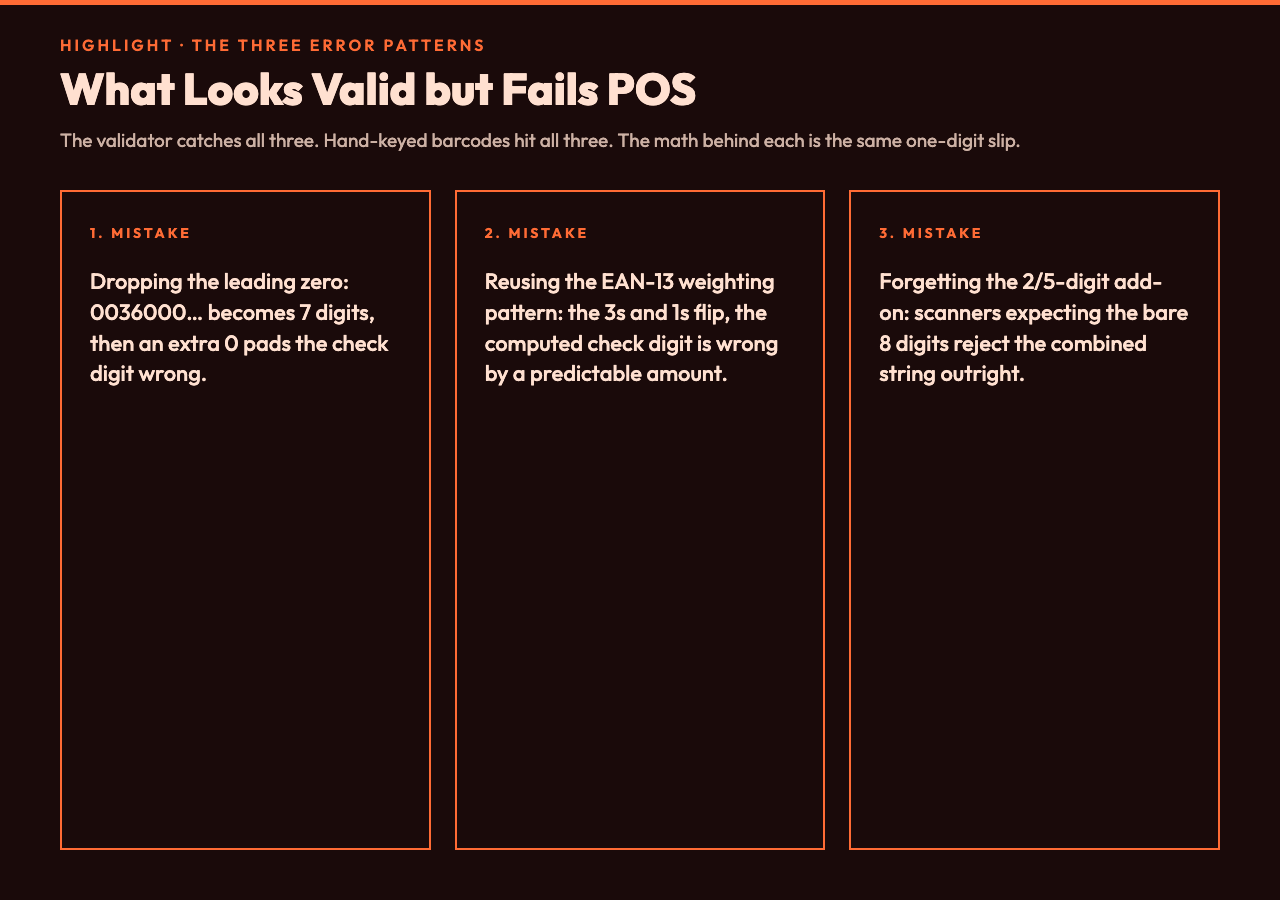
1. Dropping the leading zero. An EAN-13 starting with `0036000…` collapses to `36000…` when shortened by hand. The result is a 7-digit number that does not start with `00`, but it is 7 digits — not 8. Add an `0` at the end to “make it 8” and the check digit is now wrong because you guessed it instead of computing it. This is the single most common error we see on short-code products.
2. Reusing the EAN-13 check digit algorithm on 8-digit input. The two algorithms differ in their weighting pattern. EAN-13 weights positions 1, 3, 5, 7, 9, 11 by 1 and positions 2, 4, 6, 8, 10, 12 by 3. EAN-8 weights positions 1, 3, 5, 7 by 3 and positions 2, 4, 6 by 1. The 3s and 1s flip. Running the EAN-13 algorithm on EAN-8 input produces a check digit that is off by a predictable amount, but it is still wrong.
3. Forgetting the 2- or 5-digit add-on. EAN-8 supports a supplementary add-on for magazine issues and book ISBN-10. The validator accepts the add-on, but a scanner that expects the bare 8-digit barcode will reject the combined string. The fix is to validate the core 8 digits separately from the add-on.
For example: `40 12345 7` is `40123457` with an ISBN-10-style add-on. The bare EAN-8 is `40123457` — feed only that to the validator, then handle the add-on as a separate field.
How to Validate Before You Print
Before paying for a print run, run every SKU through the EAN-8 Barcode Validator. It checks four things in one pass: digit count, check digit correctness, GS1 country prefix assignment, and packaging structure.
For instance, take `73513537`. The validator reads it, recomputes the check digit, and confirms it matches. It then reports the prefix `735` (a registered GS1 prefix for Norway) and the manufacturer code `1353` (the company that owns this prefix). You get a four-line answer in under a second — no spreadsheet, no GS1 lookup table, no manual math.
According to the same spec, every EAN-8 you ship must pass this check before printing. The cost of catching a bad barcode in pre-press is zero. The cost of catching it after a recall is the entire print run plus the retailer chargeback.
If you are validating a batch of barcodes from a spreadsheet, copy them one at a time. The tool accepts spaces, dashes, and trailing add-ons, so `7351-3537`, `73513537 22`, and `73513537` all parse correctly — but it tells you exactly which digits it parsed, so you can spot transcription errors in the source column.
Live Examples to Test Against
For more EAN-8 and EAN-13 values to validate against, the UPC/EAN Barcode Samples hub has real barcodes grouped by region — Norwegian, French, German, US zero-suppressed, with and without add-ons. Paste a few into the validator and watch the country prefix change in the output. That is the fastest way to build intuition for which prefix ranges mean which origin.
The samples also include a row of deliberately broken barcodes (off-by-one check digit, missing leading zero, swapped digits) so you can verify your validation pipeline catches the same errors the EAN-8 Barcode Validator catches. If your pipeline flags the same rows, you are done.
The One Pre-Ship Checklist
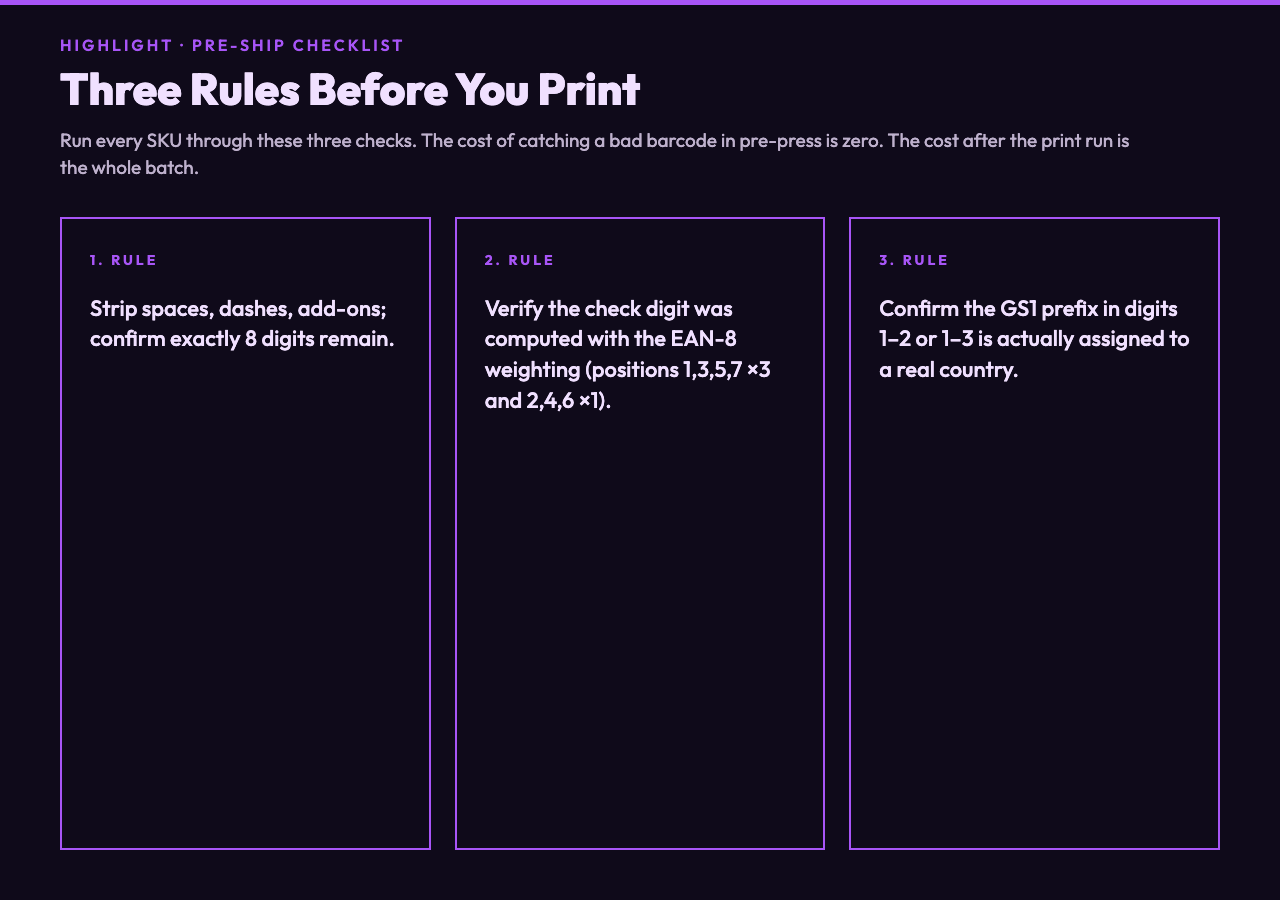
Before any new EAN-8 hits a print queue, three things must be true. First, every value is exactly 8 digits after stripping spaces, dashes, and add-ons. Second, the check digit was computed by the EAN-8 algorithm, not the EAN-13 algorithm — the 3/1 weighting pattern flips. Third, the GS1 prefix in the first two or three digits is actually assigned to a real country; an unassigned prefix means you are using a number nobody owns.
The question is whether your current workflow catches all three. For most small-batch product teams the answer is no, because the validation logic lives in a spreadsheet cell that someone wrote once and never re-checked. The EAN-8 Barcode Validator does the same check in milliseconds, and the UPC/EAN Barcode Samples hub gives you a reference set to prove it works. Ultimately, the cheapest fix is the one you make before the print run, not the one you make after the retailer rejects the shipment.
Explore more tools at elysiatools.com.
