
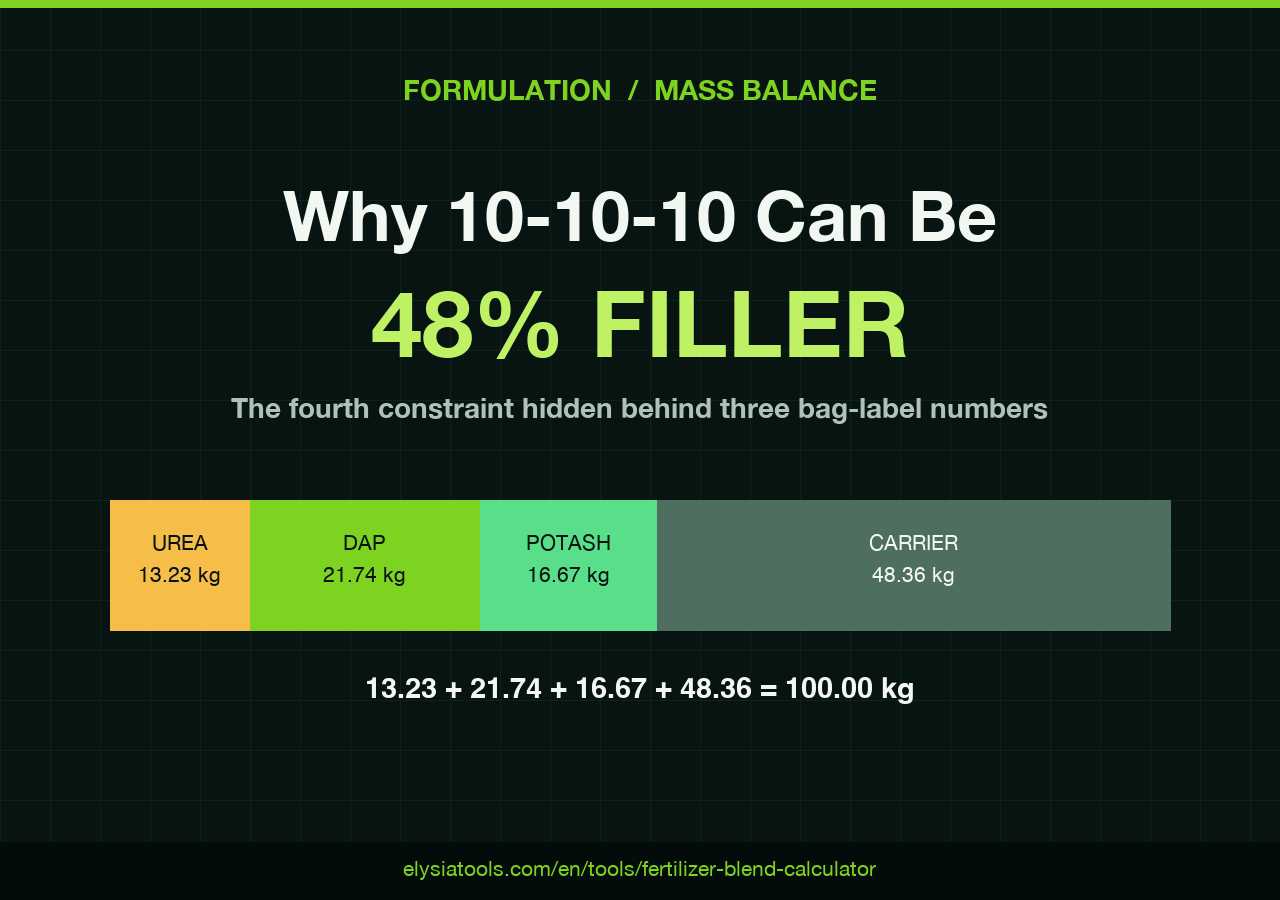
The first time I checked a mathematically exact 100 kg batch of 10-10-10, the result looked wrong: 48.36 kg was inert carrier. Yet the nutrient ledger balanced to the gram. The surprise is not a loophole. It is the mass balance that a three-number bag label hides.
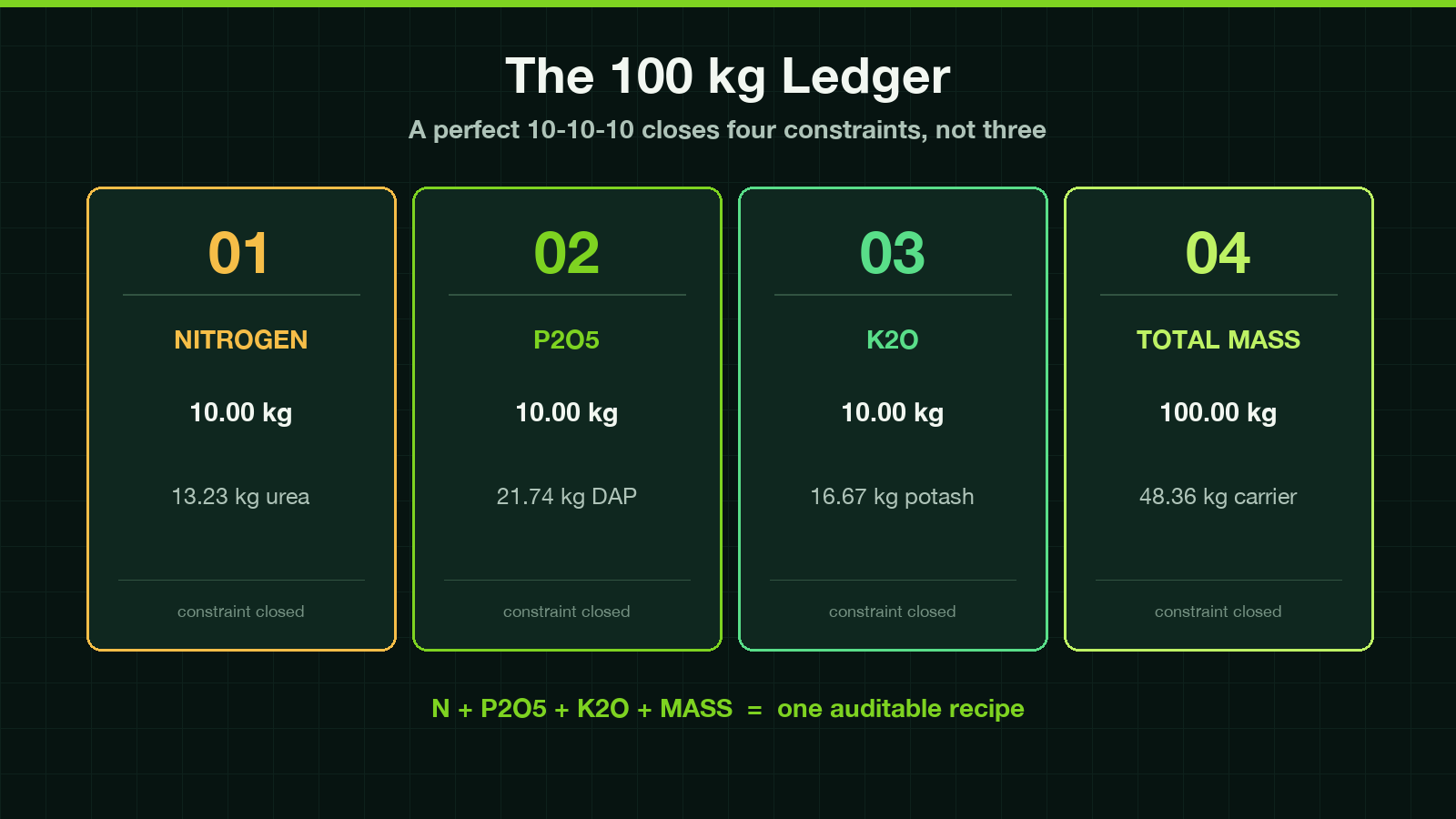
A 100 kg batch of 10-10-10 must contain 10 kg nitrogen, 10 kg phosphate expressed as P2O5, and 10 kg potash expressed as K2O. It must also weigh 100 kg. Matching three nutrient targets solves only half the job; the recipe has to close that fourth constraint.
The bag label is three concentration constraints
The familiar N-P-K label is a percentage analysis, not a recipe. In a 100 kg batch, 10-10-10 means 10 kg N, 10 kg P2O5, and 10 kg K2O. In a 25 kg batch, the same analysis means 2.5 kg of each listed nutrient. Scale changes the masses, but it does not change the percentages.
The second and third numbers encode reporting conventions. They refer to phosphate and potash equivalents, P2O5 and K2O, not elemental phosphorus and potassium. Mixing calculations therefore need to stay in the same convention as the source labels. Converting one side to elemental P or K while leaving the other in oxide-equivalent units breaks the balance before the solver starts.
The online blend calculator keeps target and source analyses in the printed bag-label convention. You enter a target such as 10-10-10, list at least two available bases in the form Name = N-P-K, and choose a batch mass from 0.1 to 10,000 kg.
A perfect 10-10-10 still needs 48.36 kg of carrier
Consider three common sources:
- Urea: 46-0-0
- DAP: 18-46-0
- Muriate of potash: 0-0-60
In the source-verified example, a 100 kg target batch returns 13.23 kg urea, 21.74 kg DAP, and 16.67 kg potash. Those active materials total 51.64 kg. The remaining 48.36 kg is inert filler or carrier.
A direct calculation confirms each line. Potash supplies 10 kg K2O because 16.67 multiplied by 60 percent is approximately 10. DAP supplies 10 kg P2O5 because 21.74 multiplied by 46 percent is approximately 10. That DAP also contributes about 3.91 kg N, so urea only needs to supply the remaining 6.09 kg N; 13.23 multiplied by 46 percent closes that gap.
This exposes the counterintuitive point: filler is not evidence that the calculation failed. Filler is often the material that makes a lower-analysis product possible. Without it, those three sources would produce a far more concentrated blend than 10-10-10.
The solver searches feasible combinations, not a magic ratio
Under the interface, each fertilizer is a three-component nutrient vector. Source inspection shows that the implementation adds a fourth constraint for total batch mass and a 0-0-0 filler component. It then enumerates combinations of up to four components, solves a least-squares system for each combination, rejects solutions with a materially negative mass, and keeps the candidate with the lowest nutrient-plus-mass error.
The small systems are solved through normal equations followed by Gaussian elimination with partial pivoting. This is useful implementation detail because it explains two behaviors in the result. First, an ingredient can receive zero kilograms even though you supplied it. Second, an unreachable target can still return the closest non-negative blend instead of an impossible recipe containing a negative bag of fertilizer.
The displayed parts ratio is derived after the kilogram solution. Each positive active mass is divided by the smallest positive mass. In the 10-10-10 case, the active ratio is approximately 1 part urea, 1.643 parts DAP, and 1.26 parts potash. That ratio is convenient for scaling, but the kilogram column remains the audit trail.
A 100% match score is narrow evidence
The calculator measures achieved and target N-P-K as vectors. It converts their Euclidean distance, relative to the target’s magnitude, into a score from 0 to 100. A result at or above 99.5 percent earns the feasible label.
That score answers a precise question: how closely do the three reported nutrient percentages match? It does not score pH, salinity, chloride sensitivity, release rate, micronutrients, granule compatibility, legal labeling tolerances, soil demand, or crop safety. The source database notes, for example, that muriate of potash is a common K source and sulfate of potash is a lower-chloride option, but the numerical objective does not assign either one an agronomic preference.
A match score validates the equation, not the field decision. That distinction is the best reason to read the output instead of copying it blindly.
When 10-30-20 cannot be made from the bases on hand
For example, the second source-verified case asks for a 50 kg batch of 10-30-20 using MAP at 11-52-0, urea at 46-0-0, and sulfate of potash at 0-0-50. The closest blend assigns 29.56 kg MAP, 20.00 kg sulfate of potash, 0 kg urea, and 0.44 kg filler.
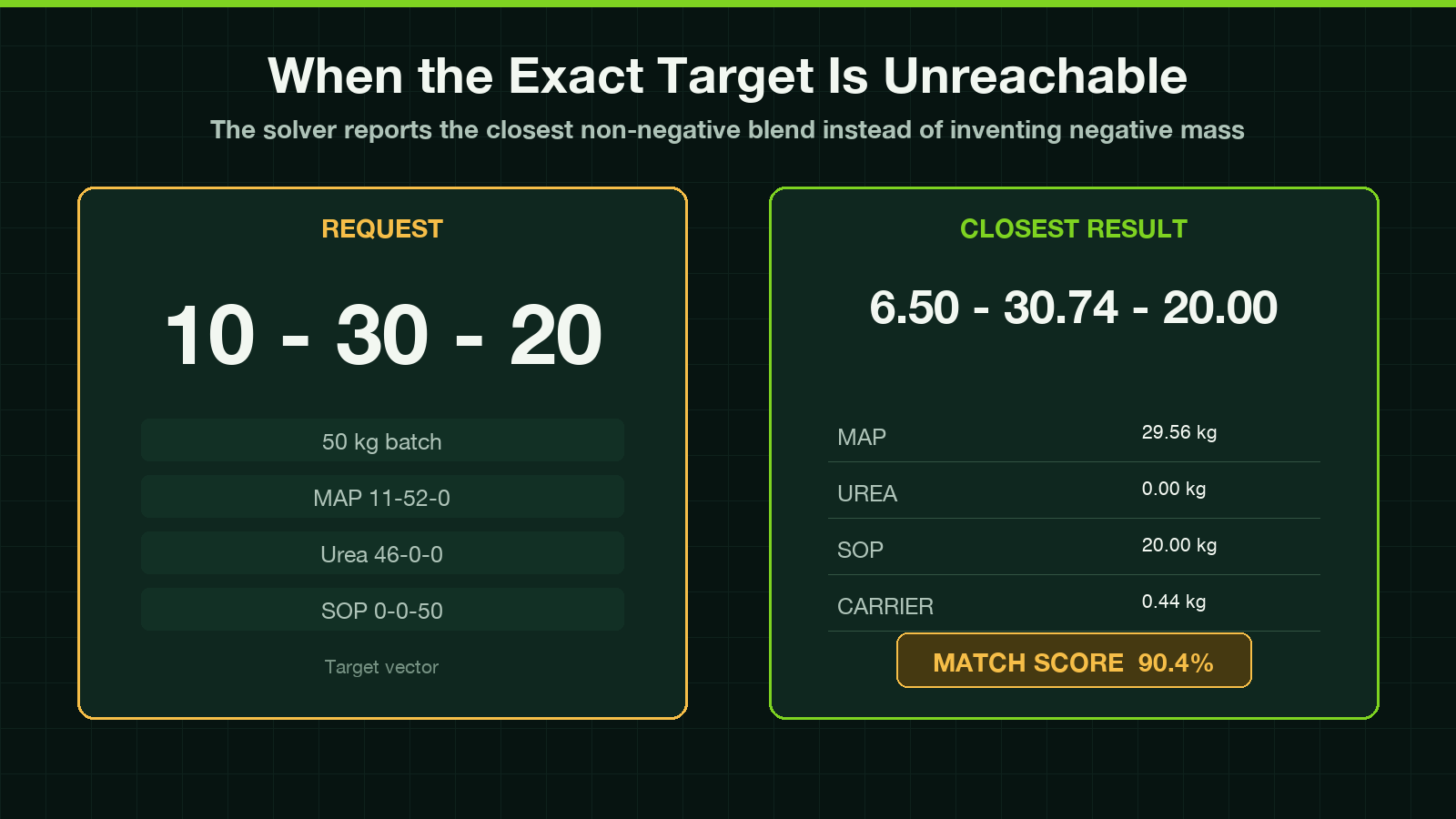
It achieves approximately 6.50-30.74-20.00, with a 90.4 percent match score. The zero for urea is not a rendering error. Adding urea would raise nitrogen, but with this combination of constraints it would also consume mass needed to carry the required P2O5 and K2O. The non-negative search selects a closer overall balance at the boundary where urea drops out.
This reveals more than making each listed ingredient appear in the recipe. A zero-weight source says the available basis set cannot use that material profitably for this target. Alter the target, add a different phosphorus source, or accept the reported compromise.
Four checks before you trust the recipe
Check the input analyses. The tested parser case blocks duplicate names and any source whose N, P2O5, and K2O percentages sum to more than 100. It accepts hyphens, commas, or spaces between the three values, and ignores blank lines plus lines beginning with a hash or double slash. A typo such as 60-60-0 fails because its total breaks a physically consistent bag analysis.
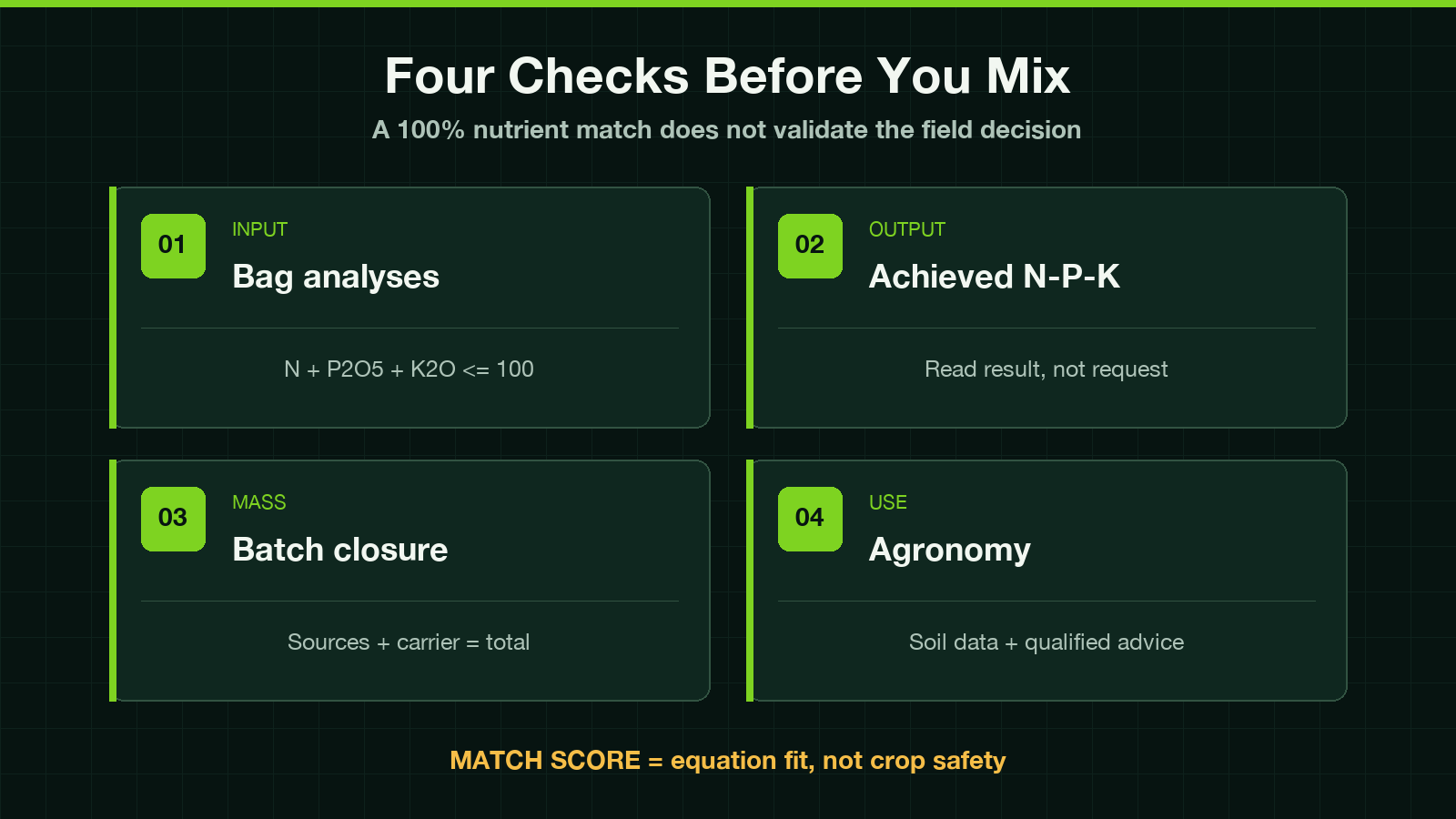
Check achieved, not requested, N-P-K. The target is what you asked for; the achieved row is what the selected bases can make. If the score is below 99.5 percent, the diagnostic note states the closest analysis. That difference belongs in your decision, not in fine print.
Check the mass closure. Add each fertilizer kilogram and the carrier. The result should equal the requested batch mass apart from display rounding. In the exact example, 13.23 + 21.74 + 16.67 + 48.36 equals 100.00 kg.
Check the active ingredients. A mathematically valid 0-0-0 carrier is not a universal product recommendation. Confirm what carrier is safe, compatible, legal, and practical for the intended material and application method. For real agricultural use, verify the formulation with qualified local guidance and current soil or tissue data.
Use parts for scaling, kilograms for verification
Parts help you scale a recipe because they preserve the active-material proportions. If the active ratio is 1 : 1.643 : 1.26, any common scoop or mass unit can reproduce that relationship. But parts alone omit the carrier and can conceal rounding drift.
For that reason, build each scale-up from the calculator’s requested batch size instead of hand-rounding the parts ratio repeatedly. Keep at least one mass-based worksheet showing source analysis, calculated kilograms, carrier, achieved N-P-K, and total. If you replace a 0-0-60 source with 0-0-50, rerun the balance; do not treat both products as interchangeable “potash.”
The tool includes 12 reference analyses, including urea, ammonium sulfate, DAP, MAP, triple superphosphate, muriate and sulfate of potash, potassium nitrate, bone meal, and blood meal. These are convenient starting values, not certificates for the material in front of you. The label on the actual product is the input that matters.
The practical workflow
Build the target from a measured soil or tissue result and qualified guidance, not a familiar bag number. Build the input from the exact guaranteed analyses on the bases you can source. Run a small planning batch in the Fertilizer N-P-K Blend Calculator, then record five outputs: kilograms per source, carrier kilograms, achieved N-P-K, match score, and any zero-weight ingredient.
Next, test the result. Ask whether the chosen chemical forms fit the crop and application, whether the carrier is appropriate, whether the materials can be blended uniformly, and whether local rules or professional advice impose other constraints. Only then should the recipe become a measured physical trial.
There is no matching Sample hub or visualization page for this tool in the current manifests, so the safest live reference is the tool itself, not an unrelated demonstration. You can explore other focused utilities at Elysia Tools.
The bottom line
Ultimately, a fertilizer blend is not finished when the three numbers match. It is finished when the nutrients, total mass, source materials, and application plan agree. Use the Fertilizer N-P-K Blend Calculator to expose that ledger before you open a bag: inspect the achieved analysis, question a zero-weight ingredient, and account for the carrier. Then treat the result as a formulation draft, not an agronomic prescription. If you cannot explain where all 100 kilograms went, what exactly are you preparing to spread?
