The Only Meteor Shower Calendar You’ll Need in 2026
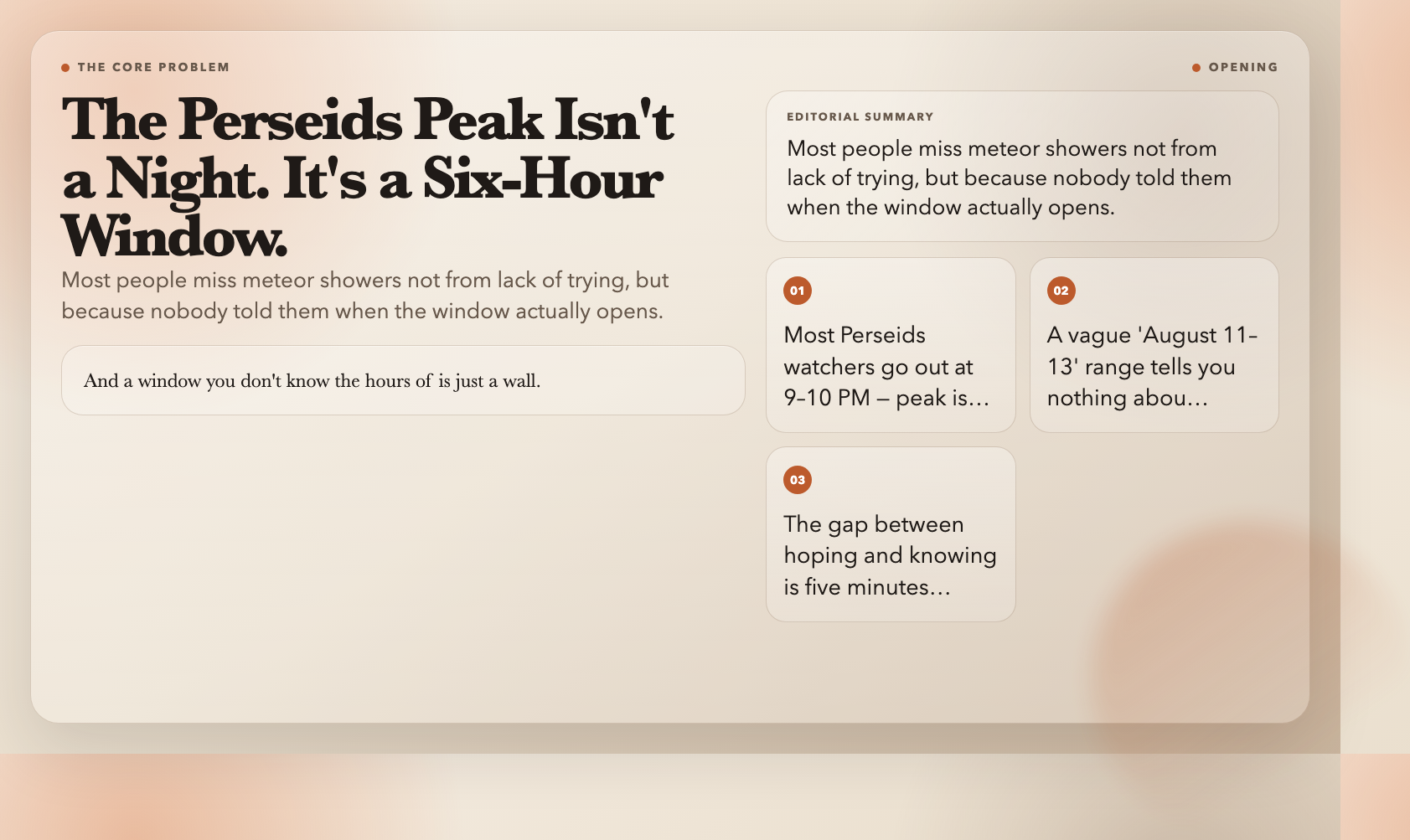
The Perseids peak isn’t a night. It’s a six-hour window—and you probably slept through it.
Here’s what usually happens: you hear about the Perseids, drag a blanket outside at 9 or 10 PM, sit in the cold for an hour, and count four meteors. You conclude meteor showers are overrated. What you missed: the actual peak was centered over the Middle East. For your timezone, it hit at 3 AM.
This is the problem with how we talk about meteor showers. “Peak in August” sounds like a destination. It’s not. It’s a window. And a window you don’t know the hours of is just a wall.
In 2026, there’s no excuse. The information exists. The question is whether you’re actually using it.
#
What a Meteor Shower Predictor Actually Does
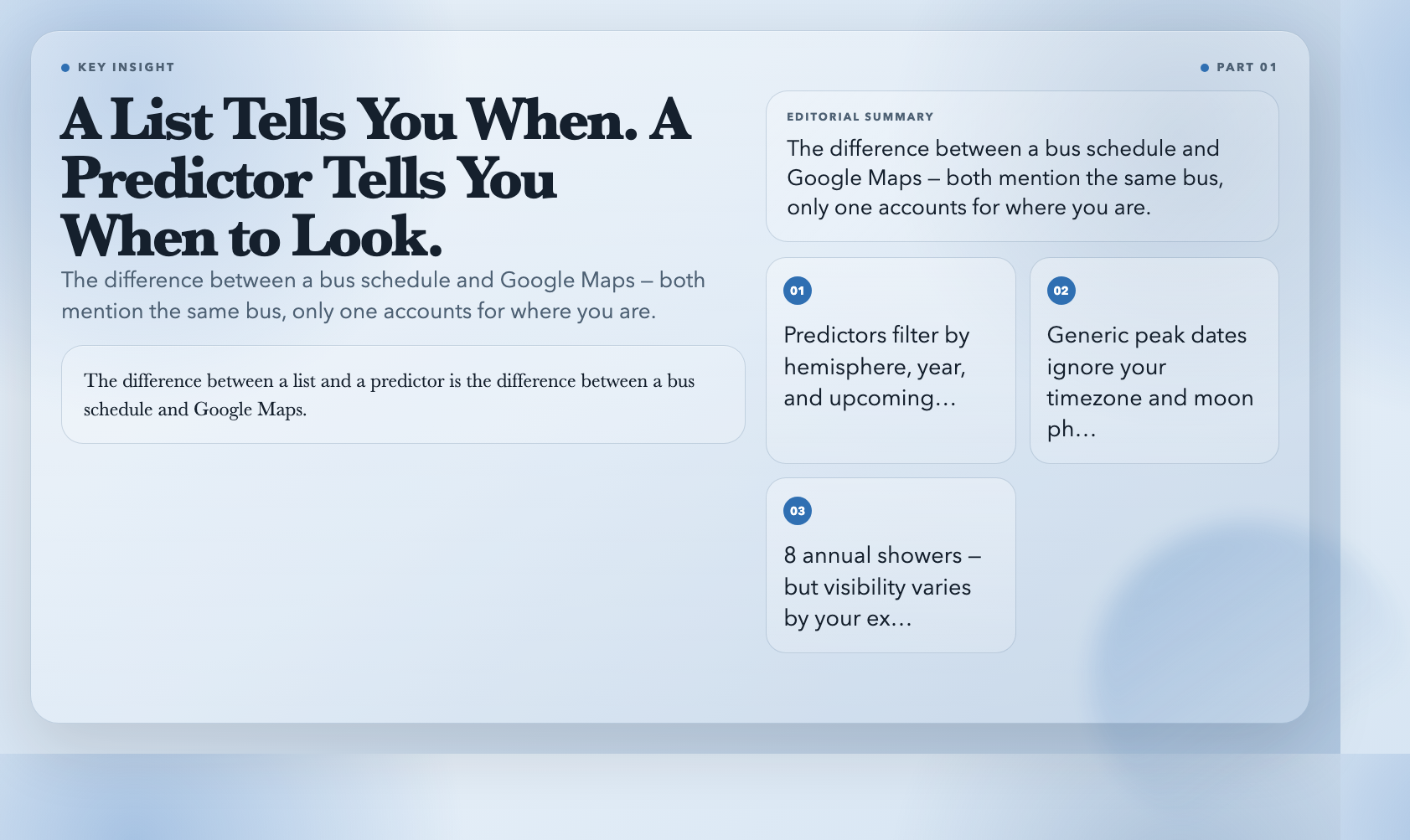
A meteor shower predictor does what a simple list cannot: it tells you *when to look* for *where you are*. Not a generically-labeled “August 11-13” window that spreads across three days in your timezone—but a precise answer for your hemisphere, your actual date, your location’s sky conditions.
You can try it here: Meteor Shower Predictor — enter your hemisphere and year, and it filters the eight annual showers down to what’s actually relevant for your location.
The difference between a list and a predictor is the difference between a bus schedule and Google Maps. Both tell you when the bus comes. Only one tells you when *your* bus comes.
Here are the eight annual meteor showers worth planning around in 2026:
#
Quadrantids — January 3-4 (Northern Hemisphere)
The Quadrantids are the opening act nobody talks about—and the most underrated shower of the year. Peak zenithal hourly rate: 120. That’s more meteors per hour than the Perseids.
The catch: the peak window is narrow, sometimes less than six hours. If you sleep through it, you’ve missed the show. The parent body is asteroid 2003 EH1, and the shower is known for bright fireballs—chunks of rock that burn bright and leave visible trails.
Best viewing is in the Northern Hemisphere, early morning hours. January skies are cold, but they’re also dark. No foliage, less humidity, cleaner air. Dress warmly and look northeast.
#
Lyrids — April 22-23
The Lyrids are the first major shower of the spring and the one most likely to surprise you. Most years they produce 18 meteors per hour—moderate. But every 60 years or so, they outburst, pushing rates to 100+ per hour. The last major outburst was in 1982. We’re overdue.
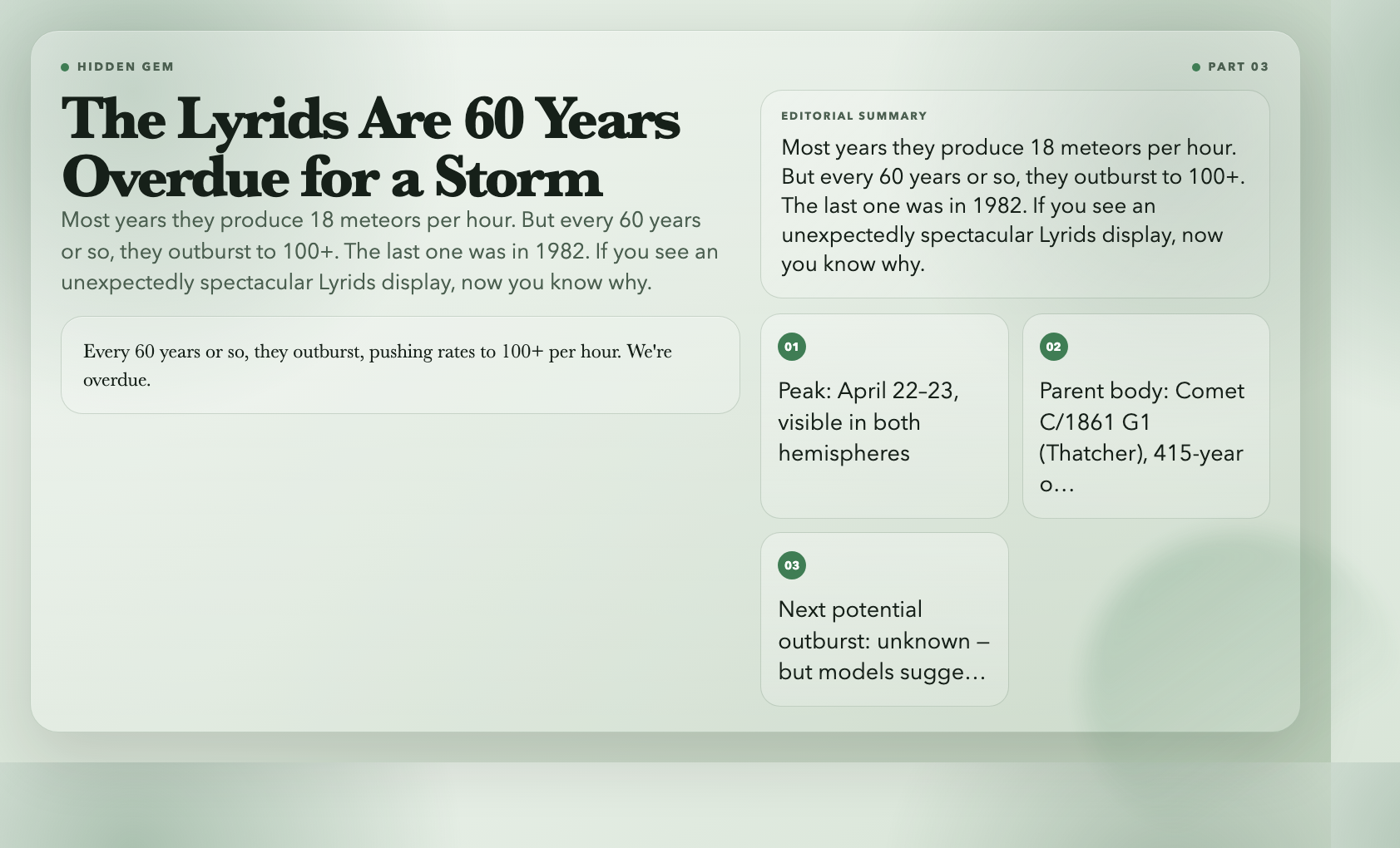
Parent body: Comet C/1861 G1 (Thatcher), which takes about 415 years to orbit the sun. The debris field we cross through in April is ancient.
Visible in both hemispheres, best viewing late evening to dawn. Moon conditions in 2026 favor this one—details depend on your specific date and location, but it’s worth checking the peak window for your area.
#
Eta Aquariids — May 5-6 (Southern Hemisphere Preferred)
Here’s one most Northern Hemisphere observers sleep on: the Eta Aquariids are the debris of Halley’s Comet, same as the October Orionids. But these are fast—meteors hit the atmosphere at 66 km/s, some of the fastest of any annual shower.
Southern Hemisphere observers get the better show, with up to 50 meteors per hour at peak. Northern observers still get a decent view, especially in the pre-dawn hours before nautical twilight.
The best part: May skies are warm in the southern hemisphere. You can watch a meteor shower without risk of hypothermia. This is not a small thing.
#
Perseids — August 11-13 (Northern Hemisphere Preferred)
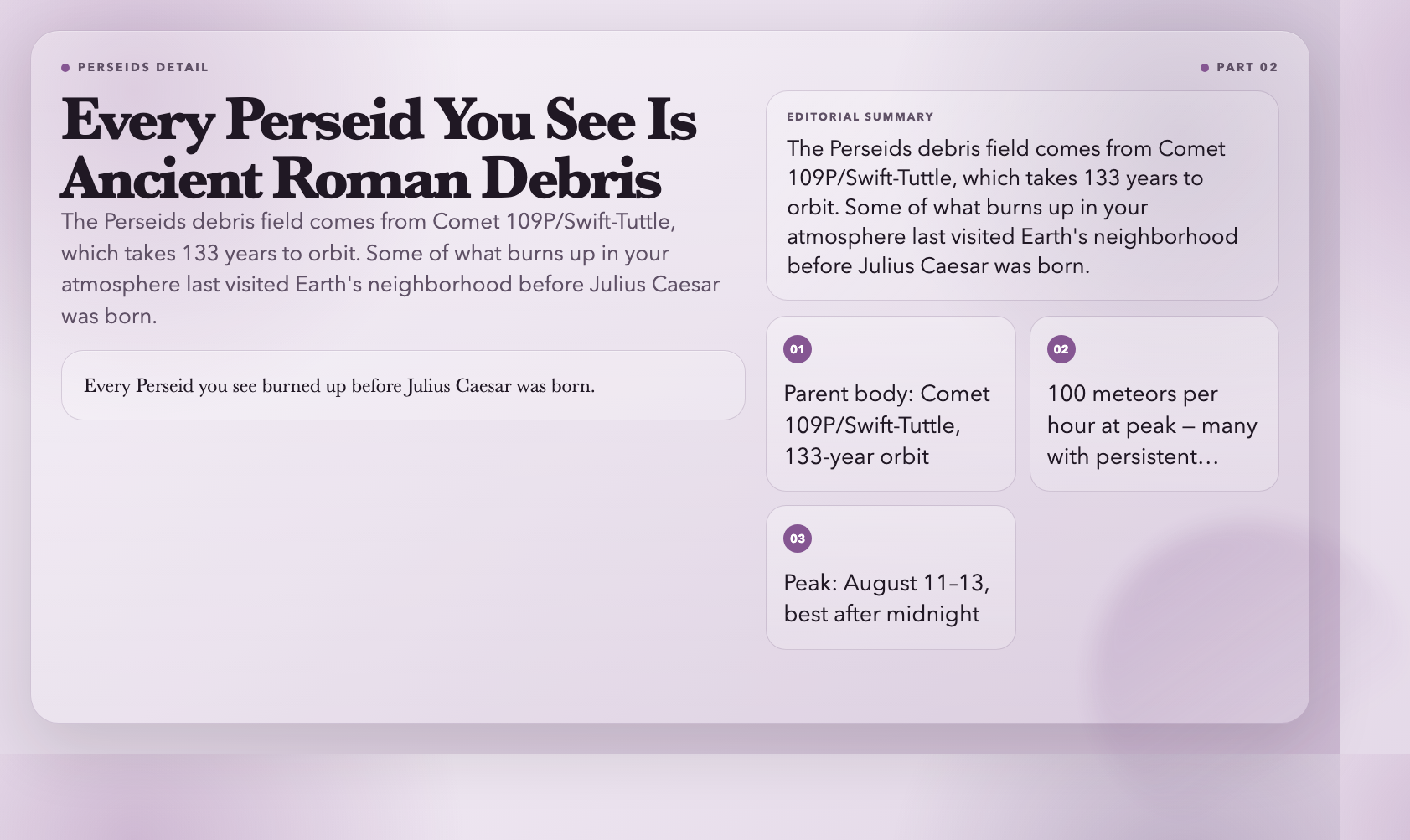
The Perseids are famous because they’re reliable and because August is when most people are outside anyway. 100 meteors per hour at peak, many bright enough to leave trains (the glowing trail behind the meteor).
But “famous” has a cost: light pollution spikes on Perseids weekend. Drive twenty minutes outside city limits and you’ll see three times as many.
Parent body: Comet 109P/Swift-Tuttle, which takes 133 years to orbit the sun. The debris field we’re passing through is ancient Roman debris, essentially. Every Perseid you see burned up before Julius Caesar was born.
Best viewing: after midnight until dawn, looking northeast. Let your eyes adapt for twenty minutes. No phones—they kill your night vision.
#
Orionids — October 21-22
Same comet as the Eta Aquariids—Halley’s—but a different debris trail. The Orionids are slightly slower (66 km/s versus slightly different velocities within the stream) and produce fewer meteors: about 20 per hour at peak.
The trade-off: Orionids often produce persistent trains—bright ionized trails that last seconds after the meteor burns up. These are the ones that make you say “what was that?” out loud.
Visible in both hemispheres. Pre-dawn hours are best. October cold is real; this is a December-level commitment in most latitudes.
#
Leonids — November 17-18
The Leonids are famous for meteor storms—periods of 1,000+ meteors per hour that have been documented as far back as 902 AD. The 1833 Leonid storm was so intense that observers reported 100,000 meteors per hour; some accounts describe it as so bright that people mistook it for a fire and rushed outside. The last major storm was in 2002. They occur when Earth passes through dense debris bands from Comet 55P/Tempel-Tuttle.
Normal years produce about 15 per hour. But every 33 years, the math lines up differently. 2033 is a potential storm year. Start practicing now.
The Leonids also produce a specific phenomenon worth watching for: meteor storms are often accompanied byGeomagnetic activity. Check aurora prediction apps alongside your meteor forecast.
#
Geminids — December 13-14
The Geminids are, for many observers, the best shower of the year. Peak rate of 120 per hour. Bright meteors. Visible in both hemispheres. December cold is a challenge but December skies are at their clearest.
What makes the Geminids unique: they’re one of the few major showers not tied to a comet. Parent body is asteroid 3200 Phaethon—a rock comet, meaning it sheds material differently than icy comets do. The debris is denser, which may explain why Geminid meteors are often bright and colorful (greenish hues are common). The Geminids were first documented in 1862, making them one of the youngest known annual showers—scientists are still learning how 3200 Phaethon produces debris at all.
This is the one you plan a trip for. Pick a dark sky site, bring a Thermos, and plan to stay until dawn.
#
Ursids — December 21-22 (Northern Hemisphere)
Minor shower, usually producing about 10 per hour. But the Ursids have a history of surprising observers: there were unexpected outbursts in 1945 and 1986, and some models suggest the debris field has density variations we don’t fully understand.
The window is narrow and the rates are low. This is not the shower you drive two hours for. But if you’re already out for the Geminids and December 21 is clear—worth glancing north after midnight.
#
The Pattern Nobody Tells You
Here’s the meta-pattern: meteor shower visibility isn’t random. It follows your hemisphere, the moon’s phase, and the time of year for atmospheric clarity.
Northern Hemisphere observers have better access to Quadrantids, Perseids, and Ursids. Southern observers get better Eta Aquariids. The Geminids and Leonids are broadly accessible.
Moon matters more than most lists admit. A full moon within a few days of peak can cut visible meteor count by 80%. A new moon on peak night can double your count. The difference between “four meteors in two hours” and “forty” is often the moon, not your eyes.
And time matters more than any other factor. The peak window for most showers is 6-12 hours. Outside that window, you’re seeing the tail end of the distribution—stragglers from the main crowd. Inside the window, you’re in the stream.
This is why a good predictor tool is different from a list. A list says “Perseids: August 11-13.” A predictor says “For your location (Northern Hemisphere, latitude ~40°N), the peak window is August 12, 23:00 UTC to August 13, 05:00 local time. Moon is at 35% illumination. Best viewing after 01:00 local.”
That’s the difference between going outside and hoping, and going outside and knowing.
#
The Open Question Nobody Is Asking
We have asteroid impact deflection technology. We can nudge a 500-meter rock off course with a spacecraft. We track near-Earth objects decades before they arrive.
We do not have a meteor shower notification system that most people actually use.
The data is there. The orbital mechanics are solved. A weather app with astronomy data layered in could deliver real-time peak alerts, moon-phase-adjusted visibility scores, and hemisphere-specific windows. The Perseids peak window is predictable to the hour for any location on Earth.
Somebody is going to build this. Until they do: look up the specific peak time for your hemisphere, check the moon phase, and set an alarm for 90 minutes before your local maximum.
Eight showers a year. Some of the best free entertainment the universe offers. The only subscription required is knowing when to look up.