
# 8 Free Health Calculators That Tell You What Your Body Actually Needs
Your fitness tracker says you burned 340 calories today. It’s off by 20–40%.
That gap isn’t a hardware problem. It’s a math problem. Wrist-worn devices estimate energy expenditure using population-average formulas that ignore your height, body composition, fitness level, and movement efficiency. A lean runner and a first-time jogger burn different calories on the same route. The device doesn’t know which one you are.
This explains why so many people stall despite tracking religiously. They’re optimizing toward numbers that don’t describe their actual body. Here are eight free tools built to handle the variables your wrist device skips.
BMI Calculator
BMI is the most cited health metric in the world. It’s also one of the most misused.
BMI reduces your body to a single ratio: weight (kg) / height (m²). The result slots you into categories — underweight, normal, overweight, obese. The problem is that BMI makes no distinction between muscle and fat. A 200-pound powerlifter at 10% body fat registers as “overweight.” An older adult with normal weight but high visceral fat registers as “healthy.”
This makes BMI useful for population screening and nearly useless for athletic or atypical bodies. If your BMI is normal with no metabolic risk factors, that’s reassuring. If you’re muscular or carry fat in unusual patterns, BMI tells you almost nothing.
Use it for: Quick population-level checks. For anything personalized, use the other tools.
The tool: BMI Calculator — metric and imperial modes, age and gender adjustment for tailored categories, and clear recommendation output rather than a raw number alone.
BMR Calculator
BMR is your calorie floor. Most nutrition advice ignores it entirely.
Basal Metabolic Rate is the number of calories your body burns at complete rest — organs functioning, lungs breathing, brain running. It accounts for 60–75% of total daily energy expenditure for most people.
Here’s what some diets get wrong: sustained caloric intake below your BMR forces metabolic adaptation. A 5’4″, 150-pound moderately active woman has a BMR around 1400 calories. A diet prescribing “1200 calories for everyone” puts her below her floor. Her body responds by slowing metabolism, increasing hunger signals, and protecting fat stores — exactly the opposite of the intended result. Physiology doesn’t negotiate.
Use it for: Finding your calorie floor before any diet or cut. Eat below this number and you’re fighting your own body.
The tool: BMR Calculator — three formulas: Mifflin-St Jeor (most accurate for most people), Harris-Benedict, and Katch-McArdle for those who know their actual body fat percentage.
Body Fat Calculator (US Navy Method)
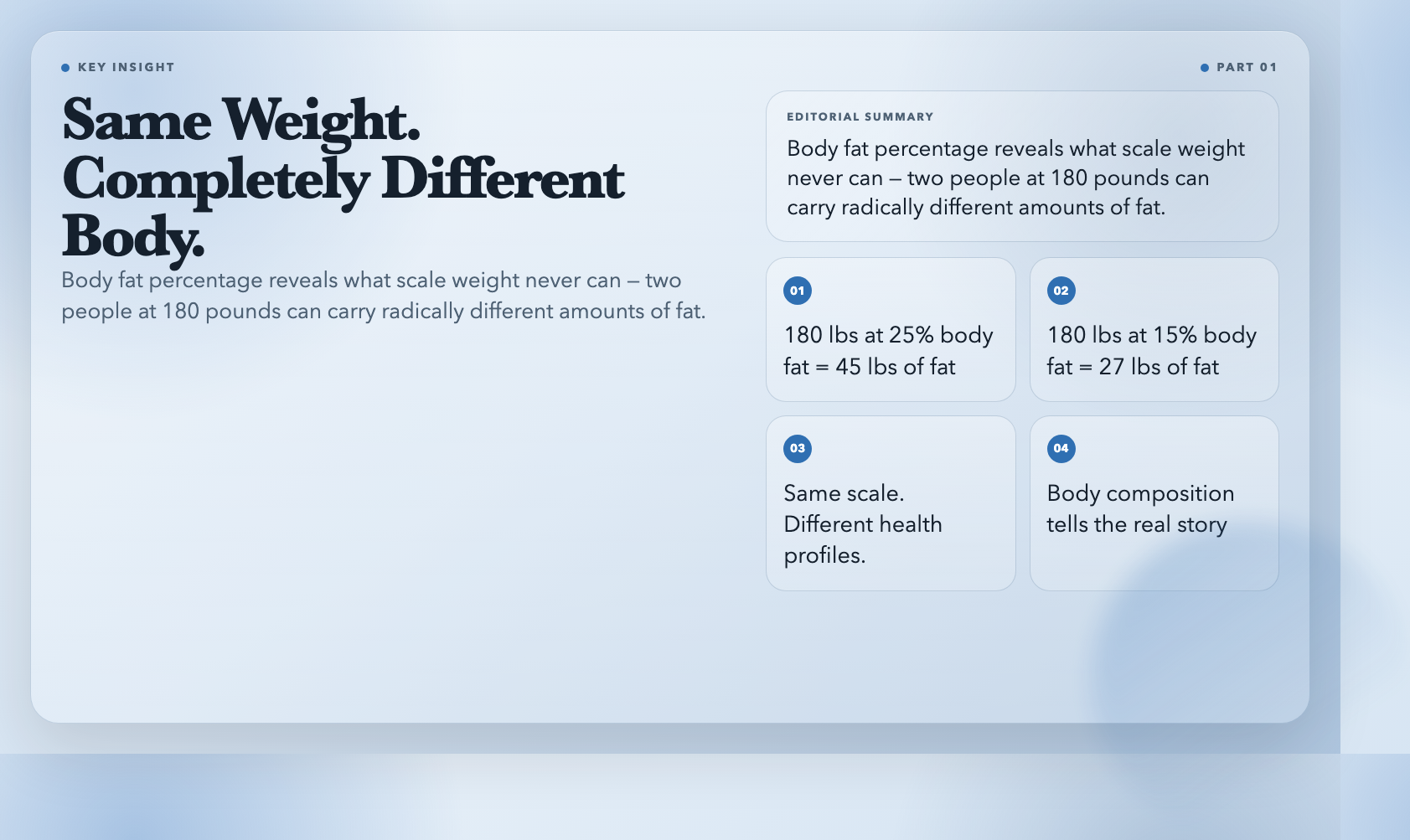
Same weight. Completely different body.
Two people at 180 pounds: one at 25% body fat carries 45 pounds of fat; one at 15% carries 27. Same scale. Radically different health markers, metabolic rates, and compositions.
The US Navy developed a field method in the 1940s to estimate body fat percentage from neck and waist measurements (hip measurement added for women) and height. No lab required — just a tape measure. The formula outperforms more expensive techniques for routine tracking.
Use it for: Tracking body composition changes over time. Weight alone is a misleading proxy for leanness. Body fat percentage tells the real story.
The tool: Body Fat Calculator (US Navy) — gender-specific formulas since fat distribution differs substantially between sexes, age-adjusted category ranges.
Daily Calorie Needs Calculator
BMR is your floor. TDEE is the number you actually need.
Total Daily Energy Expenditure multiplies your BMR by an activity factor — from 1.2× for sedentary office work to 1.9× for highly active individuals. Most people overestimate their activity level by at least one tier.
A desk worker who exercises 3–4 times per week is lightly active, not moderately active. A 5’10”, 180-pound moderately active man needs roughly 2,800 calories to maintain his weight. The same person misclassified as moderately active instead of lightly active gets a target of 3,200 — a 400-calorie swing that explains why two months of “eating clean” produced no visible change. The math doesn’t lie. Only the inputs do.
Use it for: Calculating real maintenance needs before starting a cut or lean bulk. Measure first, then adjust.
The tool: Daily Calorie Needs Calculator — combines weight, height, age, gender, activity level, and goal into a specific daily calorie target rather than a range too wide to act on.
Calorie Burned Calculator
Your fitness tracker guesses. Here’s a more defensible way.
Calorie burn depends on four variables: weight, activity type, duration, and intensity. Most trackers account for two or three. Intensity creates the largest error — a brisk 45-minute walk and a leisurely one differ by 100–150 calories, yet a wrist device might return identical estimates for both.
A dedicated calculator forces you to specify intensity deliberately. A 185-pound person cycling at 15 mph burns roughly 420 calories in 45 minutes; increase the intensity to 20 mph and the same ride jumps to around 640 calories. That’s a 220-calorie difference — equivalent to a small meal — and most wrist devices miss it entirely.
Use it for: Comparing the energy cost of different activities before you do them, or estimating workout contribution to daily balance.
The tool: Calorie Burned Calculator — 12 activity types from running to weightlifting to hiking, with intensity adjustments most wrist devices skip.
Body Adiposity Index Calculator
BAI flies under the radar. Here’s why it matters.
The Body Adiposity Index estimates body fat percentage from hip circumference and height — no scale required. Because it ignores weight, BAI is unaffected by the daily fluctuations from water retention, glycogen loading, or food weight that shift scale readings by 2–4 pounds in either direction overnight.
BAI isn’t more accurate than the Navy method. What it provides is a different signal. If your weight stays flat while your BAI creeps upward over three months, it could indicate your fat is redistributing — less subcutaneous but more visceral, which carries different health implications. That’s a pattern worth knowing about.
Use it for: A complementary check alongside scale weight and BMI. No single number tells the full picture.
The tool: Body Adiposity Index Calculator — hip circumference + height + gender + age → estimated body fat percentage with interpretive context.
Cycling Calorie Calculator
Cycling is low-impact and sustainable. Cycling calorie estimates are notoriously unreliable.
Cycling intensity varies more than almost any other cardio activity. A 30-minute recovery spin at 12 mph and a 30-minute interval session at 24 mph produce completely different energy demands for the same rider. Most generic calculators use average speed assumptions that flatten this range, making the result nearly meaningless for anyone riding above a casual pace.
Use it for: Planning cycling sessions around specific energy targets, or comparing cycling against other cardio options.
The tool: Cycling Calorie Calculator — distance or duration input, four intensity levels from light to very vigorous, metric and imperial units.
Blood Type Calculator
Not every health calculator measures weight and calories.
Blood type is genetically determined by ABO allele combinations and Rh factor. Beyond transfusion compatibility — genuinely life-critical — research has explored links between blood type and nutrient absorption, disease susceptibility, and exercise performance profiles. The inheritance math itself is deterministic: given two parents’ blood types and Rh factors, the possible blood types for their children follow fixed rules.
This information matters for family planning, managing conditions where blood type is relevant, and understanding genetic inheritance in your family.
Use it for: Understanding genetic inheritance patterns, especially when blood type has medical or planning relevance.
The tool: Blood Type Calculator — all ABO types and Rh combinations, outputs possible child blood types with probability estimates.
The Right Stack Changes Everything
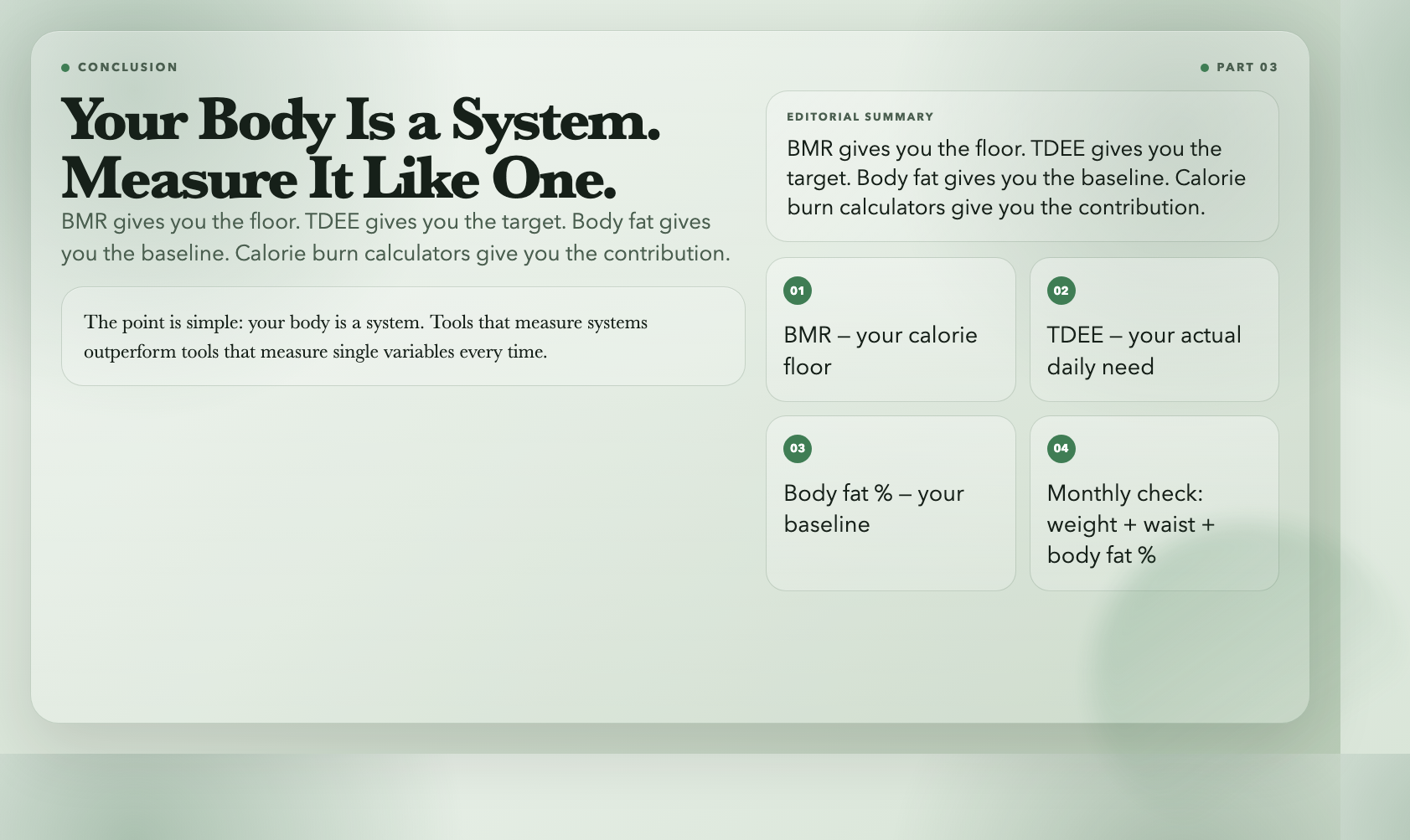
Most people track one number and wonder why they stall. The answer isn’t more discipline — it’s building a measurement system that reflects what’s actually happening inside your body.
BMR gives you the floor. TDEE gives you the target. Body fat percentage gives you the baseline. Calorie burn calculators give you the contribution. Check in monthly on three numbers: weight, waist circumference, and body fat percentage. When all three agree, you know what’s really happening. When one tells a different story, you’ve found something worth investigating.
So here’s the question: which of these eight is the most overlooked? The Blood Type Calculator — everyone reaches for the BMI one first. That, in the end, tells you more about human behavior than any of these tools ever could.
*All tools are free at ElysiaTools.*



Really enjoyed this post. Thanks for sharing such helpful info. If you want a science‑based breakfast tool, this one has been super helpful for me: