
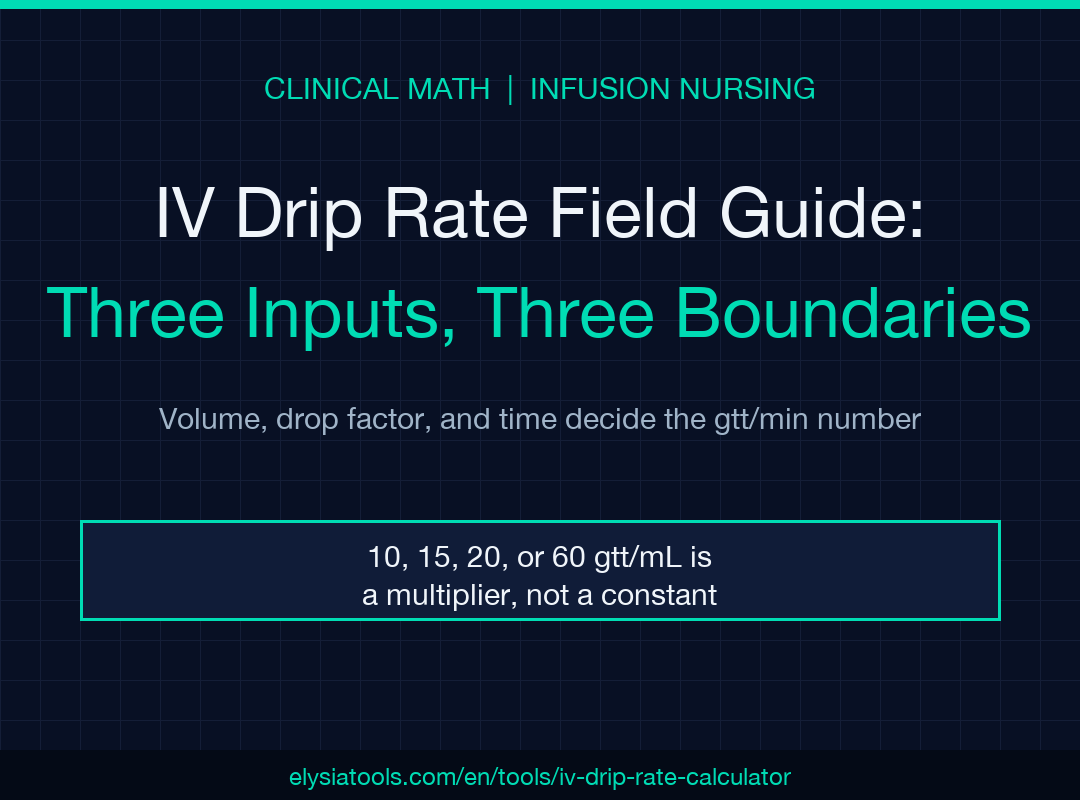
Three numbers decide everything. Gravity IV drip rate math is the simplest infusion calculation in the clinical toolbox, and that simplicity is exactly why it breaks on the ward: nurses and new residents see gtt/min = Volume * Drop factor / Time and assume it always lands close to the bag-change hour. It does not. The drop factor on the set (10, 15, 20, or 60 gtt/mL) is a multiplier on volume, not a constant; infusion time entered as 4 h vs 240 min produces identical raw rates but different downstream rounding behavior; and a pediatric 60 gtt/mL micro drip makes the displayed gtt/min numerically equal to the mL/h rate, which silently confuses flow-rate charting audits. When the rate drifts past the half-hour mark before the bag change, the audit did not catch a drip-set swap, a repositioning, or a kinked cannula, it caught a calculator that rounded once and never checked again. The gravity IV drip rate is a one-shot rounded number that pretends to be a continuous flow, and the field guide below is the audit that catches the gap between the two.
What the Gravity Drip Rate Calculator Actually Computes
The math is a single division: gtt/min = Volume (mL) * Drop factor (gtt/mL) / Time (min). Volume is the bag or bottle size, drop factor comes from the IV set packaging (10/15/20 for macro sets, 60 for micro), and time is the prescribed infusion duration. The tool returns the raw rate to one decimal place, the rounded rate to the nearest whole drop, and an equivalent mL/h so the chart entry matches the pump column. The rounding step matters because gravity drips deliver whole drops, not fractions, and a 0.4 gtt/min drift accumulates to one full mL every 150 minutes at 20 gtt/mL. The output also flags rates below 5 gtt/min (which are physically hard to count by eye) and rates above 250 gtt/min (which exceed what most adult gravity sets can sustain without drip chamber flooding). Try the Elysia Tools IV Drip Rate Calculator for the canonical computation, and check the rounding step before you trust the displayed number.
Macro vs Micro Drop Factor: Why the Same Volume Yields Different Rates
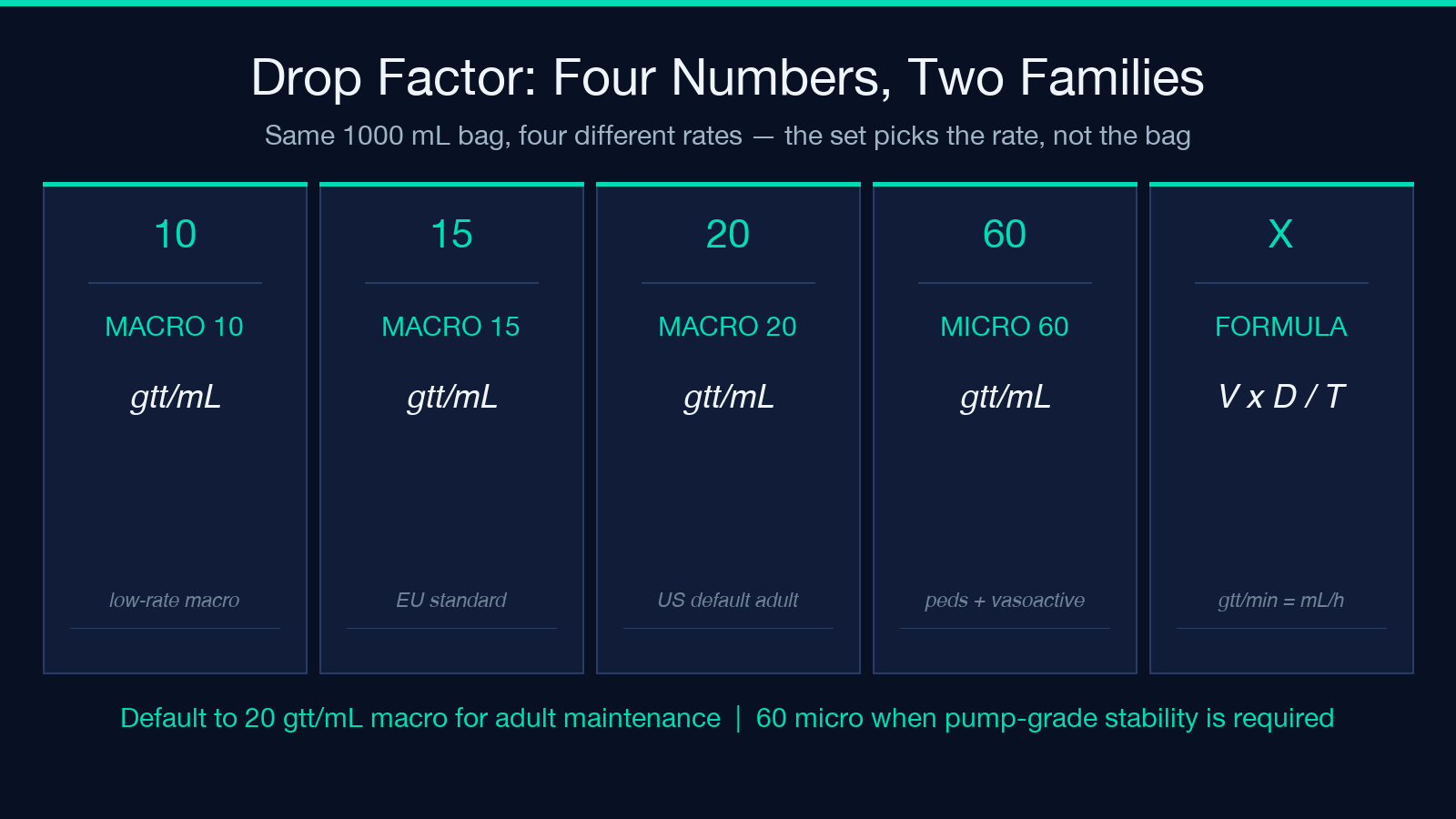
Drop factor is the most commonly mis-transcribed input. Macro sets run 10, 15, or 20 gtt/mL and are used for general adult maintenance and replacement fluids. A 20 gtt/mL set is the most common adult set and produces smaller numeric gtt/min values for the same volume/time pair than a 15 gtt/mL set. Micro sets run 60 gtt/mL and are used for pediatric infusions, vasoactive drugs titrated by hand, and any low-volume precision dose where the nurse needs to count individual drops to verify delivery. At 60 gtt/mL the numeric gtt/min value equals the mL/h rate (one full drop per second equals 60 drops per minute equals 60 mL per hour), which is why pediatric charting can use either column as long as the set is on the chart. If the order sheet says “micro drip” and the bedside has a 20 gtt/mL macro set, the rate produced by the same calculator is three times higher than the prescription intended. Cross-reference the Elysia Tools drop factor selector before any bag change.
How Infusion Time Input Affects the Raw Rate
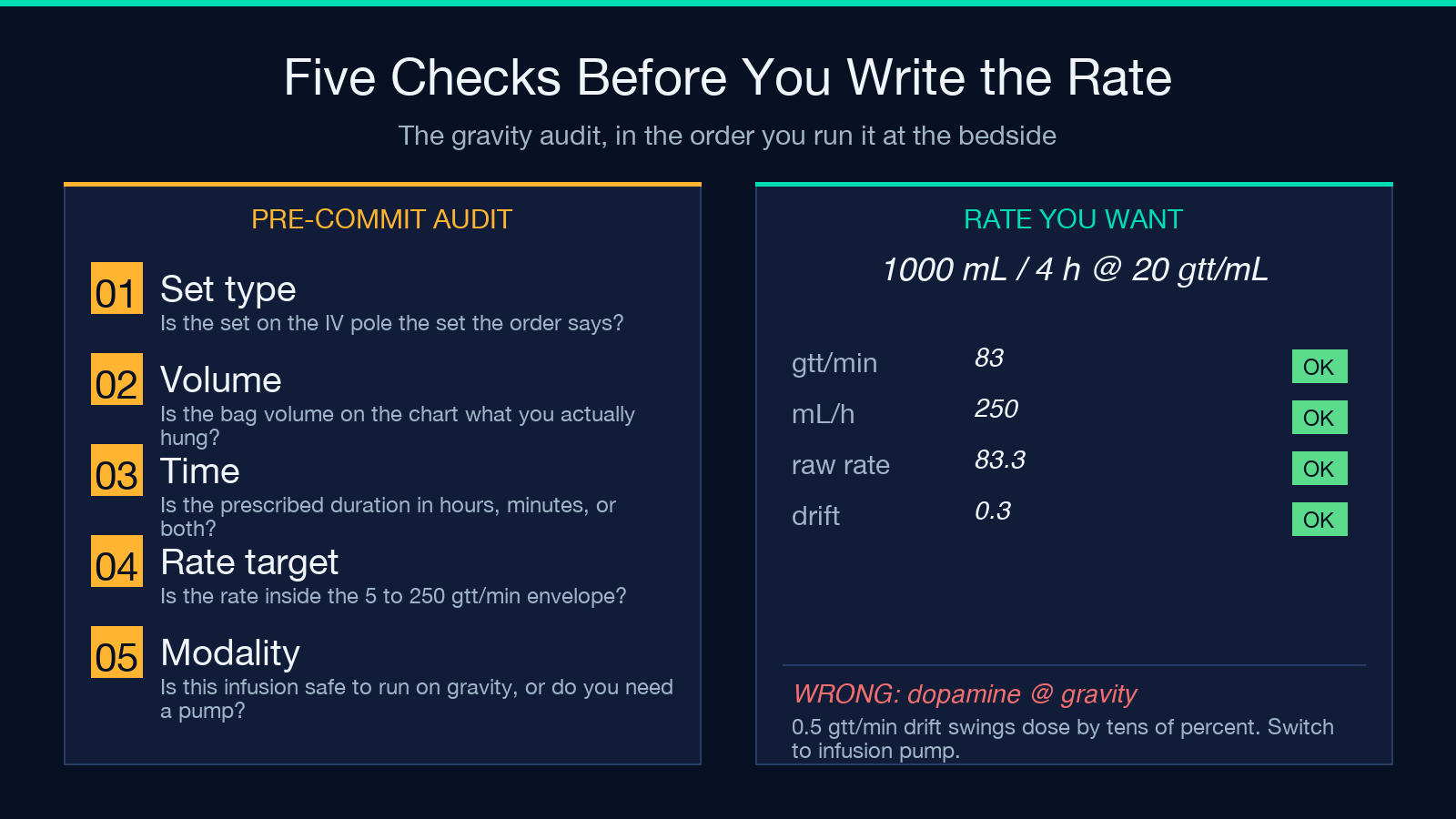
The calculator accepts time as hours + minutes or as minutes alone. The internal conversion is identical: 4 h becomes 240 min, 4 h 30 min becomes 270 min, and 30 min stays 30 min. The danger is not the conversion, it is the rounding path. A 4 h infusion over 1000 mL at 20 gtt/mL yields a raw rate of 83.3 gtt/min and a rounded rate of 83 gtt/min, a 0.3 gtt/min drift that accumulates to one full mL over the 240-minute infusion. The same volume over 4 h 30 min at 20 gtt/mL yields 74.1 gtt/min, rounded to 74 gtt/min, with a 0.1 gtt/min drift. The calculator warns when the raw-to-rounded delta exceeds 0.5 gtt/min; below that, the chart entry matches the prescription and the rounding drift falls under the standard ISMP gravity tolerance. The drift compounds, however, if the time entered is wrong by an hour, so always double-check the order entry against the prescription sheet before trusting the displayed rate.
The Micro-Drip Identity: When gtt/min Numerically Equals mL/h
At 60 gtt/mL the display is a unit identity, not a coincidence. If a micro set is hung for a 500 mL infusion over 8 hours, the rate is 500 * 60 / 480 = 62.5 gtt/min, rounded to 63 gtt/min, while the equivalent mL/h is 500 / 8 = 62.5 mL/h, rounded to 63 mL/h. The two rounded numbers match because each micro drop is one microliter. This identity is why pediatric gravity drips are auditable by either column on the chart, but it also means a transcription error between gtt/min and mL/h in the chart is invisible to the rate itself. The audit that catches it is the set-type cross-check: if the order says micro but the chart entry is in the hundreds of gtt/min, the set is wrong. This identity is also the reason Elysia Tools prints the mL/h rate alongside the gtt/min rate on every calculation; the two columns are not redundant for micro sets, they are the same value expressed twice.
Rate Boundaries: Why the Calculator Flags Under 5 and Over 250 gtt/min
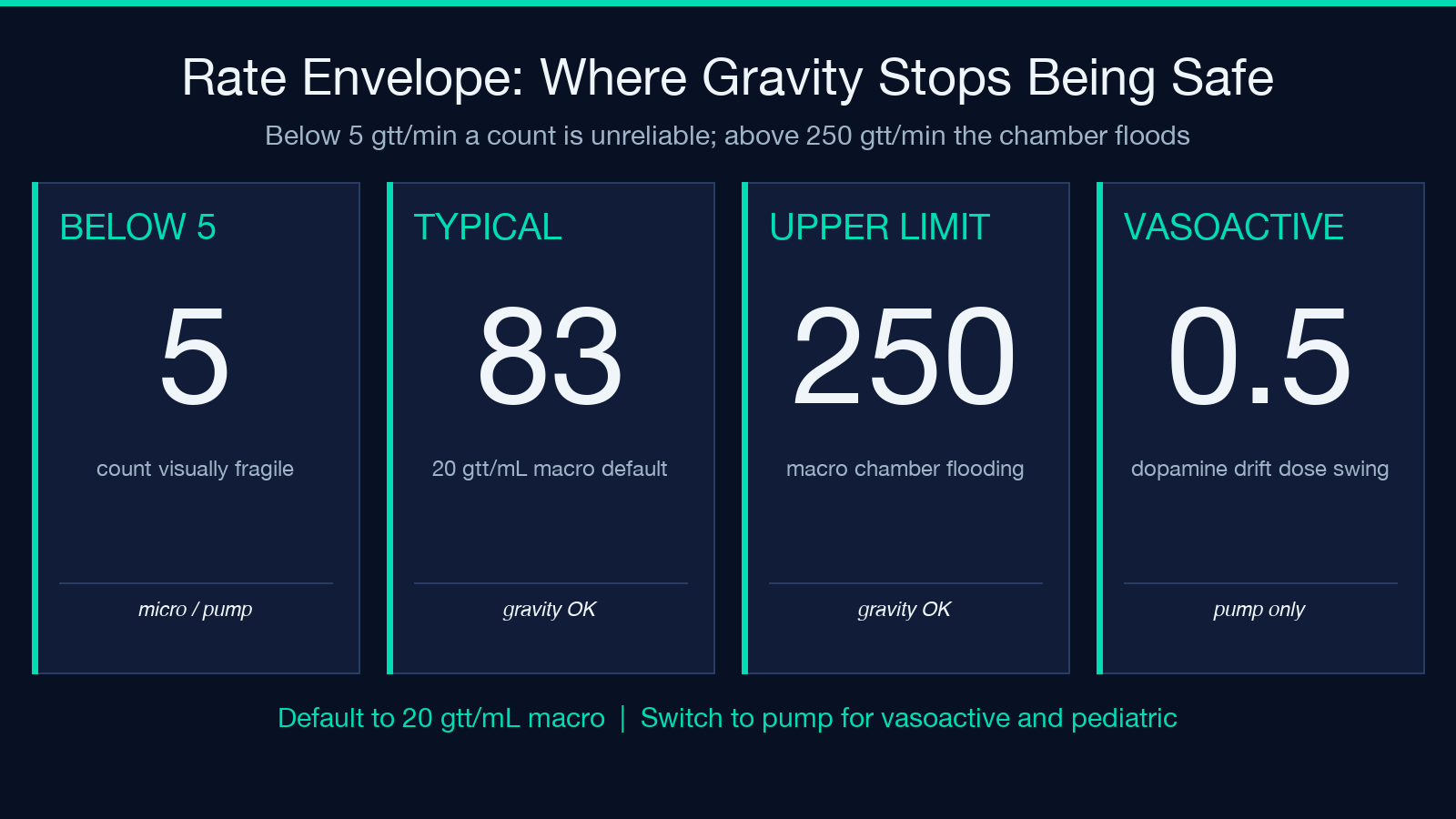
The calculator flags rates below 5 gtt/min and above 250 gtt/min because gravity drips at both extremes are unreliable in practice. Under 5 gtt/min means a drop every 12 seconds or slower, which is below the threshold for visual count consistency and is sensitive to vein pressure spikes, micro-movement of the cannula, and chamber fluid level. Over 250 gtt/min means more than four drops per second, which exceeds what most macro sets can sustain without flooding the drip chamber and air-locking the line. These thresholds are clinical conventions, not physiological limits, but they reflect what a manual count can sustain and what a macro chamber can deliver without the bag running dry ahead of schedule. If the prescription forces a rate outside these bounds, the appropriate response is to switch to an infusion pump, not to coerce the gravity set. The calculator’s warning is not a recommendation, it is a flag that the manual modality has reached its operating envelope.
Safety Boundaries: When Gravity Is the Wrong Modality
Gravity drips are unsafe for any infusion where dose accuracy is critical or where rate stability matters at minute-level granularity. Vasoactive and cardiotonic drugs (dopamine, norepinephrine, epinephrine, dobutamine, vasopressin) require infusion pump delivery because a 0.5 gtt/min drift at low rates can swing the dose by tens of percent within an hour. Insulin infusions, heparin infusions, and any titration protocol that depends on a stable steady-state plasma level must also be on a pump, not gravity. Pediatric infusions under 50 mL/h should be on a pump or syringe driver for the same reason. The calculator surfaces these boundaries by accepting the gravity computation but flagging any rate under 5 gtt/min for clinical review. The point is not that the math is wrong, it is that the modality cannot deliver the math reliably. Switch to a pump; do not coerce a gravity set to deliver a vasoactive drip.
Bag-Change Recount and Time-Tape Verification
Every bag change requires a recount. The previous bag’s rate was a one-shot rounded number, not a continuous flow, and the new bag starts from a slightly different chamber level, fluid temperature, and venous pressure. Recount the drip chamber for one full minute at the new bag’s start and write the actual count on the chart alongside the prescribed rate. For long infusions, use a time-tape (a strip of tape marked with the expected cumulative volume at each hour, laid alongside the drip chamber) to verify that the actual delivered volume matches the prescription. A time-tape catches drift that the per-minute recount cannot, because it integrates over the full hour. The calculator’s mL/h column is the time-tape’s reference value; write both on the tape and check at each hour mark. If the actual volume is more than 10% off the prescription at any hour, swap the set and recount rather than adjusting the rate.
Picking a Drop Factor Set for the Clinical Scenario
The set choice is driven by the prescription, not the bag. Macro sets at 20 gtt/mL are the default adult maintenance choice because they balance chamber visibility against count precision at typical 100-250 mL/h rates. Macro sets at 15 gtt/mL are slightly more precise at low rates and are common on wards where slow maintenance infusions are typical. Macro sets at 10 gtt/mL are rare in adult practice and are mostly used for very low-rate infusions or in pediatric wards. Micro sets at 60 gtt/mL are for pediatric, vasoactive, and any case where the nurse needs to count drops by eye and verify delivery minute-by-minute. The calculator’s drop factor selector is a single dropdown, but the clinical reasoning behind the choice is the rate target, the patient population, and the audit tolerance for drift. Default to 20 gtt/mL macro for adult maintenance; switch to 60 gtt/mL micro for anything that requires pump-grade stability.
The calculator is a math tool. It does not replace the prescription sheet, the bedside set identification, the bag-change recount, or the clinical judgment that says “this rate is wrong, switch to a pump.” The mL/h column is not a flow-rate target for charting pumps unless the chart has been confirmed to be using gravity modality at that time. The flagged-rate warning is not a safety recommendation; it is a flag that the modality has reached its envelope. Use the Elysia Tools gravity drip rate calculator to compute the rate, then write the rate on the chart, mark the time-tape, recount on bag change, and switch modality when the prescription demands it. Gravity drips are still the most common infusion modality in adult maintenance, and the audit that keeps them safe is the calculator, the recount, the time-tape, and the modality boundary in that order. Explore more clinical and bedside calculators at elysiatools.com.
