
Friedewald’s 1972 paper keeps showing up on lipid panels 50 years later because it is one subtraction, one division, and one assumption. Most labs report LDL-C as a direct measurement now, but the calculated version is still what shows up when insurance panels request indirect LDL, when point-of-care meters print a number, when ASCVD risk calculators ask for an input, and when a fasting patient sample from a community lab needs to be triaged before a clinician sees it. The Friedewald formula is not wrong; it is just conditional. The five input decisions in front of that calculation decide whether the printed number is reliable, underestimated, or silently useless at the exact thresholds that drive treatment.
This field guide walks through the five inputs that decide whether your Friedewald LDL-C lands inside the reliable band, the three downstream decisions that decide what to do when triglycerides push it outside that band, and the four ASCVD/statin decisions that hinge on the answer. The LDL-C Calculator (Friedewald) on Elysia Tools implements all five inputs plus a decimal-places control so the output matches whatever precision your clinician or risk calculator expects. A related comparison tool, the Lipid Panel Decoder, sits in the same Health cluster when you need to walk a non-numeric patient through what each band on the panel means.
Why a 1972 Formula Still Runs on Half the Lipid Panels You See Today
Friedewald, Levy, and Fredrickson’s 1972 paper proposed a single subtraction-and-division shortcut because direct LDL-C measurement was expensive and slow. The shortcut replaced the preparative ultracentrifugation that labs used before with a calculation that any clinician could do on the back of a lipid-panel printout. Fifty years later, the formula is still what runs in the back office of most insurance billing codes, what point-of-care meters print, and what ASCVD risk calculators expect as input. It is also what fails silently when TG goes above 400 mg/dL.
One Section, One Decision: Why the Formula Structure Matters
The Friedewald formula is not symmetric. The two operations inside it — subtraction and division — fail at different thresholds and for different reasons, and the order in which you read the formula matters when interpreting an unexpected output.
- Subtraction (TC − HDL-C). Always valid. The result, non-HDL-C, is the sum of LDL-C + VLDL-C + IDL-C + Lp(a). This is clinically useful by itself when Friedewald is not.
- Division (TG / 5 or TG / 2.2). Assumes TG:VLDL-C ratio is 5:1 in mg/dL or 1:2.2 in mmol/L. Fails progressively above TG ≥ 400 mg/dL. Fails categorically in non-fasting samples and type III dysbetalipoproteinemia.
- Final subtraction (non-HDL-C − TG/5). Removes the estimated VLDL-C. The result is LDL-C. Both upstream errors propagate here; this is where the failure surfaces as a printed number.
Two of the three operations have a structural validity envelope; the subtraction step (TC − HDL-C) does not. Reading the formula top-down helps catch whether an unexpected result is upstream (TG band) or downstream (final-arithmetic rounding).
The Five Inputs That Decide Whether Friedewald Is Even Valid Here
Before the subtraction runs, decide whether you should trust the result. The five inputs are not interchangeable; the order in which you decide them changes the output’s reliability envelope.
- Unit system. mg/dL vs mmol/L. The arithmetic is the same but the constant changes: 5 in mg/dL, 2.2 in mmol/L. Mixing units silently produces a number 2.27x off. Lock the unit system first; the rest of the inputs reference it.
- Total cholesterol (TC). Fasting value, same unit system. Reference ranges differ by ~2.27x between systems.
- HDL cholesterol. Fasting value, same unit system. HDL-C below 40 mg/dL (1.0 mmol/L) is a flag that Friedewald will overestimate LDL-C because the VLDL subtraction assumes normal HDL.
- Triglycerides (TG). Fasting value, same unit system. The single most consequential input — TG ≥ 400 mg/dL (4.5 mmol/L) is the canonical invalidation threshold. The formula assumes TG:VLDL-C = 5:1, and that ratio breaks above 400.
- Decimal places. 0–8, default 1. Affects display only; the underlying arithmetic is float. A clinician reading “87” vs “87.0” makes no clinical difference, but a risk calculator that strips decimals may behave differently.
Two of the five are categorically different from the other three: the unit system is a config-level decision that affects every input, and decimal places is a display-level decision that does not. The other three (TC, HDL, TG) are the numeric core and they must be in the same unit system or the formula collapses.
The Three Branching Decisions When Triglycerides Cross 400
Friedewald is conditional, not conditional-then-recoverable. When TG ≥ 400 mg/dL, the formula produces a number, but that number is progressively underestimated as TG rises. The three valid branches at this point are the three things you should do instead of reading the printed LDL-C.
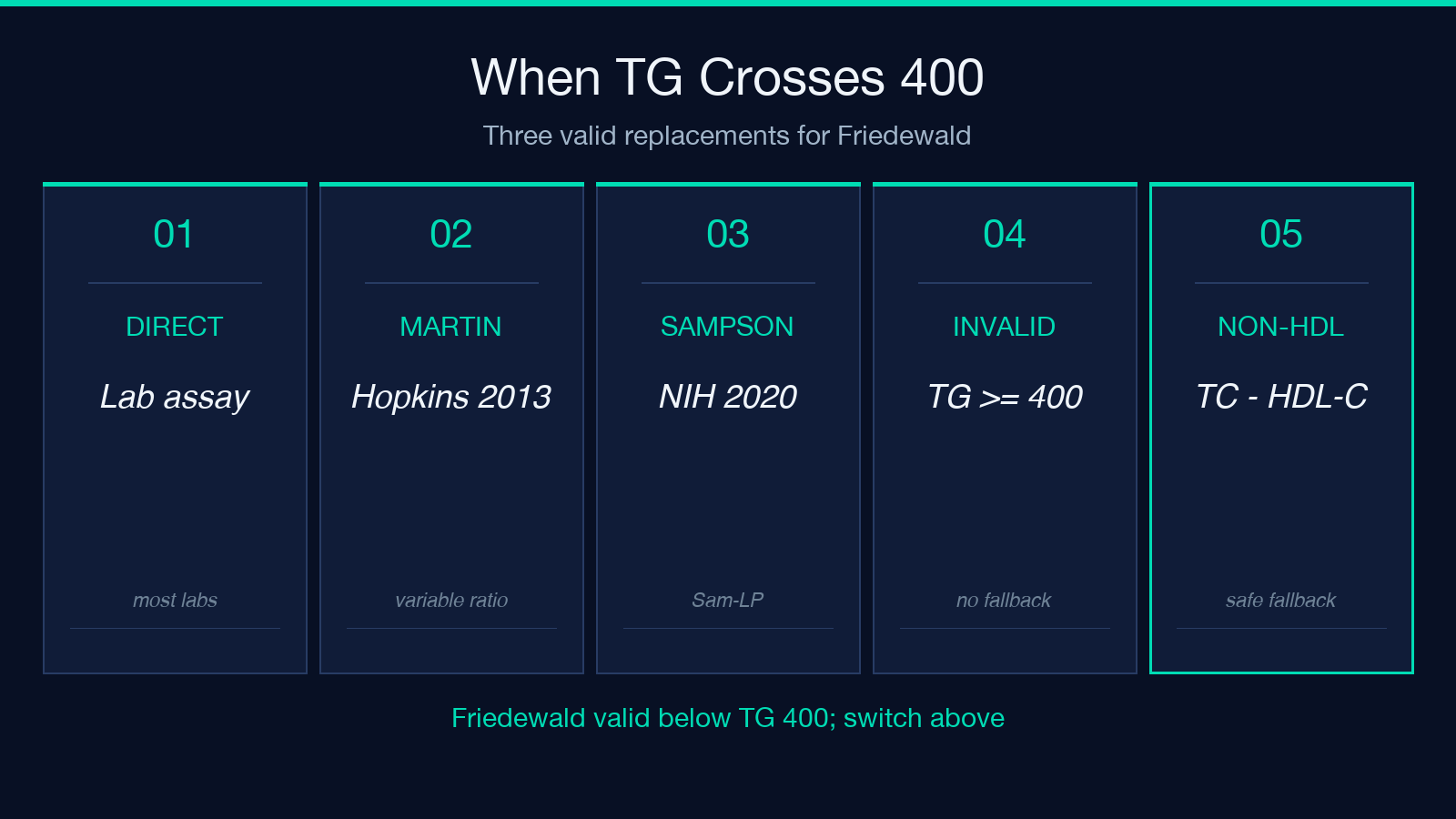
- Direct LDL assay. Most modern lab panels already do this. If you have access to a direct LDL-C measurement (immunonephelometric, enzymatic), use it and skip Friedewald entirely.
- Martin/Hopkins 2013 equation. Uses a variable TG:VLDL-C ratio (typically 3.5–7 depending on TG and non-HDL-C) rather than the fixed 5:1. Implemented in many calculators; runs from the same three fasting inputs as Friedewald.
- Sampson-NIH 2020 equation. 174-coefficient model that handles TG up to 4000 mg/dL and produces LDL-C within 3-5% of direct measurement across most populations. Recommended by the 2020 Sampson paper for accelerated lipid performance (Sam-LP); requires the same three inputs as Friedewald.
The LDL-C Calculator (Friedewald) on Elysia Tools implements Friedewald with the standard invalidation flag at TG ≥ 400 mg/dL. The post-2013 alternatives (Martin/Hopkins, Sampson-NIH) are adjacent tools in the same Elysia Tools Health cluster — browse all Health tools to find them when the printed Friedewald number is unreliable.
The Four ASCVD/Statin Decisions That Hinge on This Number
Once you have a reliable LDL-C, four downstream decisions use it directly. Each has different thresholds, and the four together explain why a number that is “close enough” clinically still matters.
- ASCVD 10-year risk (Pooled Cohort Equations). LDL-C is one of the inputs alongside age, sex, race, blood pressure, HDL-C, diabetes, and smoking. A misestimated LDL-C shifts the risk band boundary silently.
- Statin initiation threshold. 2018 ACC/AHA: LDL-C ≥ 190 mg/dL (4.9 mmol/L) triggers high-intensity statin regardless of risk score. Borderline: 70-189 mg/dL drives the risk-score-driven decision.
- Statin intensity escalation. Target LDL-C reduction ≥ 50% on high-intensity statin. The baseline reading you have now is the denominator of every future “did the statin work” check.
- Familial hypercholesterolemia (FH) screening. LDL-C ≥ 190 mg/dL in adults, or ≥ 160 mg/dL in children, is the flag for FH workup regardless of ASCVD risk. The Friedewald assumption breaks at this exact threshold because TG:VLDL-C ratio is altered in FH.
Two of these four are categorical (FH screen at 190; high-intensity statin at 190), and two are continuous (risk score, treatment response). The categorical decisions are where a Friedewald underestimate most often becomes a missed FH case.
The Two Silent Failure Modes That Escape Naive Linters
Most calculators return a number regardless of input validity. Two failure modes produce a printed result that is structurally valid but clinically wrong, and they tend to escape lint checks that look at format rather than at the input band.
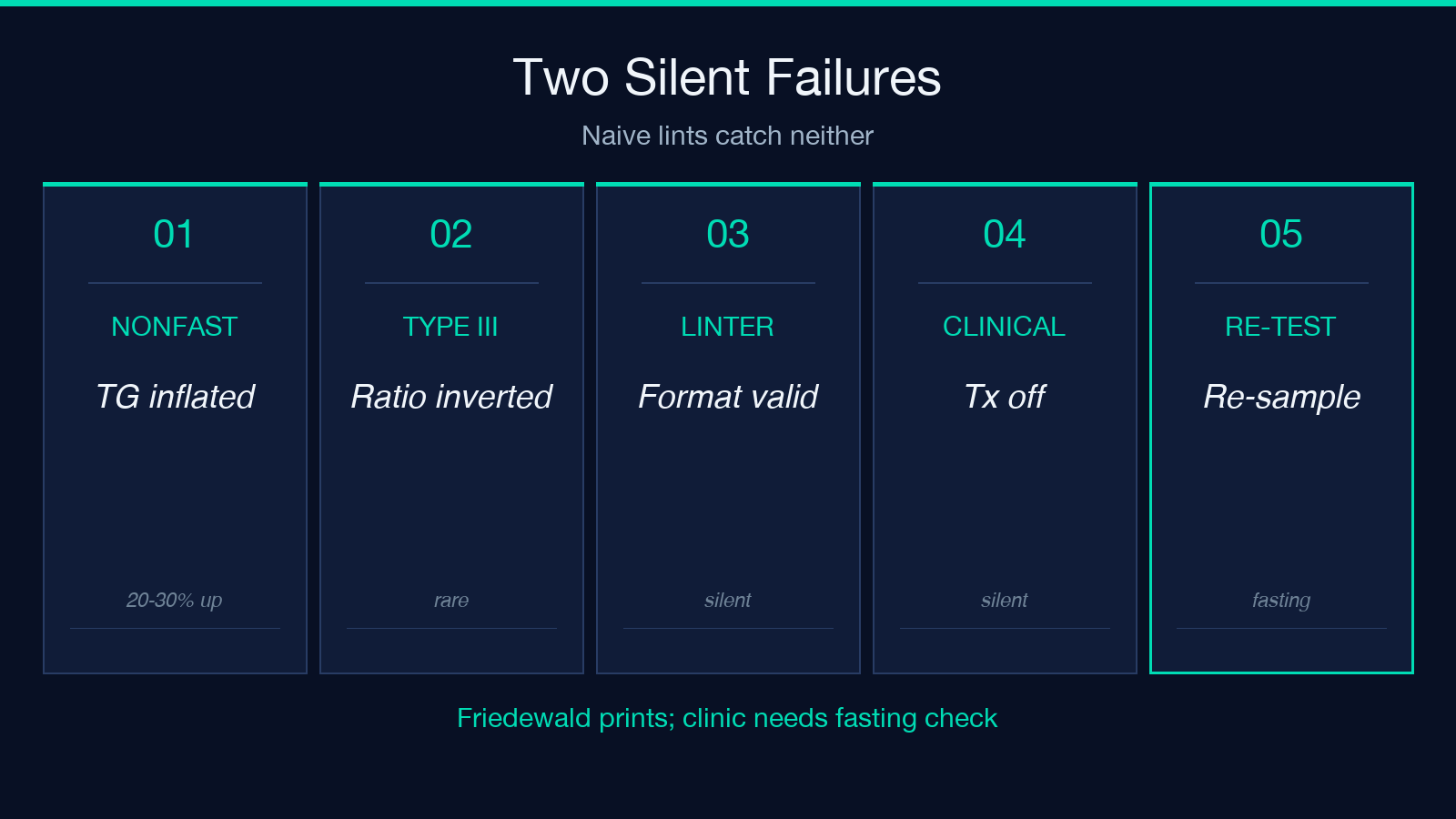
- Non-fasting TG. Friedewald assumes fasting TG. A non-fasting sample has TG inflated by 20-30% from the fasting value, which makes VLDL-C overestimated and LDL-C underestimated. The number prints cleanly; the assumption silently fails. Mitigation: either re-sample fasting, or use Sampson-NIH which is robust to non-fasting TG.
- Type III dysbetalipoproteinemia (broad-beta disease). The TG:VLDL-C ratio is inverted — VLDL-C is closer to TG/1 (not TG/5). Friedewald assumes the normal 5:1 ratio, so it overestimates LDL-C by ~2-3x in this population. Rare but present; the calculator has no way to detect it from the three inputs alone.
These two failure modes are the reason the printed Friedewald LDL-C is rarely the right answer in isolation. The calculator reports the formula result, not the clinical answer.
Three Use-Cases: Fasting Adult, Non-Fasting Screening, Pediatric FH Workup
The same three inputs serve three different clinical workflows. Each workflow has its own validity envelope, and the way you read the Friedewald output changes accordingly.
- Fasting adult, full lipid panel. The canonical case. TC, HDL-C, TG all fasting, all mg/dL (or all mmol/L). Friedewald is reliable, the result is the result, and the four downstream decisions apply directly. This is what most point-of-care lipid meters report.
- Non-fasting screening. A community health fair, a workplace wellness panel, or a sample taken after the patient ate. TG is inflated, Friedewald underestimates LDL-C. Use the Friedewald number as an upper-bound estimate and re-test fasting if the number drives a treatment decision. Alternatively, switch to Sampson-NIH which handles non-fasting TG robustly.
- Pediatric FH workup. Children with FH show LDL-C ≥ 160 mg/dL on a fasting sample. The Friedewald formula works at this age; the categorical FH threshold (160 vs adult 190) is the difference that decides whether genetic workup triggers.
Two of the three workflows (non-fasting screening and pediatric FH workup) sit on the boundary of Friedewald’s validity envelope. The fasting-adult case is the only one where the printed number is the clinical answer.
Post-Publish: The Three QA Checks That Catch What Linters Miss
Once a Friedewald number lands in a chart or a panel report, three checks catch the cases that automated lints miss. These are not input validation — they are output reconciliation.
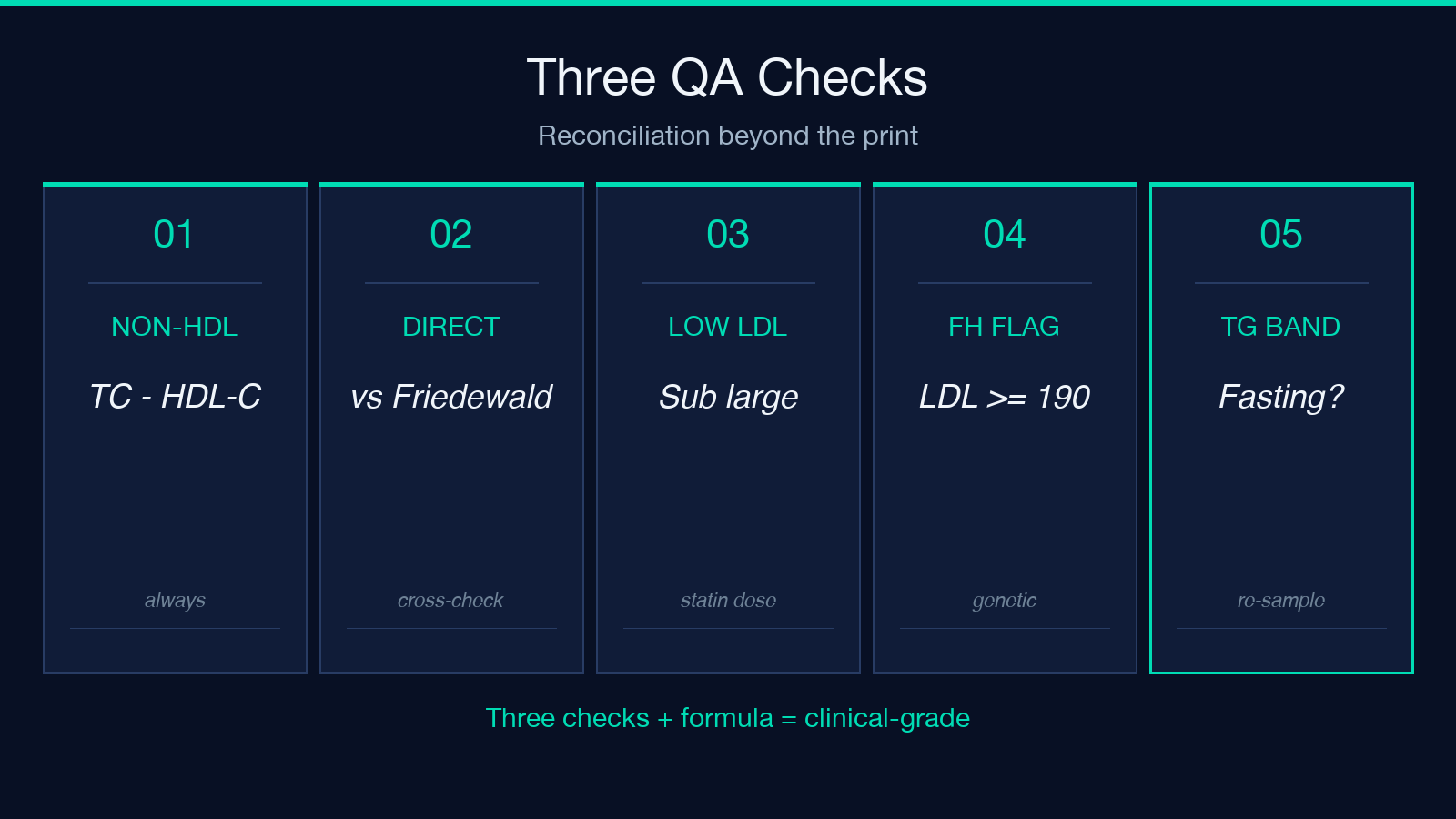
- Cross-check LDL-C against non-HDL-C. non-HDL-C = TC − HDL-C. This always works regardless of TG. If Friedewald LDL-C + (TG/5) is much less than non-HDL-C, the TG:VLDL-C ratio was probably not 5:1 and Friedewald underestimated.
- Compare with direct LDL-C if both available. Direct assay vs Friedewald should agree within 10-15% when TG < 200 mg/dL. Larger divergence at TG < 200 suggests a non-standard ratio (type III, non-fasting, or lab error).
- Re-check at extreme low LDL-C. Below 70 mg/dL, Friedewald becomes inaccurate because the constant TG/5 subtraction is large relative to the result. ACC/AHA recommends direct assay or Sampson-NIH for LDL-C < 70 mg/dL because statin titration depends on the exact value.
The three QA checks are how the formula gets trusted in production. The Friedewald calculation is one line of arithmetic; the decision to trust it is a clinical workflow that includes the formula, a unit-system check, a fasting check, and a non-HDL-C cross-check. The LDL-C Calculator (Friedewald) on Elysia Tools implements the Friedewald arithmetic plus the standard invalidation flag, but the workflow around it is what makes the output clinical-grade. For more cross-checks and comparator calculators, browse all Elysia Tools.
