# 8 Free Finance Calculators That Do the Math Your Spreadsheet Can’t
Your spreadsheet can add. It can multiply. It can reference itself across 47 tabs and color-code cells based on conditions that no one remembers writing.
But can it tell you how much you’ll actually pay on a 30-year mortgage when interest compounds daily? Can it model a debt payoff strategy that keeps you motivated with quick wins? Can it show you what $1,000 will be worth in 20 years when inflation quietly eats it away?
Probably not — at least not without 40 minutes of nested formulas and a quiet prayer that you didn’t mix up a cell reference.
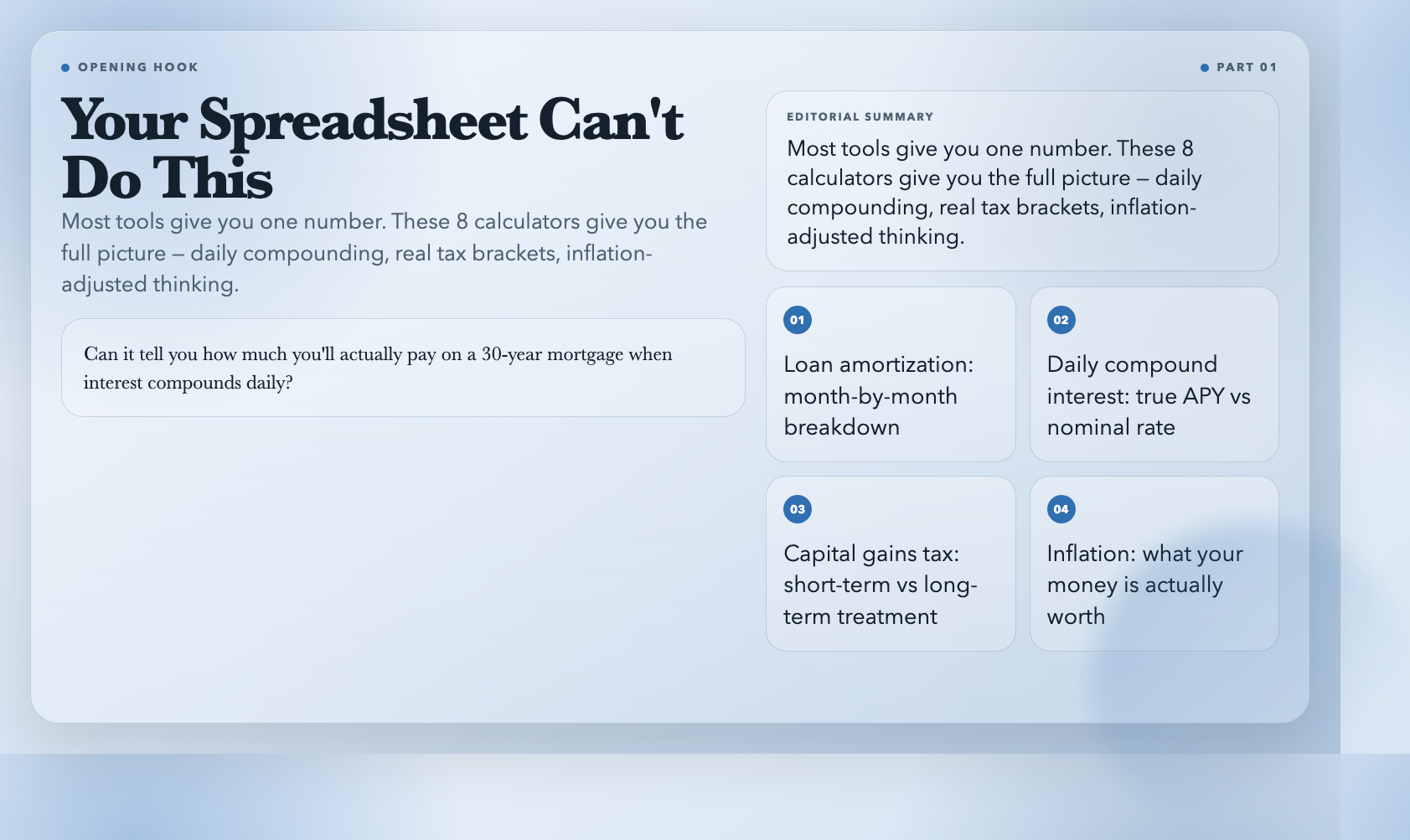
These 8 free finance calculators from ElysiaTools do the real math. They’re built for people who want clear answers, not black-box spreadsheets maintained by someone who left the company three years ago.
—
1. Loan Calculator
Most loan calculators online show you one number: your monthly payment. This one shows you everything.
You punch in the loan amount ($250,000), the interest rate (6.5%), and the term (30 years). What you get back is a full breakdown: monthly payment, total interest paid across the life of the loan, total cost, and — if you want it — a complete month-by-month amortization table showing exactly how much of each payment goes toward principal versus interest.
That’s useful if you’re deciding between a 15-year and 30-year mortgage. The 15-year payment is higher, but the total interest saved is often significant. Run both. Compare. Then decide with real numbers instead of vague intuition.
Use it when: you’re evaluating a car loan, personal loan, or mortgage and want the full picture — not just what the dealer wants you to see.
—
2. Amortization Schedule
If the Loan Calculator is the overview, this is the map.
The Amortization Schedule generates a payment-by-payment breakdown for any loan. You set the loan amount, annual interest rate, loan term, start date, and payment frequency (monthly, bi-weekly, or weekly). The tool then spits out every single payment: how much principal it retires, how much goes to interest, and what the remaining balance is after each payment.
It also groups everything into a yearly summary, so you can see — for example — that in year one of a 30-year mortgage, most of what you pay is interest. That ratio slowly flips over time. But knowing exactly when it flips, and how extra payments change that date, is the kind of precision that changes decisions.
This is the tool that makes the abstract concrete. You see exactly when the tide turns — when you’re finally paying more principal than interest. That date is closer than you think, but only if you run the math.
Use it when: you want to visualize exactly how a loan amortizes and when extra payments will have the biggest impact.
—
3. Daily Compound Interest Calculator
Compound interest is called the eighth wonder of the world for a reason. But most calculators compound monthly or annually. This one compounds daily — and the difference is real.
Start with $10,000 at 5% annual interest, add $500 a month, and let it run for 20 years. With daily compounding, you end up with more than you would with monthly compounding. Stretch it to 30 years and the difference compounds into thousands of dollars.
The tool outputs the final amount, total principal, total interest earned, APY, and a year-by-year breakdown so you can watch your balance compound in real time. It also supports choosing when during the month your contribution lands — beginning or end — which slightly affects the end result.
This means you can model actual savings scenarios. What if you increase your monthly contribution by $200 after a raise? What if you start five years earlier? Run both. Compare. Adjust. That’s how financial planning actually works — not by guessing, but by modeling and measuring.
Use it when: you’re projecting savings goals — retirement, a house down payment, a child’s education — and want the most accurate compound interest projection available for free.
Daily Compound Interest Calculator →
—
4. Future Value Calculator
Where the Daily Compound Interest Calculator focuses on your savings behavior, the Future Value Calculator answers a slightly different question: what will a single lump sum be worth at a future point in time?
You input a present value, an annual interest rate, a number of years, and a compounding frequency. You can also add regular contributions and specify whether they go in at the beginning or end of each period.
The tool calculates the future value and — crucially — shows you how much of that growth is interest versus your own contributions. This is the clearest way to see the power of time on money. A young person who invests $10,000 and leaves it alone for decades watches compound interest do the work that additional income alone cannot.
Use it when: you’re planning long-term financial goals and want to understand the growth trajectory of different investment scenarios.
—
5. Annuity Calculator
An annuity is essentially the inverse of a loan. Instead of borrowing money and paying it back, you’re making regular payments into an account that grows with interest — and then, at some point, the account pays you back.
This calculator handles three types of annuity math: the future value of a series of payments (how much your contributions will grow to), the present value of a series of payments (what a future income stream is worth today), and the payment amount needed to reach a target future or present value.
The practical use case is retirement planning. If you know you want $60,000 a year in retirement income for 20 years, this calculator works backward to tell you how much you need to have saved when you retire — and how much you need to be contributing now to get there.
Use it when: you’re thinking about retirement income, pension decisions, or structured investment products and need to understand the math behind them.
—
6. Capital Gains Tax Calculator
Most investment return calculators stop at the gain. This one goes one step further: it tells you how much of that gain you’ll actually keep after taxes.
You input the purchase price, the sale price, the holding period (in months — this determines whether you pay short-term or long-term capital gains rates), your annual income, filing status, and country. The tool then calculates your tax liability, taking into account the bracket-based nature of capital gains taxes.
The holding period distinction matters enormously. Short-term gains — held less than a year — are taxed as ordinary income. Long-term gains get preferential rates, often significantly lower. For someone selling a significant stock position, the difference between short-term and long-term treatment can amount to thousands of dollars. Run it before you sell, not after.
Use it when: you’re planning to sell stocks, real estate, or other assets and want to know your actual net proceeds — not just the gross gain.
Capital Gains Tax Calculator →
—

7. Debt Snowball Calculator
The debt snowball method is psychologically powerful: you pay off your smallest balance first, regardless of interest rate, and roll the payment you were making on that debt into the next smallest balance. Each win builds momentum. It’s not always the mathematically optimal path, but it’s often the path people actually follow — because quick wins build habits, and habits build momentum.
This calculator models that strategy precisely. You enter up to five debts, each with a balance, minimum payment, and interest rate, along with your total monthly payment budget. The tool spits out a payoff schedule: the order you’ll pay things off, the month each debt will be eliminated, the total interest you’ll pay, and the final payoff date.
What makes it useful isn’t the math — the math is straightforward. It’s the clarity it provides. You can see that your $500 credit card debt will be gone in four months, freeing up $150 to throw at the next debt. That visual progress is what makes the snowball method work for people who’ve tried raw willpower and failed.
Use it when: you have multiple debts and want to see exactly how the snowball method plays out — and whether it’s faster than just paying minimums.
—
8. Inflation Calculator
Inflation is the tax you don’t see. Every year, the purchasing power of your money erodes slightly. $100 today buys less than $100 bought five years ago. That’s inflation, quietly subtracting from everything you save.
This calculator shows you exactly how much. Input a current amount ($1,000), an annual inflation rate (the US average runs around 3%), and a number of years (say, 20). The tool tells you what that $1,000 will be worth in future dollars — and what future dollar amount you’d need to have today’s $1,000 in equivalent purchasing power.
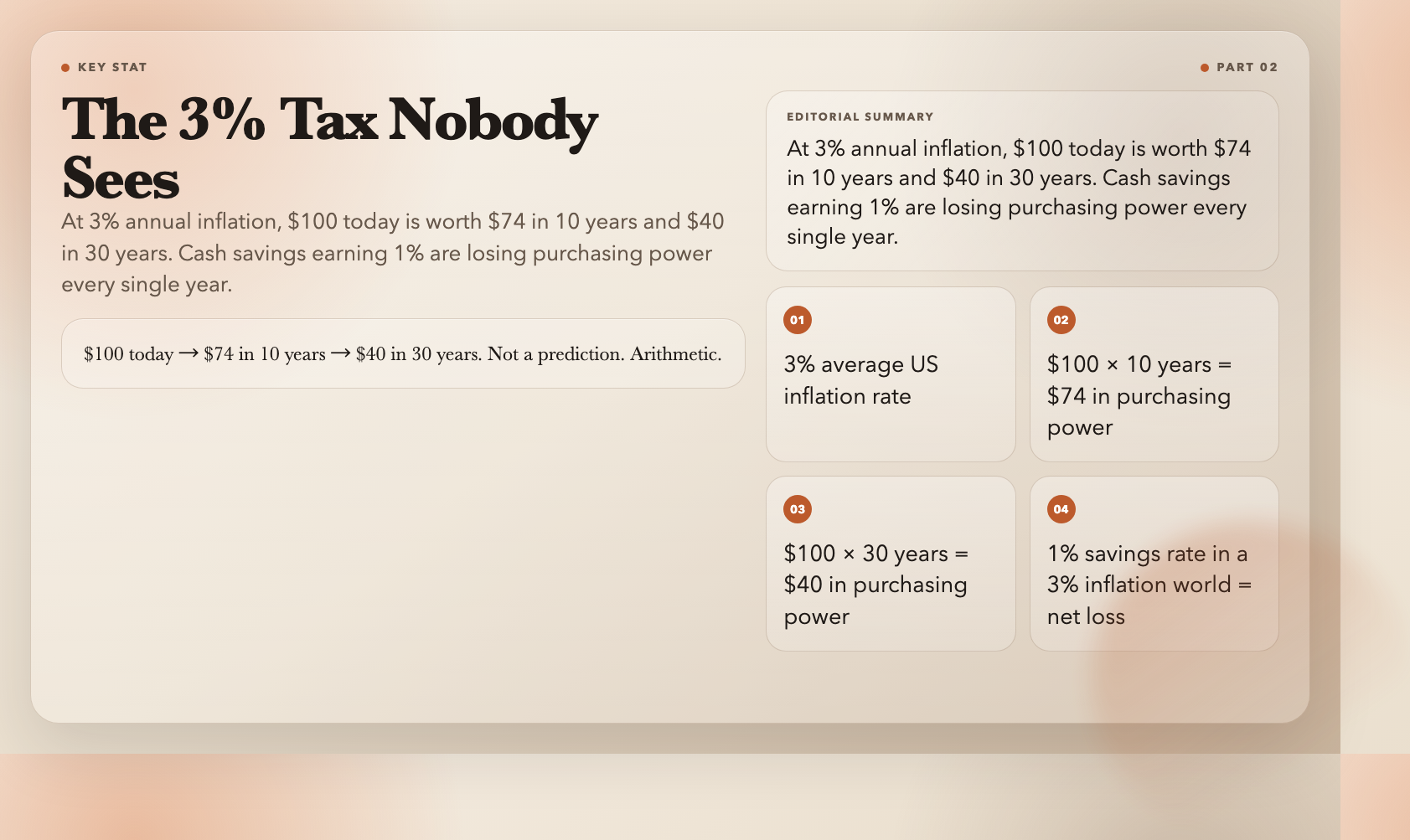
At 3% annual inflation, $100 today is worth about $74 in 10 years. In 30 years, it’s worth roughly $40. This is why keeping all your money in a savings account paying 1% interest while inflation runs at 3% means you’re net losing purchasing power every single year. This isn’t financial gloom — it’s arithmetic that changes the conversation from “is my money safe?” to “is my money safe enough adjusted for what things actually cost?”
Use it when: you want to understand the real return on your savings, evaluate whether a “safe” investment is actually safe in purchasing-power terms, or plan for long-term financial goals.
—
The Numbers Exist. The Excuses Don’t.
Personal finance isn’t one math problem. It’s a set of interconnected scenarios — how loans amortize, how savings compound, how taxes bite into gains, how inflation quietly shrinks your purchasing power, and how debt payoff strategies affect your psychology as much as your cash flow.
Most people encounter these problems one at a time, at different life stages, without the right tools. They trust a banker who has incentives, or a spreadsheet built by someone who didn’t understand the formulas they were copying, or their own back-of-envelope math that gets the direction right but the number badly wrong.
These eight calculators don’t require a finance degree. They don’t ask you to sign up. They don’t show you ads. They just do the math — daily compounding, bracket-based tax rates, realistic inflation figures — and give you numbers you can actually use to make a decision.
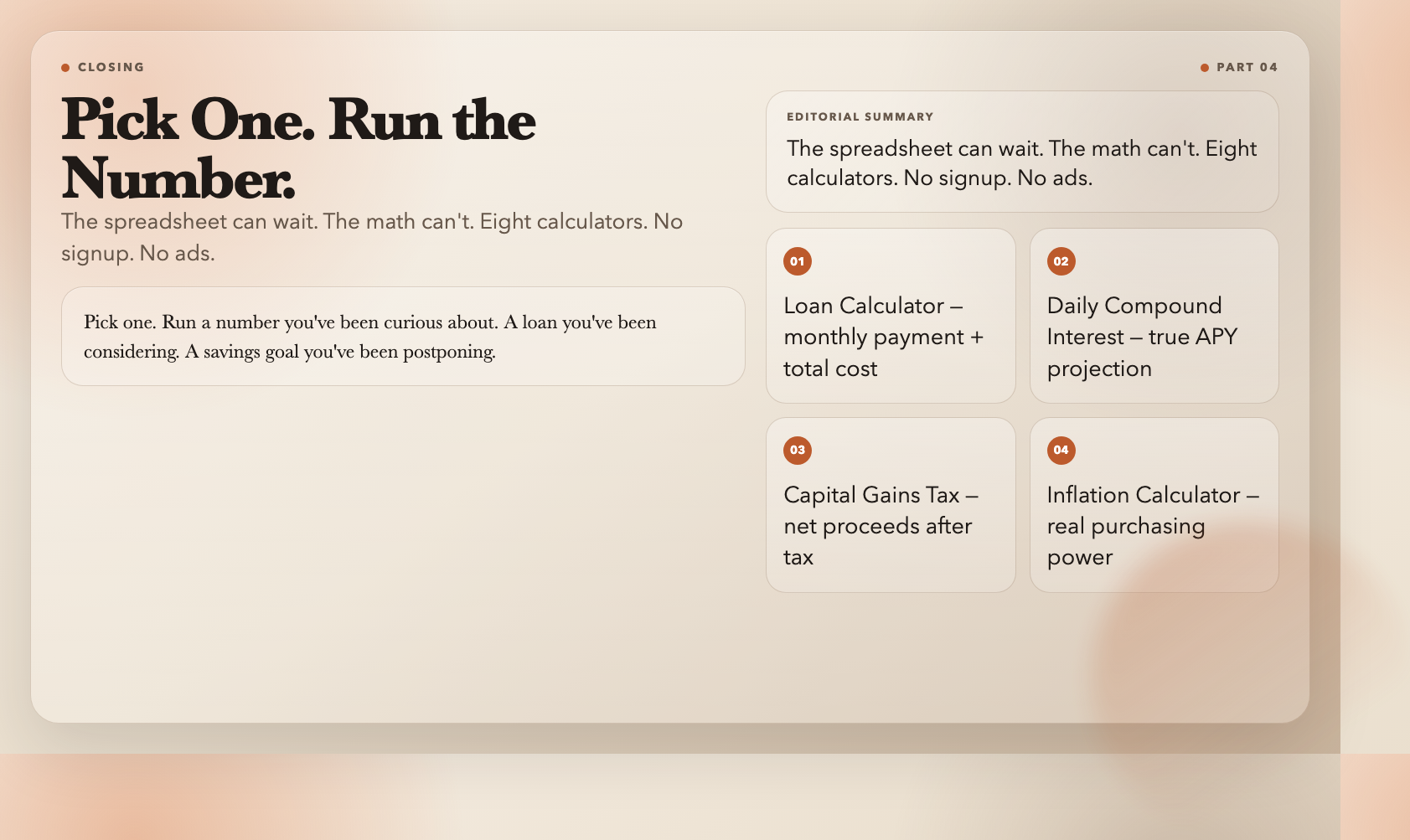
Pick one. Run a number you’ve been curious about. A loan you’ve been considering. A savings goal you’ve been postponing. A debt you’ve been dreading.
The spreadsheet can wait. The math can’t.