# Your Body Doesn’t Need Another Generic Workout Plan. Here’s What Actually Works.
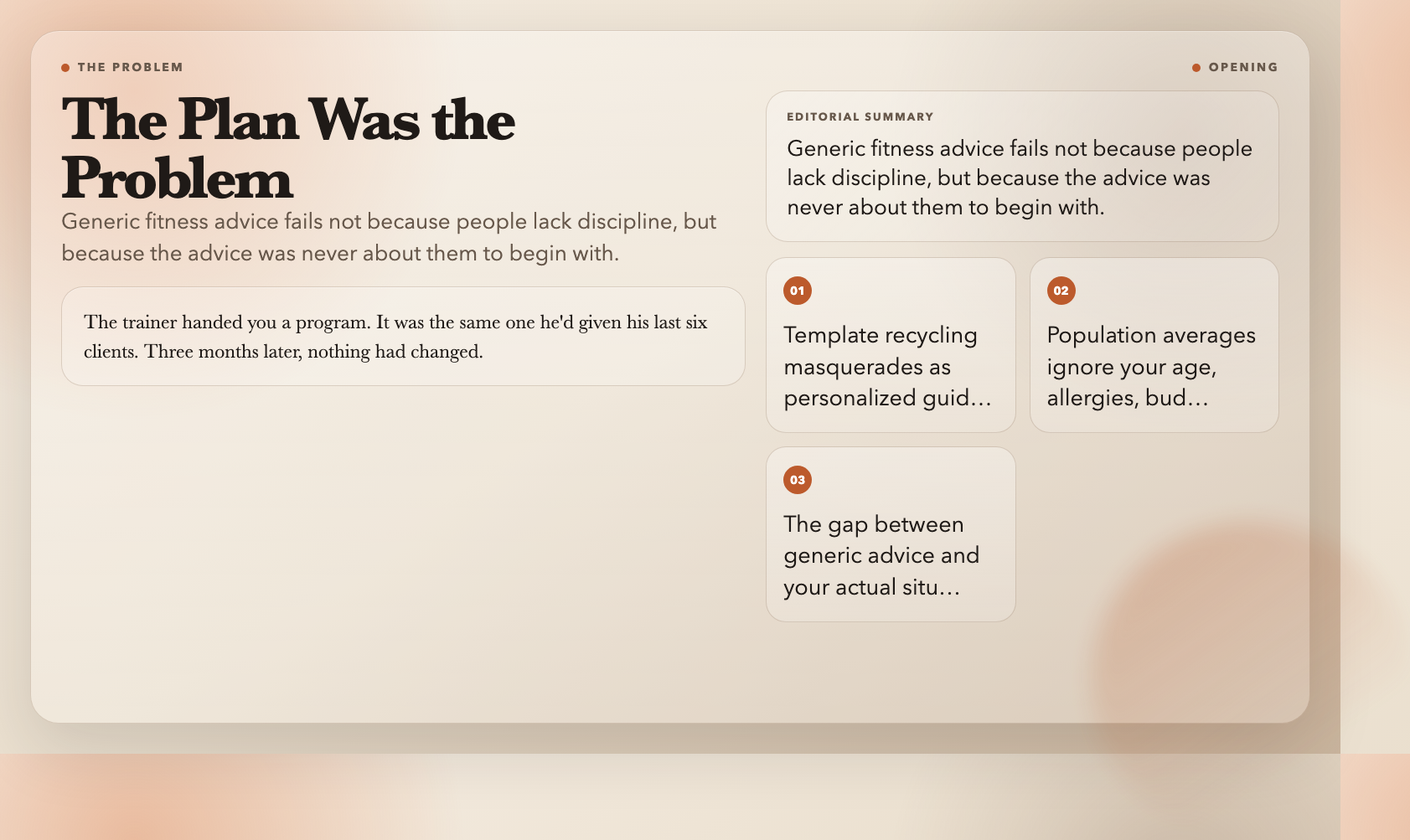
The trainer handed you a program. It was the same one he’d given his last six clients. Three months later, nothing had changed. The plan was the problem.
Most fitness advice isn’t advice — it’s template recycling with new fonts. “Eat less, move more.” “Cut carbs.” “Lift heavy, do cardio.” Every article reads like a photocopy of the one published five years ago.
Here’s what nobody states plainly: what works for the average person has nothing to do with what works for you. Your age, activity level, cooking experience, food allergies, budget, and genetic wiring all change the math. A generic 12-week plan ignores every single one.
That gap — between population-average advice and your specific numbers — is where most health journeys quietly die. A new wave of free AI tools is starting to close it.
—
1. AI Ketogenetic Diet Generator — A Week-Long Meal Plan Built Around Your Life
The ketogenic diet works. The science is solid: restrict carbs, enter ketosis, burn fat for fuel. But keto is brutally personal. Your neighbor’s 70/25/5 macro split won’t fit you if you’re a 5’9″ female office worker on 1,800 calories — not a 6’2″ CrossFit athlete on 3,200.
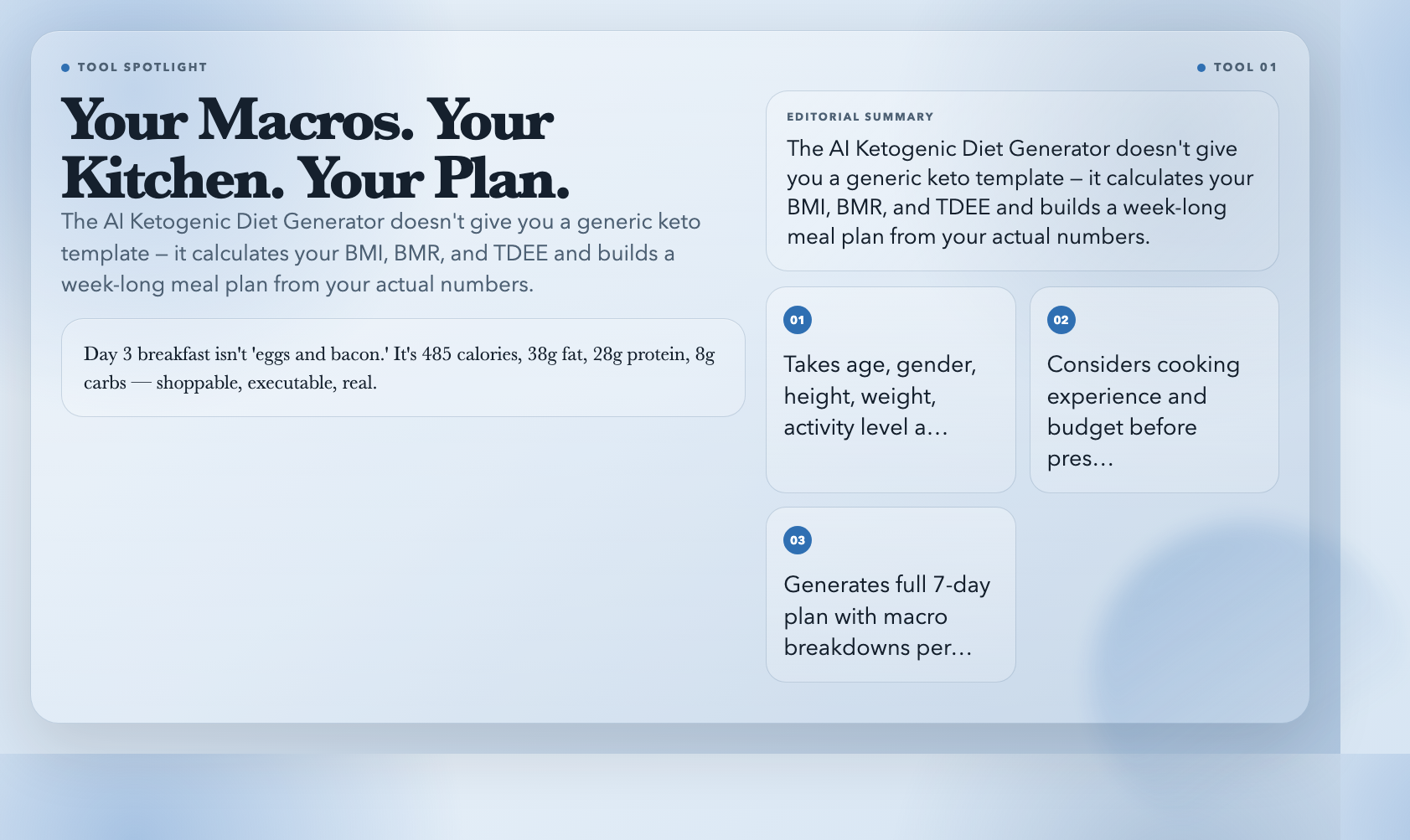
The AI Ketogenetic Diet Generator fixes this. Enter your age, gender, height, weight, activity level, cooking experience, budget, and dietary restrictions. Within seconds, you get a complete 7-day meal plan calibrated to your numbers.
The tool calculates your BMI, basal metabolic rate, and total daily energy expenditure automatically. Then it generates daily macro targets based on your goal: lose weight, maintain, or build muscle. Day 3 breakfast isn’t “eggs and bacon.” It’s “2 eggs scrambled in 1 tbsp butter, 50g avocado, 100g spinach in olive oil — 485 calories, 38g fat, 28g protein, 8g carbs.” Shoppable. Executable. Real.
Use case: Serious about keto but stuck with generic recipes that don’t match your caloric or macro targets.
—
2. AI Telomere Repair Exercise Generator — Exercise That Targets Aging at the Cellular Level
This sounds like science fiction. Telomeres are protective caps on your chromosome ends — they shorten every time a cell divides. Shorter telomeres correlate with faster biological aging. The research question: can exercise preserve them?
Yes — but only certain types and intensities. Most people doing random workouts have no idea whether their routine actually moves the needle.
The AI Telomere Repair Exercise Generator takes the science seriously. Based on your age, fitness level, available equipment, and weekly schedule, it builds a 7-day plan around three exercise modalities most linked to telomere health:
– Aerobic endurance (3× per week, 45 minutes): sustained moderate-intensity cardio. Peer-reviewed research shows this can double telomerase activity after 6 months.
– HIIT (2× per week): high-intensity intervals alternating with recovery, linked to elevated cellular repair.
– Resistance training (2× per week): muscle-preserving work that supports metabolic health and mitochondrial function.
The tool asks about your available equipment before prescribing anything — so the plan it generates is actually doable, not aspirational.
Use case: Over 35, training inconsistently, and you want a weekly plan with an actual biological rationale.
—
3. Age Calculator — The Obvious Tool That Reveals More Than You Think
Enter your birthdate. It tells you your age. That’s it.
Open the advanced mode. The Age Calculator breaks your age into total days, weeks, months, hours, minutes, and seconds. It tells you your next birthday and days remaining. It generates a milestone timeline — every major age you’ve crossed and the next one coming.
Most people have a distorted relationship with their age. They know the number but not the context. When you see “You’ve been alive for 1,247 weeks” written out, something shifts. A 45-year-old learns they’ve been alive roughly 2,350 weeks — with another 2,340 ahead if they live to 90. That math hits differently than “I’m 45.”
Use case: Perspective recalibration. Everyone should run their actual numbers once.
—
4. AI Wealth Freedom Financial Planner — Because Financial Stress Is a Health Problem
Chronic money stress is one of the most documented drivers of poor health outcomes. Cortisol doesn’t care how clean your diet is if you’re awake at 2 AM running retirement numbers.
The AI Wealth Freedom Financial Planner generates a personalized financial independence roadmap. Enter your current age, target retirement age, income, savings, investment experience, and risk tolerance. The tool calculates your financial freedom number — the net worth at which passive income covers living expenses — and maps out a concrete path to reach it.
Use case: 30 to 50, earning decent money, no coherent financial plan. You know you should be investing but have no idea if you’re on track.
—
The Pattern Nobody Talks About
These tools share one thing: they refuse to give you the generic answer.
Generic fitness advice assumes you have unlimited time, a fully equipped gym, and the discipline of an Olympic athlete. Generic financial advice assumes a six-figure income and no debt. Neither fits the average person working 45 hours a week, cooking for a family, on a moderate budget.
What these tools do differently is constraint-awareness. The ketogenic tool asks about your cooking experience before prescribing a 45-minute recipe. The telomere tool asks what equipment you own before suggesting movements. The wealth planner calibrates everything to your actual income, not a theoretical one.
That’s not revolutionary. It’s just respect for reality — which, in the world of health advice, counts as a minor miracle.

—
These Tools Won’t Replace Your Doctor. They Will Replace Your Excuses.
Generic health advice has a failure rate that would get any product pulled from shelves. The moment you enter your actual age, income, cooking level, and available equipment into a planning tool, the gap between “advice” and “plan” collapses.
These tools won’t solve everything. But they eliminate the most common excuse: “I didn’t know where to start.” You start with your real numbers. You run them through something built around constraints, not ideals. And you work from there.
The question worth asking isn’t whether these tools are perfect. It’s what you’ve been waiting for an excuse not to do.