
BLS signatures are 96 bytes, but a single rogue key can forge the whole aggregate. In a committee that signs the same message every 12 seconds, the cost of that attack is what made Ethereum 2 switch from naive aggregation to proof-of-possession. The BLS Threshold Signature Aggregation + DKG Simulator walks through the full lifecycle of that defense, from Joint-Feldman DKG to a 96-byte aggregate that verifies in two pairings, with every step grounded in real BLS12-381 scalar arithmetic rather than a black-box library call. This field guide is the manual that explains what that simulator is really showing you, and what each output line means in practice.
What BLS Looks Like at the Curve Level
BLS is short for Boneh-Lynn-Shacham, and the signatures it produces are tied to a pairing-friendly elliptic curve – the simulator hardcodes BLS12-381, which is the same curve Ethereum’s beacon chain uses for validator attestations. The two parameters that matter for the rest of this guide are G1 (the curve where public keys and signatures live) and G2 (the curve where the message-to-curve hash lands). A single signature is one G1 element, 96 bytes once you serialize it with the canonical big-endian encoding. Verify by checking e(pk, H(m)) == e(sig, g2) with two pairings – the cheap precompile path the simulator exposes.
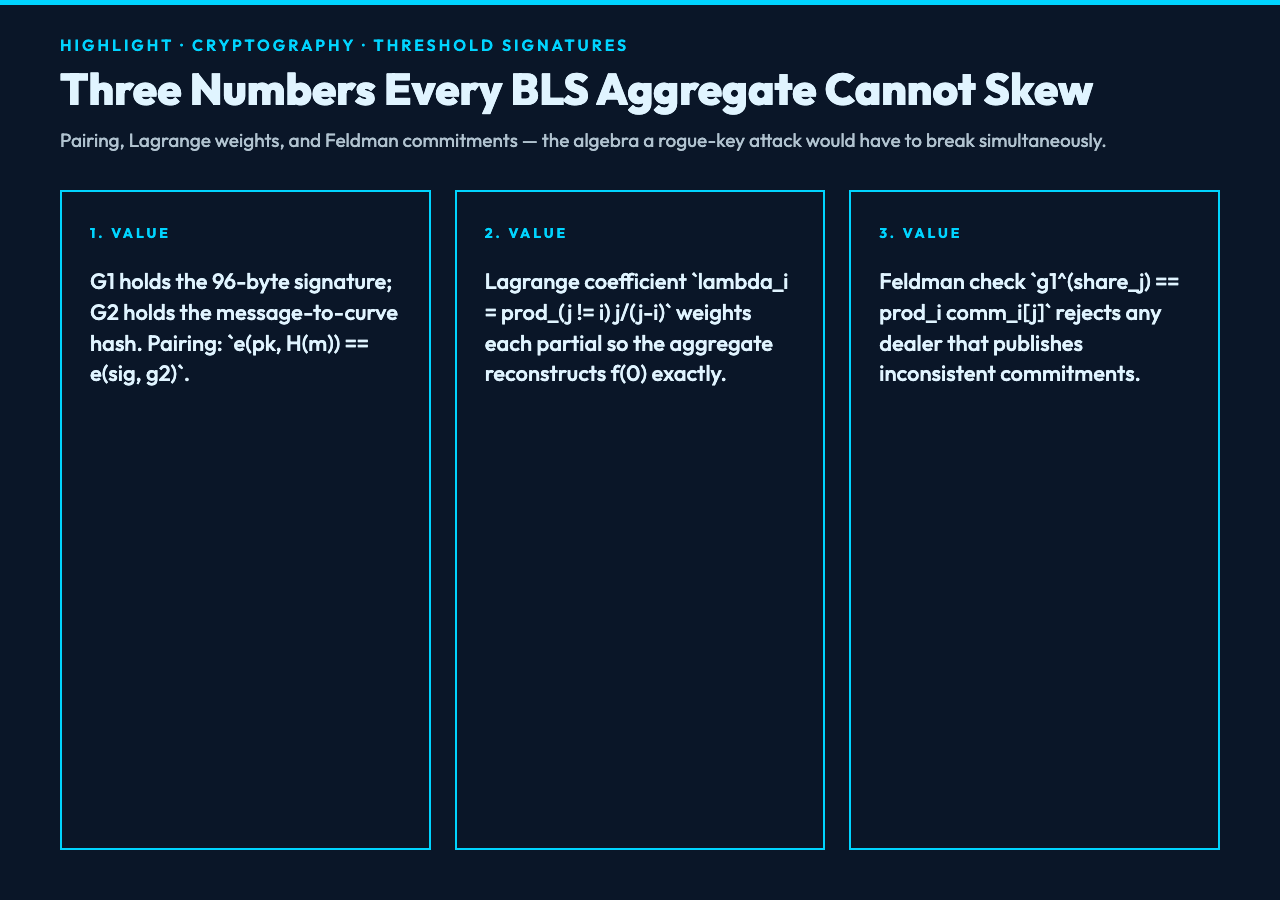
The reason a 96-byte aggregate can replace 96 individual signatures is the bilinearity of the pairing: (as1 + bs2) is a valid aggregate of two partials with the same message hash. That algebraic closure is the foundation for everything below.
One Signing Ceremony or n-of-n Honest Participants
The naive case is signing with a known group secret. All n participants already share sk, so each signer produces sig_i = sk H(m) and the aggregator sums them to (n sk) H(m). Verify against the group public key pk = sk g1. This works, but shipping sk to every participant is the security failure mode – one compromised machine leaks the whole signing key.
That is exactly why every threshold signature protocol exists. The simulator drops this section visually because there is nothing to show: the same-sk case is the one you do not want to deploy.
Why a t-of-n Threshold Needs a DKG
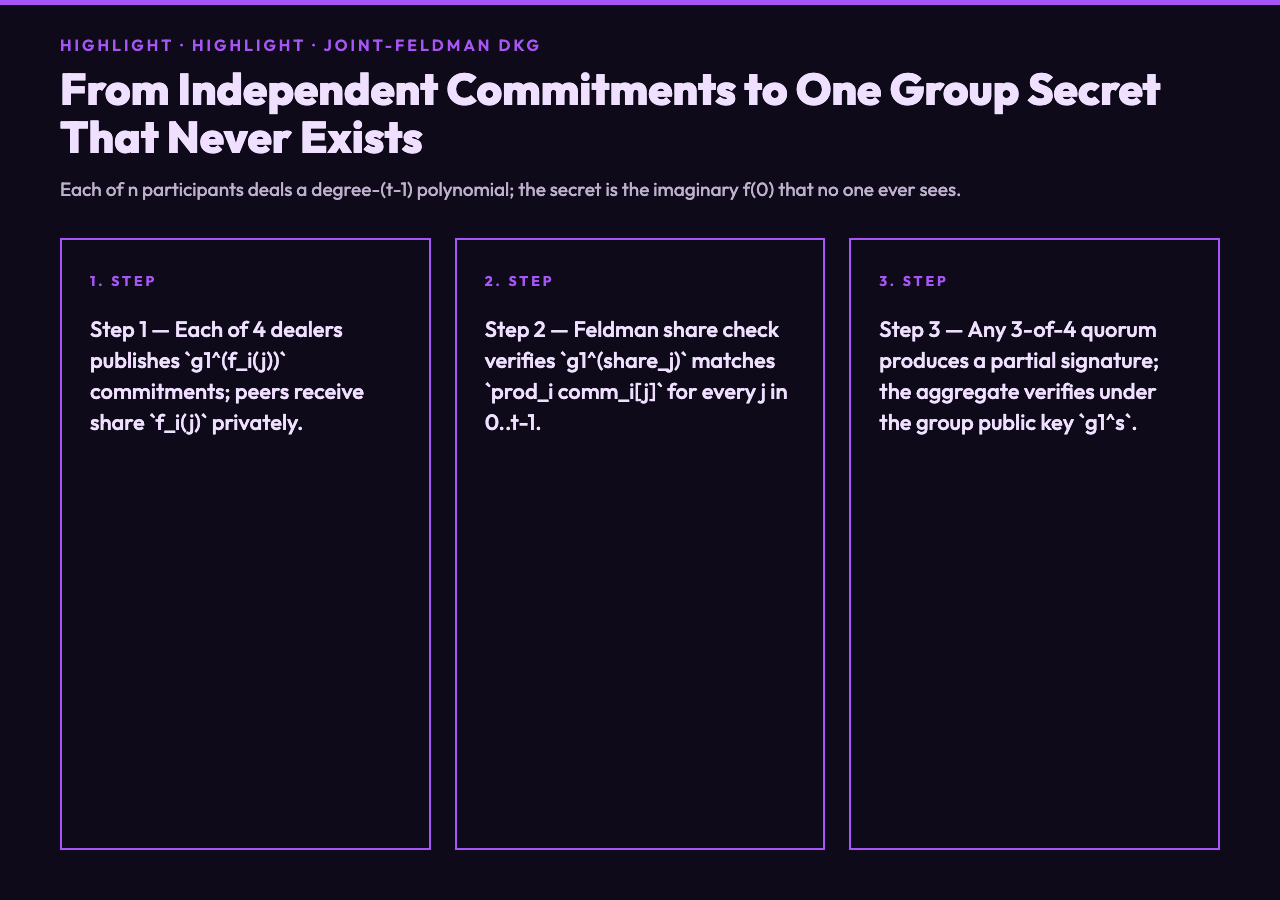
Before any signing can happen without anyone holding the whole secret, the group secret has to be created in a distributed fashion. Joint-Feldman DKG (DFK-pedersen variant in the simulator’s t-of-n path) lets each of n participants deal a random polynomial f_i(x) of degree t-1, publish commitments g1^(f_i(j)) for j = 0..t-1, and hand each peer its share f_i(j). After the ceremony every participant holds a share_j that equals the sum of all f_i(j), and the group secret s is the imaginary sum_i f_i(0) that no one has ever seen – it exists only as the discrete log of the group public key g1^s.
The Feldman share check is the line you will see most often: g1^(share_j) == prod_i comm_i[j]. If this fails for any i, the simulator returns an honest-dealer-vs-discard branch and the entire ceremony is rerun. Optional Pedersen hiding commitments (g1^(f_i(j)) AND g2^(f'_i(j)) for a second blinding polynomial) close the subliminal-channel attack on Feldman alone.
From Two to N: How a DKG Ceremony Stays Honest
After the ceremony the simulator exposes the 3-of-4 Joint-Feldman DKG scenario. Four committee members each deal a degree-2 polynomial over the real BLS12-381 scalar field. Every Feldman share check passes (g1^(f_j(i)) matches the published commitments), the group public key equals g1 raised to the never-materialized group secret, and any 3 signers – here participants 1, 2, 3 – produce partial signatures whose Lagrange-combined Sigma lambda_i s_i reconstructs f(0) exactly. A 2-signer forgery is rejected, and a different 3-of-4 quorum yields the identical aggregate signature – the simulator prints both to show the same-message same-key invariant in action.
This is why DKG ceremonies are the most expensive part of the lifecycle. After the ceremony, signing is cheap – usually two pairings per aggregate regardless of t.
Threshold Signing: Lagrange Interpolation as the Actual Math
When signers 1, 3, 4 want to produce a 3-of-4 aggregate, they each compute partial_i = sk_i H(m) and the aggregator applies the Lagrange coefficient lambda_i = prod_(j != i, j in Q) (j / (j - i)) to weight each partial. The aggregate is Sigma lambda_i partial_i and verifies under the group public key. Bumping any one signer out of the quorum and re-running produces a different* aggregate with different Lagrange weights, even though the same key signs the same message – that is exactly the property an aggregate should NOT have if you want block-proposer verifiability, but it is what the protocol guarantees.
The simulator precomputes the Lagrange coefficients and prints them alongside the partials, which is the part most implementations hide in a library.
The 96-Byte Aggregate Signature Behind Every Beacon Vote
Ethereum 2 validator committees often run 128 or 256 signers on the same attestation. The aggregate signature is still 96 bytes – a single G1 element – but the verification equation becomes e(pk_agg, H(m)) == e(sig, g2), and the fast aggregate verification trick e(prod pk_i, H(m)) == e(prod sig_i, g2) reduces 128 pairings to 2. The simulator’s same-message attestation aggregation scenario exposes both verify paths and times them on a real BLS12-381 implementation.
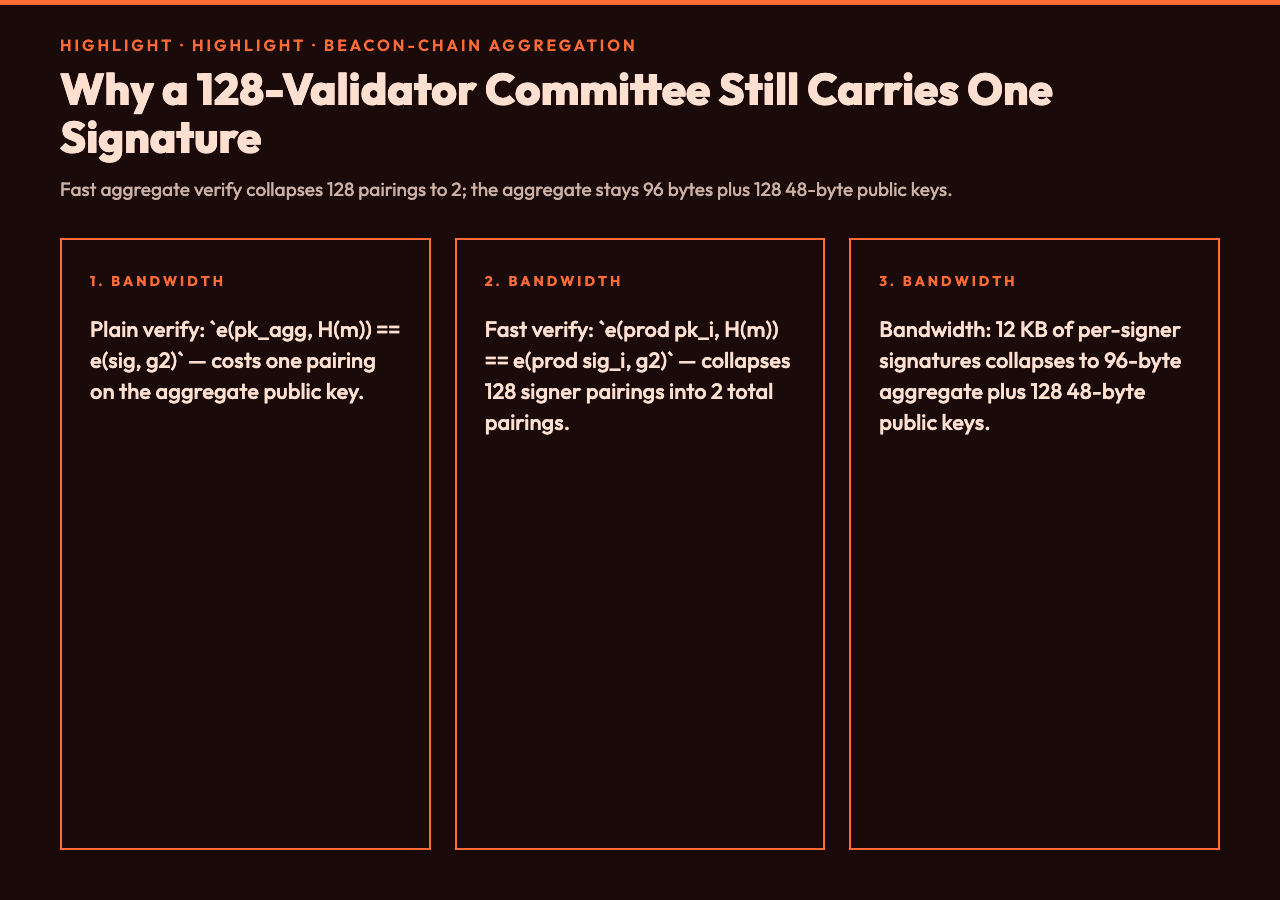
Without aggregation a 128-validator block would carry 12 KB of signature data. With BLS aggregation it carries 96 bytes plus 128 48-byte public keys. That ratio is why BLS survived the post-quantum migration debate long enough to anchor most of the active staking ecosystem.
The Rogue-Key Attack and the Proof-of-Possession Defense
If the simulator’s rogue-key branch is enabled, you can watch an attacker register pk_evil = pk_target - sk_attacker g1 without ever learning sk_target. The naive aggregate pk_evil + pk_target = sk_attacker g1 then signs whatever the attacker wants on behalf of pk_target. The Ethereum 1.x audit and the academic literature both treat this as the single most catastrophic plain-BLS failure.
The defense is proof of possession (PoP): every public key ships with a BLS signature pop = sk * H("BLS_POP_CHALLENGE"), and verification rejects any key whose PoP does not verify under itself. The simulator’s PoP defense sub-tab reproduces the attack and its fix side-by-side so you can confirm the PoP enforcement closes both vectors.
Where to Try the Full BLS Lifecycle Yourself
Open the BLS Threshold + DKG simulator to run the four core scenarios – Joint-Feldman DKG, threshold signing, rogue-key attack + PoP defense, and same-message attestation aggregation – on real BLS12-381 arithmetic. The browser tab is faster than running a Python notebook and prints the same Lagrange coefficients and Feldman checks you would derive by hand. For more pairing-based primitives, browse all Elysia Tools cryptography entries or the full tool directory.
