
Most titration errors start with a unit the order and the pump do not share. A resident writes “dopamine 5 mcg/kg/min” and the pump asks for “mL/hr” — those are two different things connected by a single arithmetic chain that has three places to silently break: the dose unit (mcg/kg/min vs mg/kg/hr vs units/kg/hr), the concentration (mg/mL vs mcg/mL vs units/mL), and the patient’s weight in kg. Miss any of the three and the pump runs at the right number for the wrong drug. The Medication Dose/Rate Calculator takes the four inputs every titrated infusion needs — drug, total volume, dose or rate, and weight — and returns the matching pump setting with the unit conversion made explicit. It runs in the browser, does no network calls, and treats the two most-asked questions as halves: high-alert infusions where two clinicians must agree on the number before the pump starts.
The arithmetic behind every weight-based infusion has exactly four pieces, in this order — concentration, hourly dose, weight multiplier, and pump rate. Get them in the wrong order and the answer is off by 60, or 1000, or both. Working through them in the right order is the only reliable way to spot the unit that quietly broke.
The four numbers behind every weight-based infusion
The dose→rate direction is the one a clinician actually runs at the bedside, and it has three inputs and one computed quantity. Drug amount (mg or mcg or units) and total volume (mL) give you concentration in the natural unit for that drug — mg/mL for vasoactives, mcg/mL for opioids and midazolam, units/mL for heparin and insulin. The dose rate (mcg/kg/min, mg/kg/hr, units/kg/hr) combines with the patient weight to give the hourly drug demand. The pump rate in mL/hr is the hourly drug demand divided by the concentration.
A worked dopamine example: 400 mg in 250 mL, ordered at 5 mcg/kg/min for a 70 kg patient. Concentration is 400 / 250 = 1.6 mg/mL, which is 1600 mcg/mL after multiplying by 1000. The hourly drug demand is 5 mcg/kg/min × 70 kg × 60 min/hr = 21000 mcg/hr. Pump rate is 21000 / 1600 = 13.125 mL/hr. That is the number the pump should show, and the number two clinicians should agree on independently before the line is connected.
The rate→dose direction is what a nurse does to verify a running pump. Same concentration calculation, but you already know the pump rate in mL/hr, so you multiply by concentration to recover the delivered hourly dose. For a heparin drip at 15 mL/hr with a bag of 25000 units in 250 mL, the concentration is 100 units/mL and the delivered dose is 15 × 100 = 1500 units/hr — a flat dose, no weight required. If the order sheet says “heparin 1500 units/hr” and the pump says 15 mL/hr, those two numbers agree and the patient is getting what was ordered.
Dose unit families and the three that confuse first-time users
Three dose-unit patterns cover virtually every titrated infusion in an adult ICU, and each has its own conversion chain. Weight-based microgram-per-kilogram-per-minute is the standard for vasoactive drips (dopamine, dobutamine, norepinephrine, epinephrine), where the order is written as “5 mcg/kg/min” and titrated up or down by 1–2 mcg every few minutes against a blood-pressure target. Weight-based milligram-per-kilogram-per-hour shows up in sedation protocols (midazolam, fentanyl, dexmedetomidine) and in some pediatric antibiotic dosing where the bag concentration makes mg/kg/hr a more natural number. Flat units-per-hour is the standard for weight-independent infusions (insulin drips in DKA, some heparin protocols, vasopressin) where the order sheet lists a single rate and the weight is irrelevant to the math.
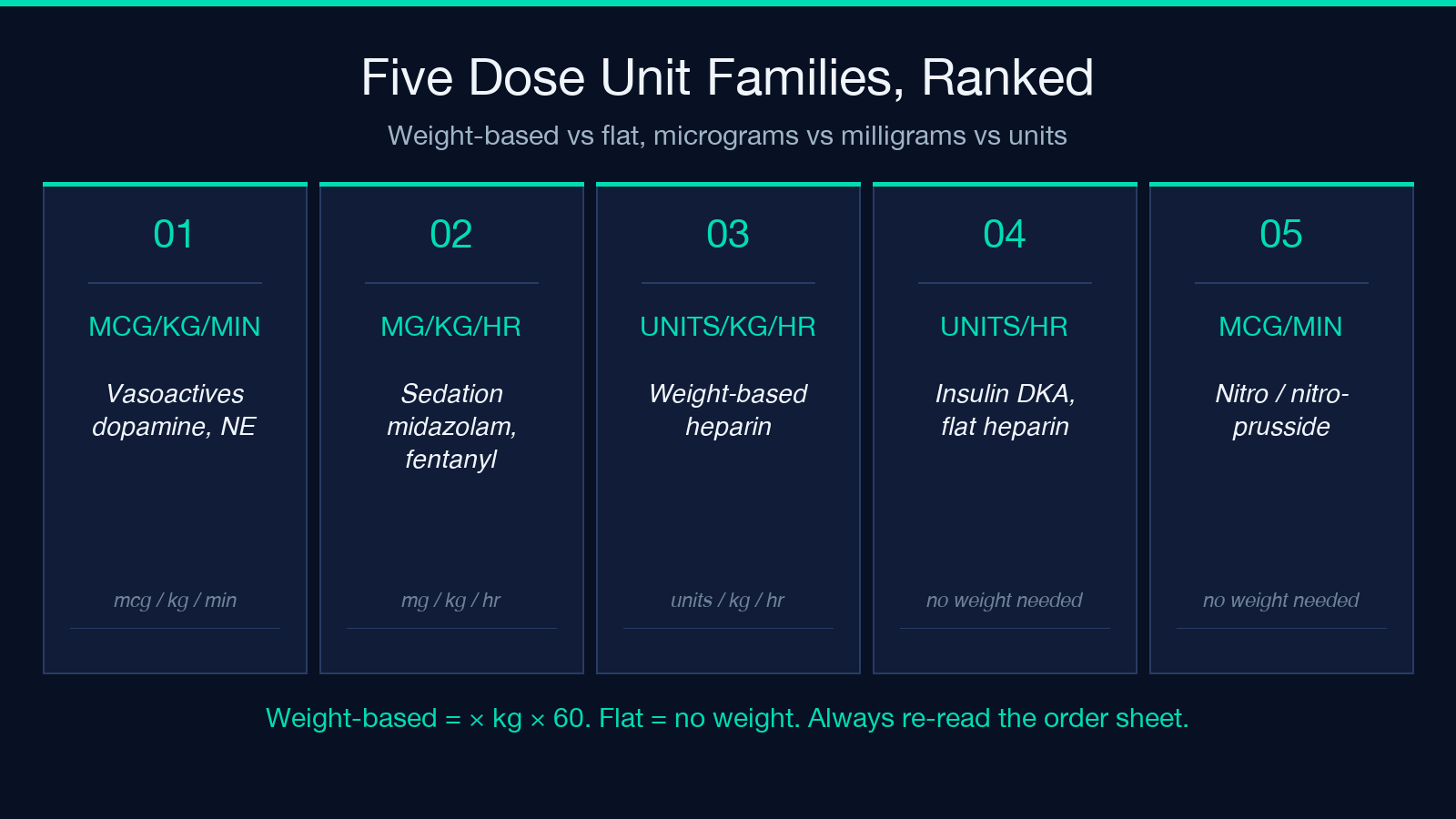
The unit-conversion mistakes that cause real harm all share a single pattern: a clinician assumes the pump concentration matches the order’s natural unit without checking. Insulin is the textbook example — a 1 unit/mL dilution lets you program “X units/hr directly” on most pumps, while a 100 units/mL dilution requires dividing by 100 to read the order correctly. The mg/mcg confusion is the ISMP-classified “high-alert” mistake: 1 mg = 1000 mcg, and writing “0.1 mg” when the bag concentration is 100 mcg/mL gives a dose 1000× too high. Every pump setting deserves a second-clinician check, and the second clinician should work the math from scratch rather than reading the first clinician’s number.
Concentration first, weight second — the chain that survives
The single most common arithmetic mistake is putting weight into the concentration step or concentration into the weight step. The correct order is always: compute concentration from drug amount and total volume; then compute hourly drug demand from the dose rate and the weight; then divide hourly demand by concentration to get pump rate. Reverse any two of those steps and the answer comes out wrong by a factor of 60, by a factor of 1000, or by a factor that does not simplify cleanly enough to be caught by eye.
A useful sanity number for vasoactive drips is roughly 0.1 to 0.2 mL/hr per mcg/kg/min per kg of patient weight for a standard 400 mg/250 mL concentration. That ratio collapses the arithmetic into a back-of-envelope check: for 5 mcg/kg/min at 70 kg, expect something close to 5 × 0.15 × 70 ≈ 52 mL/hr if your mental model of the bag is wrong. The dopamine example above (13.1 mL/hr) is the correct answer; if your calculation gives 50+ mL/hr, you have probably confused mg/mL with mcg/mL somewhere, and the pump should not start until that is resolved.
A worked example for a titrated norepinephrine drip
The most useful pattern is to run the calculation in both directions to confirm the bag concentration matches the order sheet. Standard norepinephrine is supplied as 4 mg in 250 mL, giving a concentration of 4 / 250 = 0.016 mg/mL, which is 16 mcg/mL. For a 60 kg patient ordered at 0.1 mcg/kg/min, the hourly drug demand is 0.1 × 60 × 60 = 360 mcg/hr, and the pump rate is 360 / 16 = 22.5 mL/hr. That is a typical starting norepinephrine drip for septic shock.
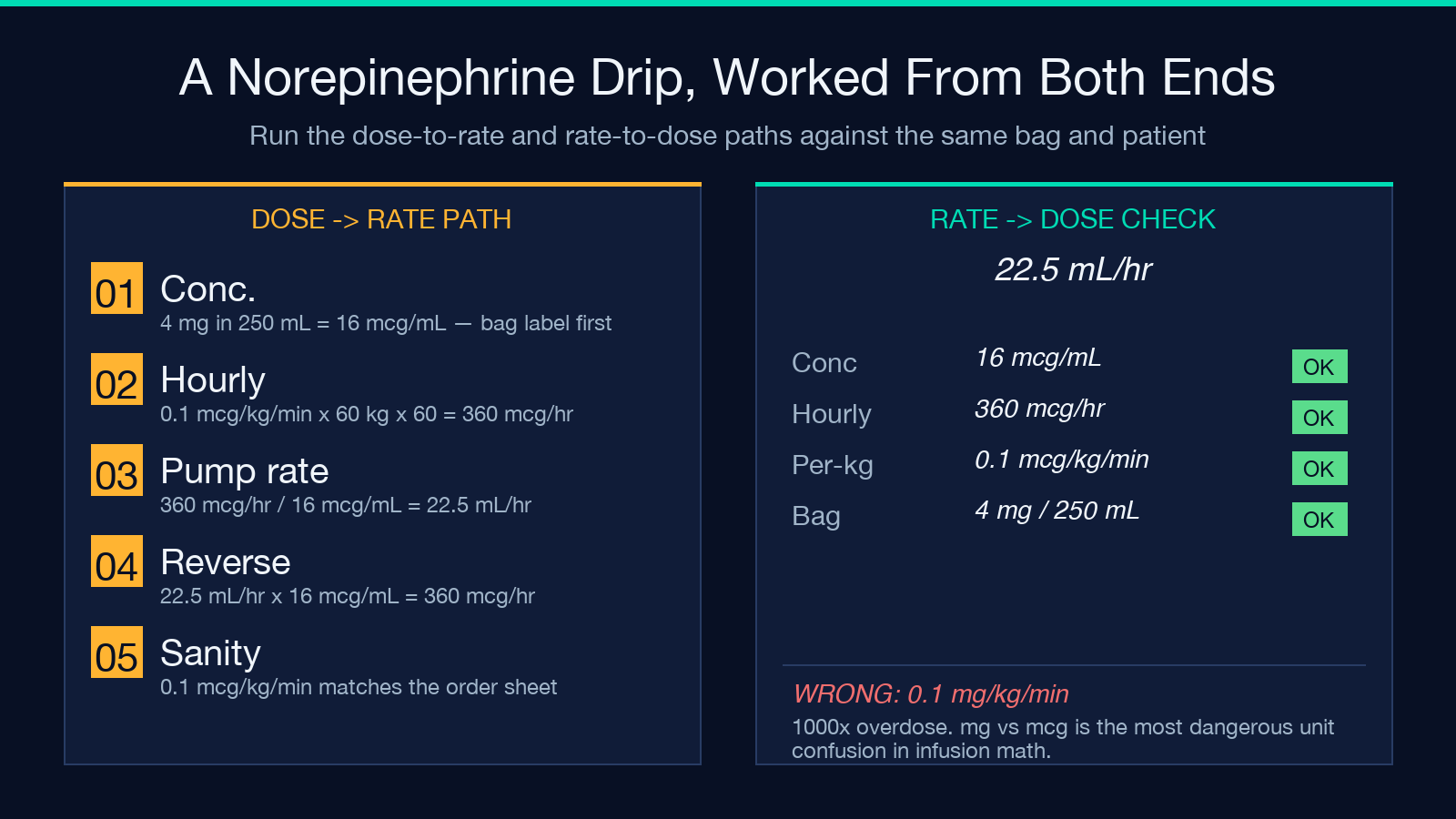
The reverse check is what you do to verify a running pump. If the pump is delivering 22.5 mL/hr against a bag with 16 mcg/mL, the patient is getting 22.5 × 16 = 360 mcg/hr, which at 60 kg works out to 360 / 60 / 60 = 0.1 mcg/kg/min. The order says 0.1 mcg/kg/min and the pump delivers 0.1 mcg/kg/min. Both clinicians agree. The line can be connected.
The two answers should match within rounding; if they do not, one of the three inputs (bag strength, patient weight, or pump rate) is wrong, and that needs to be resolved at the bedside before any titration. The 60-multiplier and the 1000-multiplier are the two conversion factors that hide inside these calculations — between mcg and mg, between minutes and hours — and missing either one moves the answer by a clinically dangerous factor.
Weight-based vs flat dosing — when weight does not matter
For weight-based infusions (mcg/kg/min, mg/kg/hr, units/kg/hr), the weight is a non-negotiable input — a 25 percent weight error produces a 25 percent dose error, which for vasoactives can mean the difference between a therapeutic blood pressure and a hypertensive crisis. The patient’s weight should be in kg (not pounds), and ideally should be a measured or estimated weight rather than a “guess” weight from a triage note. The ISMP guidance and the Royal Marsden Manual both flag weight as the most common source of infusion errors, ahead of bag strength and pump programming.
For flat dosing (units/hr for insulin, units/hr for some heparin protocols, mcg/min for nitroglycerin and nitroprusside), the weight is not required — the math is rate × concentration. The mistake here is using a weight-based order sheet for a flat infusion or vice versa. Some hospital protocols write “heparin 18 units/kg/hr” while the pump has been programmed for “1000 units/hr” — the nurse reads the order sheet and adjusts the pump down by a factor of 60× weight, leading to underdosing. Always read the order sheet’s units before reading the pump speed; if they do not match, the order sheet wins.
Pediatric weight-based dosing — when the answers change by a factor of 10
Pediatric weight-based infusions add a second layer of difficulty: the patient’s weight is smaller, so rounding errors are larger, and the bag concentrations are usually more dilute (to allow fine-grained pump programming at low flow rates). A 0.5 kg premature neonate on dopamine at 5 mcg/kg/min needs roughly 5 × 0.5 × 60 / concentration mcg/hr — which, for a 200 mg/250 mL standard pediatric bag (800 mcg/mL), works out to 0.1875 mL/hr. That is below the resolution of most general-purpose syringe pumps, which is why pediatric vasoactive drips typically use syringe pumps with 1 mL/hr minimum step resolution rather than large-volume pumps.
Pediatric and neonatal concentrations are deliberately chosen to keep the pump rate in a “readable” range — typically 1 to 20 mL/hr for a titrated drip. If the calculation gives 0.2 mL/hr, the bag is too concentrated for the patient; if it gives 200 mL/hr, the bag is too dilute. The Medication Dose/Rate Calculator handles both adult and pediatric weights on the same form, but the human sanity check at the bedside — does this number make sense for this patient? — is what catches the unit mistakes that the arithmetic cannot.
Double-clinician checks and the ISMP high-alert list
Five infusion families are on the ISMP high-alert list: insulin, heparin, vasoactives, concentrated electrolytes, and opioids. Every one of those families requires an independent double-check by two licensed clinicians at the bedside before the pump starts, and every one of those families has a documented history of fatal errors from unit confusion. The arithmetic here is not the safety net — the arithmetic is what both clinicians should be able to redo from scratch and arrive at the same number. If they cannot, the inputs (bag strength, weight, order sheet units) need to be re-verified before the pump is touched.
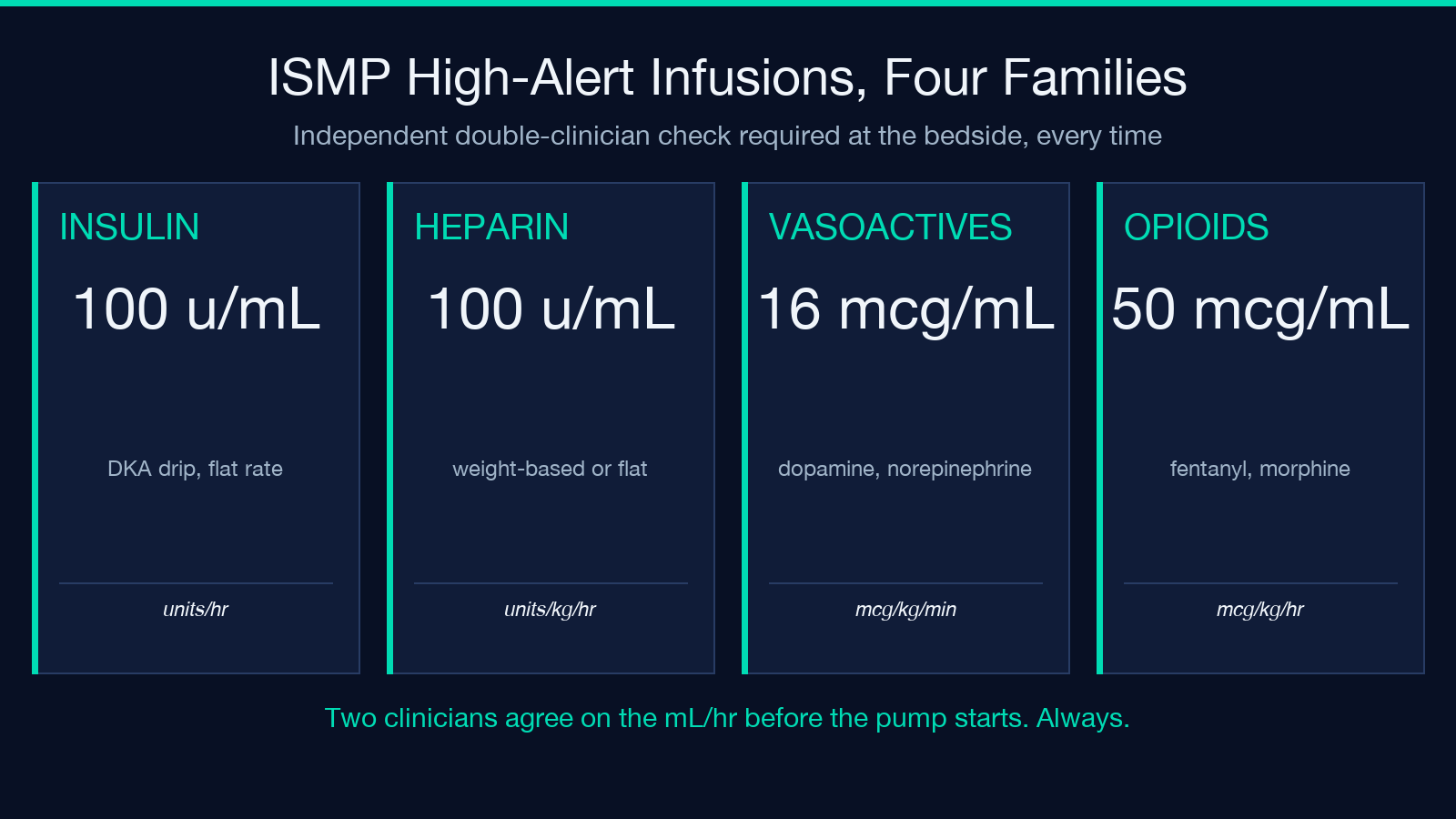
The practical workflow: clinician A computes the pump rate from the order sheet, bag label, and patient weight; clinician B does the same computation independently; both arrive at the same mL/hr; the pump is programmed to that mL/hr; the line is connected; the pump rate is verified against the order sheet at every shift change. The calculator does the arithmetic, but the second pair of eyes on the inputs is what the safety literature actually recommends. Any discrepancy between the two independent calculations is a sign that one of the three input families is wrong, and that is information the bedside clinician needs before titrating.
Where the calculator fits in a clinical workflow
It is not a replacement for the smart-pump dose-error-reduction software that sits in front of every modern infusion device, nor is it a substitute for the pharmacy-prepared standard-concentration syringes that are the single biggest patient-safety intervention in modern critical care. It is the layer that lets a clinician work the arithmetic once, on paper or on screen, before touching the pump — and the layer that lets a second clinician verify the first clinician’s work without having to redo every conversion factor mentally. It runs in the browser, does no network calls, and treats the patient weight as a single input field.
The output — pump rate in mL/hr, hourly drug demand, and concentration in natural units — feeds into the order sheet, the pump programming screen, and the shift-handover summary unchanged. Drop the JSON output into an EHR note and you have a documented audit trail for the dose verification. For adjacent tasks in the same Health category — a body-surface-area calculation for chemotherapy or burn dosing via Dose by Body Surface Area Calculator, a unit conversion for total-drug-delivered via Antibiotic Working Concentration (C₁V₁ = C₂V₂), or a creatinine-clearance estimate for renally cleared infusions via Creatinine Clearance Calculator (Cockcroft-Gault) — the umbrella’s browse all tools page groups the rest. The Medication Dose/Rate Calculator is the right tool when the work is “I have an order, a bag, and a patient, and I need the pump setting” and the wrong tool when the work drifts toward pharmacology, pharmacokinetics, or renal-adjusted dosing. Use it accordingly.
This article is for clinician workflow reference. The calculator does not provide medical advice, and any infusion decision should be made in conjunction with the institutional pharmacy, the order sheet, and a second licensed clinician at the bedside.
