
# Stop Guessing When Golden Hour Is — Free Tools Do the Math for You
You’re set up. Camera on tripod. Filter on lens. You came out for the golden hour — but the light is already flat, already past the window. You missed it. Again.
This happens because golden hour isn’t a fixed time. It shifts every single day, moving earlier or later by minutes depending on your latitude, your longitude, and the season. The same is true for blue hour, daylight duration, and meteor shower peaks. Guesswork will lose you the shot. Math won’t.
Four free browser-based tools calculate all of it precisely — no app, no account, no subscription.
Blue Hour Calculator — The Window That Lasts Under an Hour
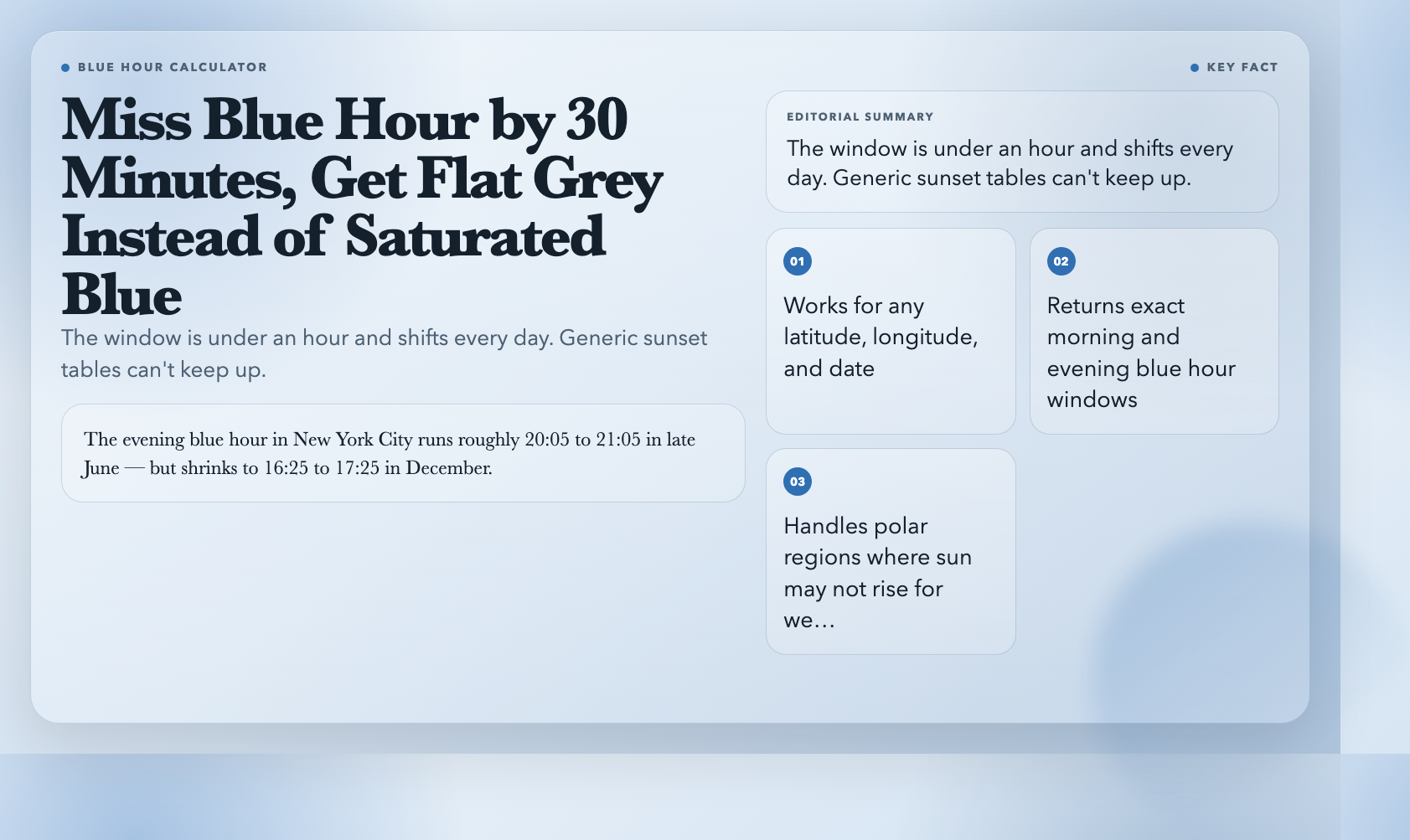
Blue hour is the brief window just before sunrise and just after sunset when the sky saturates into a deep cobalt. City lights glow against it. Architecture looks cinematic. The exposure balance between artificial lights and natural sky is nearly perfect — that’s why night cityscape photographers chase it obsessively.
The Blue Hour Calculator takes your latitude, longitude, and a date, then returns exact morning and evening blue hour windows, sunrise and sunset times, and targeted photography tips. The evening blue hour on a clear summer day in New York City, for instance, runs roughly from 20:05 to 21:05 in late June. In December, that same window compresses to around 16:25 to 17:25. Miss it by 30 minutes and you’re shooting flat grey instead of saturated blue.
The calculator handles polar regions too. In Tromsø, Norway during polar night, a generic sunset table tells you nothing useful. This tool signals that the sun genuinely doesn’t rise for weeks — so you know to pivot to other photography entirely rather than sitting disappointed at a frozen viewpoint.
Golden Hour Calculator — Warm Light, Exactly When You Need It
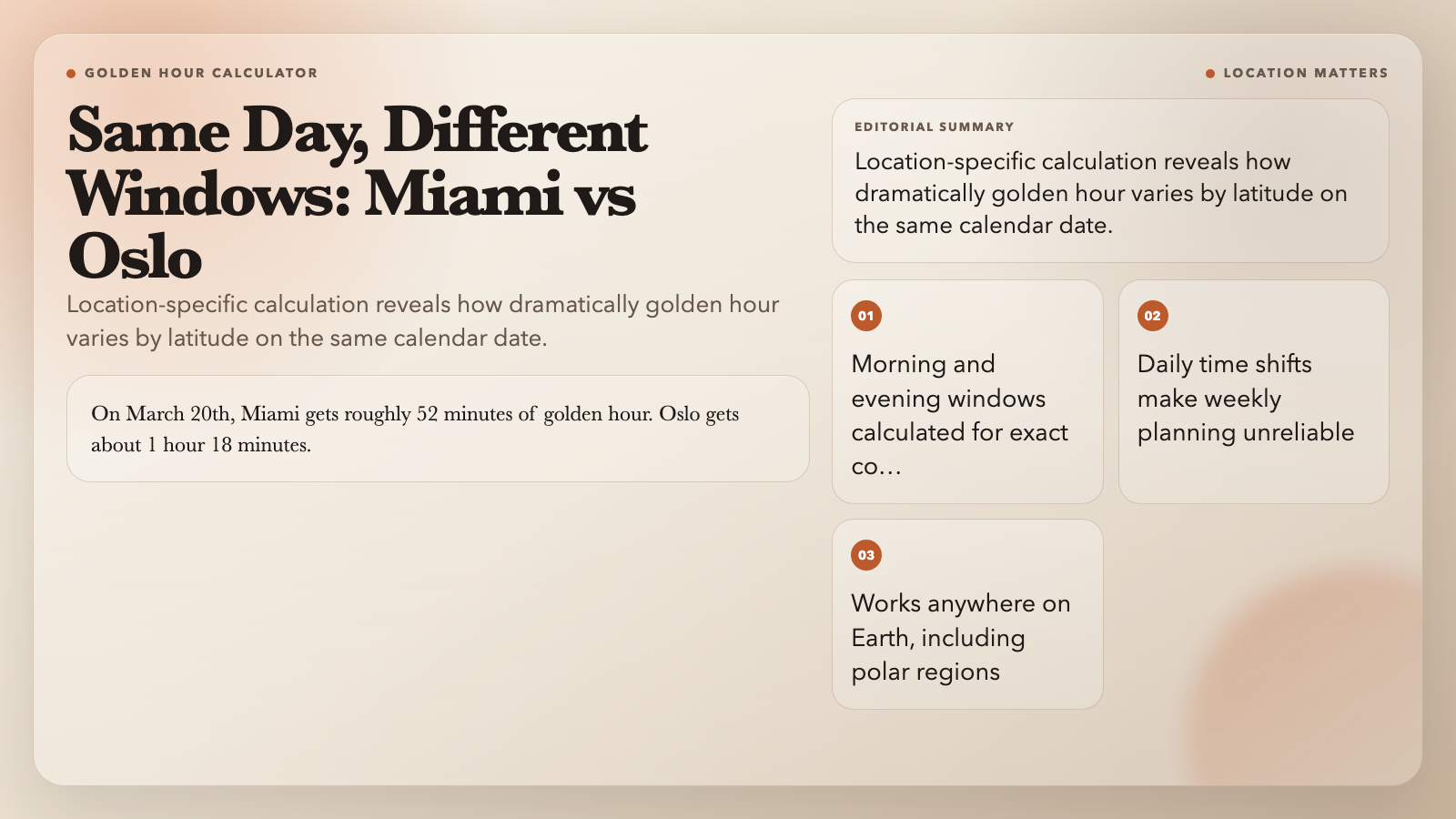
Golden hour is the period when the sun sits low enough that light travels through more atmosphere, scattering blue wavelengths and leaving warm reds and oranges. The result is directional but diffuse — flattering for skin, dimensional for landscapes, forgiving for exposure.
The Golden Hour Calculator gives you the precise morning and evening windows for your exact location and date. The difference between generic tables and location-specific calculation matters more the further north or south you are. On March 20th, the difference between golden hour duration in Miami (roughly 52 minutes) and Oslo (roughly 1 hour 18 minutes) is significant if you’re planning a shoot across time zones.
The tool also flags a practical constraint photographers learn the hard way: golden hour times change daily. A schedule that worked last week will be wrong this week. Planning a full-day shoot requires knowing when the windows open in advance — not improvising on the day.
Daylight Calculator — Plan the Whole Day, Not Just Sunrise
Portrait photographers and landscape shooters often focus on golden hour and ignore the rest of the day. That’s a mistake when you’re doing a multi-location job.
The Daylight Calculator gives you sunrise, sunset, total daylight hours and minutes, the solar declination angle, and day-of-year number for any location and date. In winter, London offers about 7 hours 43 minutes of daylight. In summer, that stretches to over 16 hours. A full-day commercial shoot in December is a very different proposition than the same shoot in June — this tool quantifies exactly how different.
It also detects polar day and polar night conditions. Photographers working in Alaska, northern Scandinavia, or Antarctica need to know when the sun simply won’t rise or won’t set, not just when the golden window opens.
Meteor Shower Predictor — The Peak Date Most Photographers Miss
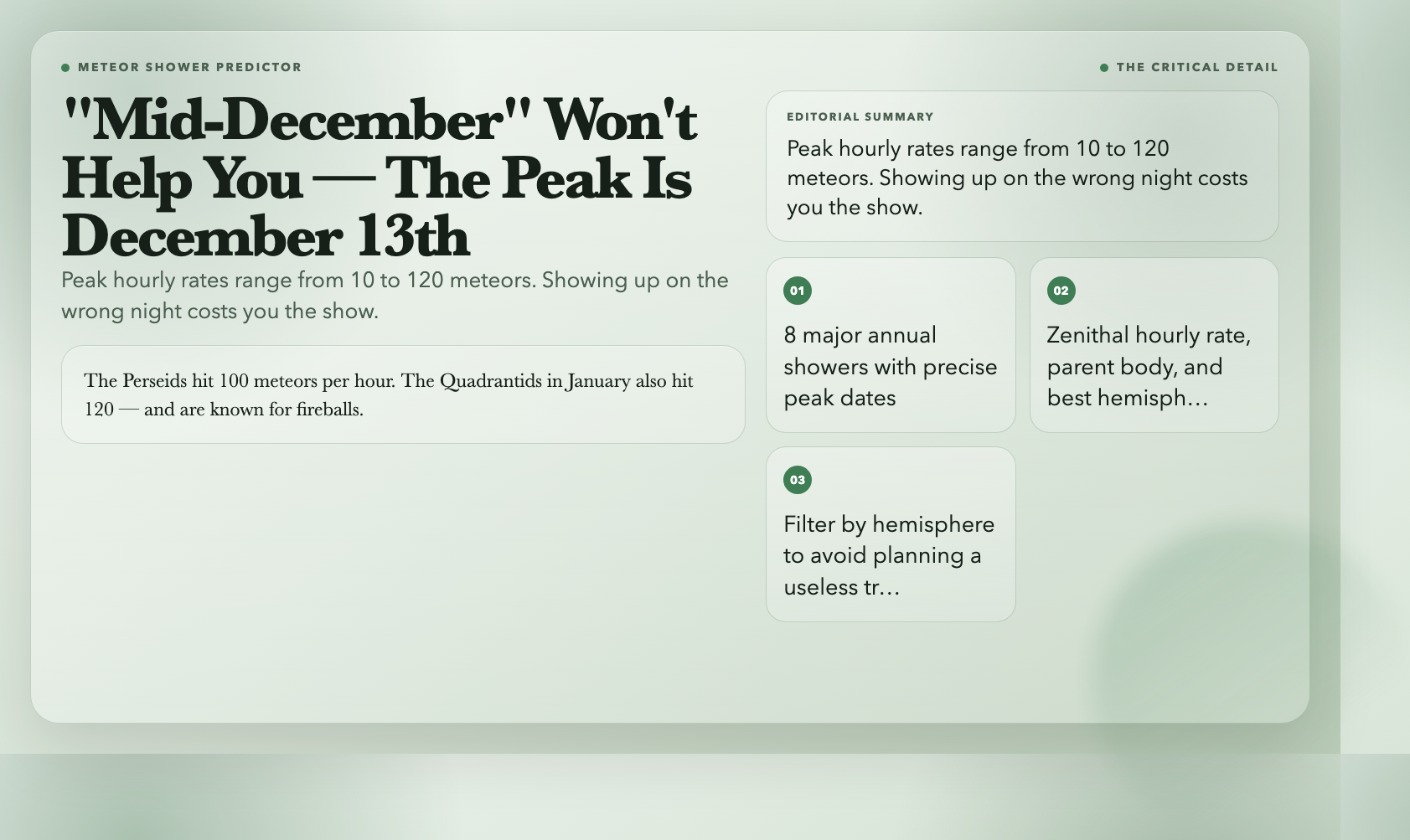
Meteor shower photography has surged in popularity, but most enthusiasts show up on the wrong night. They’re looking at “mid-December” instead of “the night of December 13th.” That distinction matters when peak hourly rates range from 10 to 120.
The Meteor Shower Predictor lists all eight major annual meteor showers with their peak dates, expected zenithal hourly rate, the parent comet or asteroid that creates each shower, and which hemisphere gets the best view. The Perseids in August hit 100 meteors per hour at peak. The Geminids in December reach 120. The Quadrantids in January — less famous but equally intense — also hit 120 and are known for producing bright fireballs.
For photographers, this data does more than satisfy curiosity. Meteor shower photography requires scouting a dark location with minimal light pollution, setting up a wide-angle lens on a sturdy tripod, and running 15-30 second exposures at high ISO. You cannot improvise that setup in one evening. Knowing the peak date weeks in advance is what makes a planned shoot possible versus a frustrated guess.
The Planning Advantage
These tools share a common philosophy: replace guesswork with precision. They’re free, run in any browser, require no login, and are part of a collection of over 1,600 free tools covering tasks from document generation to data validation.
The next time you’re planning a pre-dawn cityscape, an evening portrait session, a full-day landscape shoot, or a midnight meteor trip, spend 60 seconds running the numbers. Then show up on time — because good light doesn’t wait, but it can be predicted.



매번 감으로만 찍으러 나갔다가 골든아워를 놓쳐서 허탈할 때가 많았는데 이런 무료 계산기가 있는지 몰랐네요. 특히 지역마다 시간 차이가 크다는 점을 데이터로 확인하니 다음 출사 때는 꼭 미리 계산해보고 움직여야겠습니다.
I had no idea the difference in golden hour length between Miami and Oslo was that drastic. These calculators are going to be a lifesaver for my upcoming travel photography trip.
以前总是靠感觉去猜日落时间,结果经常错过光线最好的那几分钟。这篇文章推荐的计算器真的很实用,尤其是那个蓝色小时的精确时间,对拍城市夜景太有帮助了。