8 Free Security Tools Every Developer Needs in 2026
Every day, automated scanners sweep the internet hunting for SQL injections, unvalidated inputs, and broken access controls. They don’t discriminate between Fortune 500s and five-person startups. The difference between a near-miss and a breach is often just one unparameterized query.
You don’t need a $50,000 security suite to catch these vulnerabilities early. Here’s a set of eight free tools that cover the most dangerous attack vectors developers face — and all of them work right now, no signup required.
1. SQL Injection Detector
SQL injection still tops the OWASP Top 10 because it still works. One unparameterized query can hand an attacker your entire user database.
The SQL Injection Detector scans text and code for injection patterns across seven categories: boolean-based payloads (' OR '1'='1), UNION extraction, time-based blind attacks (SLEEP(5)), stacked queries, comment-based evasion, stored procedure calls (xp_cmdshell), and more.
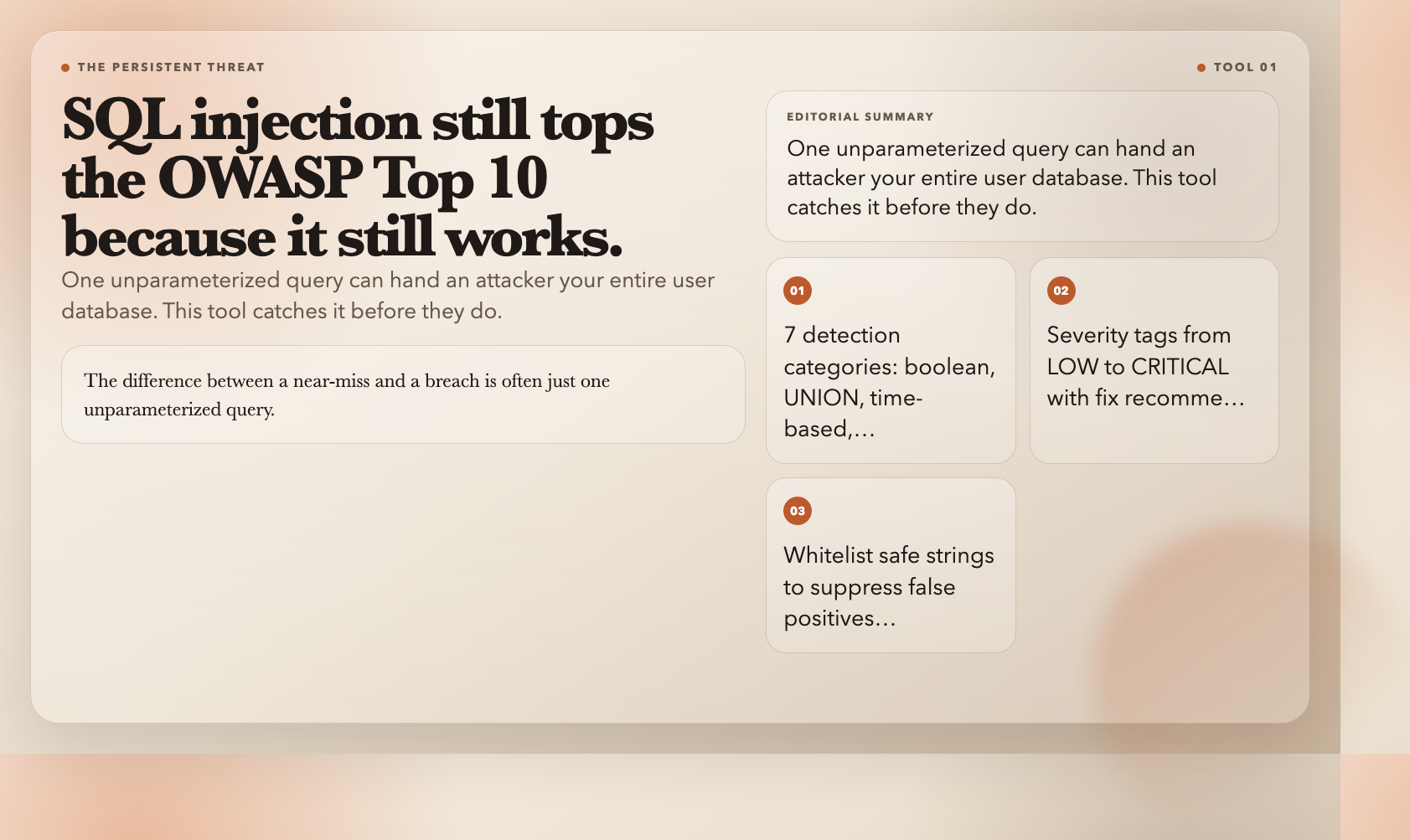
Each finding carries a severity tag (LOW through CRITICAL) plus a fix recommendation. You can whitelist safe strings to suppress false positives — useful when scanning log files or legitimate SQL snippets. Run your database-adjacent inputs through this before they reach production.
2. XSS Payload Detector
Cross-Site Scripting lets attackers inject client-side scripts that hijack sessions, steal credentials, or deface pages. Modern web apps are complex; XSS surfaces in dozens of ways.
The XSS Payload Detector catches the full spectrum: script tags, event handlers (onerror, onload), dangerous protocols (javascript:, data:), DOM manipulation calls (eval, innerHTML), SVG payloads, encoded polyglots, and CSS expression injection.
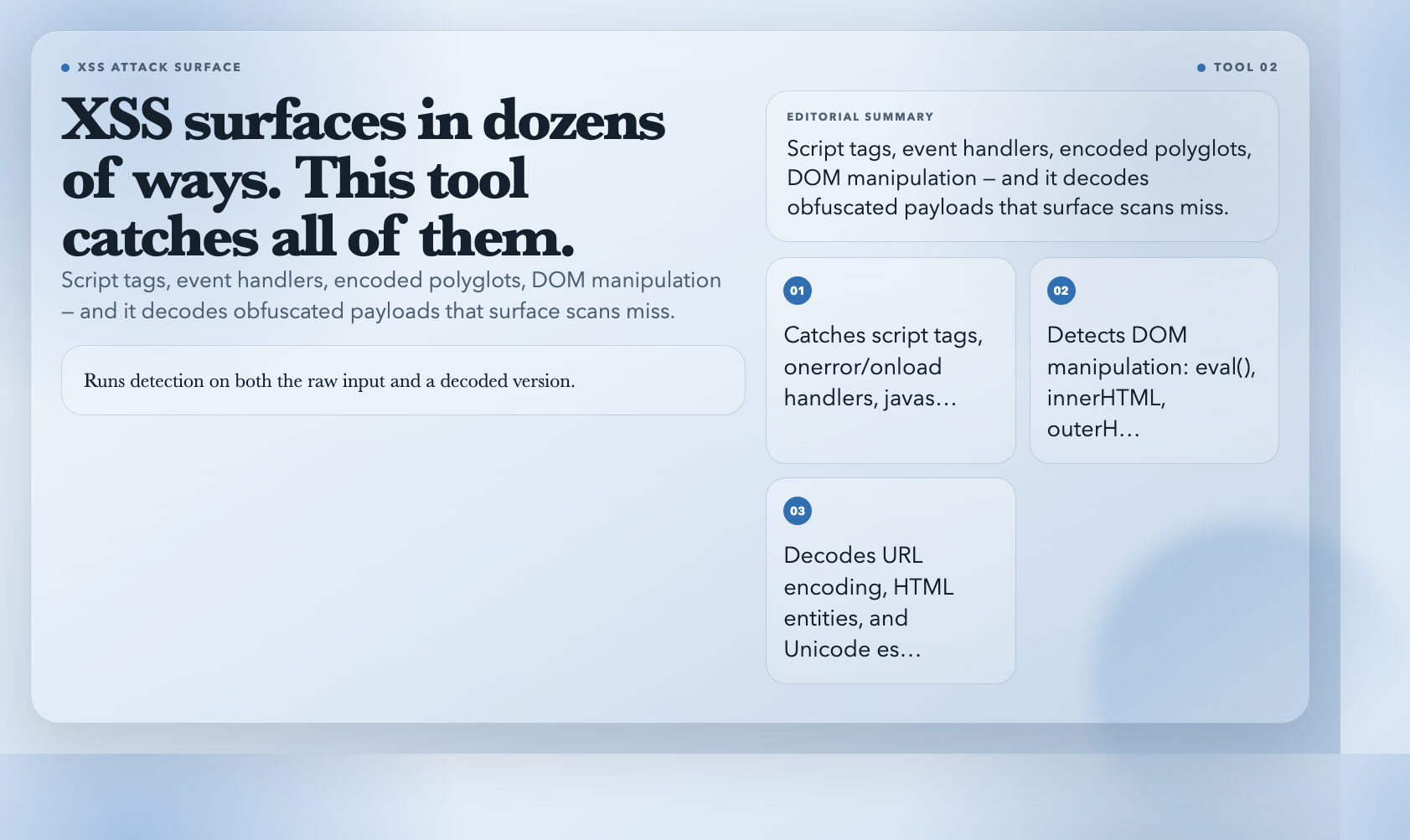
The tool runs detection on both the raw input and a decoded version, catching obfuscated attacks that bypass surface-level scans.
3. Webhook Debugger & Relay
Webhook integrations fail silently and notoriously. You can’t replay a Stripe event from your browser. You can’t inspect headers without writing curl commands. Signature verification requires custom glue code for every provider.
The Webhook Debugger & Relay gives you a real-time capture URL. Every incoming request — headers, body, timing — gets recorded and viewable in a live dashboard. Configure a relay target URL to forward inspected requests to your actual endpoint, filter by method or body content, and auto-replay matching requests.

This eliminates the “it worked in Postman” debug loop for third-party webhook integrations entirely.
4. Accessibility Checker
Accessibility gaps and security gaps often share the same root cause: developers who don’t test with diverse inputs. Missing labels, unhandled focus states, and invisible form errors create both legal liability and exploitable surface area.
The Accessibility Checker validates HTML and live URLs against WCAG 2.1 AA and AAA standards. It flags images without alt text, missing form labels, insufficient color contrast (calculated using relative luminance), empty links, and missing ARIA attributes. Color contrast analysis is particularly valuable — if users can’t read error messages, they’ll bypass controls or enter bad data.
5. Strong Password Validator
Over 80% of credential-based breaches start with weak passwords. Most password checkers just say “too weak” without explaining why or how to fix it.
The Strong Password Validator scores passwords across three dimensions — length, complexity, and character variety — and returns a 0–100 score with per-category breakdowns. It flags keyboard walks, repeated characters, dictionary words, and sequential strings. Critically, it also gives actionable suggestions rather than just rejection: “try a passphrase of four unrelated words.”
6. Credit Card Validator
If your app touches payment data, even for a moment before tokenization, you carry PCI-DSS obligations. Invalid card numbers that reach your payment processor waste API calls and generate support tickets.
The Credit Card Validator identifies card type from the first digits (BIN/IIN) and validates the Luhn checksum. Use it for real-time client-side form validation — show the card type icon as the user types, and block submission of numbers that fail the checksum before they ever hit your server.
7. IBAN & SWIFT Validator
International wire transfers are expensive and irreversible. An invalid IBAN gets rejected at the bank level; your customer loses time, you absorb fees, and someone files a support ticket.
The IBAN & SWIFT Validator validates IBAN checksums for banks across Europe and internationally, and verifies BIC/SWIFT codes for correspondent routing. It catches transposition errors and structural mistakes before they reach your payment provider. If you’re building cross-border invoicing, marketplace escrow, or payout systems, this belongs in your pre-submission pipeline.
8. Global Phone Validator
Phone-based 2FA is only as strong as your phone validation. Numbers in the wrong format get silently dropped by SMS gateways. Landlines accepting VoIP verification codes create account takeover risk.
The Global Phone Validator validates numbers against E.164 formatting for 230+ countries, detects line type (mobile, landline, VoIP), and reformats numbers to the correct local convention before they’re sent to Twilio, MessageBird, or any SMS provider. Your “send code” button stops reaching dead numbers.
Security tools are only as good as the habit of using them. These eight won’t replace a full penetration test, but they catch the most common vulnerabilities during development — when a fix takes an hour instead of a PR disaster.
Pick one. Run it on your current project today. The vulnerability you find isn’t going to appear in an attacker’s report — it only appears in yours.
Explore all eight tools and hundreds more at ElysiaTools.com.