A user types “4111 1111 1111 1111” into your checkout form. Your system processes it. It’s not a real card — it’s a test number that card networks publish publicly. But your payment processor still calls it valid. The Luhn digit is wrong, but no one checked. You’re now absorbing a failed transaction fee, and the customer is frustrated.
This is not an edge case. It’s what happens when validation is missing at exactly the point where it matters most.
The same pattern shows up everywhere: a mistyped ISBN corrupts a book catalog for three years before anyone notices; a cron expression with `0 0 * * 0` instead of `0 0 * * *` fires every Sunday instead of every day; a German EU VAT number written as 8 digits instead of 9 causes a compliance audit on a cross-border invoice. These aren’t exotic failures. They are the quiet, daily cost of treating input as trustworthy by default.
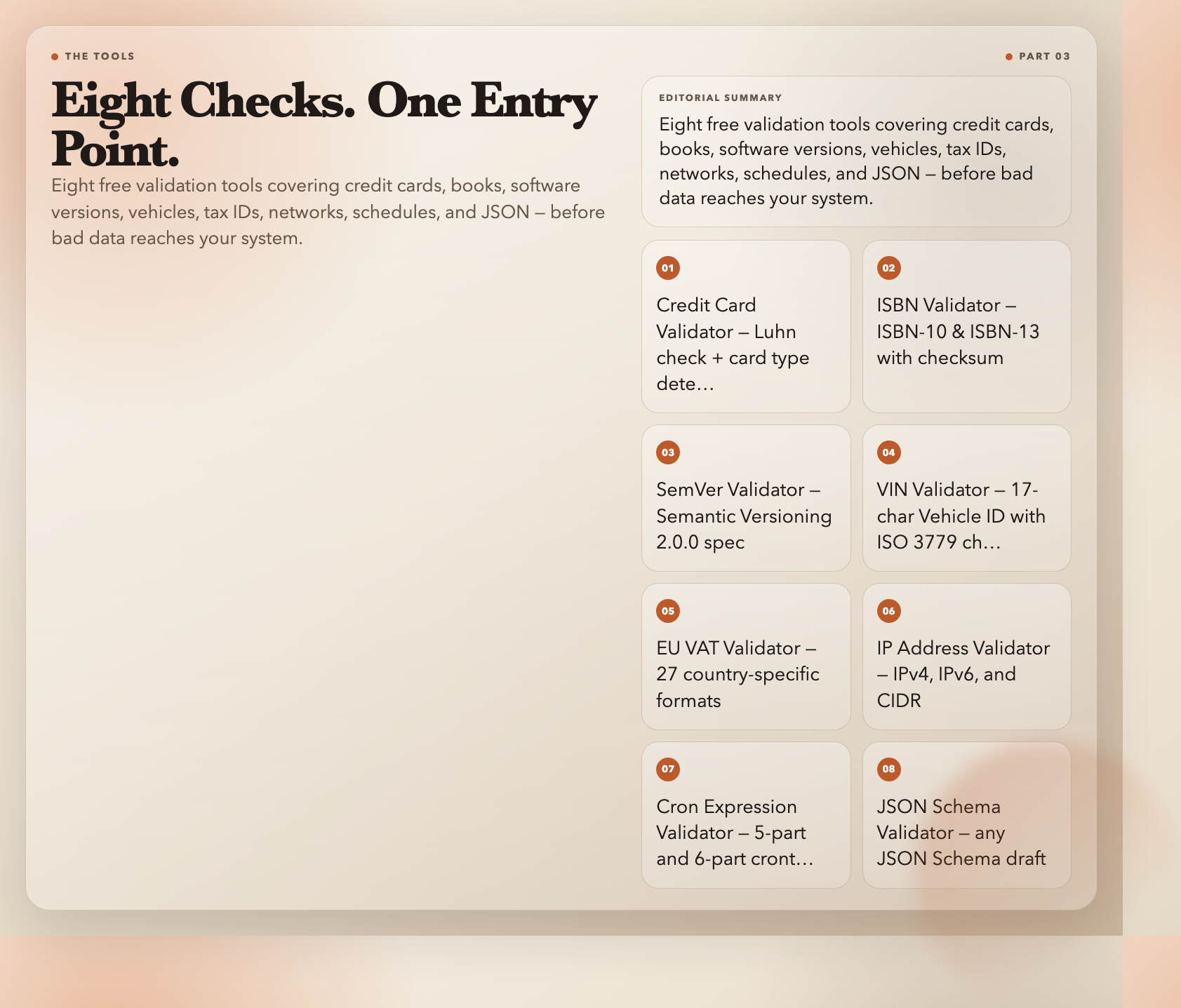
Here are eight free validation tools that flip that assumption.
—
1. Credit Card Validator
Payment forms see typos constantly. A missing digit, a swapped number — the kind of error a human eye slides past. Credit Card Validator runs the Luhn algorithm (the same checksum Visa, MasterCard, Amex, and every other major network uses) and reports instantly whether a number is structurally sound. It also identifies the card type from the IIN/BIN prefix — Visa, MasterCard, Amex, Discover, JCB, UnionPay, Diners Club, Maestro — without needing an API call.
Luhn catches random typos, not fraud. A valid Luhn number isn’t a real, authorized card. But it eliminates the large class of transcription errors that generate failed transaction fees, crashed batch jobs, and customer frustration at a broken checkout. Studies on data entry error rates in financial forms consistently show 2–4% of manually entered card numbers contain at least one digit error.
Use it when: Processing payments manually, building a checkout prototype, or auditing a database of stored card numbers.
—
2. ISBN Validator
Books have identifiers with built-in redundancy. ISBN-10 uses a 10-digit scheme where the final character is a computed check digit (X is valid for 10). ISBN-13 uses a GS1 prefix (978 or 979) followed by a computed check digit. Both formats detect single-digit errors and transposition errors — but only if you actually check.
ISBN Validator parses both formats, decomposes the identifier into its component parts (prefix, registration group, registrant, publication, and check digit), and confirms the checksum. It also auto-converts between formats: enter an ISBN-10 and it returns the ISBN-13 equivalent, and the reverse for 978-prefixed ISBN-13s. This is useful when migrating between catalog systems that expect different formats.
Use it when: Building a book marketplace, migrating a library database, or validating publisher submissions.
—
3. SemVer Validator
Semantic Versioning (SemVer 2.0.0) is the de facto standard for npm, PyPI, RubyGems, and most other package managers. The rules are precise: no leading zeros in major/minor/patch, pre-release identifiers sort lexicographically by numeric value (alpha.10 sorts after alpha.2), and build metadata is ignored for precedence. Violations are surprisingly common — developers type v1.2.3 when they mean 1.2.3, or use an underscore instead of a hyphen, or include spaces.
SemVer Validator parses any version string against the spec and reports exactly where it breaks the rules: leading zeros, invalid pre-release characters, malformed build metadata. It also extracts and labels each component. Why does this matter? Package managers, CI pipelines, and dependency resolvers all compare versions programmatically. A malformed string can silently bypass a version constraint and pull in an incompatible release without warning.
Use it when: Validating user-submitted version numbers, building a package registry, or debugging a dependency conflict.
—
4. VIN Validator
Every vehicle has a 17-character Vehicle Identification Number encoding the manufacturer (WMI), vehicle descriptors (VDS), model year, plant code, and serial number. VINs carry a checksum in position 9 per ISO 3779 — and it’s wrong on a significant fraction of used car listings, dealer databases, and auction records.
VIN Validator parses the full structure, validates the checksum, identifies the country of origin from the WMI prefix, and extracts the model year from the VIS section. It catches forbidden characters (I, O, and Q are not valid in VINs), length errors, and checksum failures that indicate a mistyped or fraudulent number.
Use it when: Building a vehicle marketplace, verifying fleet records, or processing insurance claims.
—
5. EU VAT Validator
Cross-border B2B commerce requires valid EU VAT numbers. The problem: each of the 27 member states uses a different format. Germany is 9 digits. France is 11 alphanumeric characters. The Netherlands is 9 digits, a literal “B”, then 2 more digits. Italy is 11 digits. Sweden is 12 digits. Entering the wrong format — or the right format with the wrong check digit — breaks the VAT-reverse-charge mechanism and creates a tax liability.
EU VAT Validator detects the country from the prefix, validates the format against country-specific rules, and runs checksums where applicable. It doesn’t replace a live VIES database lookup, but it catches the structural errors — wrong length, wrong character type, failed checksum — that have nothing to do with whether the number is currently registered.
Use it when: Operating an EU B2B platform, validating supplier registrations, or processing cross-border invoices.
—
6. IP Address Validator
“192.168.1.1” is valid. “192.1681.1.1” is not — but a simple regex checking for digits and dots will pass it without complaint. IP Address Validator handles IPv4, IPv6, and CIDR notation for both. For IPv4 CIDR blocks it calculates the network address, subnet mask, broadcast address, and usable host range. For IPv6 it expands the full form, compresses it back, identifies the scope (link-local, unique local, multicast, global), and distinguishes private from public addresses.
This matters in network configuration UIs, firewall rule builders, and anywhere users specify IP ranges. A misconfigured CIDR block silently includes or excludes hosts you didn’t intend.
Use it when: Validating firewall rules, building a subnet calculator, or processing network configuration files.
—
7. Cron Expression Validator
`0 0 * * *` means “every day at midnight.” `0 0 * * 0` means “every Sunday at midnight.” That single extra field — day of week — changes the entire schedule, and it’s easy to type the wrong one when you’re in a hurry. Cron is a 5-part or 6-part expression with its own logic: a `?` in one field means “no restriction” but behaves differently in the day vs. day-of-week field; ranges and lists interact in ways that aren’t obvious.
Cron Expression Validator parses crontab syntax, breaks down every field (minute, hour, day, month, day-of-week), generates a plain-English description, flags conflicting specifications, and shows the next five scheduled run times. It handles both standard 5-part cron and 6-part cron with seconds.
Use it when: Building a scheduling UI, testing a crontab entry before deployment, or debugging a job that fires at the wrong time.
Try Cron Expression Validator →
—
8. JSON Schema Validator
APIs accept JSON. Not all JSON is valid for your schema. A field that should be an integer receives a string. A required property is missing. An enum field gets a value outside the allowed list. JSON Schema Validator checks structure, data types, required fields, enum constraints, string formats, numeric ranges, and custom patterns — against any JSON Schema draft you provide.
It works without a local library or external service. Paste the schema, paste the JSON, and it returns the specific constraint that failed and the JSON path where it occurred. This is especially useful during development when you’re iterating on a schema and need to test payloads quickly.
Use it when: Building an API that accepts JSON, testing webhook handlers, or validating configuration files during deployment.
—
The Pattern Is the Point
Every tool here follows the same logic: validate before you trust. The failure modes vary — corrupted catalogs, fraud exposure, a cron job that fires on the wrong day — but the principle is universal. Bad input that looks correct costs more to fix later than it does to catch now.
The numbers back this up. Research from form analytics platforms consistently finds 2–4% of credit card entries in payment forms contain at least one digit error. Studies on data quality in enterprise databases report that 20–30% of records contain critical field-level errors within two years of entry. These aren’t edge cases. They’re the quiet baseline of unvalidated systems.
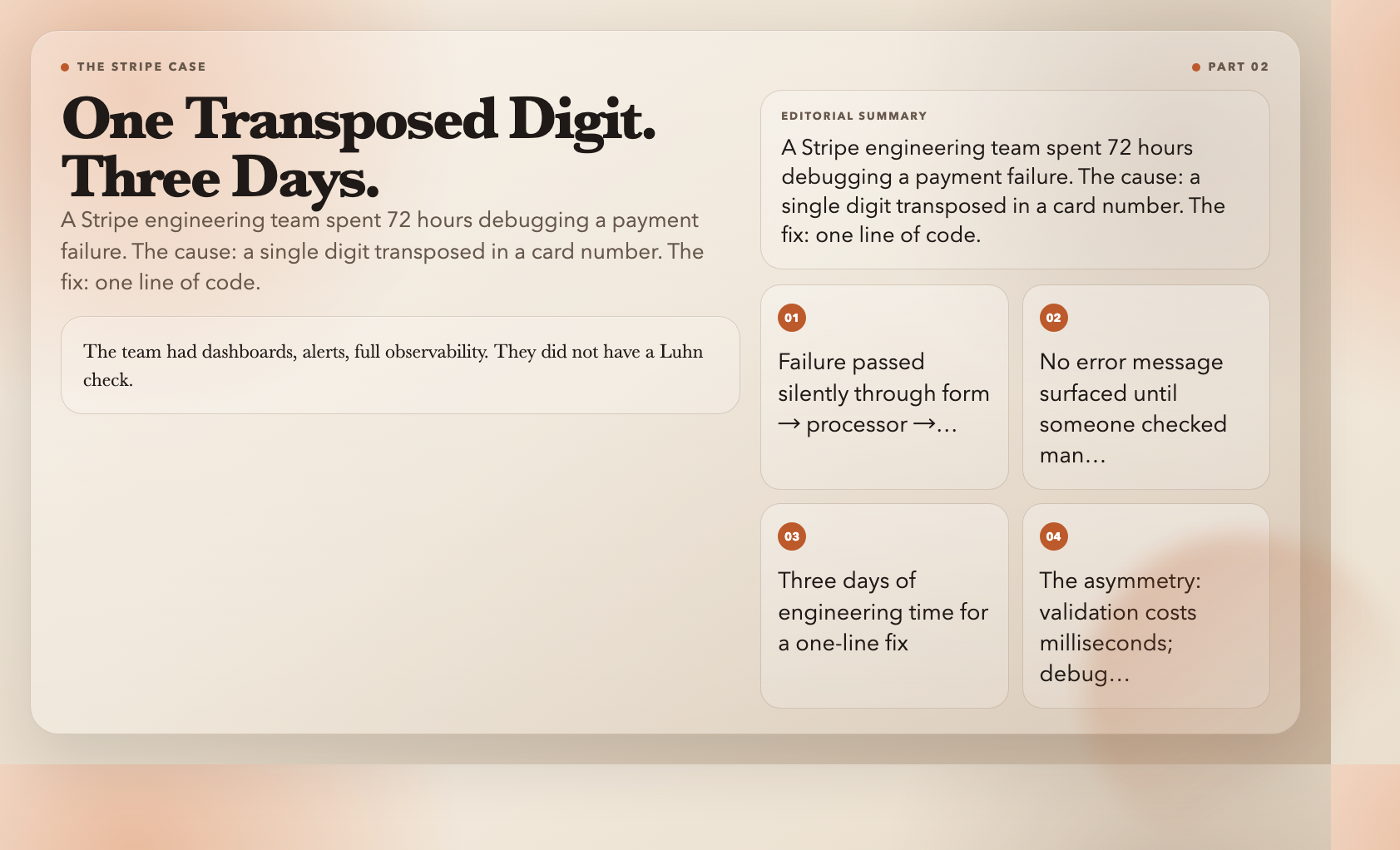
The Stripe case illustrates why it matters: a transposed digit passed through a form, through a payment processor, into a transaction log, and into a dashboard before anyone noticed. Three days of engineering time. One line of code to fix.
The check costs milliseconds. The failure it prevents costs days.
All eight tools — and 60+ more — are free at ElysiaTools.com.