# 8 Free Sports Analytics Calculators Every Athlete Needs in 2026
Your fitness tracker knows your heart rate. It has no idea what that number means for your training.
Most athletes are drowning in data and starving for insight. Points per game, average pace, weekly volume — the numbers accumulate in apps and spreadsheets, but nobody’s turning them into decisions. The problem isn’t the data. It’s the gap between raw numbers and actionable understanding — and for most people, closing that gap means paying $200/month for a premium platform or learning to code.
It doesn’t have to. A growing suite of free calculators is putting professional-grade sports analytics into the hands of athletes at every level — no subscription, no learning curve.
Here are eight worth bookmarking.
1. Basketball Stats Calculator — Know Your Real Value as a Player
The standard box score tells you points, rebounds, and assists. It doesn’t tell you whether you’re helping your team win.
The Basketball Stats Calculator on ElysiaTools goes deeper. It computes field goal percentage adjusted for three-pointers, points per game, and Player Efficiency Rating (PER) — a single number that attempts to boil a player’s overall contribution into one comparable metric.
Why it matters: PER normalizes across pace and minutes, so a 20-minute role player can be compared fairly to a 35-minute starter. This means you can actually tell whether your efficiency justifies your court time.
Use it when: you’re evaluating your own development over a season, or comparing yourself fairly against teammates in different roles.
Try the Basketball Stats Calculator →
2. Baseball Statistics Calculator — More Than Batting Average
Batting average is the most cited baseball stat and one of the least informative. A .270 hitter with a high on-base percentage and slugging average is far more valuable than a .300 hitter who only hits singles.
The Baseball Statistics Calculator computes batting average and on-base percentage (OBP), giving you a more complete picture of a player’s offensive contribution in seconds.
Why it matters: OBP answers the question that batting average ignores — how often does this player hurt his team by making an out? In modern baseball analytics, OBP is considered more valuable than batting average.
Use it when: you’re settling debates about who’s the better hitter, or building a case for MVP consideration using real math instead of vibes.
Try the Baseball Statistics Calculator →
3. One Rep Max Calculator — Stop Guessing, Start Lifting Smarter
Your one-rep max (1RM) is the most important number in any strength program. Almost nobody tests it regularly, because grinding to true max is fatiguing, risky, and burns training time that could be spent actually lifting.
The One Rep Max Calculator sidesteps this entirely. Enter a weight you’ve lifted for 5 reps, and it estimates your 1RM using the Epley or Brzycki formulas — the same equations used in collegiate strength programs.
Why it matters: Once you know your estimated 1RM, you can derive every working weight for every rep range in seconds. Run 225 lbs for 4 reps? That’s roughly a 245-lb estimated max. Program your percentages, track progression over months, and add weight only when the math says you’ve earned it — not when it “feels right,” which is how people end up stalling for years.
Use it when: you’re writing a mesocycle and need to set working weights for 3×5, 5×5, or intensity clusters — or when you want to compare your strength fairly across different rep ranges.
Try the One Rep Max Calculator →
4. Target Heart Rate Calculator — Train at the Right Intensity
Most athletes know they should train in different heart rate zones. Few know which zone they’re actually in at any given moment, because the math to translate max heart rate into meaningful percentages takes 10 minutes and nobody does it.
The Target Heart Rate Calculator automates this in seconds. Enter your age, pick a formula, and get all five standard training zones — from active recovery through VO2 max — laid out clearly.
Why it matters: Different physiological adaptations live in different zones. Zone 2 work (roughly 60–70% of max HR) builds mitochondrial density and fat oxidation capacity — the foundation of endurance. Zone 4–5 work improves lactate clearance and top-end speed. If every run “feels hard,” you’re likely overcooking Zone 2 and undertraining the aerobic base that makes everything else possible. Studies consistently show recreational athletes spend disproportionately too much time at high intensity and too little at low intensity — the reverse of what produces results.
Use it when: you’re pacing a long run, programming a cycling block, or trying to diagnose why your endurance gains have stalled.
Try the Target Heart Rate Calculator →
5. RPE Calculator — Quantify How Hard You Actually Worked
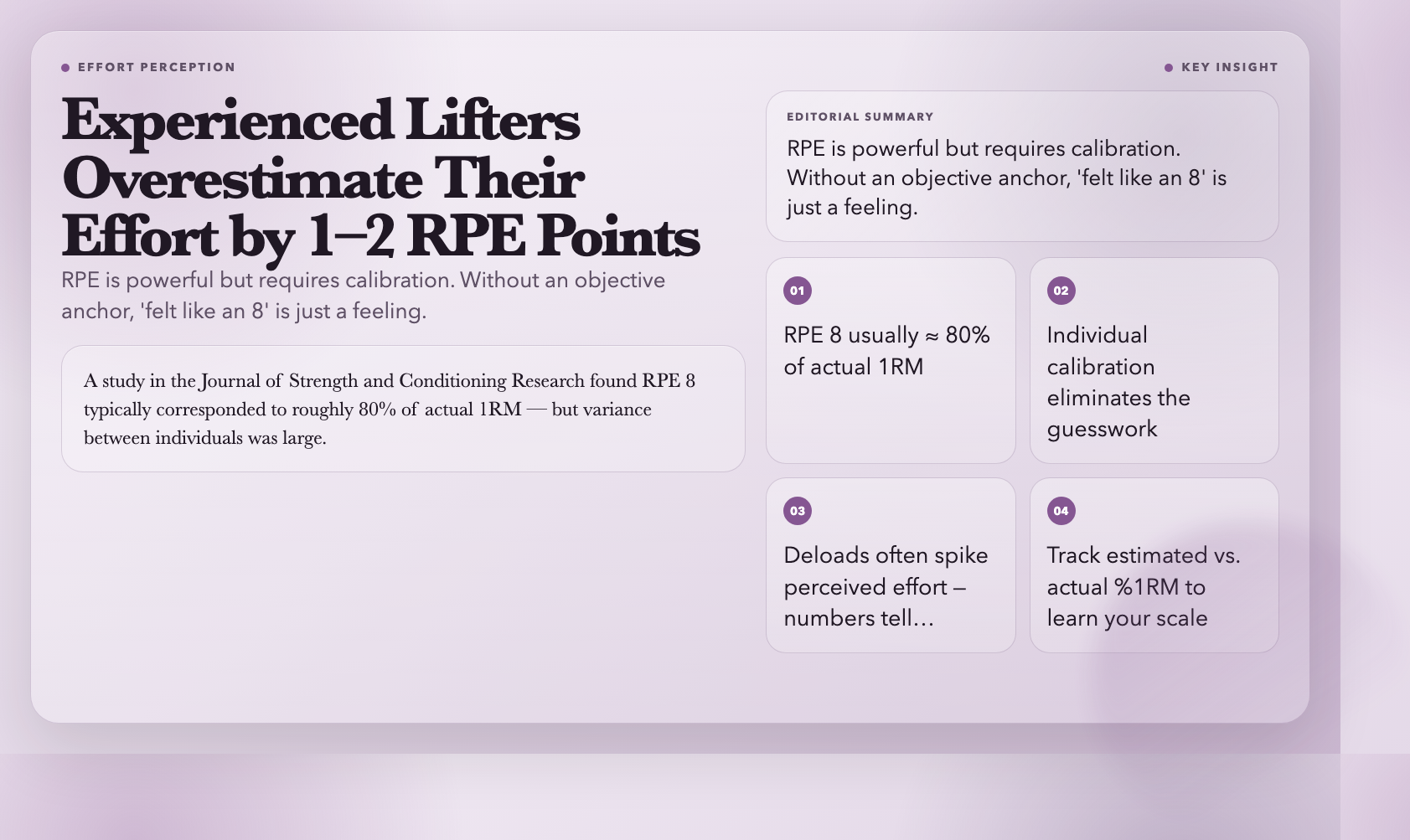
Rate of Perceived Exertion (RPE) is the athlete’s most honest effort scale — it captures fatigue, recovery state, and central nervous system load in a way that no heart rate monitor can. The problem is that “felt like an 8” is useless without a way to translate it into something objective.
The RPE Calculator does exactly that. Input your RPE and the number of reps completed, and it converts the combination into an estimated percentage of your one-rep max — giving the subjective scale a hard number to anchor against.
Why it matters: Experienced lifters consistently overestimate their effort by 1–2 RPE points. A study in the Journal of Strength and Conditioning Research found that RPE 8 typically corresponded to roughly 80% of actual 1RM — but the variance between individuals was large. The calculator lets you build your own calibration: track estimated %1RM vs. actual %1RM over time, and you’ll quickly learn whether your RPE scale is honest or inflated.
Use it when: you want to self-regulate training intensity without constant testing, or during deload weeks when perceived effort spikes and you need an objective check against it.
6. Training Load Calculator — Prevent Burnout Before It Happens
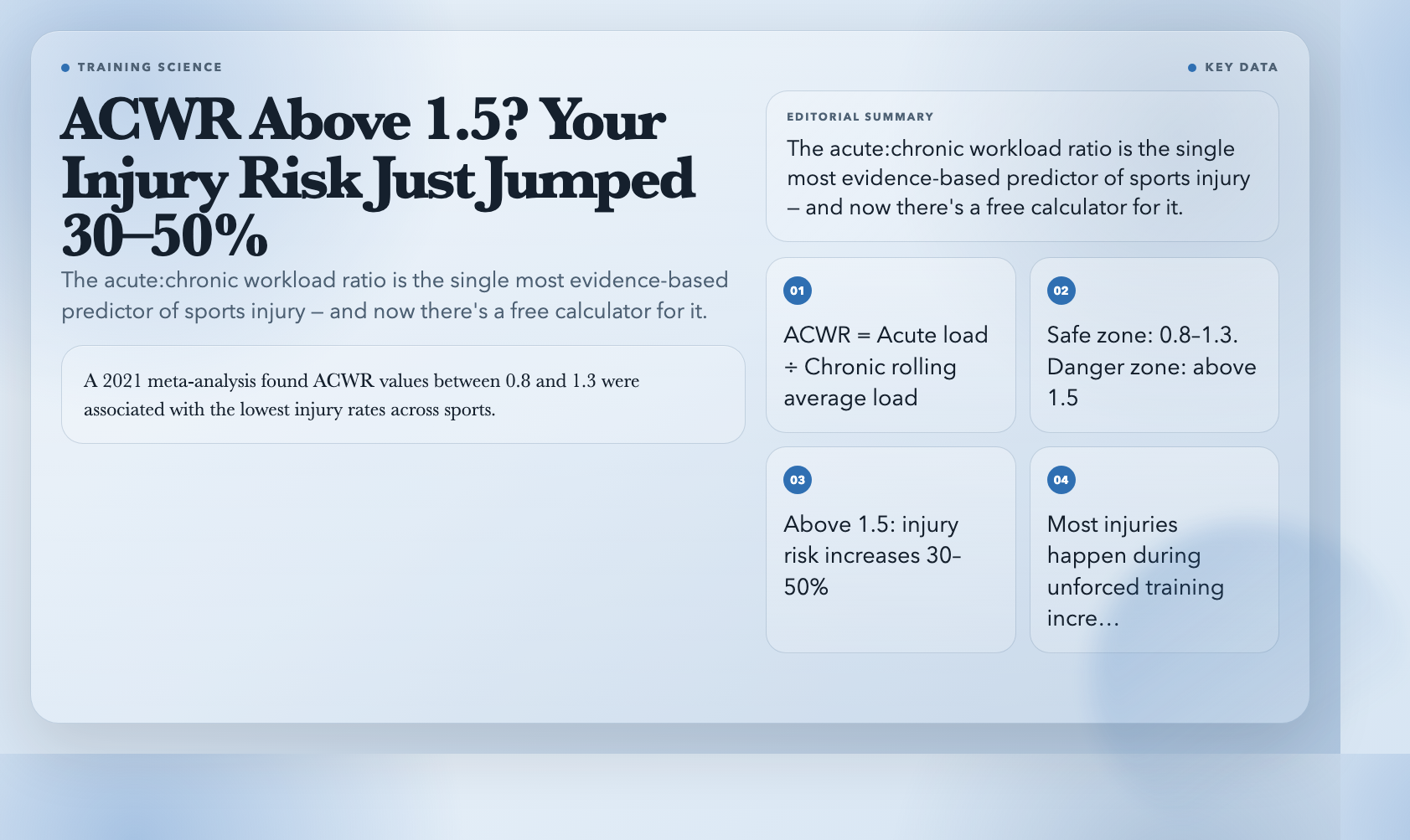
Training load is the total stress you place on your body over a given period. Too much, too fast — “load error” in sports science terms — is the single most common cause of overuse injury and burnout in endurance athletes. The acute:chronic workload ratio (ACWR) is the gold standard metric for this; it compares your recent training stress (acute) to your long-term average (chronic), and research consistently shows that athletes whose ACWR spikes above 1.5 face dramatically elevated injury risk.
The Training Load Calculator computes exactly this ratio — aggregate your session stress scores, compare them to your rolling average, and get a number that tells you whether your current block is building fitness or building toward a breakdown.
Why it matters: A 2021 meta-analysis in the British Journal of Sports Medicine found that ACWR values between 0.8 and 1.3 were associated with the lowest injury rates across sports. Above 1.5, injury risk increases by 30–50%. The calculator gives you the data to stay in the safe zone without a sports scientist on staff.
Use it when: you’re base-building and want to ensure you’re accumulating volume sustainably, or you’re returning from injury and need an objective guardrail for your comeback.
Try the Training Load Calculator →
7. VO2 Max Calculator — The Number That Predicts Performance
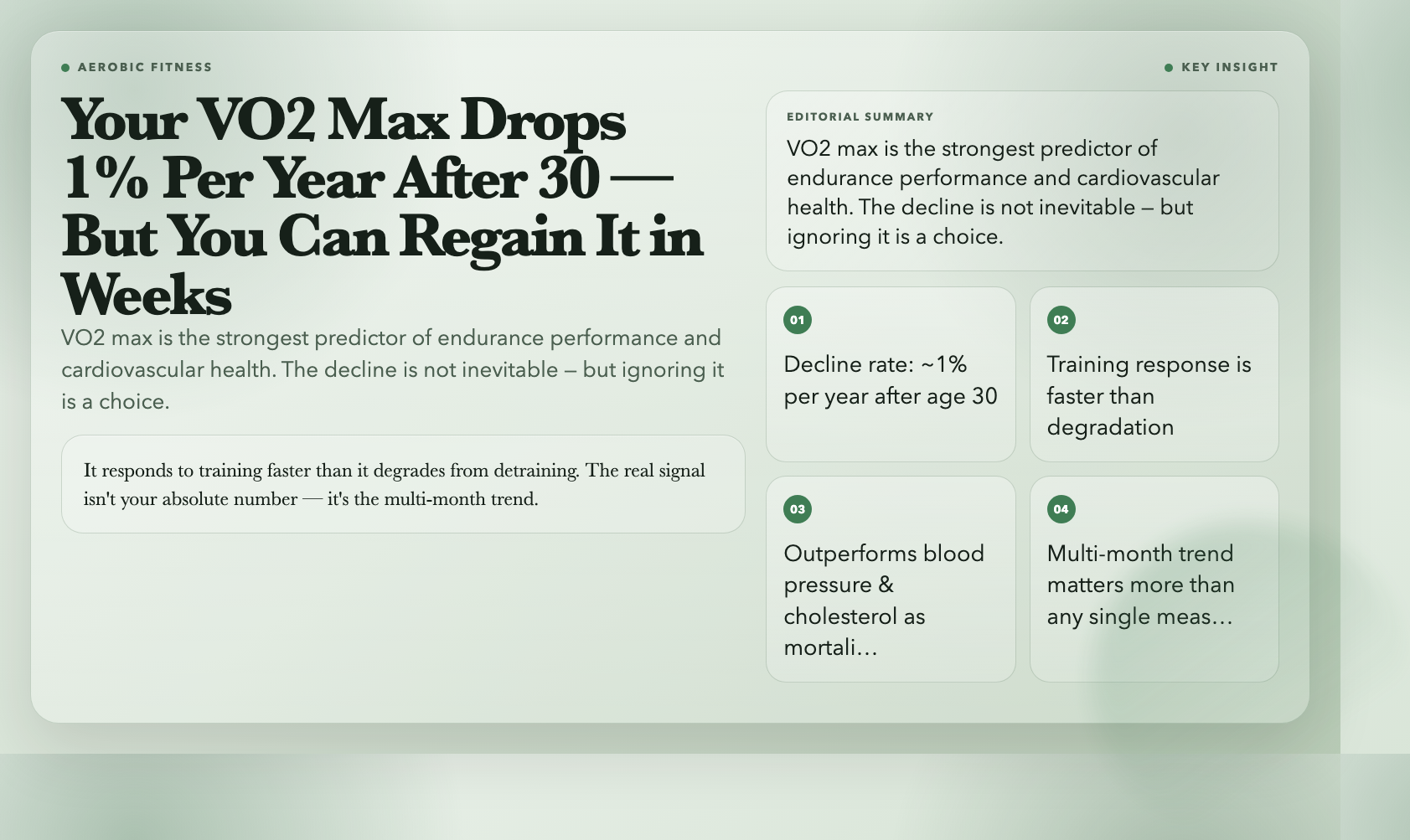
VO2 max is the gold standard measure of aerobic fitness — the maximum rate at which your body can consume oxygen during intense exercise. It’s the single strongest physiological predictor of endurance performance and a leading indicator of cardiovascular health that outperforms cholesterol panels and blood pressure checks in predicting all-cause mortality.
The VO2 Max Calculator estimates yours from submaximal exercise data using validated formulas (Cooper, Uth). No lab required.
Why it matters: VO2 max declines roughly 1% per year after 30 — but it responds to training faster than it degrades from detraining. In other words, you can regain in weeks what you lost in months. The real signal isn’t your absolute number on any given day; it’s the trend over months and years. A declining VO2 max is a warning sign that your current training structure isn’t working, even if your race times haven’t yet shown it.
Use it when: you want an objective baseline for your aerobic engine, or you need to compare your fitness honestly rather than relying on subjective “feeling fit.”
8. Calorie Burned Calculator — Fine-Tune Your Energy Balance
Training load matters, but energy balance matters more. Train hard, eat wrong, and you’re spinning your wheels. Run a chronic deficit without knowing it, and your performance ceiling drops regardless of how well-structured your sessions are.
The Calorie Burned Calculator estimates energy expenditure across dozens of activities — running, cycling, swimming, strength training, recreational sports — using validated MET (Metabolic Equivalent of Task) values from exercise physiology research.
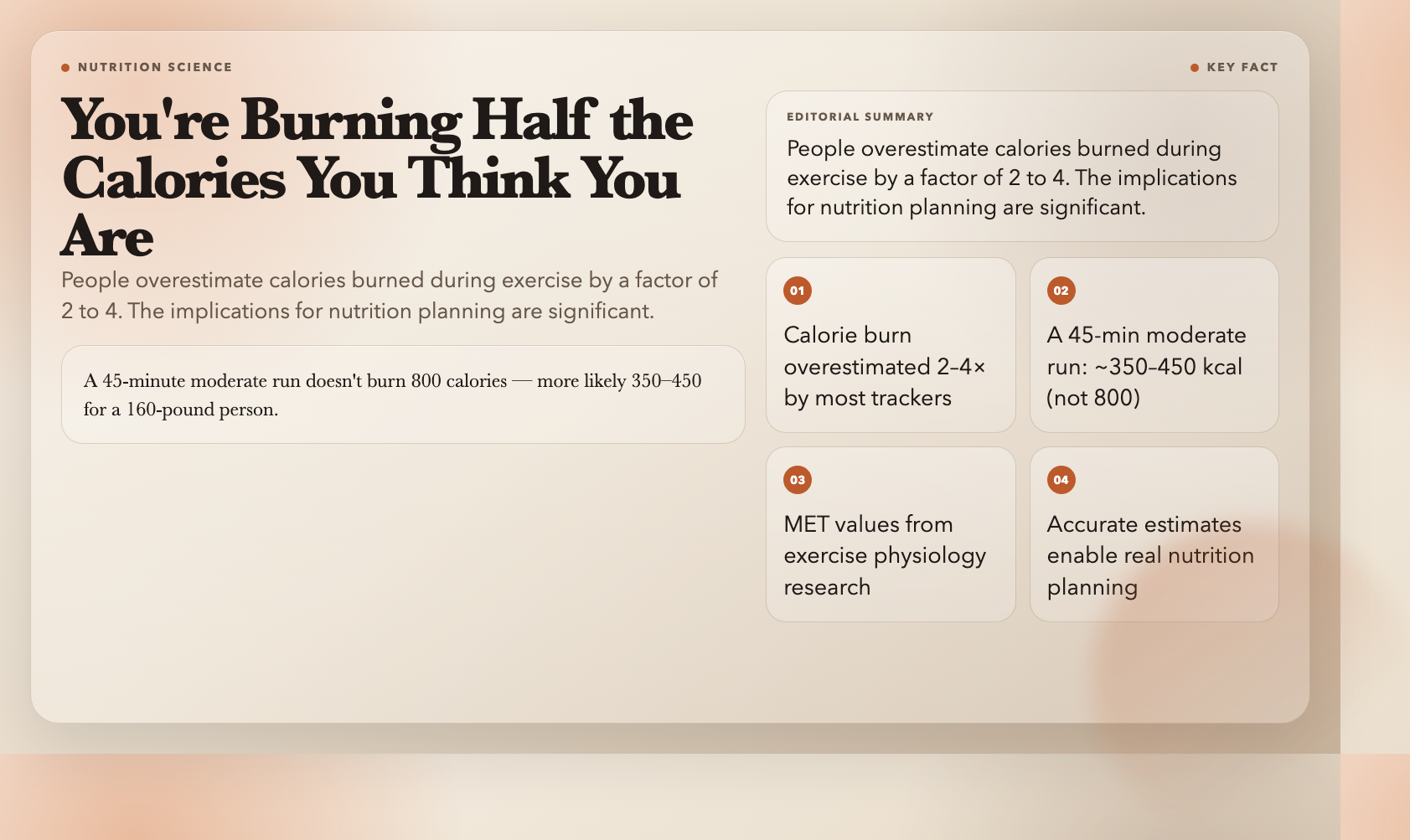
Why it matters: Research consistently shows that people overestimate calories burned during exercise by a factor of two to four. A 45-minute moderate run doesn’t burn 800 calories — more likely 350–450 for a 160-pound person. This calculator gives you a realistic number you can use to plan pre-workout nutrition, calculate your actual deficit on a cut, or justify that second helping of rice when you’re deep in a volume block.
Use it when: you’re in a strength or endurance phase and need to calibrate nutrition to training load, or you’re cutting and want to know how big a deficit your sessions are actually creating.
Try the Calorie Burned Calculator →
—
The Pattern Across These Tools
Every one of these calculators takes something athletes have always done qualitatively — guessing effort, estimating load, eyeballing intensity — and puts a number on it.
The number isn’t the point. The point is that once something is a number, you can track it, compare it, and make decisions based on it rather than memory or intuition. That’s what separates athletes who improve steadily from athletes who plateau.
The best time to start tracking these metrics was five years ago. The second-best time is today — and all eight of these tools are free.
Start with one. Pick the stat that most aligns with your current training goal. Track it for four weeks. Then decide what to do next.