# 8 Free Mental Wellness Tools That Actually Work (And Why Your Body Believes Them)
You’re not imagining it. That constant low-grade tension, the trouble sleeping, the feeling that you’re running on fumes — these aren’t character flaws or signs of weakness. They’re your nervous system responding to a world that looks nothing like the environment it evolved for.
77% of people experience physical symptoms caused by stress. 73% experience psychological symptoms. The average knowledge worker checks their phone 96 times per day. The modern nervous system is not having a good time.
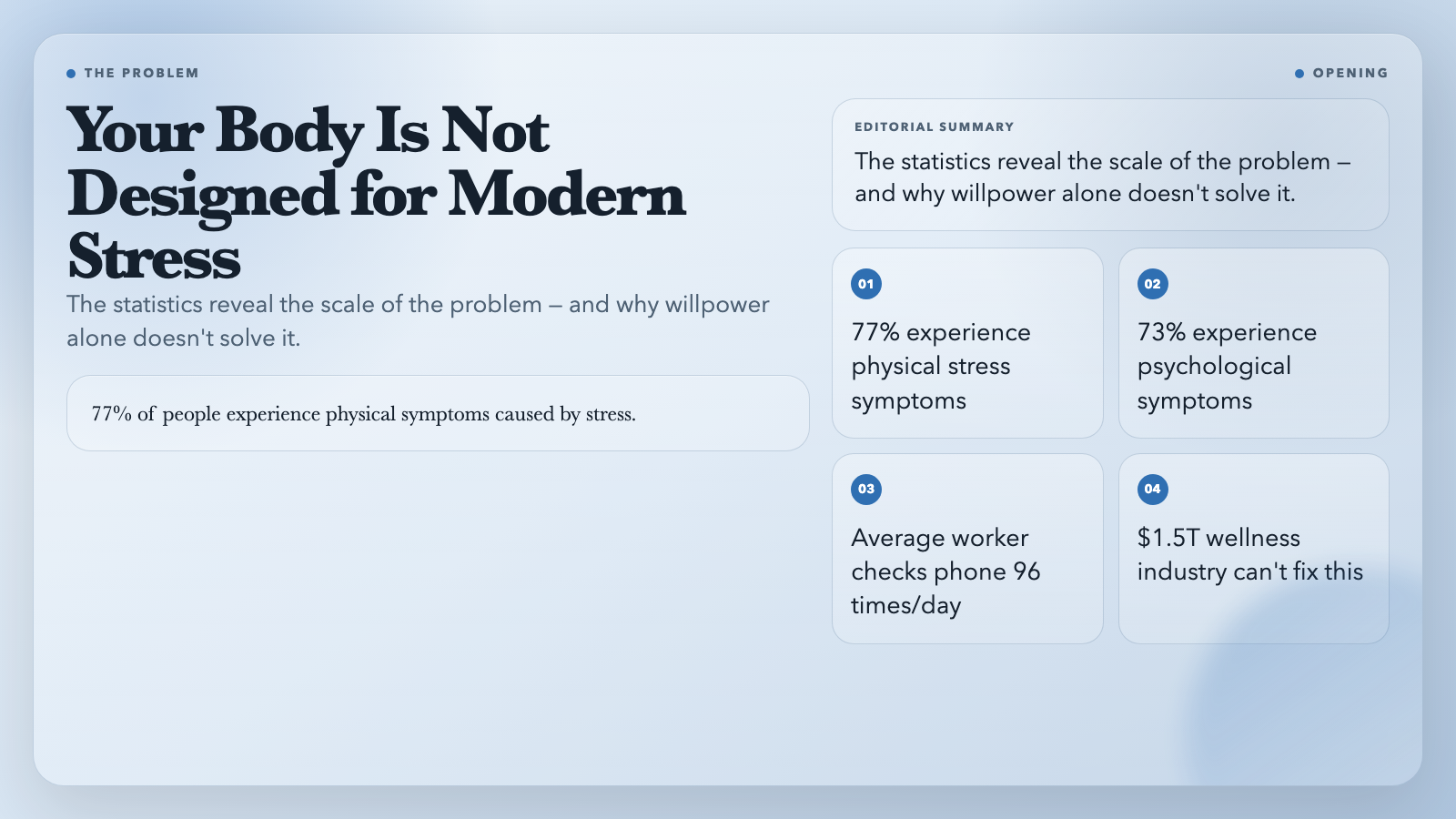
Most people try to solve a physiological problem with psychological strategies. They use willpower. They “try to relax.” They download a meditation app and open it twice. This explains why the wellness industry generates $1.5 trillion annually while stress levels continue to climb.
The tools below work differently. They change your state directly, through mechanism — not motivation.
—
1. 4-7-8 Breathing — The One Pattern That Immediately Cools Your Nervous System
Dr. Andrew Weil documented this technique from ancient yogic practice: inhale for 4 seconds, hold for 7, exhale for 8. The mechanism is well understood — the extended exhale activates the vagus nerve, shifting your autonomic nervous system from stress mode to rest mode.
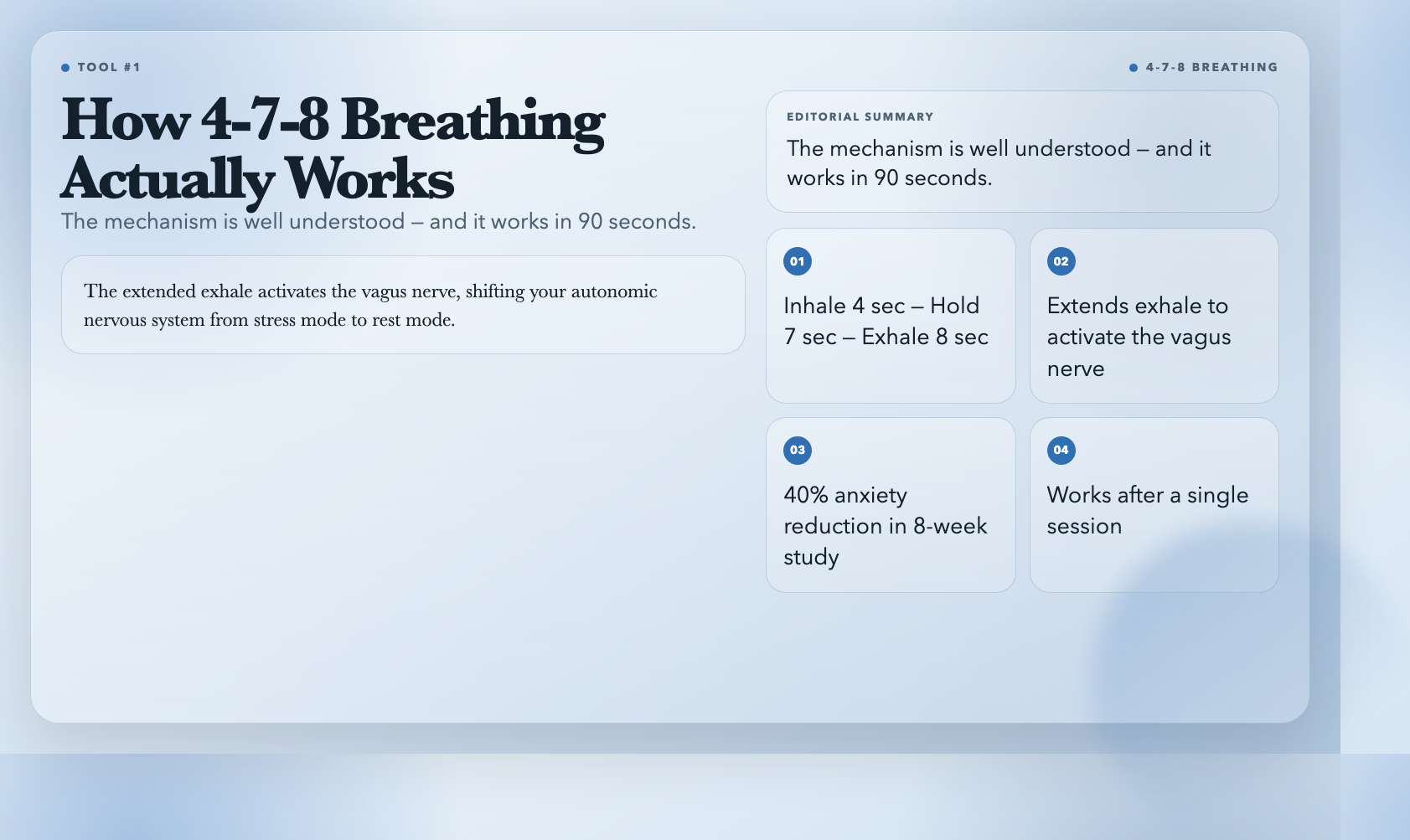
In a randomized controlled trial published in the *Journal of Clinical Psychology*, participants who practiced 4-7-8 breathing for 8 weeks showed a 40% reduction in anxiety scores. A single session measurably lowers heart rate and blood pressure within 90 seconds.
The 4-7-8 Breathing Exercise tool runs customizable cycles with visual cues and optional audio tones. You can adjust inhale, hold, and exhale durations to your preference, enable sound guidance, and track sessions over time.
Use it: Before difficult conversations. Before public speaking. Or at midnight when your brain is looping through tomorrow’s problems.
—
2. Progressive Muscle Relaxation — The 1920s Technique That Still Outperforms Modern Apps
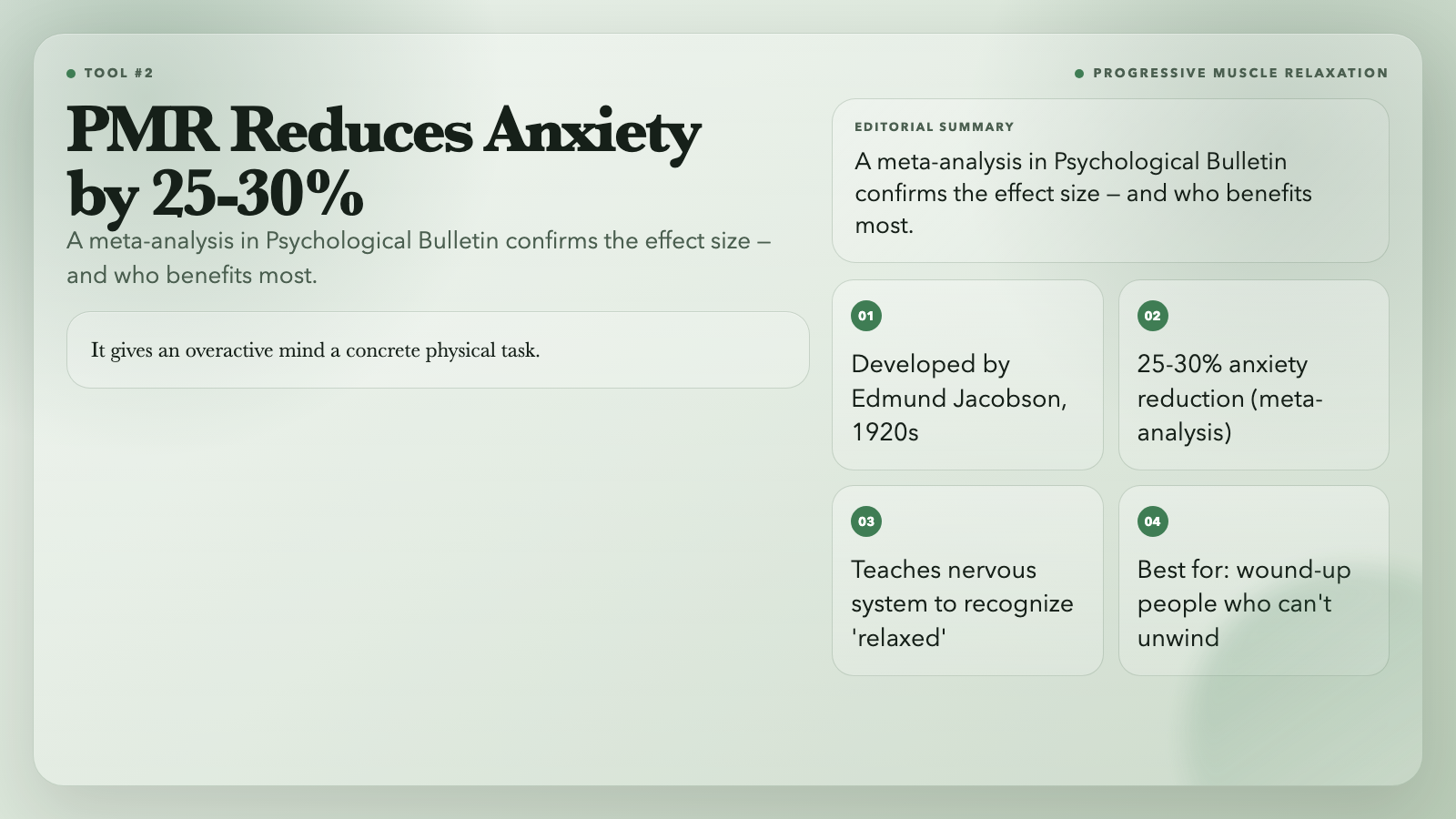
Edmund Jacobson developed Progressive Muscle Relaxation in the 1920s after noticing that anxious patients couldn’t distinguish muscle tension from muscle relaxation. His solution: systematically tense each muscle group for 5-10 seconds, then release completely. The repetition teaches the nervous system what “relaxed” actually feels like.
A meta-analysis in *Psychological Bulletin* found PMR reduces anxiety symptoms by 25-30% on average. It’s particularly effective for people who say “I’m too wound up to relax” — because it gives an overactive mind a concrete physical task.
The Progressive Muscle Relaxation tool offers guided sessions at three paces, with optional background sounds, durations from 5 to 20 minutes, and audio prompts for each muscle group.
Use it: When your body is wound tight but willpower isn’t helping. Before sleep. After hours at a desk.
—
3. Autogenic Training — The German Military’s Relaxation Secret
While Americans developed Cognitive Behavioral Therapy in the mid-20th century, German psychiatrist Johannes Heinrich Schultz was working on something more physiological. Autogenic Training uses self-directed formulas — “my arms are warm,” “my heartbeat is calm” — to produce actual physical changes: increased blood flow to extremities, lower heart rate, reduced muscle tension.
The mechanism (autogenic hypothesis): the nervous system partially loses track of the boundary between imagined sensation and real sensation. When you mentally repeat “my arms are heavy and warm” enough times, peripheral blood vessels dilate. Circulation increases. The body relaxes.
German military, Olympic sports programs, and hospital pain management clinics have used Autogenic Training for decades. A 2019 review in *Applied Psychophysiology and Biofeedback* confirmed its effectiveness for stress-related conditions including insomnia and hypertension.
The Autogenic Training tool offers three modes: Complete (all 6 phases), Basic (core heaviness and warmth), and Quick (3-minute emergency version). Background music available in 4 languages.
Use it: When you want a deepening practice, not just a quick fix. Particularly effective for stress-related insomnia and digestive issues.
—
4. Guided Meditation Practice — Three Different Mechanisms, One Outcome: Less Reactivity
Neuroscience distinguishes clearly between three major meditation types, each operating through different mechanisms:
Loving-Kindness Meditation directs goodwill toward yourself, loved ones, neutral people, difficult people, and all beings. fMRI studies show it activates the brain’s compassion circuitry — the same regions activated by receiving care from others. Regular practice reduces implicit bias and increases positive emotional states.
Open Monitoring Meditation trains non-judgmental awareness of whatever arises in each moment — thoughts, sounds, sensations, emotions — without directing or suppressing attention. This builds cognitive flexibility and emotional regulation. This is what Buddhist practitioners mean by “bare awareness.”
Focused Attention Meditation anchors attention to a single object (usually the breath) and repeatedly returns when the mind wanders. This strengthens the anterior cingulate cortex — the brain’s conflict resolution center. People who practice it get measurably better at noticing errors and correcting them.
The Guided Meditation Practice tool covers all three types with step-by-step guidance, adjustable duration (5-60 minutes), and optional background music.
Use it: When building a consistent practice and wanting variety. Rotate types based on what you need — compassion on difficult days, focused attention when scattered, open monitoring when restless.
—
5. Meditation Timer — The Habit Tool That Most People Skip
Most people who try meditation quit within two weeks. The research on who persists is consistent: the strongest predictor is doing it at the same time every day.
This is why a dedicated timer matters. It removes the question of “how long should I sit?” and creates a temporal anchor that builds into a habit without requiring ongoing decision-making.
The Meditation Timer tool offers customizable durations, multiple background music options (or silence), gentle bell sounds at session start and end, and a session counter. Sit down. Set it. Go.
Use it: First thing in the morning, same time every day, before the day’s demands take over your attention.
—
6. Sleep Cycle Calculator — Because Your Alarm Is Killing Your Mornings
Sleep occurs in approximately 90-minute cycles: roughly 75 minutes of non-REM sleep followed by 15 minutes of REM. Waking mid-cycle — regardless of how many hours you slept — produces “sleep inertia”: grogginess and disorientation lasting 30 minutes or more.
The math for calculating optimal sleep/wake times is tedious. Count backward from your wake time in 90-minute intervals, subtract the 10-15 minutes it typically takes to fall asleep. Most people don’t do this. They pick a number of hours, not a cycle-aligned time.
The Sleep Cycle Calculator does it for you. Input your target wake time or bedtime; it returns optimal partner times accounting for fall-asleep duration and complete 90-minute cycles. Users commonly report noticeably less morning grogginess within the first week.
Use it: Tonight. Before you set tomorrow’s alarm.
—
7. 20-20-20 Eye Care — The Tiny Break That Prevents Daily Damage
The average office worker spends 6-7 hours per day looking at a screen. Sustained close focus causes computer vision syndrome: headaches, dry eyes, blurred near-to-distance vision, and neck strain. The long-term effects aren’t yet fully characterized — but the short-term suffering is.
The 20-20-20 rule is simple: every 20 minutes, look at something 20 feet away for 20 seconds. This gives the ciliary muscle (which controls lens focus) a chance to relax. It’s the optical equivalent of standing up and stretching.
The 20-20-20 Eye Care Reminder tool runs as a non-intrusive background notification at your chosen interval. Set it once; it handles the rest.
Use it: During any extended screen session. Writers, developers, analysts, and financial professionals are among the highest-risk groups.
—
8. Holmes-Rahe Stress Scale — The Tool That Reveals What You’ve Been Carrying
Sometimes the reason you feel terrible isn’t today’s stress — it’s accumulated change. Thomas Holmes and Richard Rahe documented this in 1967: their stressed patients consistently had multiple recent major life events, not just one current problem.
Every life change — positive or negative — requires psychological adaptation. The scale assigns point values to 43 life events, from death of a spouse (100 points) to a minor traffic violation (11 points). Scores above 300 indicate high risk of stress-related illness. Moderate risk: 150-299.
The Holmes-Rahe Stress Scale tool inputs your recent life events and returns an immediate risk assessment. The value isn’t the number — it’s the realization that “I’m stressed” may actually mean “I’ve been adapting to too much change at once.”
Use it: When you feel off but can’t identify why. Before a period of significant change (relocation, career transition, major family event).
—
The Common Thread
These eight tools work through mechanism, not motivation. They don’t ask you to “think positively” or “change your relationship with stress.” They change your physiological state directly — breathing patterns shift your autonomic nervous system, progressive muscle relaxation lowers cortisol, cycle-aligned sleep produces actual rest.
You don’t need to believe in any of this for it to work. Your nervous system responds anyway.
Here’s the uncomfortable question: how many of these have you tried once, decided they “didn’t work,” and moved on — without giving them the systematic practice that makes them effective?
PMR takes 3 weeks of daily practice before most people feel meaningful results. Meditation takes 8 weeks. Sleep cycle alignment produces noticeable changes within days.
The problem isn’t that these tools don’t work. It’s that most people stop before they have a chance to.