8 Free Financial Calculators That Do the Math in Seconds
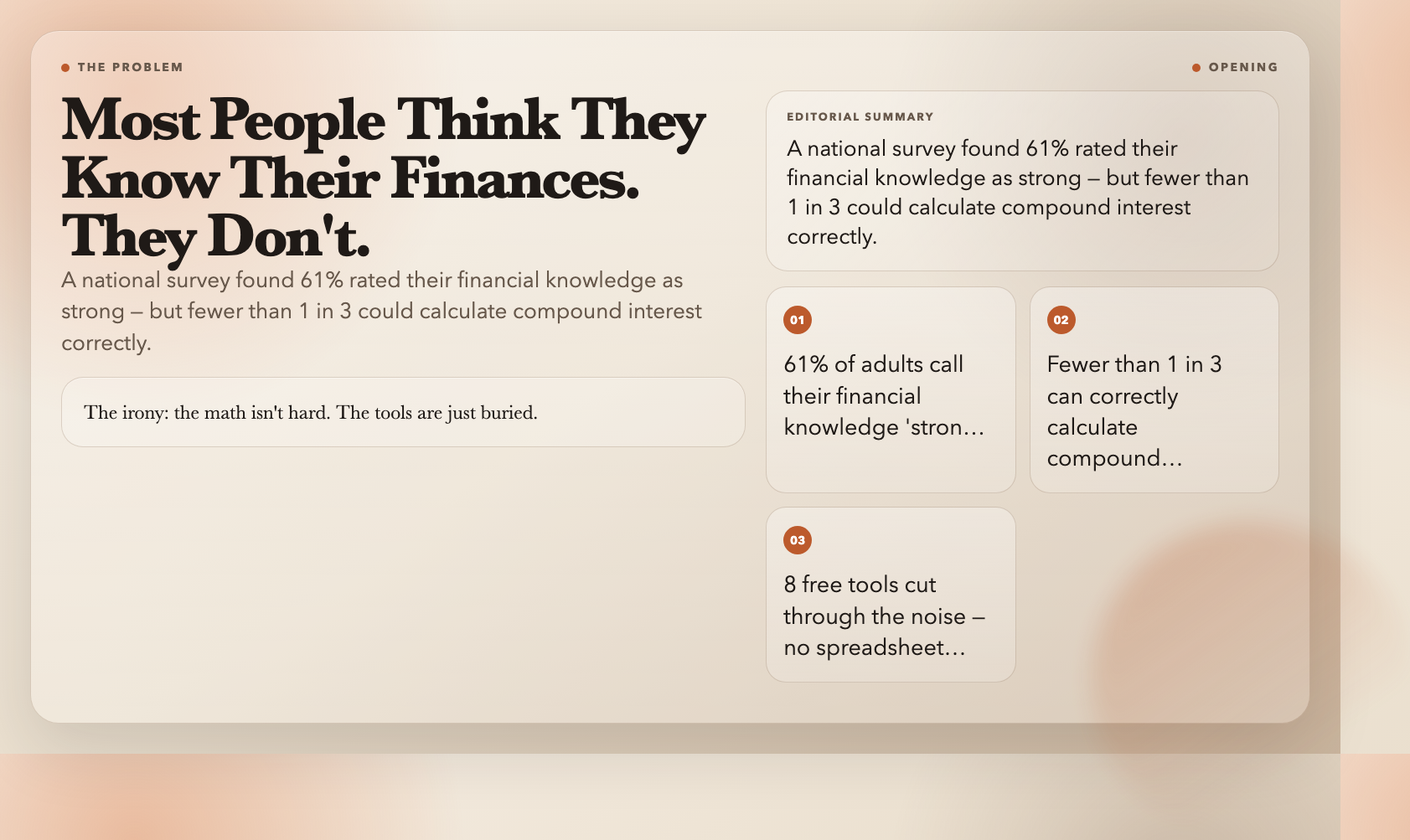
Most Americans think they understand their finances. A 2024 Northwestern Mutual survey found 61% described their financial knowledge as “strong” — yet when asked to calculate compound interest or estimate debt payoff time, fewer than one in three got close.
The irony: the math isn’t hard. The tools are just buried.
Amortization Schedule Calculator
A loan is a story told in numbers. The Amortization Schedule calculator tells you exactly how that story unfolds — which payments chip away at principal, which go to interest, and when you finally own the thing free and clear.
You input the loan amount, interest rate, loan term, and start date. The tool spits out a full payment-by-payment breakdown: principal paid, interest accrued, and remaining balance on every single line.
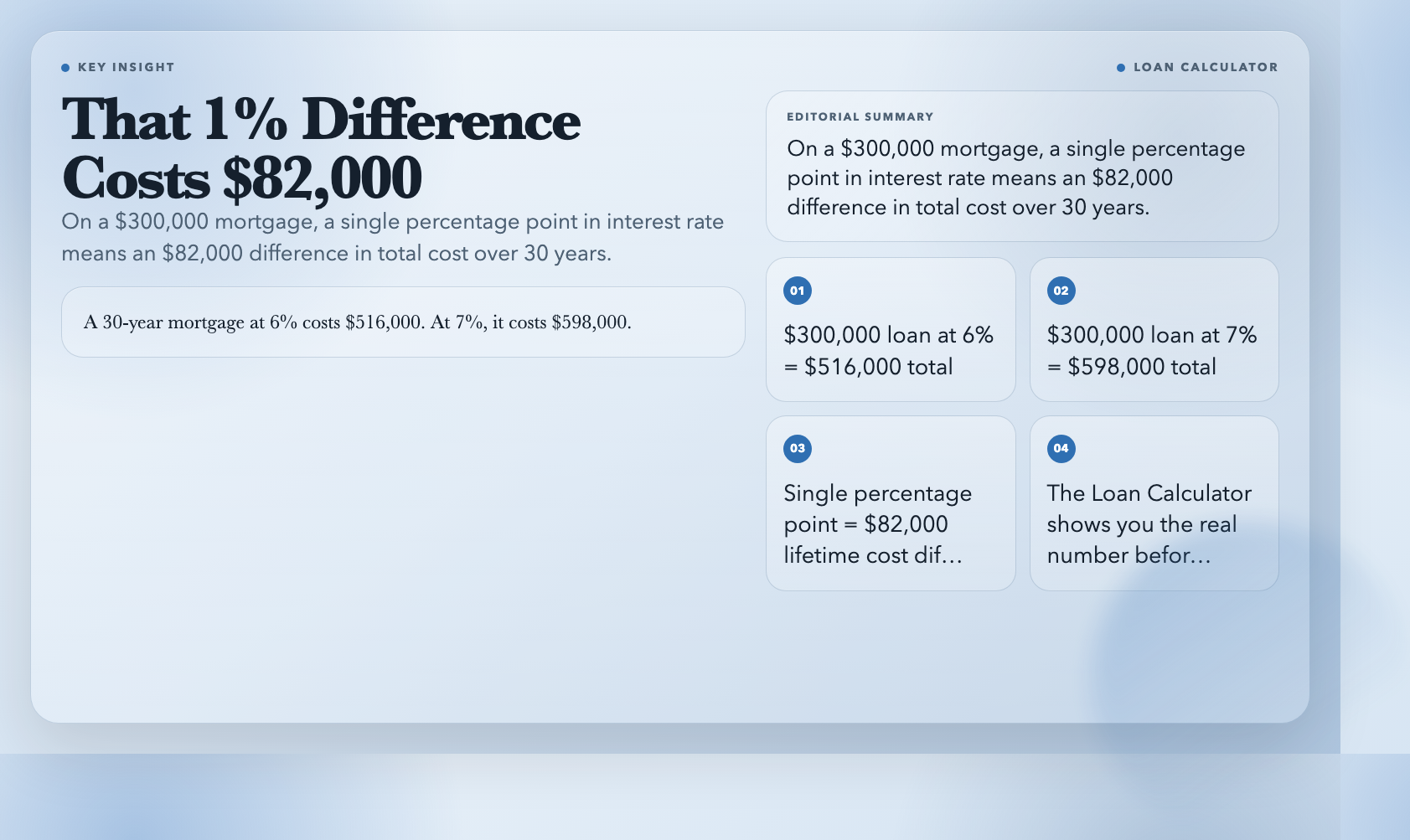
Use it when: You’re evaluating a mortgage, auto loan, or personal loan and want to see exactly what you’re signing up for before you sign. A $300,000 mortgage at 7% over 30 years costs $598,000 total. At 6%, it costs $516,000. That single percentage point is $82,000 — now you can see exactly where it goes.
Try the Amortization Schedule Calculator →
Annuity Calculator
Retirement planning hits a wall when you try to translate “I need $1 million by age 65” into a monthly savings target. The Annuity Calculator bridges that gap.
It calculates the future value or present value of regular payments at a given interest rate — or works backward to tell you how much to save each month to hit a target. You choose the payment frequency: annually, semi-annually, quarterly, or monthly.
Use it when: You’re planning 401(k), IRA, or annuity contributions and want a concrete number instead of a vague goal. For example: a 35-year-old saving $500/month at 7% annual returns will have roughly $1.03 million by age 65. The calculator shows you the exact figure.
Bond Yield Calculator
Bond yields sound like something only Wall Street traders care about. They’re not. If you hold any bond funds in a 401(k) or IRA, you own bond yields — and you should know what they mean.
The Bond Yield Calculator takes a bond’s face value, coupon rate, current market price, and years to maturity, then calculates its current yield and yield to maturity (YTM). YTM is the number that matters — it tells you your actual return if you hold the bond to maturity.
Use it when: You’re comparing bonds or bond funds and want to know which one actually pays better, not just which one has the higher coupon rate. A bond trading at a discount with a modest coupon can outperform a bond trading at a premium — YTM accounts for that.
Try the Bond Yield Calculator →
Capital Gains Tax Calculator
You bought stock at $10,000, sold it for $15,000. The IRS wants its cut. But how much?
The Capital Gains Tax Calculator answers that in seconds. Enter your purchase price, sale price, holding period, annual income, and filing status. It tells you exactly how much tax you owe — short-term or long-term — and supports US, UK, Canada, and Australia tax rules.
Use it when: You’re about to sell an investment and want to know your actual net profit before you execute the trade. This means you can compare whether holding a position in a Roth IRA (tax-free growth) outperforms a taxable brokerage account after capital gains taxes are applied.
Try the Capital Gains Tax Calculator →
Compound Interest (Daily) Calculator
Albert Einstein allegedly called compound interest the eighth wonder of the world. Whether he said it or not, the math is real. $10,000 invested at 7% annually doubles in roughly 10 years. The Compound Interest Calculator with daily compounding shows you exactly how powerful the compounding effect is when interest accrues every single day rather than monthly or annually.
Use it when: You’re comparing high-yield savings accounts, CDs, or investment returns and want to see the difference that compounding frequency makes. The difference between daily and monthly compounding on $10,000 at 5% over 10 years is roughly $350 — free money just from choosing the right account.
Try the Compound Interest (Daily) Calculator →
Debt Snowball Calculator
The debt snowball method is simple: pay off your smallest balance first, then roll that payment into the next smallest. It’s a psychological win that builds momentum. The Debt Snowball Calculator shows you exactly how long this takes and how much interest you’ll pay.
You enter your total monthly payment budget and up to five debts (name, balance, minimum payment, interest rate). The calculator lays out the payoff order, payoff date, and total interest for each debt.
Use it when: You’re developing a debt payoff strategy and want to see the snowball method’s impact. Example: five debts totaling $27,000 at $1,000/month total payment — the calculator shows the exact month you hit zero and the total interest paid under the snowball approach.
Try the Debt Snowball Calculator →
Loan Calculator
Before you take out any loan — mortgage, auto, personal — you need the Loan Calculator. It tells you the true monthly payment, total interest paid, and total cost of the loan over its lifetime.
Plug in the loan amount, interest rate, loan term, and payment frequency (monthly, bi-weekly, weekly, or semi-monthly). Optional down payment and amortization schedule included.
Use it when: You’re comparing loan offers from different lenders and want to know which one costs the least — not just which one has the lowest rate. The Loan Calculator makes the real cost visible before you sign.
Rent vs. Buy Calculator
The rent vs. buy decision is one of the most emotionally charged in personal finance. The Rent vs. Buy Calculator removes the emotion and brings in real numbers: home price, down payment, mortgage rate, property tax, insurance, maintenance, expected rent increases, and investment opportunity cost.
It models both scenarios over 1–30 years and tells you which option nets you more wealth — and when the break-even point occurs.
Use it when: You’re deciding whether to rent or buy in your specific market. In some cities, renting and investing the difference wins. In others, buying builds more long-term wealth. The calculator gives you the number for your situation.
Try the Rent vs. Buy Calculator →
The Unfinished Part
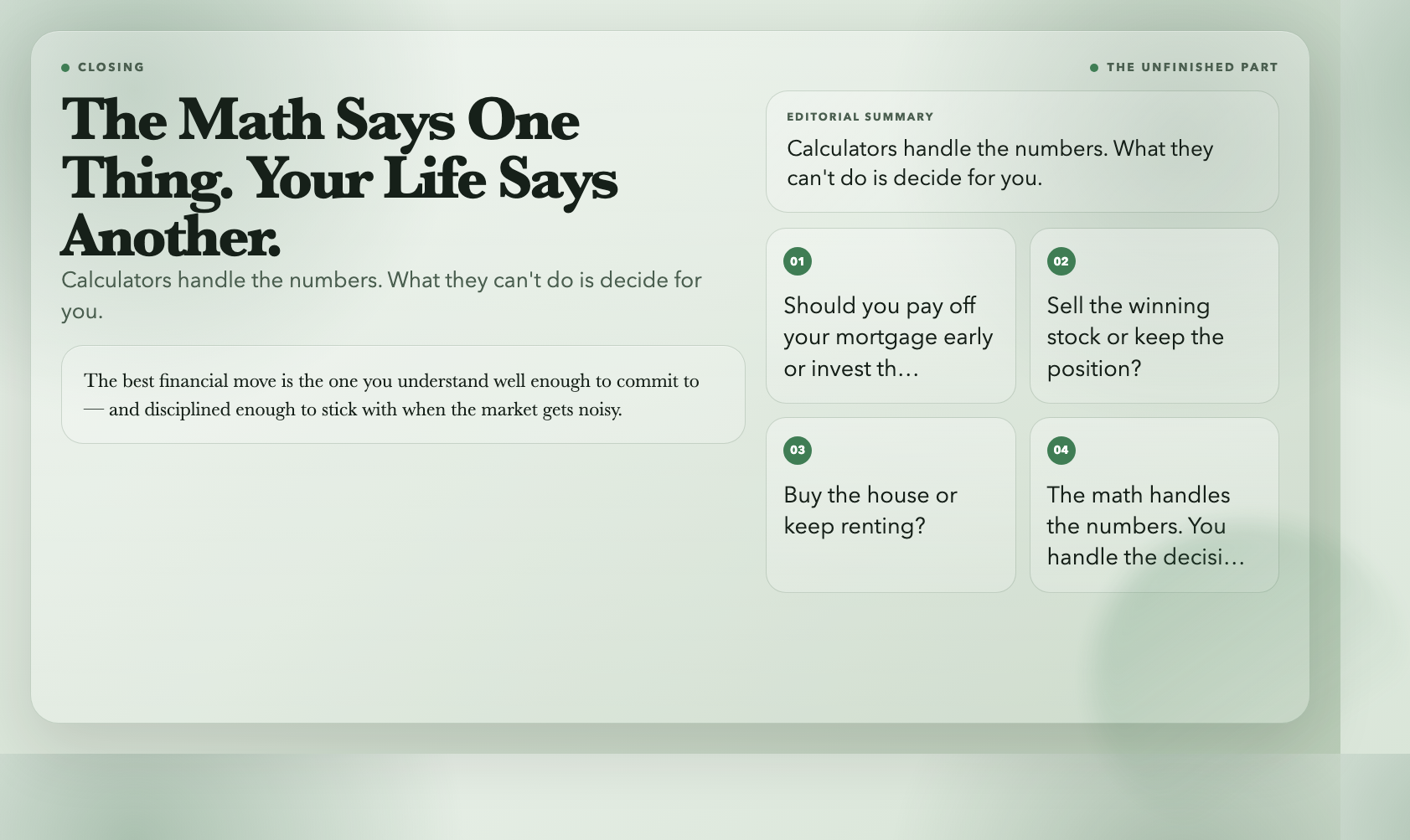
These calculators handle the math. They tell you what you owe, when you’ll be free of it, and how much it will cost.
What they can’t do is decide for you.
Should you pay off your mortgage early or invest the difference? Sell a winning stock and lock in gains? Buy the house or keep renting?
The math says one thing. Your life says another. And that’s the part that no calculator has solved yet — because the best financial move is the one you understand well enough to commit to, and disciplined enough to stick with when the market gets noisy.