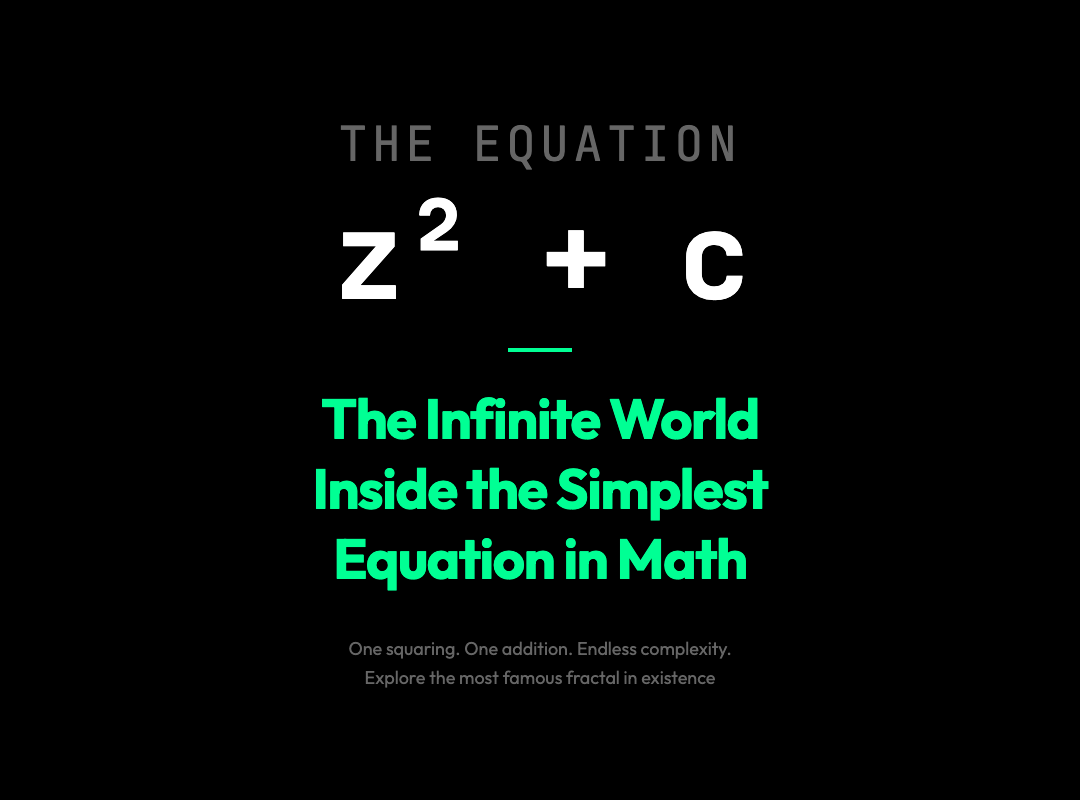
The Infinite World Inside the Simplest Equation in Mathematics
There is an equation so simple that a fifth-grader can write it down. And there is a picture — the most famous picture in all of mathematics — that emerges from running that equation, over and over, on every point of the complex plane. The picture has a shape. That shape has a boundary. And on that boundary, if you are patient enough to keep zooming, you will find oceans, coastlines, neurons, galaxies, and more shapes that look exactly like the original. Forever.
This is the Mandelbrot Set. And it will make you question everything you thought you understood about infinity, complexity, and what it means for something to be complicated.
The Equation That Breaks Intuition
Here is every symbol you need:
z_{n+1} = z_n^2 + c
That is it. Pick a point c on the complex plane. Start with z₀ = 0. Plug it in. Get a new number. Plug that in. Keep going.
If the magnitude of z never exceeds 2 no matter how many times you iterate, then c is in the set. Color it black. If z eventually escapes — if it grows without bound — then c is not in the set. Color it white, or red, or whatever shade corresponds to how fast it escaped.
This is not a trick question. There is no randomness, no approximation, no human judgment involved. For any complex number c, the answer is deterministic and immediate: in or out.
Now draw every point on the complex plane and color it accordingly.
What you get is the most complex object in mathematics.
Why the Boundary Never Ends
Here is what makes the Mandelbrot Set genuinely impossible to comprehend.
The interior — the black region — is perfectly understood. Every point there is easy to classify: its orbits stay bounded forever. Mathematicians have known for decades exactly which c values live there and why.
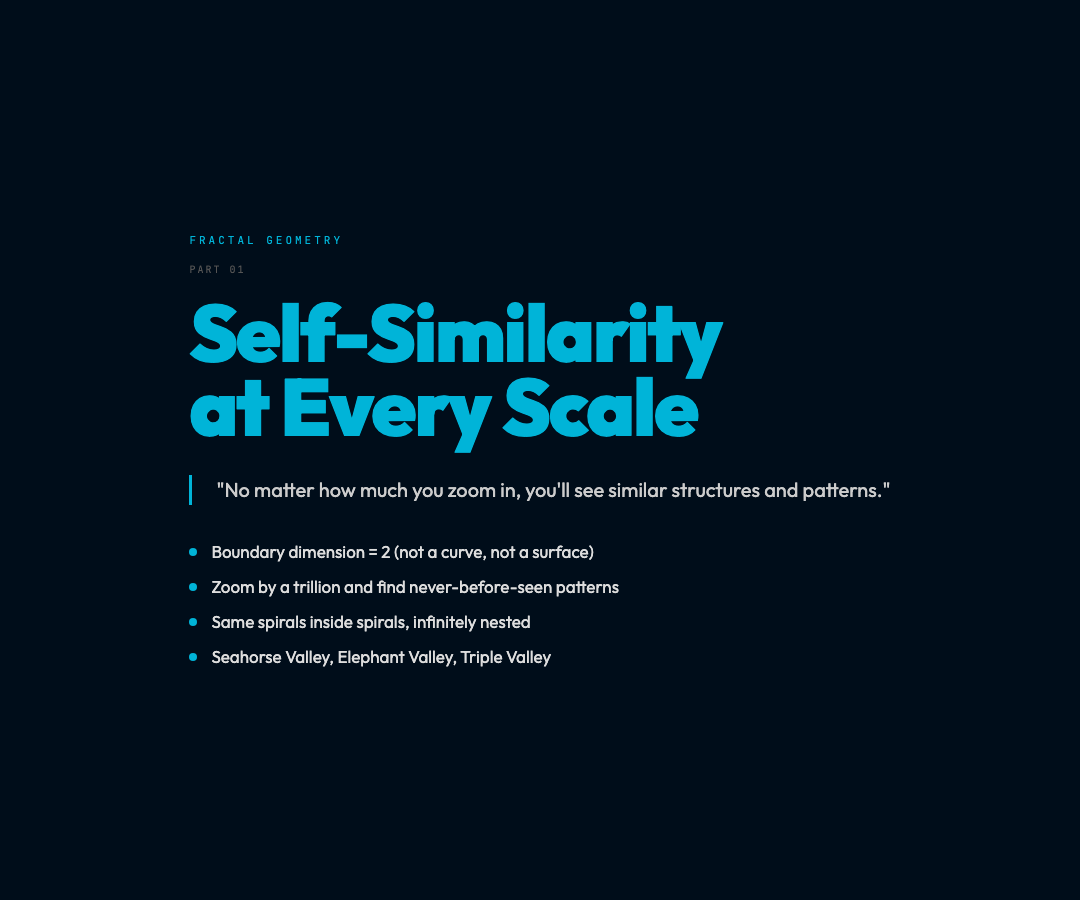
The boundary is where everything falls apart. And the boundary has a dimension of exactly 2 — not 1, not 1.5, but 2. This means it is not a curve. It is not a surface either. It occupies space in a way that defies every geometric intuition you have.
As you zoom in on any point along the boundary, you see spirals. And inside those spirals, more spirals. And inside those, tiny versions of the whole set. The same shape, down to the finest filament, repeating at every scale, forever.
This is what fractality means. Not rough edges or jagged lines. Self-similarity at every scale, without end.
Benoit Mandelbrot, who popularized the set in 1980, spent much of his career arguing that this kind of fractal geometry was the correct language for describing the roughness of the real world: coastlines, mountain ranges, tree branches, blood vessels, stock market fluctuations. The Mandelbrot Set was his proof of concept — a constructed object that showed, without ambiguity, that simple rules could generate infinite complexity.
The Places Worth Zooming
If you explore the Mandelbrot Set with any good visualization tool, you will quickly discover that some regions are more photogenic than others.
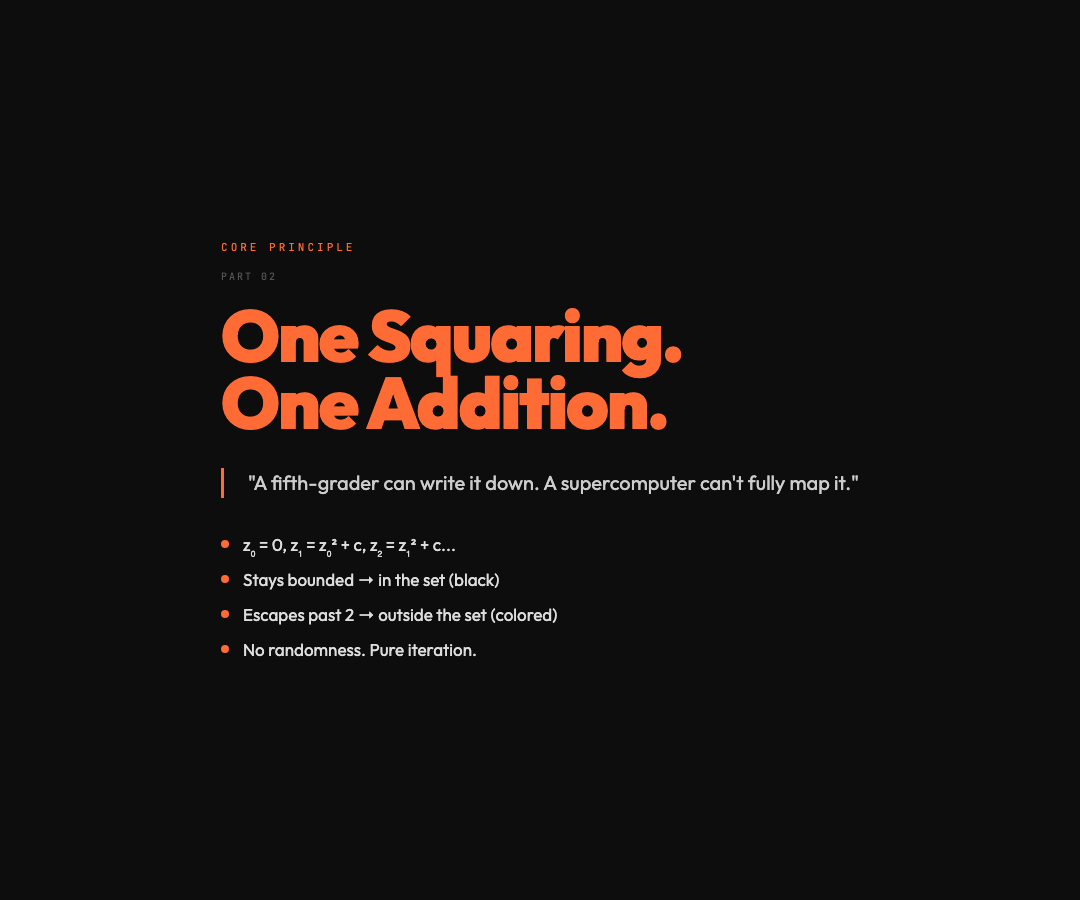
Seahorse Valley on the left side of the set produces structures that genuinely resemble seahorses — small spirals with protruding filaments, repeating at smaller and smaller scales.
Elephant Valley at the bottom center shows large circular structures with what look like elephant tusks extending from them.
The Triple Valley region near the top produces repeating triangular patterns.
These are not just pretty shapes. They are the visible manifestations of mathematical structures that are provably infinitely complex. You can zoom in on any of these regions by a factor of a trillion and still find new patterns that have never been seen by human eyes before.
This is not a metaphor. The number of distinct configurations reachable by zooming into the Mandelbrot Set is greater than the number of atoms in the observable universe. And unlike most vast numbers in mathematics, this one is entirely literal.
The Connection That Stunned Mathematicians
When Mandelbrot first plotted the set on a computer, he noticed something that no one had predicted: parts of the Mandelbrot Set looked almost exactly like Julia Sets — a different family of fractals studied since 1918 by Gaston Julia and Pierre Fatou.
This was not coincidence. The Mandelbrot Set acts as a map of Julia Sets. Every point c in the Mandelbrot Set corresponds to a specific Julia Set J_c. The boundary of the Mandelbrot Set is precisely where the Julia Sets transition from being connected (one single piece) to being disconnected (a dust of isolated points).
In other words: the shape of the Mandelbrot Set tells you the complete story of an entire infinite family of fractals. It is a catalog of everything that can happen when you iterate z² + c.
This is why mathematicians found it so unsettling. Here was a shape that was simultaneously a map, a catalog, an index, and an infinite fountain of new mathematics — all produced by the simplest possible nonlinear iterative process.
What This Actually Means for You
You do not need to understand the math to feel the philosophical weight of the Mandelbrot Set.
It says something specific and disturbing about the relationship between simplicity and complexity. The equation z² + c contains exactly one squaring operation and one addition. There is no randomness, no noise, no external influence. The complexity is not imported from outside. It is already present in the structure of iteration itself.
This shows up everywhere in the real world once you know where to look. The timing of earthquakes follows a power law — small ones happen constantly, big ones are rare but not nearly as rare as exponential reasoning would suggest. City sizes follow a power law. The frequency of wars follows a power law. The distribution of wealth follows a power law. In every case, what looks like a special exception is actually the natural output of a system that has been running for a long time under simple rules.
The Mandelbrot Set is the purest mathematical illustration of this principle. There is no randomness in z² + c. There is only the inexorable logic of iteration, and the infinite variety that logic produces.
Four Rules, Infinite Geometry
The next time you see the Mandelbrot Set rendered in vivid color, with its spiraling shapes and impossible filigree, remember what you are actually looking at.
You are looking at every possible outcome of the simplest equation that produces non-trivial behavior. You are looking at a shape that is simultaneously a catalog of all related shapes, a map of a vast mathematical territory, and a demonstration that infinity is not an abstract concept — it is baked into the structure of elementary arithmetic.
Run the equation. Color the result. See what happens.
The complexity is not in the rules. It is in the iteration.