Why a Positive Medical Test Doesn’t Mean What You Think It Does
You tested positive for a rare disease. The test is 99% accurate. So you’re 99% sure you have it.
Not even close.
Here’s the math that hospitals rarely explain: if the disease affects 1 in 1,000 people and your test is 99% accurate, a positive result still means roughly a 9% chance of actually being sick. The other 91% are false positives — healthy people flagged by an imperfect test.
This is Bayes’ theorem. It governs medical diagnoses, spam filters, fraud detection, and Netflix recommendations. And it breaks human intuition so consistently that entire fields have been built around the gap between how we think about probability and how it actually works.
The Paradox That Breaks Every Intuition
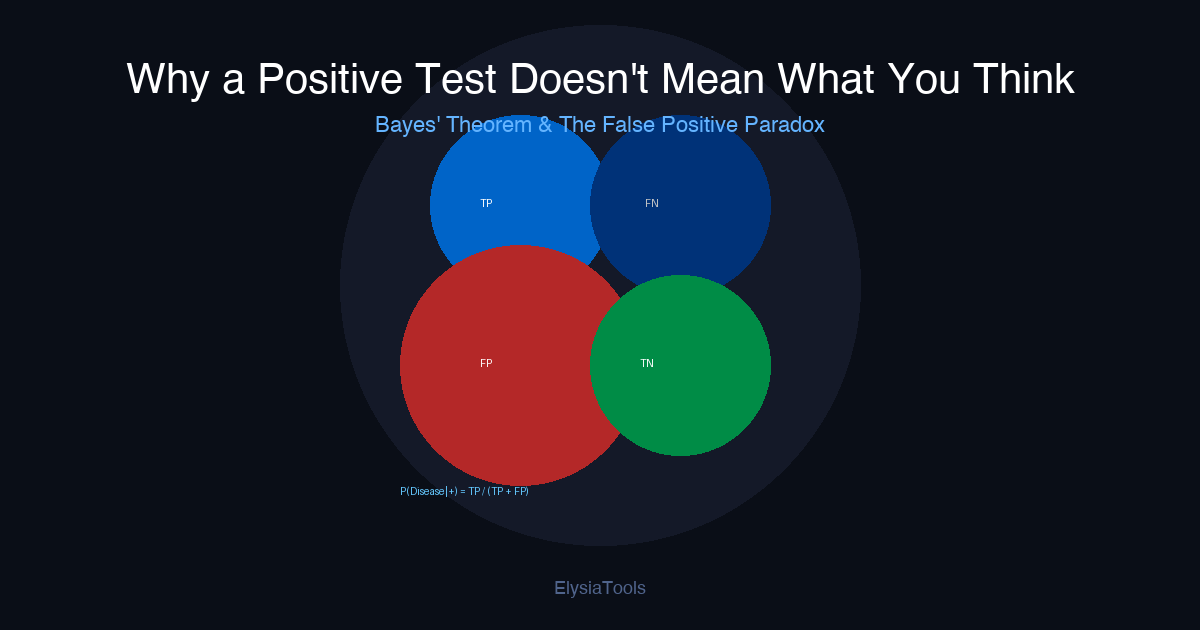
Imagine screening 10,000 people for a disease that affects 1% of the population. That’s 100 truly sick people and 9,900 healthy ones.
Your 99% accurate test catches 99 of the 100 sick people. It also incorrectly flags 99 of the 9,900 healthy people as positive.
You now have 198 positive results. Only 99 are real. A positive test means roughly a 50% chance — not 99%.
This is the false positive paradox. It ambushes doctors, judges, data scientists, and anyone interpreting signals from imperfect systems.
Consider DNA database searches. A “99.9% match” sounds conclusive. But a database with 1 million profiles generates roughly 1,000 matches for any given search — including the actual criminal and approximately 999 innocent people whose DNA coincidentally resembles the crime scene sample. Police have arrested the wrong people on exactly this logic.
Airport security faces the same math. Most alarms aren’t weapons. They’re belt buckles, coins, and medical implants. The system is sensitive, but the thing it’s looking for is rare.
The Formula That Fixes Your Probability Instinct
Bayes’ theorem formalizes how new evidence should update your beliefs:
P(A|B) = P(B|A) × P(A) / P(B)
– P(A) — prior: how likely was this before the evidence arrived?
– P(B|A) — likelihood: how likely is this evidence if the hypothesis is true?
– P(B) — evidence probability: how likely is this evidence across all scenarios?
– P(A|B) — posterior: your updated belief after seeing the evidence
In medical terms: the probability you have the disease after testing positive equals the true positive rate times the disease prevalence, divided by all positive results — true and false combined.
The denominator trips up nearly everyone. It includes sick people who test positive AND healthy people who test positive. When the disease is rare, healthy people outnumber the sick, so false positives flood the denominator and drown out the true signal.
The Visualization That Makes It Click
Numbers alone don’t change intuition. What makes this paradox visceral is watching 10,000 simulated people split into four groups as you adjust parameters.
The Bayes’ Theorem Visualization on ElysiaTools lets you:
– Drag the disease prevalence slider from 0.1% to 10% and watch the positive predictive value swing from under 10% to over 90%
– See how test specificity — the true negative rate — matters as much as sensitivity
– Observe the critical threshold where a positive result transitions from reliable to misleading
– Run the general Bayesian update with arbitrary priors and likelihoods
When you can watch a population of 10,000 dots rearrange themselves as you move one slider, the paradox stops being an equation and starts being an intuition.
Where This Shows Up Beyond Medicine
Machine learning: Naive Bayes classifiers apply this reasoning to text classification. Engineers who ignore base rates build systems that misclassify rare categories with false confidence.
Fraud detection: Credit card fraud affects roughly 0.1% of transactions. Even a 1% false positive rate generates thousands of blocked legitimate purchases per million processed. Banks constantly trade off fraud recall against customer experience — a tradeoff that requires understanding the math they’re using.
Scientific research: The replication crisis in psychology was partly driven by ignoring base rates. At a 5% false positive rate, studying 1,000 rare phenomena produces 50 “significant” results that are pure noise. Peer review missed this because researchers weren’t asking the prior probability question before celebrating results.
A/B testing: Running 1,000 simultaneous experiments at 95% confidence means 50 “winning” variants that are actually no better than the control. Without correcting for multiple comparisons, optimization is just statistical noise wearing a business suit.
The One Question to Ask Before Believing Any “Positive” Result
The false positive paradox isn’t a curiosity. It’s a structural feature of any system that processes rare signals with imperfect accuracy. Once you see it, you can’t unsee it — in medical reports, in detection dashboards, in research papers, and in the business metrics you check every morning.
The question is simple: what was the base rate? Ask it before the result. Your decisions will be better for it.