# A Black Hole Lives 10⁶⁷ Years. Then It Explodes.
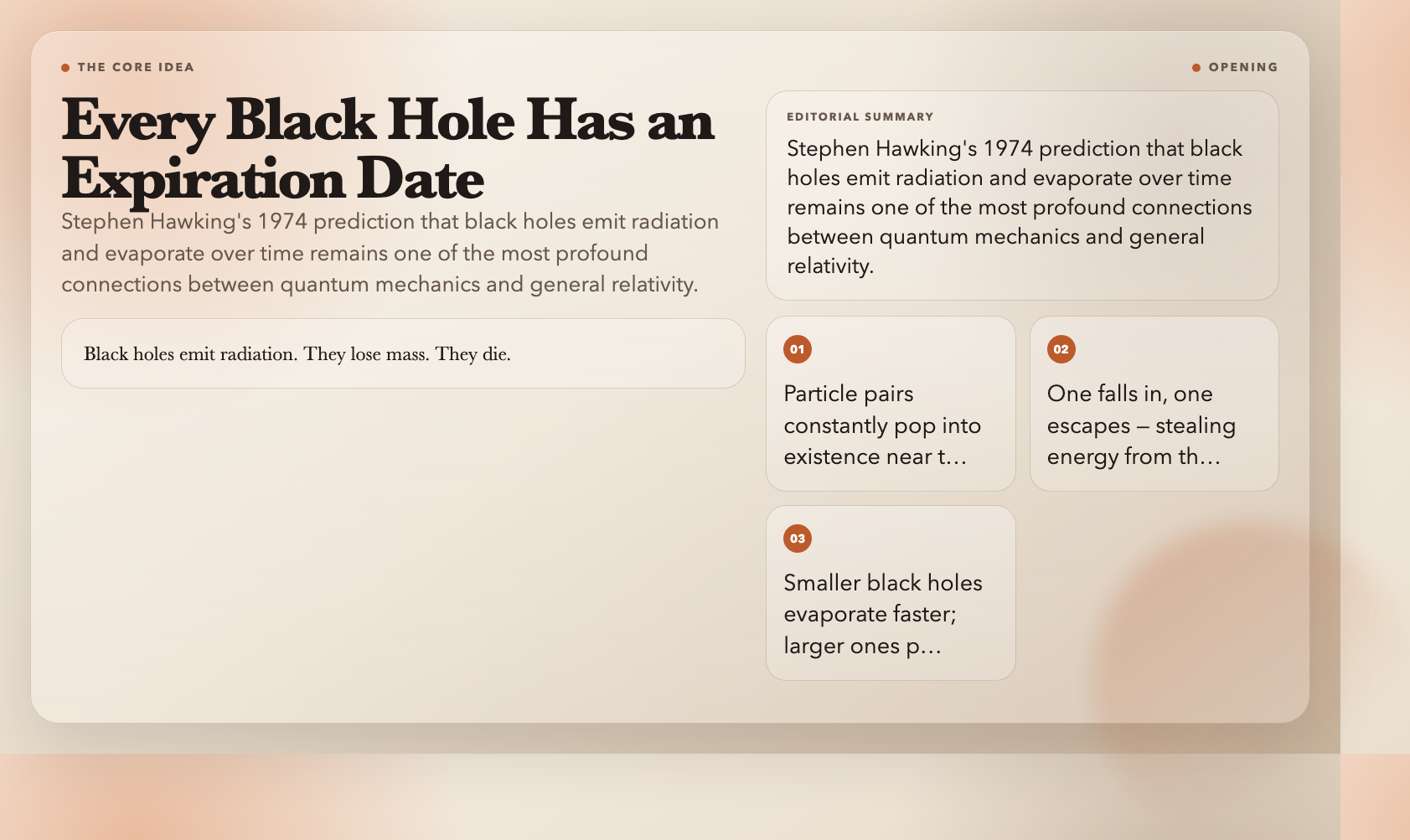
Stephen Hawking said something impossible in 1974. Black holes emit radiation. They lose mass. They die. The physics world spent years trying to prove him wrong. It couldn’t.
Here’s the mechanism. Empty space constantly creates particle pairs that annihilate instantly. At a black hole’s event horizon, the geometry separates some pairs before they cancel. One particle falls in. The other escapes as real energy. That energy comes from the black hole’s mass.
This is Hawking radiation. Every black hole has an expiration date.
The temperature formula: T = (ℏc³) / (8πGMk). Temperature is inversely proportional to mass. A Sun-mass black hole has a temperature of 60 nanokelvin. The cosmic background radiation is 2.7 kelvin. Stellar black holes absorb more than they emit. They aren’t evaporating. Not yet.
An interactive visualization lets you watch black holes evaporate across different mass scales.
## Mass, Temperature, and Power Output
The visualization shows three curves as you adjust initial mass:
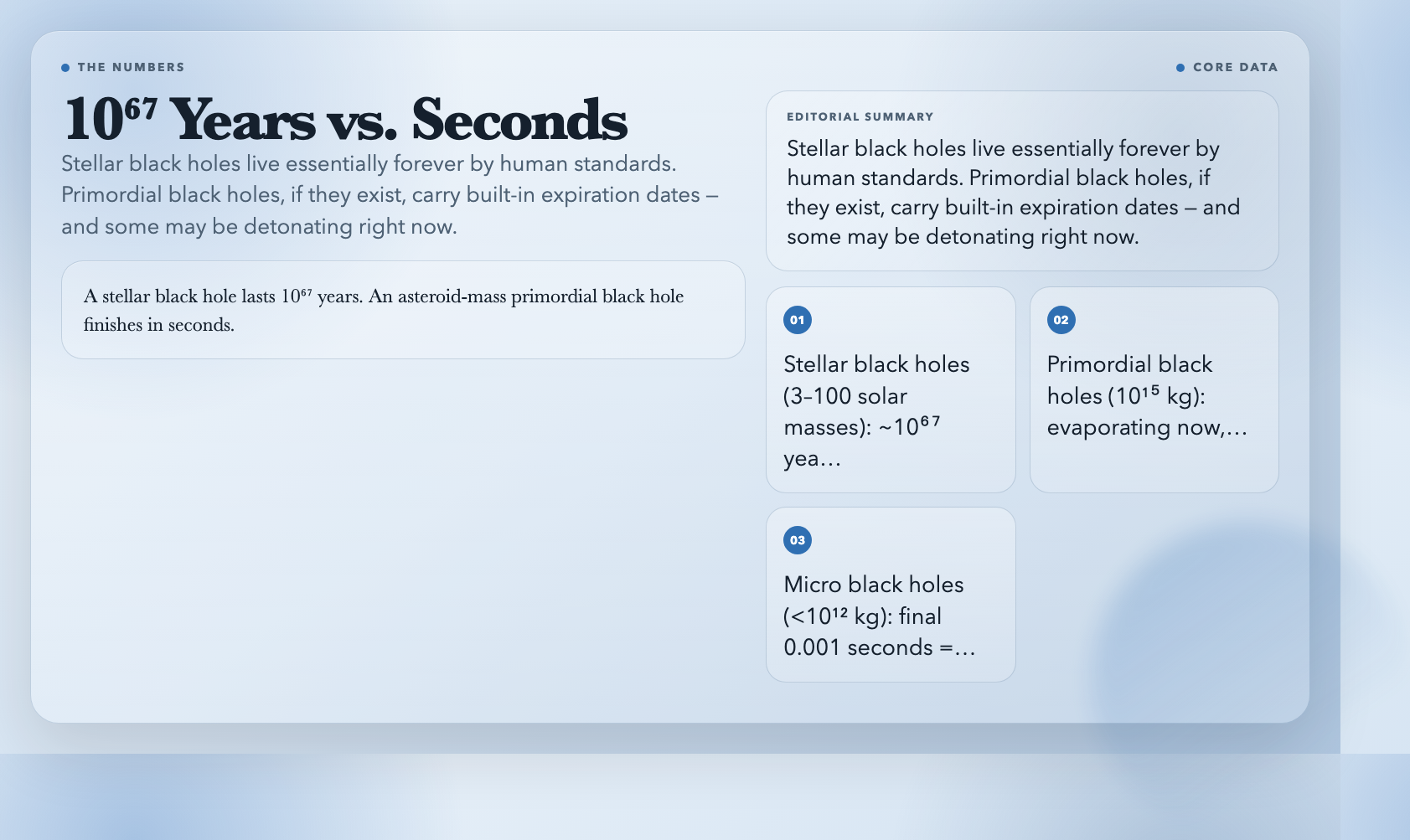
Mass vs. time: Evaporation accelerates. dM/dt ∝ -1/M². A stellar black hole lasts 10⁶⁷ years. An asteroid-mass primordial black hole finishes in seconds.
Temperature vs. mass: T ∝ 1/M. Halve the mass, double the temperature. A Sun-mass black hole is colder than the cosmic background. A 10¹⁵ kg black hole is hotter than the Sun’s core.
Power output: Below ~10⁹ kg, the remaining mass releases at once. Equivalent to several million tons of TNT. The black hole detonates, not fades.
## Four Types, Four Destinations
### Stellar Remnants (3–100 solar masses)
These are the black holes LIGO detected through gravitational waves. Temperature: ~10⁻⁸ K. The cosmic background feeds them more energy than they radiate. They grow, not shrink. Set the visualization to stellar mass and watch nothing happen for billions of years.
### Supermassive Black Holes (10⁶–10⁹ solar masses)
Sagittarius A* holds 4 million solar masses. Temperature: ~10⁻¹⁷ K. The cosmic background overwhelms their radiation by 10¹³. They outlast every star in their galaxy.
### Primordial Black Holes (10¹²–10²⁰ kg, if they exist)
These hypothetical objects formed in the first second after the Big Bang. Some would be evaporating right now. NASA’s Swift and Fermi telescopes search for gamma-ray bursts from dying primordial black holes. No confirmed detection yet.
### Micro Black Holes (less than 10¹² kg)
A 10¹⁰ kg micro black hole radiates at 10¹⁷ watts — a million nuclear reactors in something smaller than an atom. The final 0.001 seconds release energy equivalent to several million tons of TNT. Detonation, not fade.
## Why the Visualization Matters
The equations are in every textbook. The visualization makes them physical intuition. Watch temperature climb from 60 nanokelvin to 10⁷ Kelvin as mass drops. Watch the power curve go vertical in the final moments.
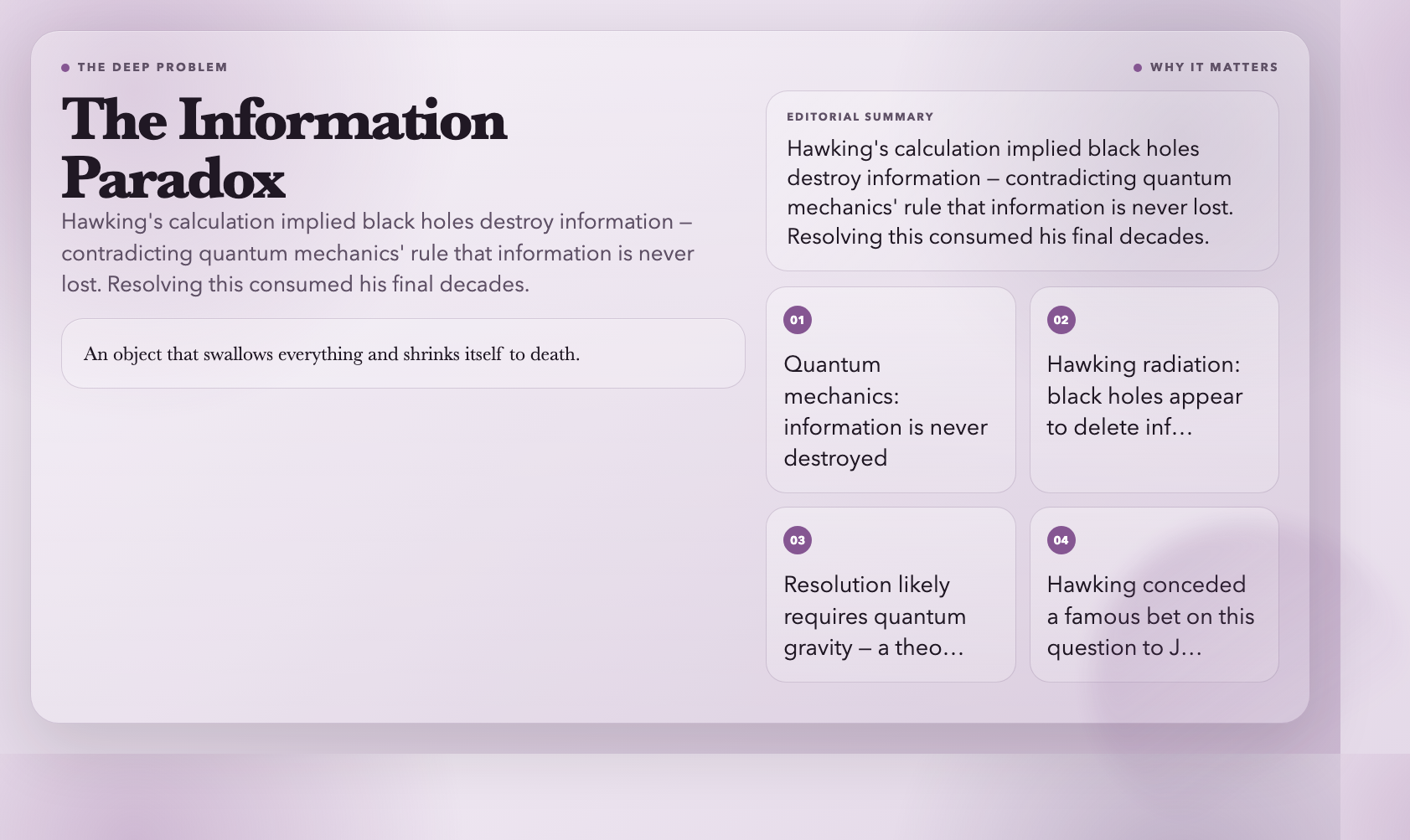
This connects to the information paradox — the deepest unsolved problem in physics. Hawking’s calculation implied black holes destroy information, contradicting quantum mechanics. He spent decades trying to resolve it. He conceded a famous bet on this question to John Preskill in 2004.
The visualization can’t answer the paradox. But it shows what’s at stake: an object that swallows everything and shrinks itself to death.
## The Takeaway
Stellar black holes are effectively permanent. The universe is 10¹⁰ years old. These objects live 10⁶⁷ years.
Primordial black holes, if they exist, carry built-in expiration dates. Some are dying now, releasing gamma-ray bursts that telescopes might detect today.
Run stellar mass in the visualization and watch nothing happen. Then switch to primordial and watch an asteroid-mass object vanish in seconds. The timescale difference is the physics.
## One More Thing
Set the visualization to primordial mass. Crank the time speed. Watch the power curve go vertical. In the final milliseconds, output exceeds everything the black hole absorbed over its lifetime. Then it’s gone. No remnant. Just physics honoring its own rules.
That’s Hawking radiation. A black hole choosing its own death.
Explore the Black Hole Hawking Radiation visualization and 230+ interactive science tools at ElysiaTools.