The Algorithm That Proved Determinism Can’t Predict Everything
A simple mechanical system destroyed Laplace’s dream of perfect predictability
In 1814, the French mathematician Pierre-Simon Laplace wrote something that would haunt science for two centuries. He imagined a vast intellect — a “demon” — that knew the position and velocity of every atom in the universe. Such a being, Laplace wrote, “would encompass nothing vague or uncertain.” The entire future would be as visible as the past.
For nearly 100 years, physicists believed him. The universe ran on gears. Predictable, mechanical, deterministic gears.
Then someone built a double pendulum.
What Is a Double Pendulum?
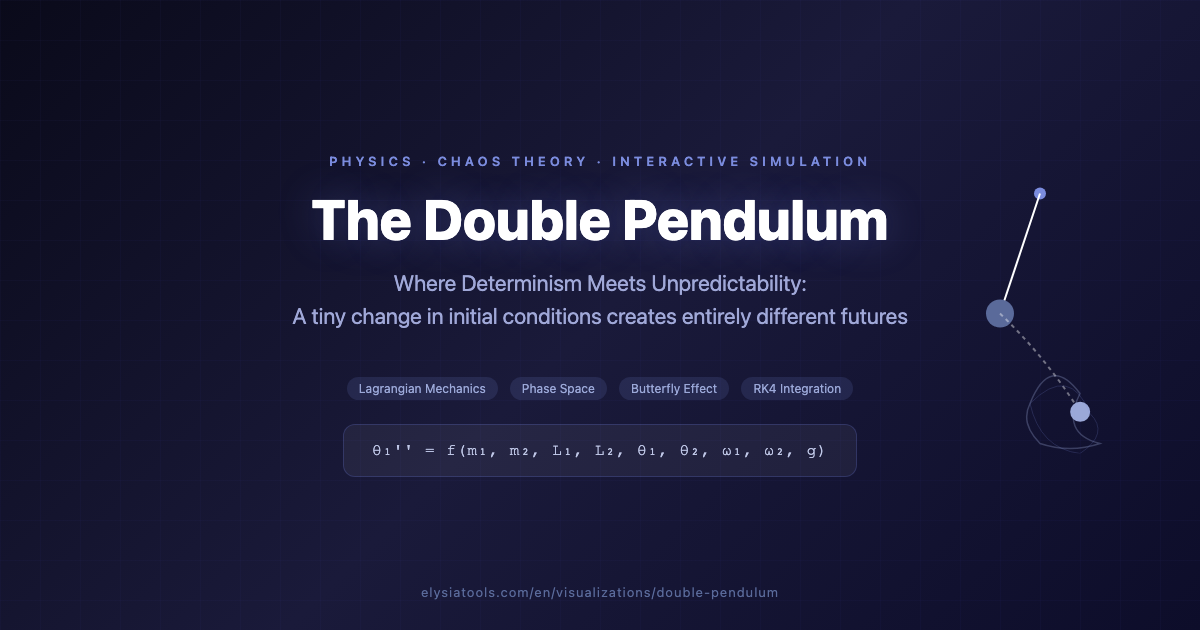
A double pendulum is about as simple as it sounds: take one pendulum — a weight swinging on a rod — and attach a second pendulum to its end. Two masses, two rods, gravity doing what gravity does.
Nothing complicated about the parts. The surprise is what happens when they move together.
Unlike a single pendulum, which swings in a predictable, periodic arc, the double pendulum is chaotic. It doesn’t settle into a repeating pattern. Instead, it traces complex, never-repeating trajectories through space. Give it the exact same starting conditions twice, and you’ll get the same motion — but change those starting conditions by just 0.001 degrees, and after a few seconds, the two pendulums will be doing entirely different things.
The paths have diverged. The futures are no longer the same.
This sensitivity to initial conditions became one of the most famous ideas in science: the butterfly effect. The flapping of a butterfly’s wings in Brazil doesn’t literally cause a tornado in Texas — but the metaphor captures something real. In a chaotic system, small perturbations compound over time until prediction becomes fundamentally impossible, not just practically difficult.
The Mathematics Behind the Chaos
The double pendulum obeys the Lagrangian equations of motion — a reformulation of Newton’s laws that simplifies constrained systems. For a double pendulum, these reduce to two coupled differential equations governing how the angular velocities of each mass change over time.
The equations are deterministic. Given the initial angles (θ₁, θ₂) and angular velocities (ω₁, ω₂) at time t=0, the equations tell you exactly what the state will be at any future moment. There is no randomness, no quantum uncertainty, no mystery.
The chaos isn’t in the physics. It’s in the geometry of the solution.
Here is the core tension: the equations are perfectly deterministic, yet the solutions are unpredictable over long time horizons. This is the paradox of classical chaos. The system is not random — it follows precise rules. But those rules amplify tiny differences in initial conditions exponentially, so that prediction becomes practically impossible even though the underlying mechanics are fully known.
To simulate a double pendulum numerically, you need a method that preserves this delicate dynamics accurately. The standard choice is Runge-Kutta 4th order (RK4) integration — a technique that estimates the solution by averaging four evaluations of the derivative at different points within each time step. Standard Euler integration accumulates error too quickly for chaotic systems; RK4 maintains accuracy over the timescales needed to observe the chaotic behavior.
Phase Space: Where Chaos Becomes Visible
One of the most revealing ways to study a chaotic system is to look at its phase space — a coordinate system where each axis represents one variable of the system. For a double pendulum, you plot θ₁ against ω₁ (the angle and angular velocity of the first mass). As the pendulum swings, the system traces a path through this 2D space.
In a non-chaotic (integrable) system, the phase space trajectory is a closed loop — the system returns to the same state repeatedly, like a planet orbiting a star. In the double pendulum, the phase space trajectory never closes on itself. It fills a region of the space, visiting every point within its reachable domain but never repeating exactly.
This is the geometric signature of chaos: a non-periodic, bounded trajectory that never intersects itself.
When you visualize this phase portrait, you see something remarkable — fractal-like structures emerging from pure mechanics. The boundaries between different regimes of motion are infinitely complex, with nested regions of regularity and chaos at every scale. Zoom in on any boundary, and you find more boundaries, endlessly.
Why Energy Conservation Doesn’t Save Predictability
Here is an intuition that trips up many first-time students of chaos: if total energy is conserved, shouldn’t the system be predictable? Can’t you just account for the energy and know where everything will be?
No — and here’s why.
The total mechanical energy of an ideal double pendulum (no friction, no air resistance) is indeed constant. Kinetic plus potential energy always sums to the same value. But energy conservation alone constrains only the overall magnitude of motion. It says nothing about the sequence of states, the path through phase space.
Think of it this way: if I tell you a car traveled 100 kilometers with constant speed, you know the distance but not the route. It could have driven in circles or gone cross-country. Energy conservation gives you the distance; it doesn’t specify the trajectory.
In the double pendulum, energy is partitioned between the two masses continuously — flowing from kinetic to potential and back, in complex patterns modulated by the coupling between the two swings. This constant exchange, combined with the sensitivity to initial conditions, generates the chaotic dynamics. Energy conservation is real; predictability is not guaranteed by it.
What the Interactive Tool Actually Shows
The Double Pendulum Chaos simulator on ElysiaTools lets you manipulate every physical parameter — masses, rod lengths, initial angles, gravity — and watch the system respond in real time.
Several features are particularly worth exploring:
The Multi-Trail mode launches five pendulums with nearly identical starting conditions (differing by just a few thousandths of a degree). At first, they swing together. After 10-20 seconds, you can see the trails beginning to diverge. After 30 seconds, they’re doing entirely different things. This is chaos made visible.
The phase space plot (θ₁ vs ω₁) shows the trajectory through state space in real time. Watch how it fills a region without ever crossing itself — a visual demonstration of non-periodic bounded motion.
The energy chart tracks kinetic, potential, and total energy as the system evolves. Total energy stays flat (conservation), while kinetic and potential trade off in patterns too complex to predict analytically.
Try this: set both initial angles to 90° and let it run. Then change just the second angle from 90° to 90.5°. Watch the trajectories diverge. That 0.5° difference — less than one percent — produces entirely different paths within seconds.
The Deeper Implication
Laplace’s demon couldn’t exist — not because we can’t measure precisely enough, but because some systems are fundamentally unpredictable no matter how precise your measurements are.
This isn’t a failure of technology. It’s a property of certain dynamical systems. The double pendulum is fully classical — no quantum mechanics, no uncertainty principle, just Newton and Lagrange. And yet it is unpredictable in a deep sense. The obstacle isn’t measurement error; it’s the exponential sensitivity built into the equations themselves.
Edward Lorenz discovered the same phenomenon in weather models in 1961, famously asking whether a butterfly’s wing flap could set a tornado spinning. The answer, refined over decades of chaos research, is more subtle: not every flap causes a tornado, but weather is genuinely unpredictable beyond roughly 10-14 days, not because of computational limits, but because of the chaotic dynamics embedded in atmospheric circulation.
The double pendulum is a laboratory for this idea. A table-top demonstration that deterministic physics does not imply predictable behavior. That complexity can arise from simplicity. That order and chaos are not opposites but dance partners in the mathematics of dynamical systems.
It’s also, incidentally, beautiful. The trails traced by a swinging double pendulum — the way they swirl and fold without ever repeating — are genuinely gorgeous. Chaos has an aesthetic. The double pendulum shows it to you for free.
Try it yourself: Double Pendulum Chaos Simulator — adjust the parameters, enable Multi-Trail mode, and watch determinism fail to predict the future.