# The Algorithm Nature Uses to Grow Lightning, Crystals, and Blood Vessels
In 1981, two physicists ran a computer simulation expecting shapeless blobs. Instead, their program grew a fractal tree that looked exactly like a lightning bolt — and exactly like a coral branch, and exactly like the capillary network inside a human kidney. Thomas Witten and Leonard Sander had stumbled onto one of the most universality-exhibiting growth models in physics: Diffusion-Limited Aggregation. The name barely hints at what it explains.

The Two-Sentence Algorithm Behind Half of Nature’s Complexity
Here is the entire rule: place one particle at the center of a plane. Launch other particles from a circle far outside. Each new particle wanders randomly — Brownian motion, the same jitter you see when pollen grains dance in water under a microscope. When a wandering particle touches the existing cluster, it sticks. Permanently.
That’s it. No master plan. No blueprint. No top-down instruction.

The resulting shape is a fractal tree. No two aggregates look identical. But they all share the same statistical fingerprint — the same fractal dimension, the same branching ratios, the same qualitative character. Physicists call this universality: the details don’t matter as much as the underlying structure.
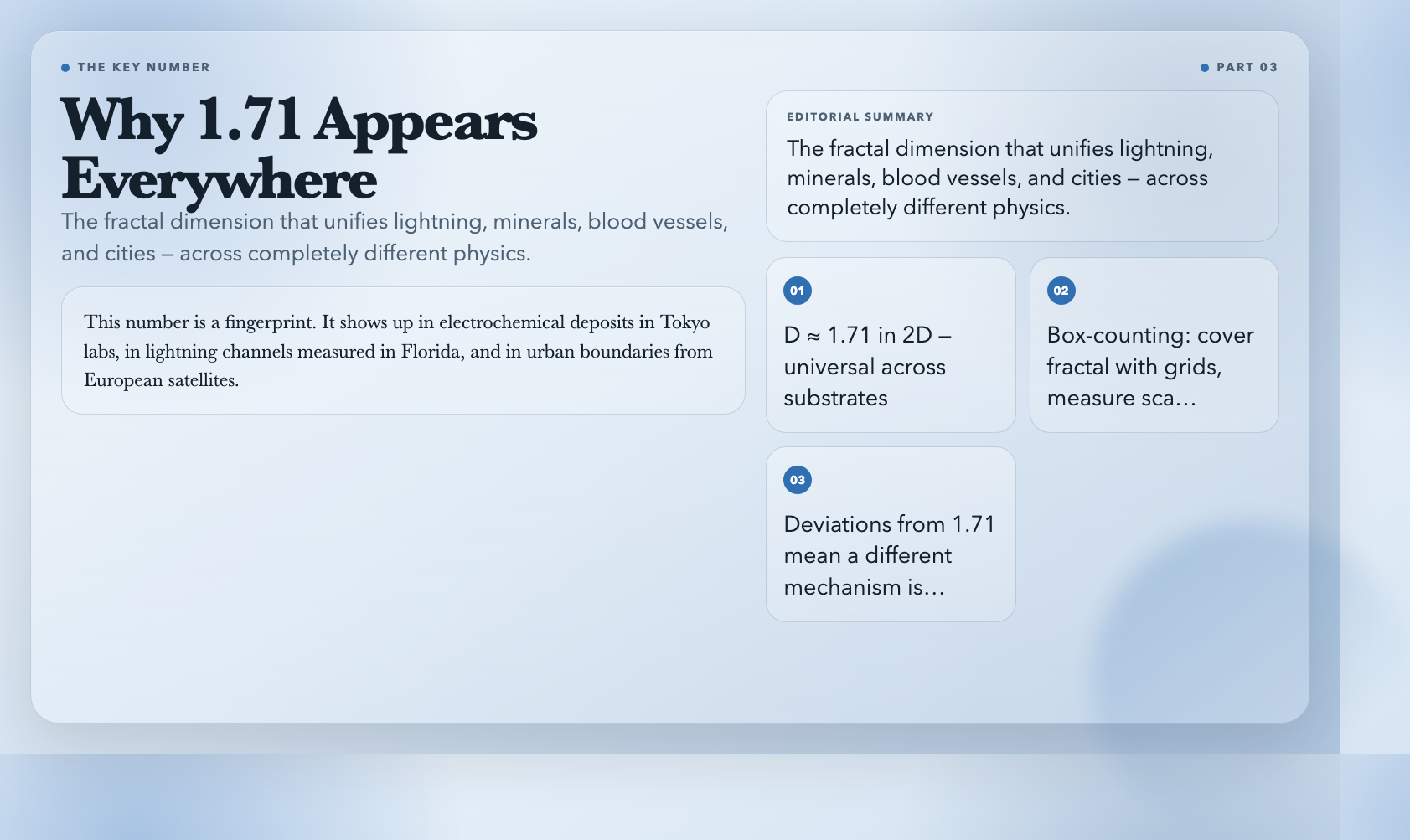
In two dimensions, DLA structures converge on a fractal dimension of 1.71 — regardless of what particles you use, what medium they drift through, or how fast they move. This number is a fingerprint. It shows up in electrochemical deposits in Tokyo labs, in lightning channels measured in Florida, and in urban boundaries traced from European satellite imagery — all confirming the same model.
Watch it happen at Elysia Tools’ DLA visualization. The interactive simulator lets you adjust emission rate, step size, and seed position. The fractal dimension counter in the top right tracks the live estimate as particles accumulate. Start with the Classic preset and watch the aggregate grow — then try Off-Center Seed to see how asymmetry propagates through the branching structure.
Why the Dimension Always Settles at 1.71
DLA structures sit between a line (dimension 1) and a filled plane (dimension 2). They fill space more aggressively than a smoke wisp but never become solid surfaces. The value 1.71 appears across laboratory electrochemical deposits, measured lightning channels, and urban boundary geometries — across completely different physical systems.
The dimension is measured via box-counting: cover the fractal with grids of different sizes, count how many boxes contain part of the structure, and analyze how that count scales with box size. As the aggregate grows, the measured dimension converges toward 1.71. This convergence is so reliable that deviations from it signal a different mechanism is at work — if a dendritic structure shows a dimension of 1.3 or 1.9, something other than DLA drove its formation.
Four Places DLA Shows Up in the Real World
Lightning — Electric current is a random walk of charged particles seeking ground. As ionization propagates through air, it follows the same aggregation logic as DLA. Higher field strength produces more aggressive branching. Laboratory dielectric breakdown experiments in the 1990s — particularly work at the University of Chicago and the International Center for Lightning Research in Florida — confirmed that measured branching dimensions matched DLA predictions within experimental error. No two strikes are identical in detail. All share the same statistical structure. This is DLA dynamics made visible during every thunderstorm.
Mineral dendrites — The branching patterns in polished stones — particularly manganese oxide dendrites in limestone formations — form by DLA-like processes over millions of years. Groundwater carries dissolved metal ions through rock fractures. Where flow velocity drops, ions deposit onto existing surfaces following the sticky-walker rule. The manganese dendrites at the Amitabha Buddha Cave in China, the Lake Superior region deposits, and the dendritic patterns in opal from Oregon all exhibit fractal dimensions between 1.68 and 1.74, consistent with DLA. These were not designed. They emerged from simple chemistry and random motion over geological time.
Vascular biology — The human circulatory system branches from one aorta into arterioles and capillaries in a fractal pattern. These branching angles aren’t genetically specified for every vessel — they emerge from physical constraints: minimize cardiac pumping energy while maximizing oxygen delivery surface area. In 1996, J.B. Bassingthwaighe at the University of Washington demonstrated that the fractal dimension of the human circulatory system measures approximately 1.71 — matching DLA exactly. Biomedical engineers now use DLA-informed models to design vascular grafts and artificial lung structures.
Electrochemical deposition — Run current through a metal salt solution and plate metal onto an electrode. The deposit grows by DLA. Voltage controls the effective diffusion speed of ions: higher voltage means faster diffusion and denser branching. Battery researchers exploit this relationship deliberately, controlling deposit morphology to maximize electrode surface area in lithium-ion and sodium-ion battery designs. The fractal dimension of the deposited structure directly predicts its electrochemical surface area — a key parameter in battery performance.
Urban growth — A 2012 study by researchers at MIT and the Santa Fe Institute analyzed urban boundaries across 50 US cities and found fractal dimensions between 1.65 and 1.78. A 2018 European study found the same relationship across 30 cities. The DLA model captures the emergent geometry of millions of uncoordinated decisions remarkably well — and the deviations from DLA predictions reveal where human planning overrides natural clustering dynamics.
The Intuition Worth Keeping
DLA is a masterclass in emergence. Two rules — wander randomly, stick on contact — produce structures that look designed. The pattern emerges from local interactions with no global blueprint. This is the same logic behind neural network formation during brain development, ant colony trail optimization, and traffic congestion.
Once you understand the algorithm, you see it everywhere. In frost patterns on your window on cold mornings. In the branching of tree roots underground. In the drainage networks on Mars photographed by orbiting satellites. In the coral structures that build entire reefs over centuries. The same rule, running in different physical substrates, producing apparently unrelated phenomena.
The DLA visualization at Elysia Tools builds that intuition fast. Start with the Classic DLA preset and watch the aggregate grow. Increase the emission rate and watch the structure densify. Try the Off-Center Seed preset and watch asymmetry ripple through the branching network. Each setting is a different physical system in disguise.
One more thing worth noticing: the fractal dimension always converges toward 1.71, regardless of your settings. That invariance is the signature of universality — the fingerprint of a rule so fundamental that nature keeps returning to it, across contexts, across scales, across four billion years of evolution.
The question worth sitting with: what other simple rules are quietly building the complex world around you?