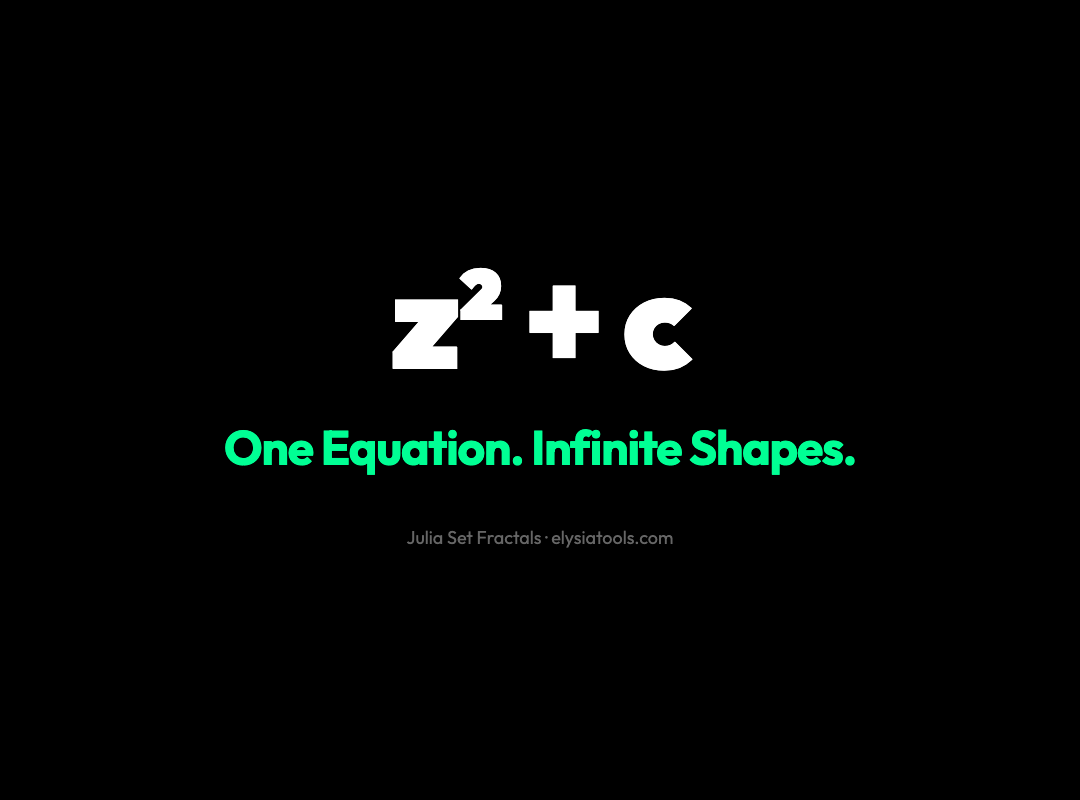
The Fractal That Reveals Why the Same Equation Produces Infinite Different Shapes
There’s a moment when mathematics becomes magic. For most people, that moment doesn’t arrive in a classroom — it arrives when they see a Julia set for the first time.
The equation is absurdly simple: z_{n+1} = z_n² + c. Two variables, one constant, and a square operation repeated hundreds of times. That is the entire machinery. And yet, depending on which complex number you choose for c, this formula will produce a perfect circle, a spiraling galaxy, a fractal rabbit, a dragon mid-flight, or nothing at all — just scattered dust across the complex plane.
The same equation. Infinite faces.
The Difference That Changes Everything
To understand why Julia sets feel like different species of the same creature, you need to understand their sibling: the Mandelbrot set.
The Mandelbrot set asks a deceptively simple question. Take a point c in the complex plane. Set your starting point z₀ = 0. Iterate z_{n+1} = z_n² + c. Does the result stay bounded, or does it fly off toward infinity? Plot every c that stays bounded, and you get the Mandelbrot set — that iconic seahorse-shaped cloud that became a cultural emblem of chaos theory.
The Mandelbrot set is beautiful, but it answers only one question: which c values work?
Julia sets ask a different, more granular question. Now you fix c to a single value. You hold that constant constant. And then you vary the starting point z₀ across the entire complex plane. For each starting point, you ask: does this orbit stay bounded or escape? The set of points that stay bounded — that’s your Julia set.
Same formula. Different experimental setup. And the results are so dramatically varied that mathematicians routinely describe them as belonging to completely different “types.”
A Map of All Possible Universes
Here’s the fact that makes even seasoned mathematicians pause: the Mandelbrot set is a map of all Julia sets.
Every point inside the Mandelbrot set corresponds to a specific Julia set. That seahorse-shaped boundary? Every point on it produces a Julia set with a distinct character. The interior regions — the bulbs attached to the main cardioid — each produce their own families of shapes.
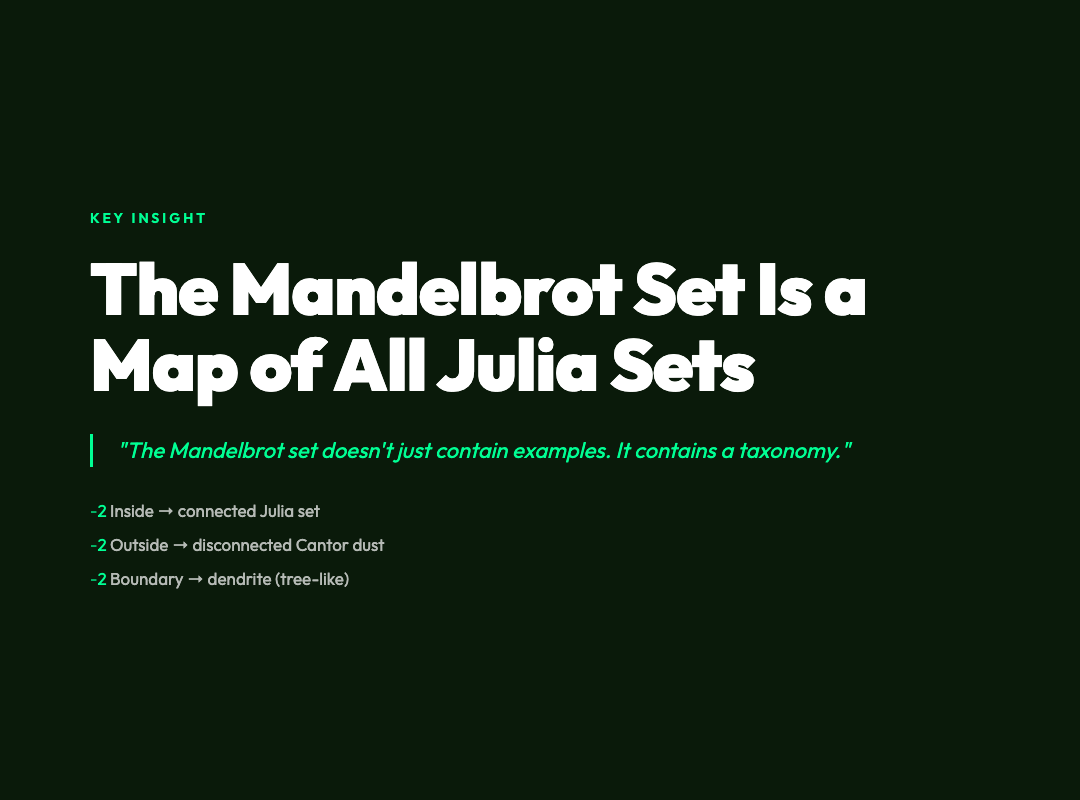
This means you can navigate the entire universe of Julia sets by exploring the Mandelbrot set. Pick a point inside the Mandelbrot set, and you get a connected Julia set — one piece, intact, with intricate filigree at every scale. Pick a point outside the Mandelbrot set, and your Julia set shatters into Cantor dust — an infinite scattering of disconnected points, each one isolated, each one part of a pattern that never coheres. Pick a point on the boundary itself, and you get a dendrite — a tree-like structure that branches infinitely without ever closing into a solid shape.
The Mandelbrot set doesn’t just contain examples. It contains a taxonomy.
The Famous Inhabitants
Mathematicians have mapped enough of this territory to have favorites. Here are the ones that keep appearing in textbooks, art installations, and generative visualization tools — because they are genuinely stunning.
The Circle (c = 0). The simplest possible Julia set. Fix c = 0, and the formula becomes z_{n+1} = z_n². Every point on the unit circle stays on the unit circle forever. Every point inside collapses toward zero. Every point outside flies outward. The result is a perfect, pristine circle — the baseline case from which all other Julia sets are deviations.
Douady’s Rabbit (c = −0.8 + 0.156i). This is the crowd-pleaser. The shape looks exactly like a rabbit — two large ears, a compact body, and a tail. It was discovered and named by Adrien Douady, one of the pioneers of complex dynamics. If you want to show someone what a Julia set is and why it matters, you show them the Rabbit.
The Dragon (c = −0.835 − 0.2321i). Unlike the Rabbit’s cheerful geometry, the Dragon has an aggressive, angular quality. It twists and folds on itself, creating sharp ridges that branch and rebranch. It feels less like an animal and more like a force — a crystalline storm frozen mid-eruption.
The Spiral (c = 0.285 + 0.01i). A quieter Julia set. The iteration draws orbits that curve gently inward, forming spirals within spirals. There’s something meditative about it — a mathematical shape that seems to breathe.
The Dendrite. Not a single point but a category: any c chosen on the boundary of the Mandelbrot set produces a dendrite. These are tree-like structures with no solid interior — just infinitely branching lines that never close. They look like frost on a window, or lightning seen under a microscope.
The Siegel Disk. A rare and delicate case where the rotation at the center is periodic, creating closed rings within the set. These are technically difficult to find numerically, which makes them feel like hidden chambers in a vast fractal palace.
The Boundary Problem
If there is a single idea that captures why Julia sets are inexhaustible, it is this: the boundary contains infinite complexity.
For any well-behaved mathematical shape, the boundary is usually simpler than the interior. A circle’s boundary is just a one-dimensional curve. A square’s boundary is four line segments. But Julia set boundaries are not well-behaved. Zoom in on any section of the boundary, and you find structure. Zoom in further, and you find more structure. There is no resolution at which the detail runs out.
This is what it means for a shape to be a fractal: it is never fully resolved. No matter how deep you go, there is more to see.
And the boundary of a Julia set is itself a fractal — in fact, it is the Julia set itself. The boundary and the set are the same object viewed from different angles. You cannot separate them. You cannot simplify them.
This creates a practical problem for visualization and a philosophical one for mathematics. Every pixel you render is a question about infinity. Every zoom reveals that the question has not been answered — only restated at a smaller scale.
Why This Matters Beyond Beauty
Fractals like Julia sets are not merely mathematical curiosities. They appear in nature: in coastlines, in lightning bolts, in the branching of neurons, in the shapes of snowflakes and ferns. The same property that makes Julia sets inexhaustible — self-similarity at every scale — is the property that makes natural forms feel rich and complex rather than simple and thin.
Understanding the Julia set equation is, in a small way, understanding why complexity exists. The formula does not need to be complicated to produce complicated results. The complexity is embedded in the iteration — in the feedback loop where every output becomes the next input. One step is simple. A thousand steps are not.
This is also why interactive visualization is not just a gimmick for exploring Julia sets — it is the only honest approach. Static images cannot convey the experience of moving through parameter space, of watching the shape morph as c changes, of feeling the sudden discontinuity when c crosses from inside the Mandelbrot set to outside. You have to move. You have to choose points and see what happens.
Explore It Yourself
The formula z_{n+1} = z_n² + c is not difficult to understand. But the territory it opens up is. Every point in the complex plane is a door. Some doors lead to circles. Some to rabbits. Some to dragons. Some to nothing at all.

You can explore this territory directly with the ElysiaTools Julia Set visualization
The question worth sitting with is this: if the same equation can produce a circle, a rabbit, and a dragon — what else is hiding in the complex plane, waiting for the right point to be chosen?
There is only one way to find out.
Explore the Julia Set visualization at elysiatools.com/en/visualizations/julia-set.