Why a 1963 Computer Glitch Gave Us the Most Beautiful Equation in Chaos Theory
In 1963, Edward Lorenz was rerunning a climate simulation on a Royal McBee—a room-sized computer that processed roughly 60 operations per second. To save time, he entered initial values from a printout, keeping three decimal places instead of the original six. What happened next broke meteorology forever.
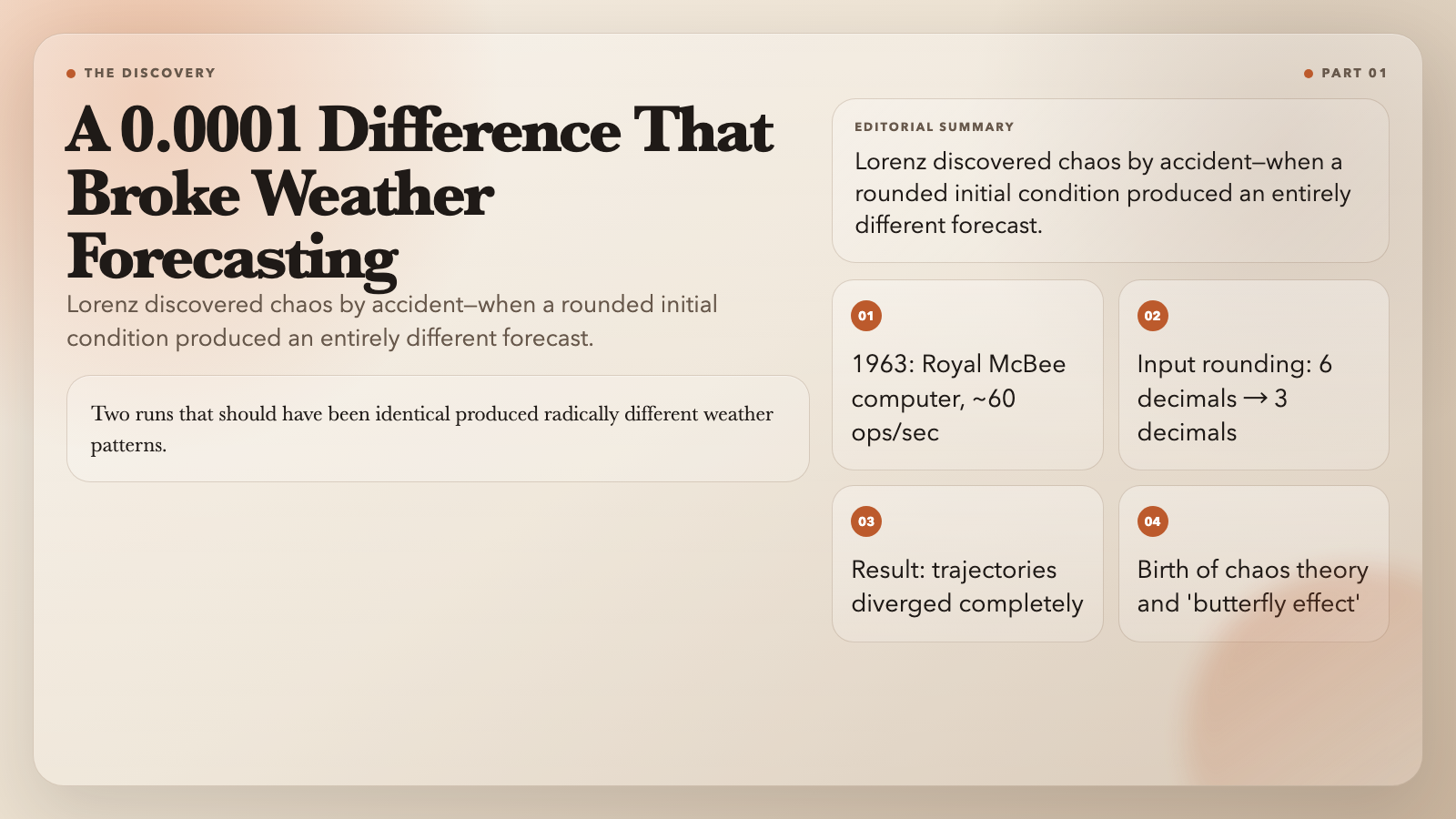
The simulation diverged. Not slightly—completely. Two runs that should have been identical produced radically different weather patterns. The cause: a difference of 0.0001 units in the initial conditions.
That glitch became the Lorenz attractor—and the phrase “butterfly effect.”
#
What You’re Actually Looking At
The Lorenz attractor is a 3D fractal that emerges from three linked differential equations:
“`
dx/dt = σ(y – x)
dy/dt = x(ρ – z) – y
dz/dt = xy – βz
“`
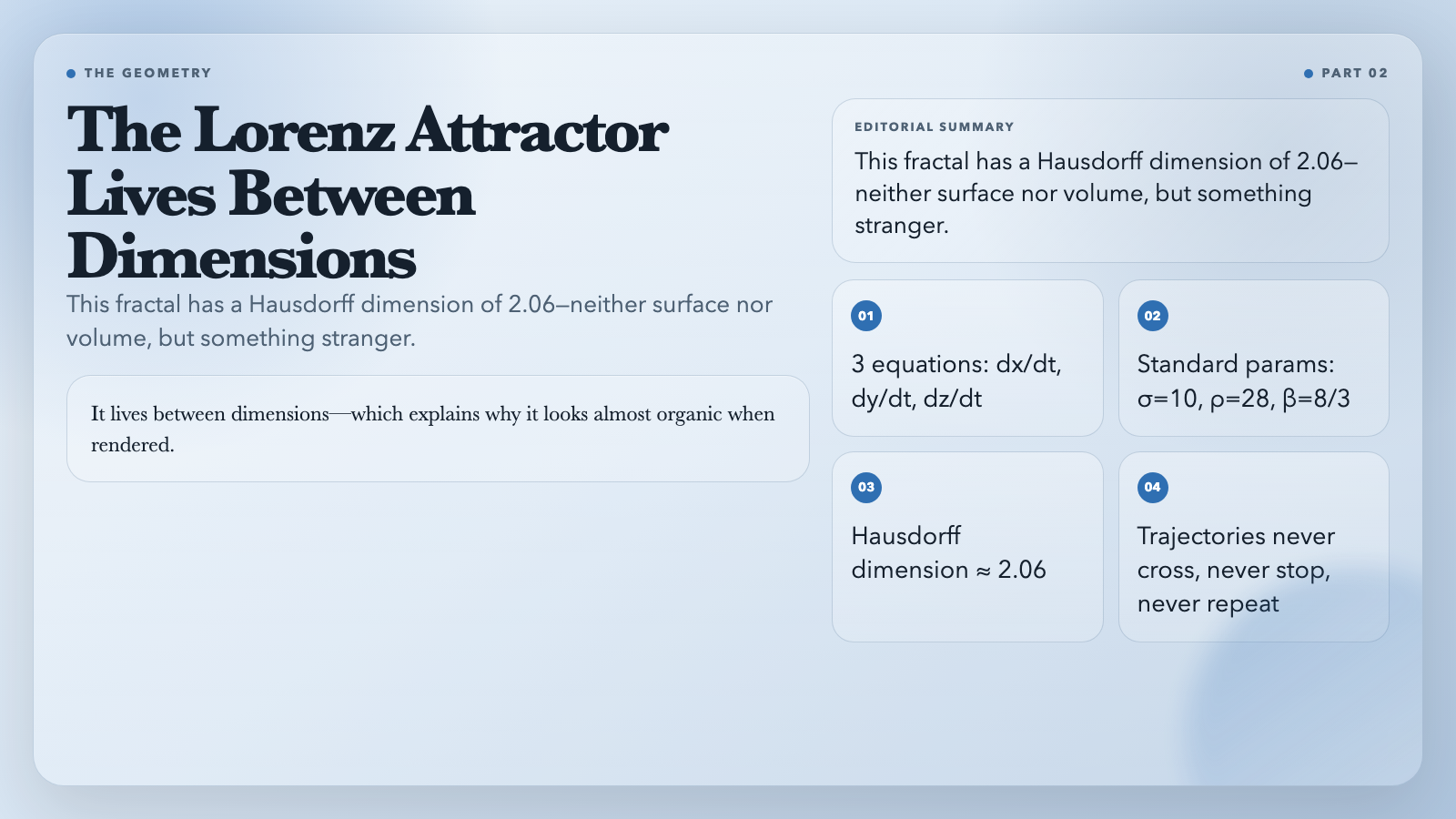
With standard parameters (σ = 10, ρ = 28, β = 8/3), this system never settles, never repeats, never crosses itself—and never stops. The trajectory weaves forever within a bounded region, tracing out that distinctive double-spiral.
The strange part: its Hausdorff dimension is approximately 2.06. It’s neither surface nor volume. It lives between dimensions—which explains why it looks almost organic when rendered.
#
The Butterfly Effect, Quantified
Lorenz didn’t just discover chaos. He measured how fast two trajectories diverge. With standard parameters, the system’s Lyapunov exponent is positive (~0.9056 per unit time). Two points 0.0001 units apart will have their distance grow by a factor of e every 1.1 time units.
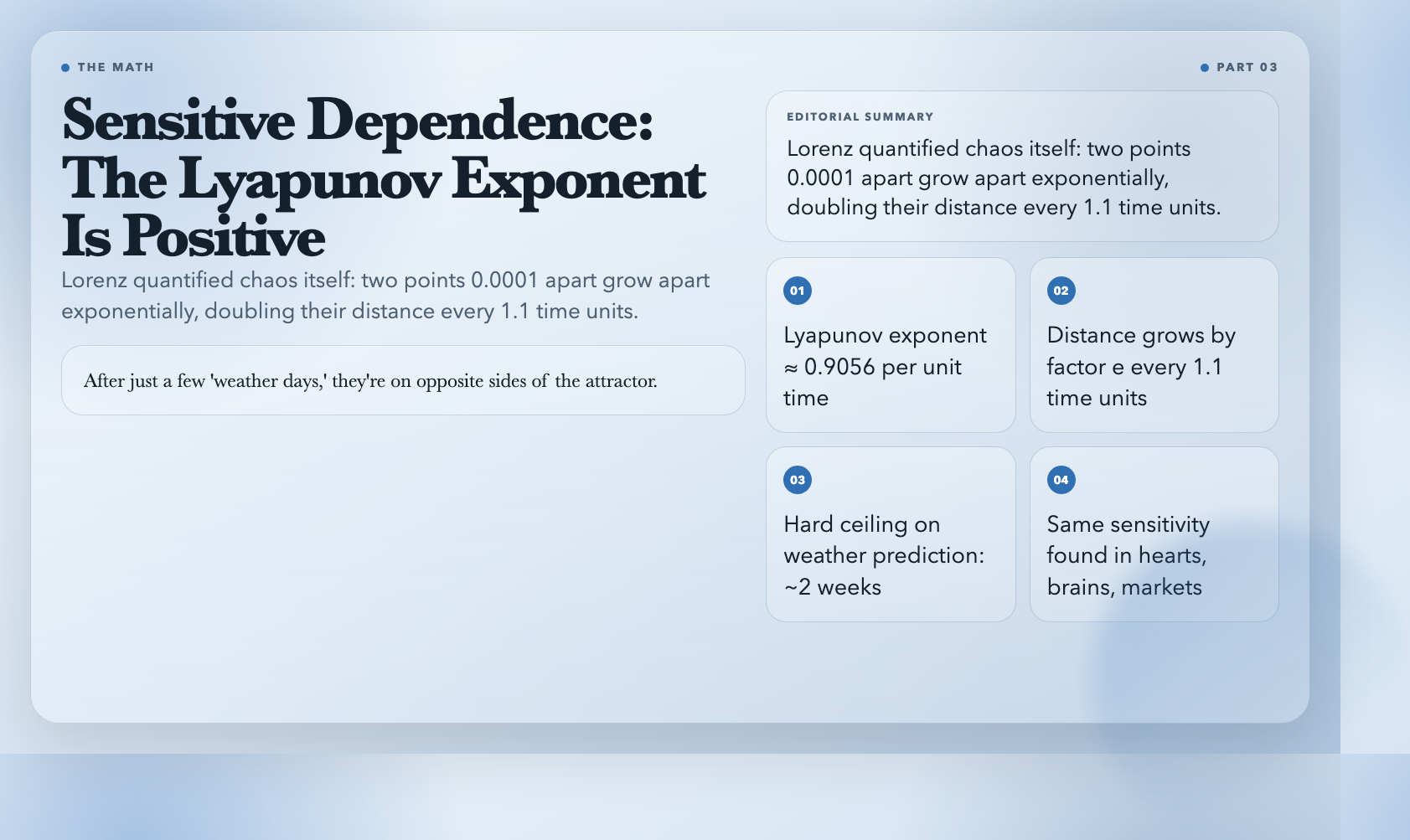
After just a few “weather days,” they’re on opposite sides of the attractor.
This isn’t academic. It means weather prediction has a hard ceiling. In 1961, Lorenz estimated that a two-week forecast was the limit—given the best possible initial data. We’re still essentially there. We can model climate (30-year averages), but we can’t predict whether it’ll rain on your wedding day three weeks from now.
#
What This Tool Actually Shows You
The Lorenz Attractor does something textbooks can’t: it lets you touch chaos.
Parameter sweep: Adjust σ, ρ, and β. Watch the attractor morph. Push ρ below 1 and trajectories collapse to a point. Push it past 24.74 and chaos erupts. This is the Feigenbaum constant appearing in real time—the same number that governs population explosions, electronic oscillations, and fluid turbulence.
Compare Traces: Start two particles from positions differing by 0.001 unit. Watch them diverge in real time. This is the most visceral demonstration of sensitive dependence I’ve found in any interactive tool.
Self-similarity at every scale: Zoom into any region and you’ll find smaller versions of the attractor. Zoom again—more structure. This fractal property means infinite complexity encoded in three equations.
#
Why Chaos Keeps Showing Up Everywhere
The Lorenz attractor isn’t a mathematical curiosity. The same structure appears in:
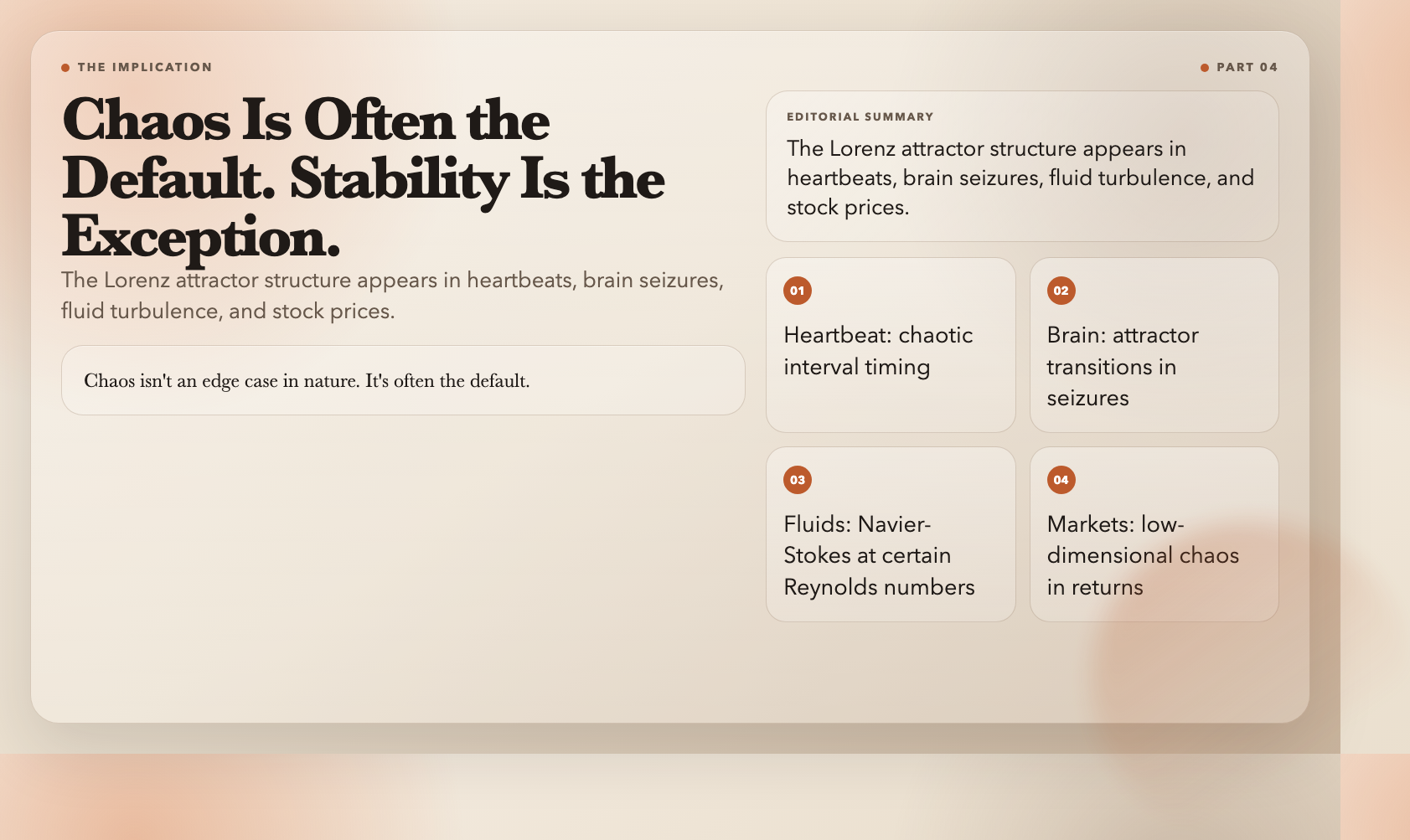
– Heartbeat dynamics: The time between beats isn’t periodic—it’s chaotic, following attractor-like geometry
– Brain activity: Epileptic seizures and Parkinsonian tremors both show characteristic attractor transitions
– Fluid turbulence: The Navier-Stokes equations contain Lorenz-like dynamics at certain Reynolds numbers
– Stock prices: Financial returns show low-dimensional chaos masked by noise
This breadth suggests something uncomfortable: chaos isn’t an edge case in nature. It’s often the default. Stable equilibrium is the exception, not the rule.
#
The Question We Still Can’t Answer
Here’s what still bothers mathematicians: why is the Lorenz attractor so structurally stable? Small parameter changes deform it but don’t destroy its essential chaotic character. The system seems to have a basin of attraction around chaos itself.
We don’t fully understand why. But we know this: cross certain parameter thresholds and the attractor suddenly collapses into periodic behavior, or explodes into wild divergence. There’s a geometry to chaos we’re still mapping—and it’s beautiful.
What we do know with certainty: a butterfly’s wing flap changes everything—eventually. We just can’t tell you exactly when.