The Algorithm That Keeps the World Stable: Why PID Control Is the Quiet Engine of Modern Engineering
The Three-Number Trick That Runs Everything
Every time you set a thermostat, accelerate in a car with cruise control, or watch a drone hover in place, you’re watching three numbers do impossible work.
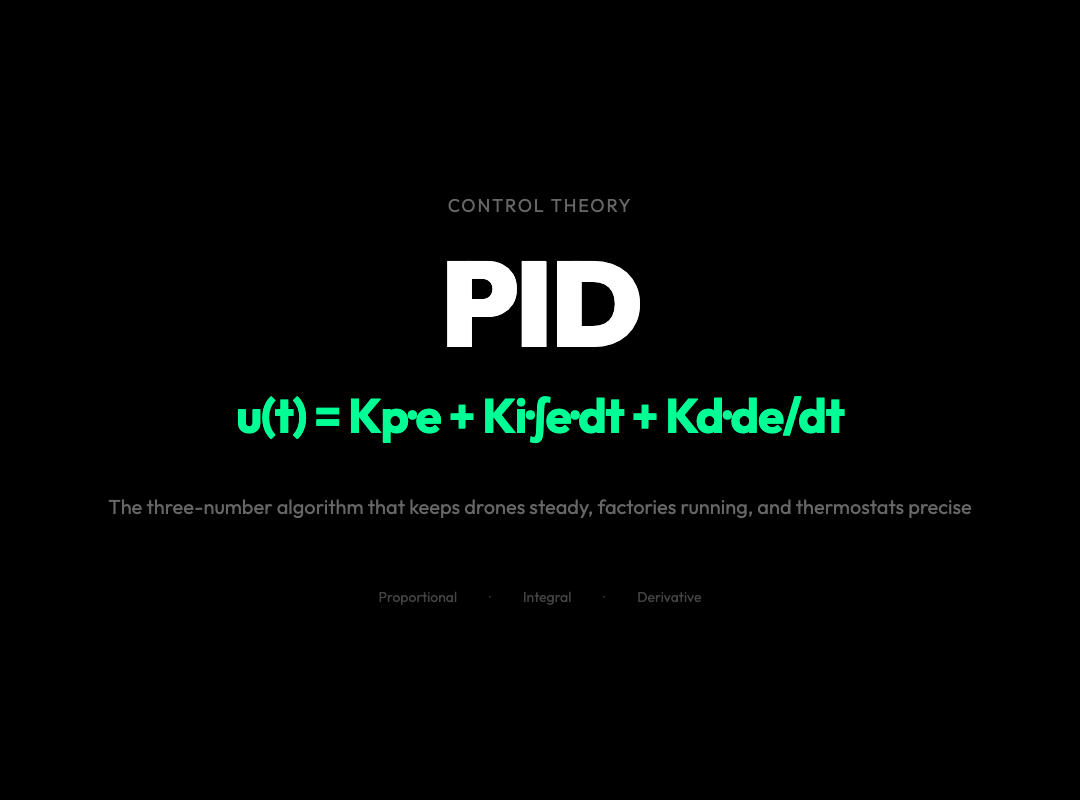
Those three numbers — Kp, Ki, and Kd — form the PID controller, the most widely deployed control algorithm on Earth. It runs in your car’s anti-lock braking system, inside every CNC machine, inside the temperature regulator that keeps your CPU from melting, and inside the quadcopter that just delivered your package. The formula is deceptively simple:
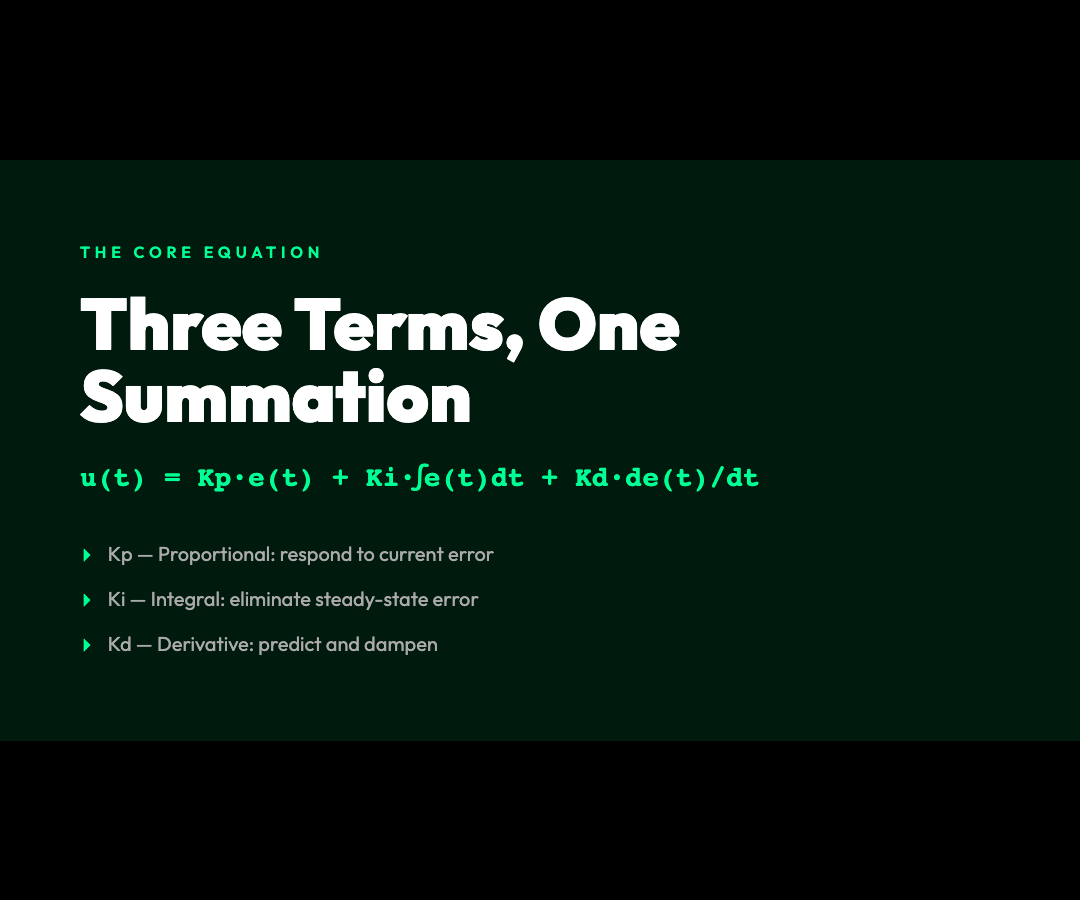
u(t) = Kp·e(t) + Ki·∫e(t)dt + Kd·de(t)/dt
But don’t let the clean notation fool you. Getting those three terms to work together — rather than fight each other — is the art form that separates a good engineer from a great one.
Why “Just Adjusting” Is a Skill
The canonical PID tuning advice you find in textbooks sounds almost patronizing: “Start with Kp around 1-3, add Ki if you see steady-state error, add Kd last if you see oscillation.” This is technically correct. It is also completely useless unless you understand why each parameter causes what it causes.
Here’s what actually happens when you turn the knobs:
Kp alone — Crank it up and your system responds faster. But push too hard and the output overshoots, then oscillates. The system starts hunting: over-correction, under-correction, over-correction again. Anyone who has seen a stock price or a thermostat “hunt” has witnessed this firsthand.
Ki added — This is what eliminates the steady-state error. That gap between where you are and where you want to be — the persistent offset that proportional control alone can never close. But Ki accumulates over time, and accumulation means inertia. Too much Ki and the system overshoots badly, oscillating for seconds before settling. Too little and the gap closes so slowly you wonder if it’s doing anything at all.
Kd added — This is the lookahead term. It doesn’t care about where you are or how far you’ve drifted. It cares about how fast you’re approaching the target and pushes back accordingly. High Kd smooths out oscillations but amplifies sensor noise — the derivative term, by definition, magnifies rapid changes, and noise is made of rapid changes.
The result is a three-way tug-of-war where each term’s benefit is another term’s liability. Getting them to cooperate is the craft.
The Engineering Intuition Behind Every Knob
What’s remarkable is that the PID controller gives engineers a direct physiological analogy for each term:
– Proportional is like pushing a swing. The harder you push (relative to how far off you are), the faster you close the gap.
– Integral is like remembering. It holds a running total of every miss — every moment the system fell short — and keeps applying pressure until the debt is paid.
– Derivative is like braking. It’s the dampening force that says “slow down, you’re approaching fast, don’t overshoot.”
This three-part architecture is so natural that many engineers develop an intuitive feel for PID behavior before they ever write the math down. The formula just codifies what the intuition already predicted.
The Step Response: Reading a System’s Soul
If you want to understand a PID-tuned system, watch how it responds to a step input — a sudden change from one steady state to another. That single curve tells you almost everything.
A well-tuned step response has a characteristic shape: a quick initial rise, a modest overshoot, a small undershoot as it bounces back, and then convergence. The metrics that matter are:
– Rise time — how quickly it gets near the target – Overshoot — how far it went past before reversing – Settling time — how long until it essentially stops moving – Steady-state error — the final gap between where it landed and where you wanted
Each PID parameter maps directly to these metrics. Kp governs rise time. Kd controls overshoot. Ki eliminates steady-state error but inflates settling time. The engineering insight is that these goals are partially in conflict — you cannot simultaneously minimize rise time and overshoot. Every tuning decision is a compromise.

The Disturbance Rejection Test
If step response is the audition, disturbance rejection is the performance.
A disturbance is an external force that pushes the system away from its target after it’s already settled. In a temperature controller, it’s a door opening in winter. In a motor speed controller, it’s a load change. In a drone, it’s a wind gust.
A system that tracks setpoints beautifully but collapses under disturbances has not actually been tuned — it’s been optimized for a fantasy. Real-world PID tuning tests the system by adding disturbances mid-operation and watching how hard it fights to return. This is where the derivative term earns its keep: it provides proactive correction rather than reactive correction, sensing the drift and responding before the error grows large.
The PID controller’s ability to handle disturbances is what makes it ubiquitous. Every control problem that matters in the real world involves disturbances — not just setpoint tracking in a lab.
Why It Hasn’t Been Replaced
Modern control theory offers more sophisticated approaches: state-space control, model predictive control, adaptive control. These methods can outperform PID in specific high-complexity scenarios. So why is PID still in virtually every industrial controller, every embedded system, every consumer device?
Three reasons:
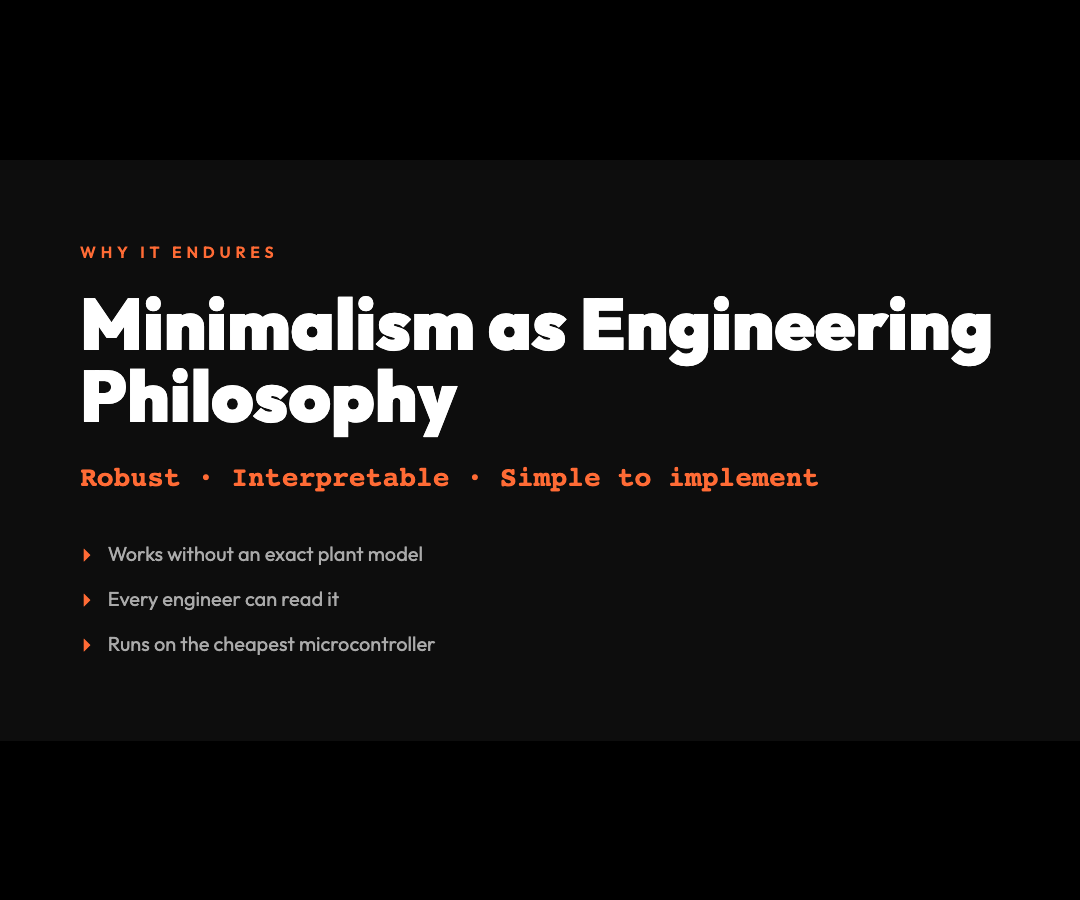
Robustness. A well-tuned PID loop is remarkably tolerant of modeling errors. It doesn’t need an exact mathematical model of the plant — it observes behavior and adjusts accordingly.
Interpretability. Every engineer can look at a PID loop’s three parameters and understand immediately what’s happening. This is not true of a neural network controller or a state-space observer.
Implementation simplicity. A PID controller can be implemented in a few lines of code, runs on the cheapest microcontroller, and requires no cloud connectivity or machine learning infrastructure. For the vast majority of real-world control problems — ones where the dynamics are well-understood and the cost pressures are real — PID is the right tool.
The Interactive Laboratory
The PID Controller Visualizer on ElysiaTools lets you test these relationships directly. You can:
– Apply step inputs and sine waves and watch the response curve form in real time – Add disturbances mid-simulation and observe the recovery – Tune Kp, Ki, and Kd with sliders and see the effect on overshoot, rise time, and settling time – Switch between different system configurations
What makes the visualization particularly instructive is that it shows all three PID components separately: the proportional, integral, and derivative contributions to the output signal, displayed as stacked traces. You can see the derivative term dampening the approach as the output closes in, and watch the integral term fighting to eliminate that last bit of steady-state error.
The Algorithm That Asks Nothing and Does Everything
PID control is one of those rare pieces of engineering that has no single inventor. It emerged organically across multiple industries in the early 20th century — pneumatic controllers, hydraulic systems, early process control in chemical plants — and converged on the same three-term architecture because it was the minimal structure that worked.
That minimalism is part of its genius. Three parameters. One summation. The entire visible world of control theory, running on hardware that predates the transistor.
The next time you set your thermostat to 72°F, watch a robot arm assemble something with inhuman precision, or hold a drone steady against the wind, consider the three numbers doing their work silently in the background. They ask for nothing — no machine learning, no cloud compute, no training data. Just the right tuning, and the patience to understand what each knob really does.
That’s the quiet elegance of PID control. It doesn’t try to be clever. It just works.