The One Law of Physics That Explains Why Time Flows Forward
You cannot unscramble an egg. You cannot unburn toast. You cannot push spilled milk back into the glass.
These aren’t just metaphors — they are manifestations of a single law that governs every physical process in the universe. It’s called entropy, and it might be the most profound insight in all of physics.
What Entropy Actually Means
Most explanations of entropy start with disorder. That’s misleading. Entropy is fundamentally about information — specifically, how many possible configurations a system can occupy.
Consider a room with ten particles. If all particles cluster in the left corner, there’s only one way to arrange them that looks the same to our eyes. But if they’re spread randomly across the room, there are astronomically more configurations that produce that same macroscopic appearance.
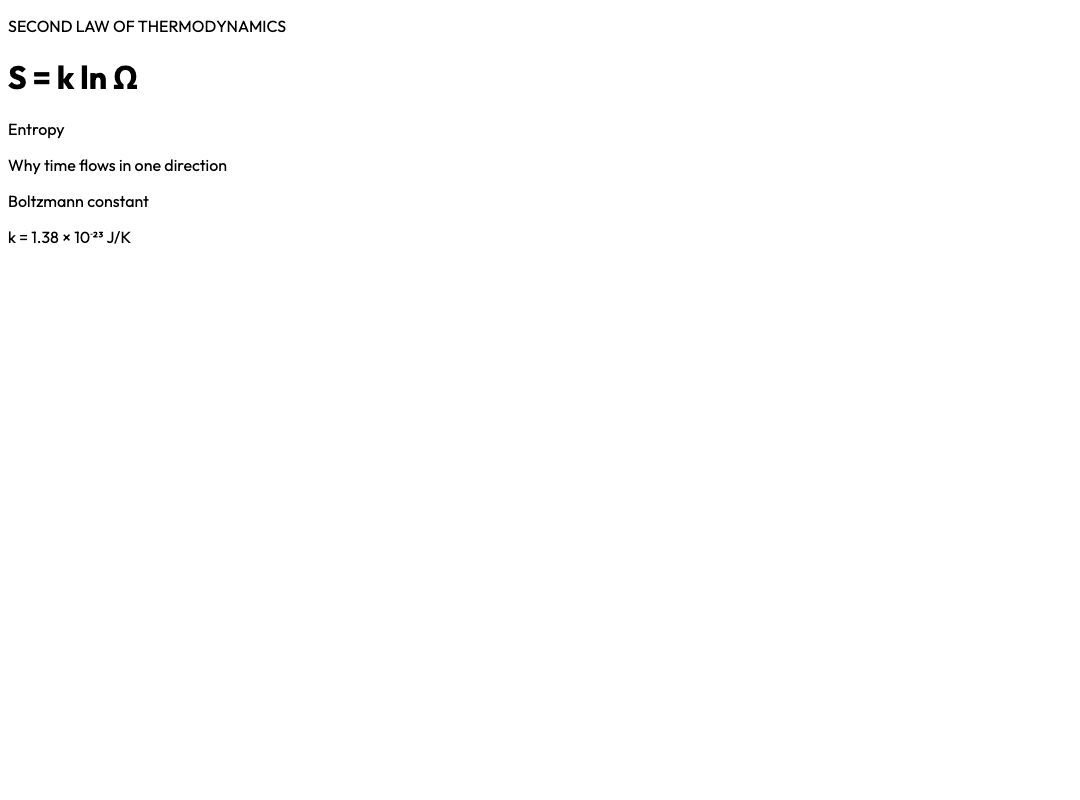
Entropy measures this mathematically. The Boltzmann formula expresses it as:
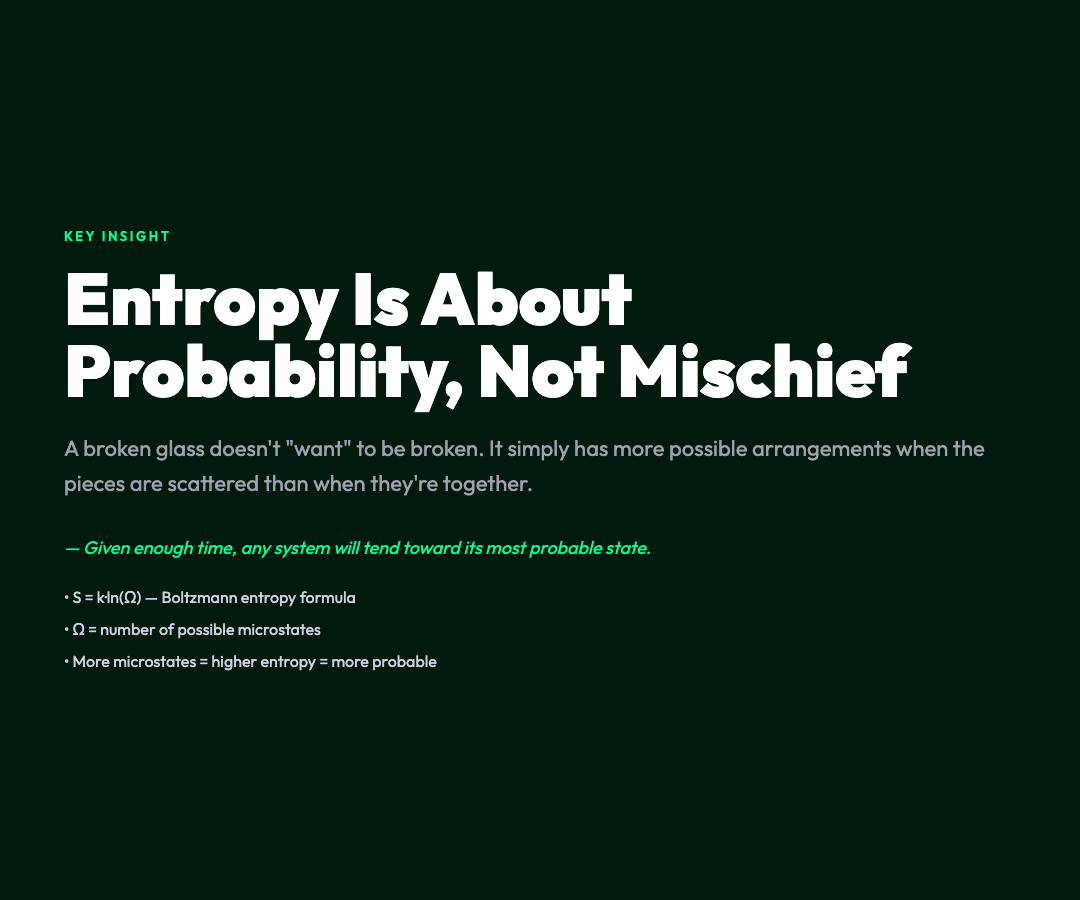
S = k·ln(Ω)
Where Ω is the number of microstates — the count of possible microscopic arrangements that produce the same macroscopic picture. When Ω is small, entropy is low and the system is ordered. When Ω is large, entropy is high and the system is disordered.
A broken glass doesn’t “want” to be broken. It simply has more possible arrangements when the pieces are scattered than when they’re together. Given enough time, any system will tend toward its most probable state — which is what we call increasing entropy.
The Second Law: More Than Just “Disorder Increases”
The Second Law of Thermodynamics states that in an isolated system, entropy never decreases. This isn’t a suggestion or a trend — it’s a mathematical necessity that emerges from statistics.
But here’s what most people miss: entropy doesn’t forbid local decreases. You can freeze water into ice, which is more ordered (lower entropy). Living organisms maintain low-entropy states for years. Civilizations build monuments.
What the Second Law demands is that total entropy must increase. Local pockets of order can form, but only by exporting entropy elsewhere. When you freeze ice, you release heat to the surrounding air — and that air’s entropy increase exceeds the ice’s entropy decrease.
The universe plays a zero-sum game. Every local victory is paid for with interest somewhere else.
Maxwell’s Demon: The Paradox That Wasn’t
In 1867, James Clerk Maxwell proposed a thought experiment that seemed to violate the Second Law. Imagine a demon standing at a door between two gas chambers. The demon can see individual molecules. It opens the door to let fast molecules through one way and slow molecules the other way — cooling one side and heating the other.
If this worked, it would decrease entropy without compensation. The Second Law would be broken.
The resolution came 115 years later, from physicist Rolf Landauer. The demon must measure each molecule to determine its speed. Measurement requires information. And information, once erased, has a thermodynamic cost.
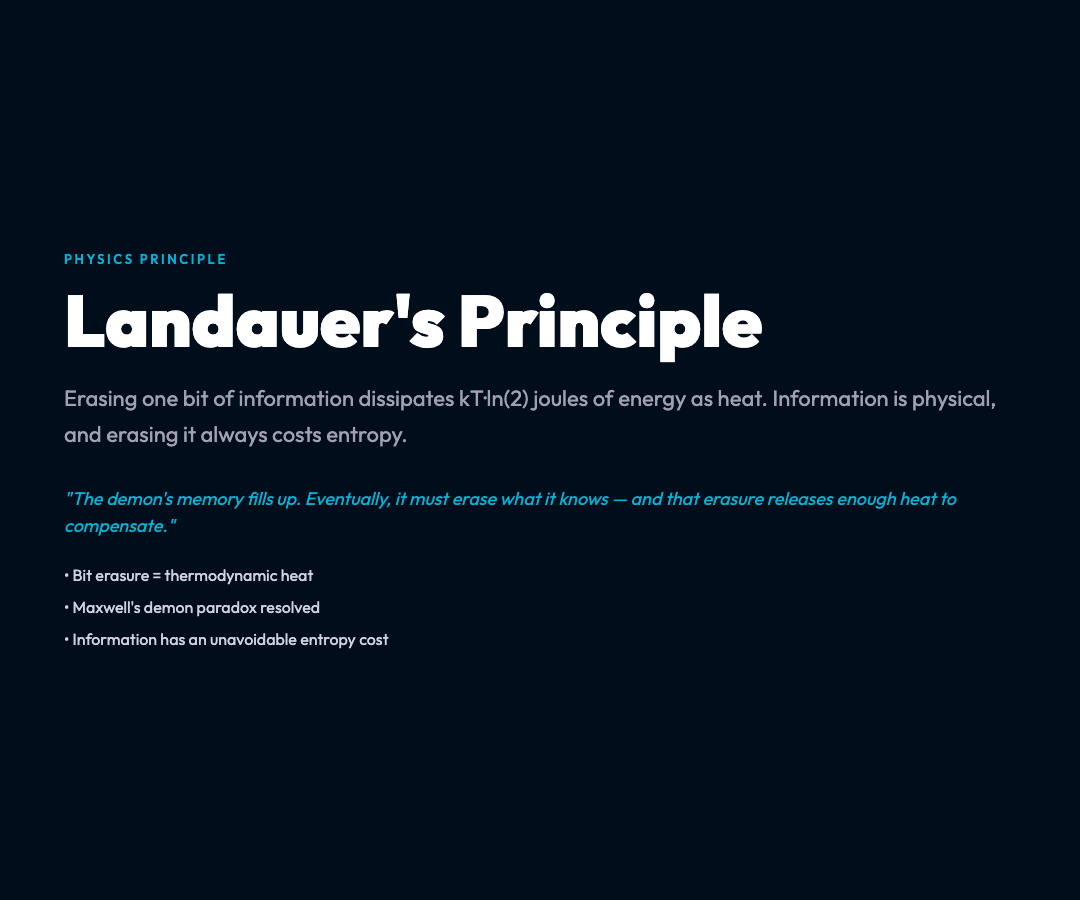
Landauer’s principle: Erasing one bit of information dissipates kT·ln(2) joules of energy as heat. The demon’s memory fills up. Eventually, it must erase what it knows — and that erasure releases enough heat to compensate for the entropy reduction.
The Second Law survives. Information is physical, and manipulating it has an unavoidable entropy cost.
Why Time Flows in One Direction
Entropy doesn’t just describe physical processes — it explains the arrow of time.
The fundamental equations of physics are time-symmetric. An electron can go forward or backward in time; the math doesn’t care. But humans definitely experience time in one direction. Why?
Because entropy provides the distinction.
At the Big Bang, the universe started in an extraordinarily low-entropy state — hot, dense, and uniform. Every low-entropy state is special; it constrains what can happen next. As entropy has increased, the universe has evolved toward increasingly probable configurations.
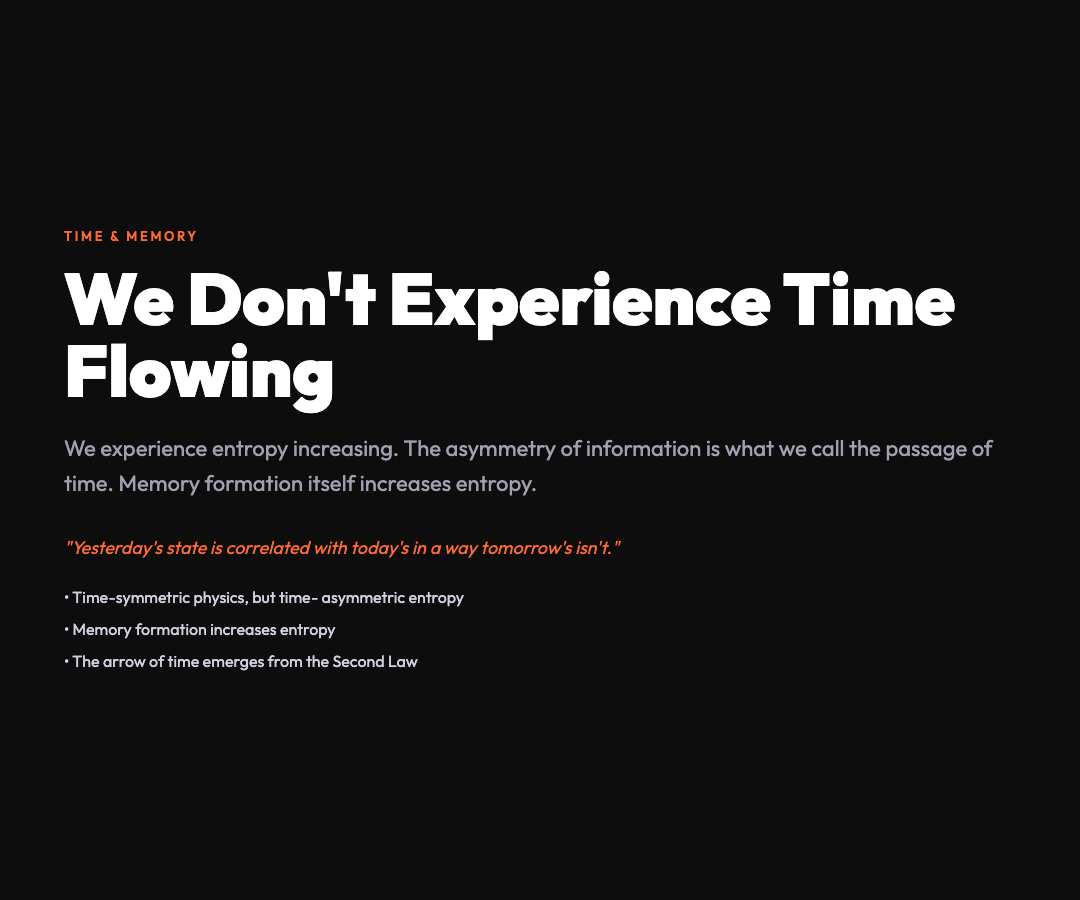
Yesterday’s state is correlated with today’s in a way tomorrow’s isn’t. This asymmetry of information is what we experience as the passage of time.
The fact that we remember yesterday rather than tomorrow isn’t a quirk of neuroscience — it’s a consequence of the Second Law. Memory formation involves physical processes that increase entropy. A brain that could remember future events would need to decrease entropy, which violates thermodynamics.
We don’t experience time flowing. We experience entropy increasing.
Practical Consequences
The Second Law isn’t just philosophical. It sets hard limits on what machines can do:
Heat engines cannot be 100% efficient. Some heat must be exhausted. The Carnot efficiency limit — achievable only by reversible processes — defines the theoretical maximum.
Refrigerators require work input. Moving heat against its natural direction costs energy. The better a refrigerator is at cooling, the more electricity it consumes.
Living organisms are fighting entropy constantly. Your body maintains low entropy through metabolism — you eat ordered food and excrete high-entropy waste. Death occurs when this process fails and your molecules disperse toward thermal equilibrium.
Information processing has a minimum energy cost. Computation generates heat. Modern computers dissipate megawatts partly because we constantly overwrite data, each erasure creating thermodynamic entropy.
These aren’t engineering limitations waiting for better technology. They are consequences of fundamental physics.
The Cost of Local Order
Here’s the uncomfortable truth: every structure humans build comes at entropy’s expense.
A city is an extraordinary ordering of matter. Skyscrapers, bridges, computers — all represent dramatic local entropy reductions. But constructing them consumes energy, which exports entropy to the environment. Running them continues the process.
The low-entropy energy we use (oil, food, nuclear fuel) comes from ancient deposits of organized matter. Burning them disperses that organization into atmospheric heat. The waste heat warms the planet. The entropy accumulates.
This is why “energy conservation” and “entropy” tell different stories. Conserving energy is trivial — energy is never lost, only transformed. What we’re actually depleting is low-entropy energy, the kind that can do useful work. Once energy disperses to thermal equilibrium, it becomes useless for powering civilization, regardless of how much of it exists.
What Entropy Tells Us About the Future
The universe ends in heat death — not because fire consumes everything, but because all energy eventually disperses uniformly. No temperature differences means no potential to do work. No further processes. A maximum-entropy equilibrium lasting essentially forever.
This isn’t a comforting picture. But it’s the logically inevitable consequence of the Second Law applied over sufficiently long timescales.
The stars will burn out. Galaxies will drift apart. Matter will decay. Eventually, even black holes will evaporate via Hawking radiation, distributing their mass across an unfathomably vast space.
What survives is entropy — the final bookkeeping of every process that ever occurred, spread thin across an expanding void.
Why This Matters Now
Understanding entropy changes how you think about information, time, and complexity. It explains why some processes are irreversible and others aren’t. It clarifies why “waste” is not just an engineering problem but a physical inevitability. It reveals that memory, causation, and the direction of time are not separate mysteries — they share a common root.
You cannot unburn toast. The carbon atoms in the charred surface have diffused into configurations that are statistically overwhelming. The information about the bread’s original molecular structure has been erased, and erasing information generates entropy.
The universe’s bias toward disorder is not a cosmic injustice. It’s the mechanism by which time itself acquires direction, by which cause precedes effect, by which yesterday becomes fixed and tomorrow remains open.
That is what entropy is: the fingerprint of time’s arrow, etched into every physical process, from the quantum vacuum to the crunch of your breakfast.
Try the interactive Entropy and the Second Law of Thermodynamics visualization to explore particle diffusion, Maxwell’s demon, and the time evolution of entropy — all in your browser.