
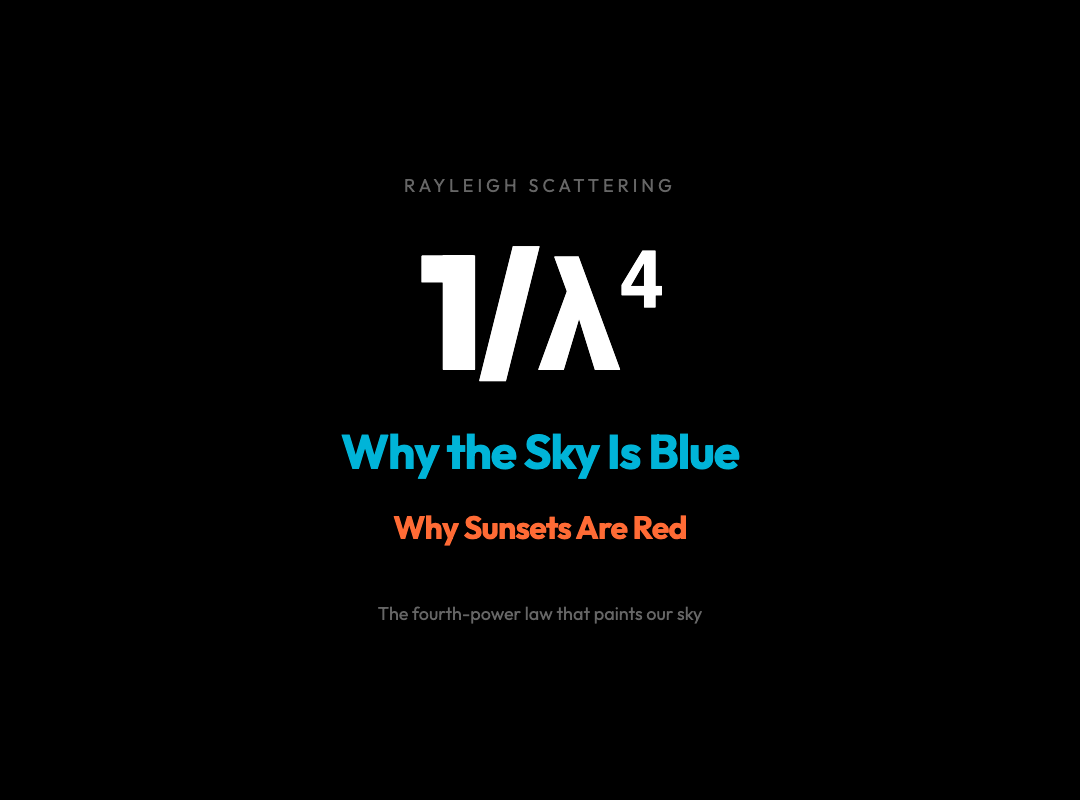
Why the Sky Is Blue and Sunsets Are Red: The 1/λ⁴ Law Behind Everyday Colors
Look up at a midday sky. It’s blue — but it could just as easily have been violet. The atmosphere scatters both colors indiscriminately, yet we see blue, not violet. The reason why reveals something deep about how light interacts with matter, and why the same atmosphere that paints the sky blue at noon sets it on fire at dusk.
This is the story of Rayleigh scattering — and the elegant 1/λ⁴ law that explains every blue sky and every crimson sunset you’ve ever seen.
The Light That Reaches Your Eyes
When sunlight enters Earth’s atmosphere, it doesn’t travel in a straight line to your eyes. It collides with molecules — nitrogen, oxygen, argon — each one redirecting the light in random directions. This deflection is called scattering.
Not all wavelengths scatter equally. The key relationship, discovered by Lord Rayleigh in 1871, is:
I ∝ 1/λ⁴
The intensity of scattered light is inversely proportional to the fourth power of its wavelength. This is an extraordinarily steep relationship. Blue light at 450 nm scatters roughly 5.9 times more than green light at 550 nm. Violet light at 400 nm scatters about 9.4 times more than red light at 700 nm.
The fourth power is the critical detail. (700/450)⁴ ≈ 5.9 — that exponent amplifies small differences in wavelength into massive differences in visibility.
Why Blue Wins Over Violet
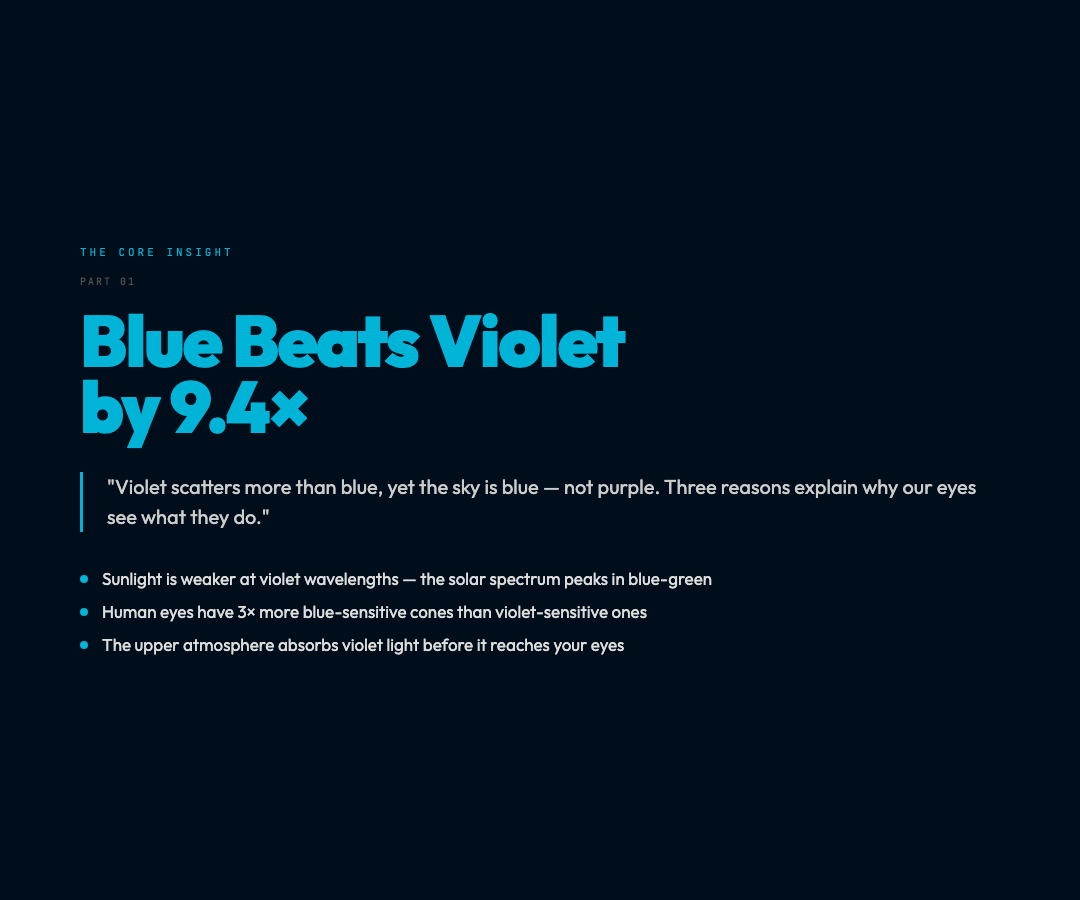
If violet scatters even more than blue, why isn’t the sky purple?
Three reasons:
1. Sunlight is weaker at violet wavelengths. The sun’s spectrum peaks in the blue-green range, not in violet.
2. Our eyes are more sensitive to blue. The human eye has roughly three times as many cone cells sensitive to blue light as to violet.
3. The upper atmosphere absorbs violet. Some violet light is filtered out before it reaches your eyes.
The result: blue dominates the scattered light we receive. The sky isn’t violet because violet is already gone by the time the light reaches you — absorbed in the upper atmosphere or simply drowned out by the blue our eyes are wired to detect.
This is not a minor effect. The scattering ratio of blue to red is approximately 9.4× — nearly an order of magnitude. This is why the sky at noon is a reliable, saturated blue, not a muddy purple.
The Sunset Calculation: 40 Times More Atmosphere
At noon, sunlight takes the shortest path through the atmosphere — roughly 100 km equivalent depth. At sunset, the sun sits near the horizon, and light must slice through the atmosphere at a shallow angle. The path length increases to as much as 40 times the noon path.
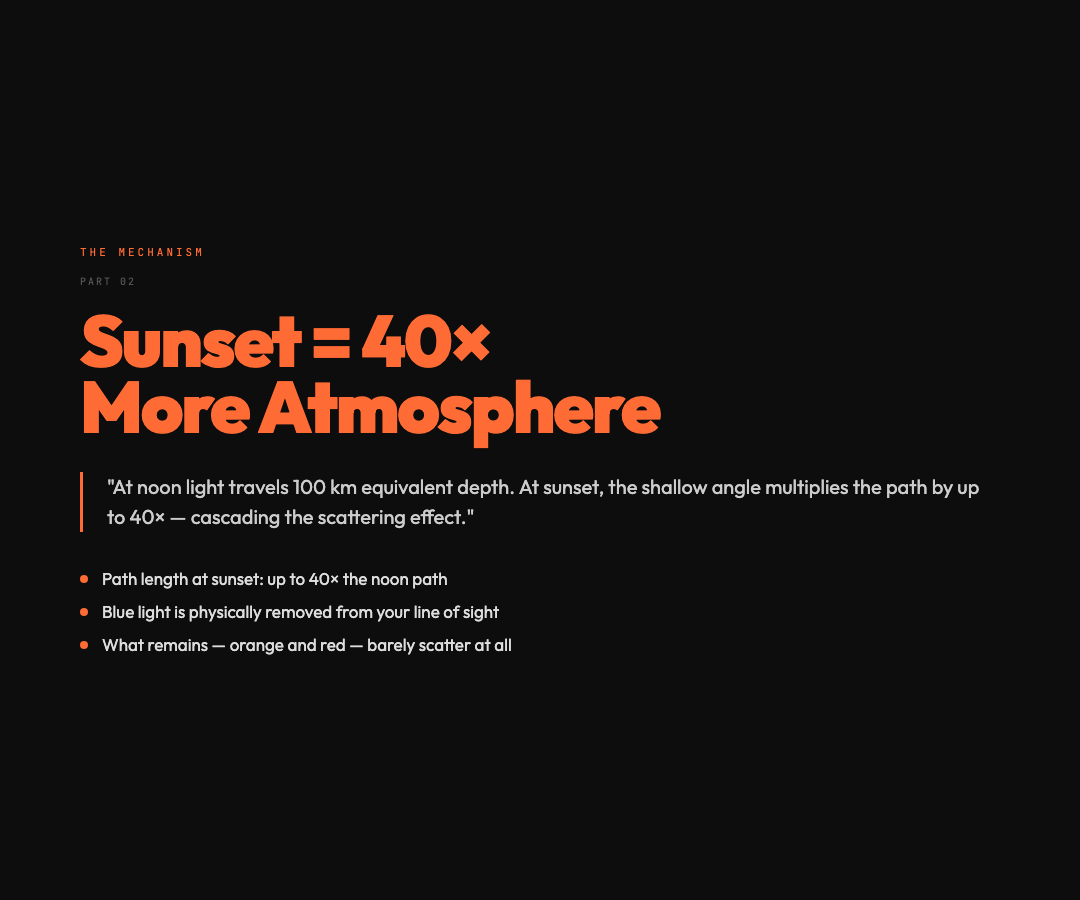
This is where the math gets dramatic. With 40 times more atmosphere to traverse, the scattering doesn’t just increase — it cascades. Blue and violet light, already scattered 5–10 times more efficiently than red, get scattered so many times they scatter in every direction except toward your eyes. What reaches you is the survivors: orange and red wavelengths that barely scatter at all.
The scattering ratio at sunset isn’t 9.4×. It’s the difference between nearly zero blue reaching your eyes and a sky full of red.
This is why a sunset isn’t just “less blue” — it’s actively red, orange, and gold. The blue has been physically removed from your line of sight by the atmosphere itself.
Why Clouds Stay White
Rayleigh scattering applies to particles smaller than the wavelength of light — air molecules, roughly 0.1 nm. Water droplets in clouds are 10–1000× larger than the wavelength of visible light.
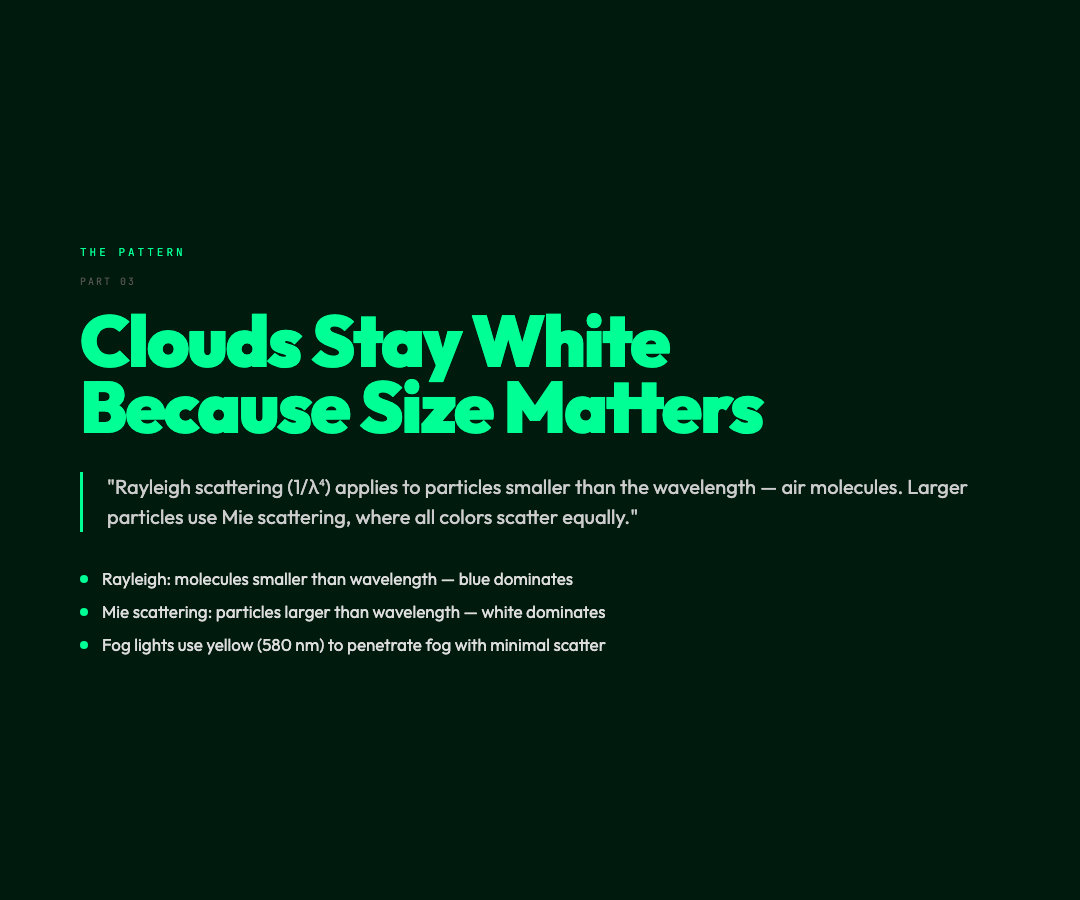
When particles are larger than the wavelength, a different rule applies: Mie scattering. All wavelengths scatter equally. This is why clouds appear white — they scatter every color in equal measure, and white is the sum of all visible wavelengths combined.
The same physics explains why fog lights are yellow or red, why distant mountains appear blue (Rayleigh scattering of light bouncing off air molecules between you and the peaks), and why the ocean looks blue (water absorbs red wavelengths; blue scatters back).
The 1/λ⁴ Law in the Real World
Rayleigh scattering isn’t just a curiosity about sunsets. It’s engineering:
– Fog lights use 580 nm yellow light, which scatters roughly 1/3 as much as blue 450 nm light. In fog, the difference between seeing and not seeing is measured in this scatter coefficient. – Polarizing photography filters work because scattered light is partially polarized. Rotating a polarizer lets photographers block this polarized component, making skies appear deeper blue. – Satellite remote sensing must correct for atmospheric scattering to accurately measure Earth’s surface reflectance — the entire field of atmospheric correction relies on variations of the 1/λ⁴ law. – Laser safety accounts for scattering: blue lasers are scattered ~10× more than red lasers of the same power, making them appear brighter in hazy air even at the same output.
The Atmosphere as Prism
Earth’s atmosphere is, in a sense, a prism — but one that separates light by scattering rather than refraction. Every blue sky is the result of countless nitrogen and oxygen molecules acting as tiny scattering centers, preferentially removing short wavelengths from the direct beam and redirecting them sideways into your eyes.
The blue sky is not blue light falling from the sun. It is scattered light — sunlight that was deflected from its original path by air molecules, bounced around the atmosphere, and arrived at your eyes from an entirely different direction.
This is why the sky is brightest near the horizon (where you see more scattered light from the long atmospheric path) and darkest directly overhead (where you see only the most efficiently scattered blue, having stripped away the longer wavelengths through multiple scattering events).
The elegance of 1/λ⁴ is that it takes a single physical mechanism — molecules smaller than the wavelength of light — and produces a coherent account of blue skies, red sunsets, white clouds, and blue mountains. One equation, one mechanism, four everyday phenomena explained.
Try it yourself: Light Scattering — Rayleigh Scattering Visualization lets you drag the sun position, adjust wavelength, and watch the sky color change in real time. The scattering curve, wavelength comparison, and atmosphere density sliders let you build an intuition for why the math produces the colors you see.


I think the admin of this site is in fact working hard in support of his web page, since here every stuff is quality based data.
Whats up are using WordPress for your site platform? I’m new to the blog world but I’m
trying to get started and set up my own. Do you require any
coding expertise to make your own blog? Any help would be really appreciated!
Hi there, I log on to your blogs daily. Your writing style is witty, keep up the good work!