Why Your Voice Chases Itself in a Cathedral: The Physics of Echo and Reverberation
Stand in a large cathedral and clap your hands once. The sound doesn’t just stop — it stretches, swells, and slowly dissolves into the stone. Every subsequent footstep, whispered word, and note from a distant choir seems to hang in the air. This is not your imagination. It is acoustics at work, and it follows a few simple rules that explain why some rooms feel alive and others feel dead.
The 50-Millisecond Rule: When Echo Becomes Reverberation
Sound travels at 343 meters per second in air at 20°C. That number is the key to everything.

Imagine standing 17 meters from a hard wall and shouting. Your voice travels to the wall and back — 34 meters total — taking exactly 0.1 seconds (100 milliseconds). You hear your voice return as a distinct repeat. That is an echo.
Now stand 8 meters from the same wall. Your voice covers 16 meters in about 47 milliseconds. The return arrives so quickly that your brain no longer perceives it as separate — it blends the reflection into a single, richer sound. This is reverberation.
The dividing line is roughly 50 milliseconds. Below that threshold, reflections merge with the original sound and amplify it. Above it, they become distinct copies. This single number — 50 ms — is what architects and acoustic engineers argue about most.
Sabine’s Formula: Predicting How Long Sound Lingers
Once sound enters a room, it bounces off every surface — walls, floor, ceiling, furniture. Each collision absorbs some energy and reflects the rest. The room slowly “forgets” the sound through thousands of these tiny absorptions.
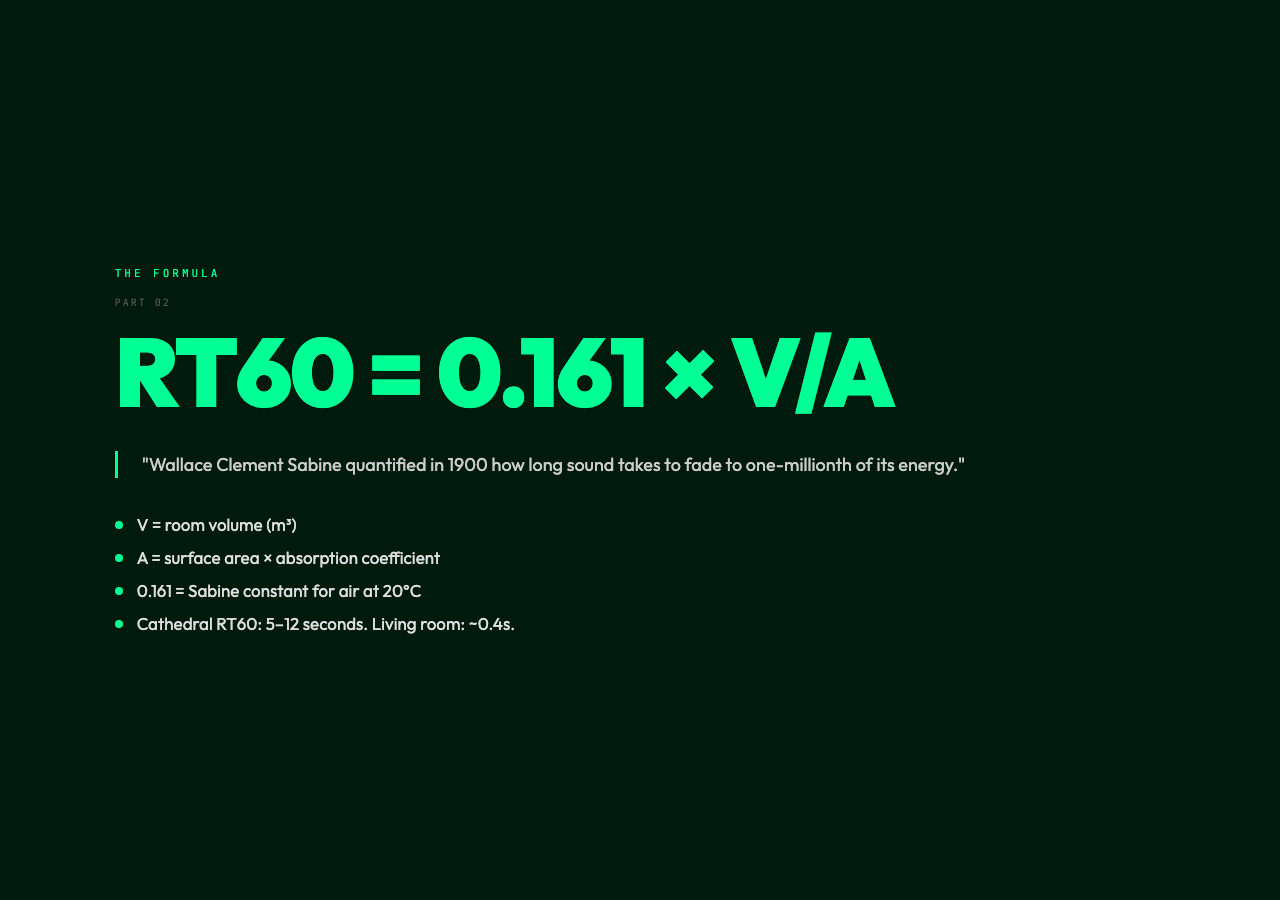
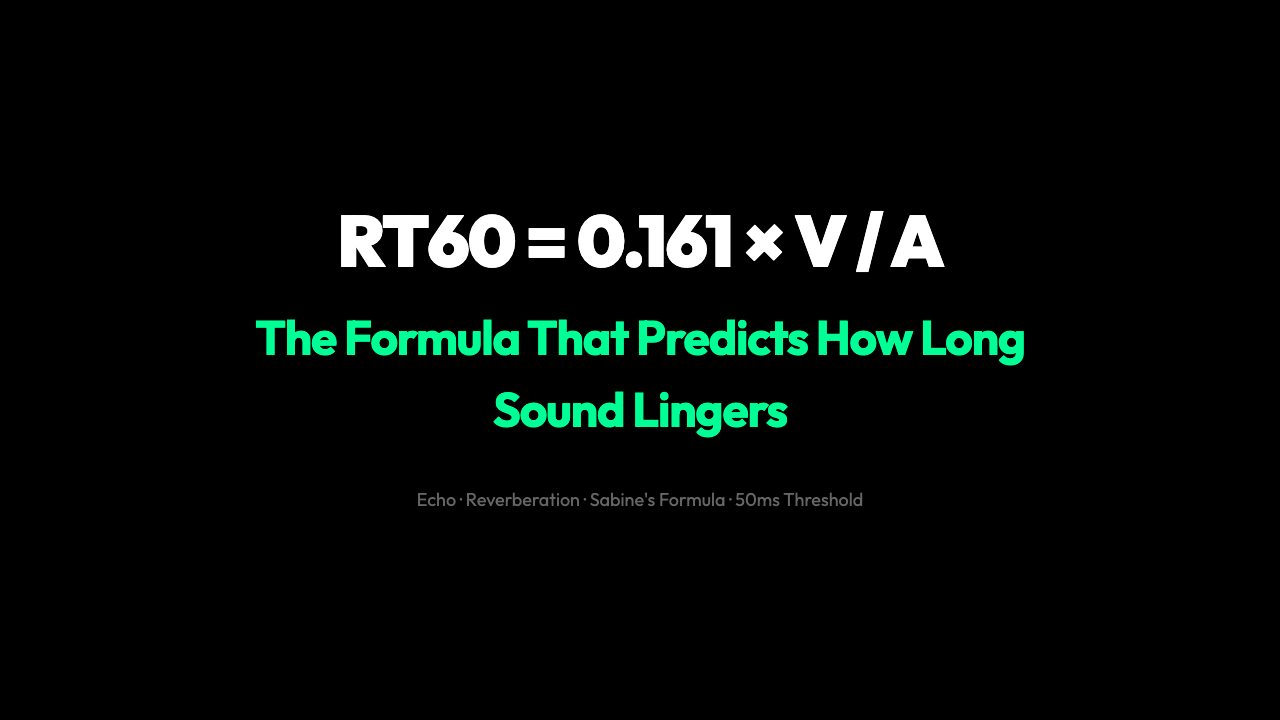
In 1900, Harvard physicist Wallace Clement Sabine quantified this process with an equation that bears his name. Sabine’s formula for the reverberation time RT60 — the time for sound to fade to one-millionth of its original energy (a 60 dB drop) — is:
RT60 = 0.161 × V / A
Where: – V = room volume (cubic meters) – A = total absorption (surface area × absorption coefficient) – 0.161 = Sabine’s constant for air at room temperature
Consider a medium room: 10 meters wide, 5 meters deep, and 3 meters tall.
– Volume V = 10 × 5 × 3 = 150 m³ – Surface area = 2 × (10×5 + 10×3 + 5×3) = 190 m² – With a typical absorption coefficient of 0.3: A = 190 × 0.3 = 57 m² – RT60 = 0.161 × 150 / 57 ≈ 0.42 seconds
A small, furnished room dies quickly. Now compare that to a cathedral with stone walls and no furniture. Stone has an absorption coefficient near 0.1. The enormous volume (thousands of cubic meters) divided by relatively low absorption produces RT60 values of 5, 8, or even 12 seconds. Sound that clap you heard at the beginning? It was still bouncing long after you stopped listening.
Why Reflection Matters More Than Volume
Reflection is not just about hard surfaces. It is about the mismatch between sound traveling through air and hitting a solid boundary.
When a sound wave strikes a wall, some of its energy reflects back and some transmits through. The reflected portion depends on the impedance difference between the two media. A thick stone wall reflects nearly all sound. A thick curtain absorbs most of it. A glass window falls somewhere in between.
This is why recording studios cover their walls with acoustic foam, thick curtains, or hanging baffles. Each material adds absorption, reduces the number of useful reflections, and shortens RT60. The goal is not silence — it is a controlled acoustic space where sound decays predictably and speech or music remains clear.
Sabine’s formula reveals a counterintuitive relationship: RT60 is inversely proportional to absorption. Add more absorption, and sound fades faster. Remove absorption, and it lingers. This is why an empty concert hall is almost unusable — without seating, curtains, and audience members to absorb energy, the hall becomes excessively reverberant and music turns into acoustic mud.
The Three Numbers That Define Any Room
Acoustic engineers reduce any room to three numbers:
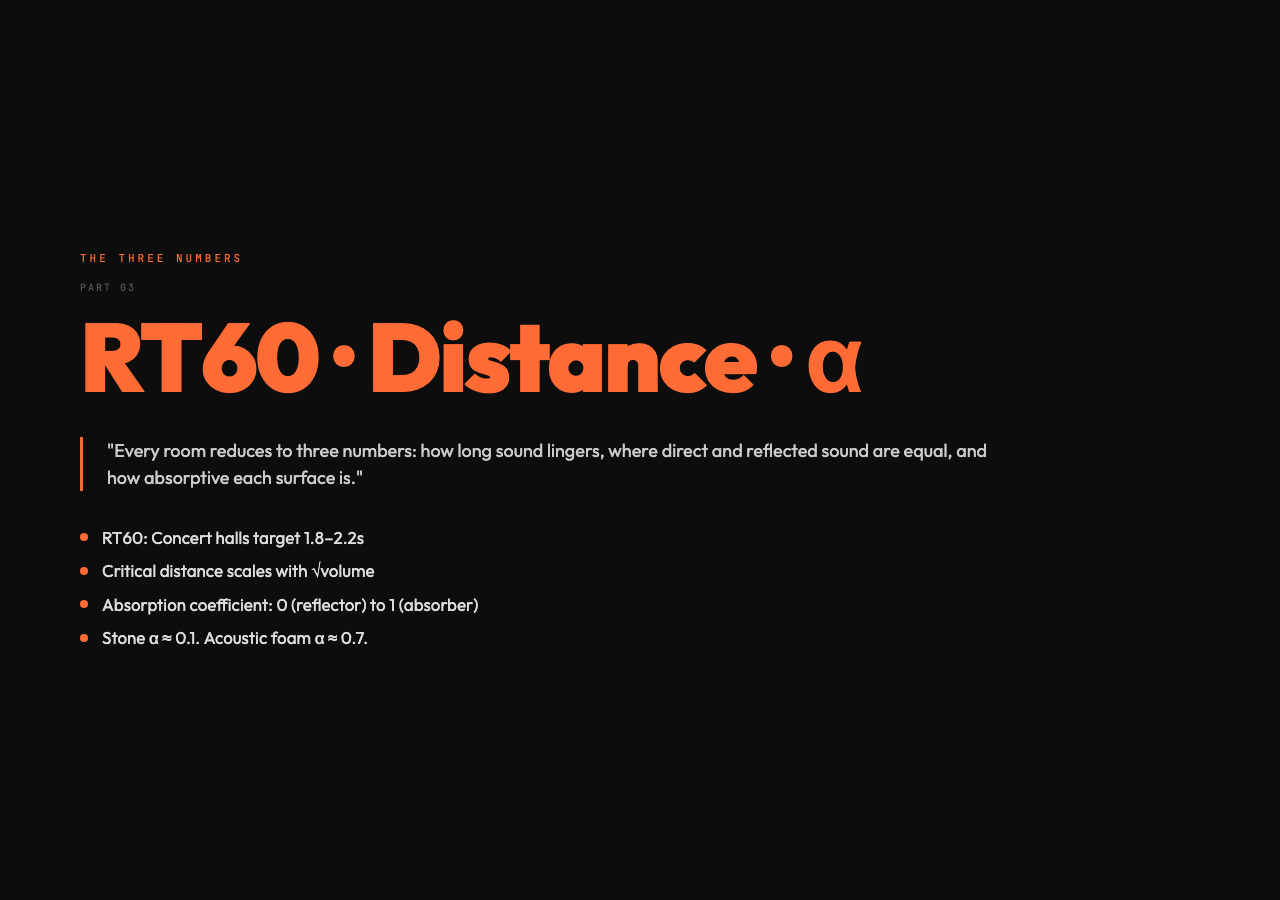
RT60 — how long sound takes to decay by 60 dB. Concert halls aim for 1.8–2.2 seconds (warm, music-friendly). Lecture halls prefer 0.8–1.2 seconds (speech clarity). Open-plan offices target under 0.5 seconds (so conversations do not compete).
Critical distance — the point in a room where direct sound and reverberant sound are equally loud. It scales with the square root of the room’s volume. Larger rooms have a larger critical distance, meaning you must stand closer to a sound source to hear it “intimately” rather than immersed in reverb.
Absorption coefficient — a number between 0 (perfect reflector) and 1 (perfect absorber) for each surface material. Plasterboard scores around 0.3. Heavy curtains around 0.5–0.7. Open windows: 1.0 (sound passes through completely, no reflection).
What This Means for Design
Every room is an acoustic instrument. The shape determines which reflection paths exist. The surface materials determine how much energy is absorbed at each bounce. The volume sets the timescale of the decay.
This is why the Vienna Musikverein (home of the Vienna Philharmonic) has been tuned over decades of careful modification — every balcony dimension, every surface material, every seat angle was refined to produce a RT60 near 2 seconds that makes orchestral music sound lush without obscuring detail.
It is also why your tiled bathroom sounds so different from your carpeted living room. The hard tile surfaces reflect almost everything. The soft furnishings absorb it. The bathroom has a short critical distance and a long RT60 — you hear your voice both directly and through hundreds of reflections simultaneously, which is why singing in the shower sounds so full.
Listen for the 17-Meter Threshold
The next time you are in a large room — a church, a gymnasium, an empty auditorium — try this: clap once and listen. Count roughly how long it takes before the sound stops chasing itself.
If the reverb lingers for more than a second, you are in a room with hard, reflective surfaces and a large volume. If the sound dies quickly, the room has more absorption.
And the next time your voice comes back to you as a distinct echo, you can estimate the reflecting wall is at least 17 meters away. Sound covered 34 meters in the time you noticed.
That gap between 17 meters and 8 meters — between echo and reverberation — is the invisible boundary that determines whether a room feels like a concert hall or a closet. It is all governed by one speed, one threshold, and one century-old formula.