
Why Every Circuit in the World Obeys Two Rules (And Your Phone Charger Is No Exception)
Your phone battery is dead. You plug in the charger. Within an hour, it is alive again. In that simple transaction — a cable, a voltage, a flow of electrons — two rules are doing all the work. They have no batteries, no显示屏, no app. Yet every phone charger, every flashlight, every solar panel obeys them without exception.
Those two rules are Kirchhoff’s Current Law and Kirchhoff’s Voltage Law. Together, they are the grammar of every electrical system on Earth.
The Man Who Mapped the Invisible
Gustav Kirchhoff was a German physicist who, in 1845, laid out two seemingly obvious truths about circuits. Obvious in retrospect. Revolutionary at the time.
His insight came from a deeper principle: conservation. Charge cannot appear from nowhere. Energy cannot materialize from nothing. Kirchhoff simply made these conservation laws quantitative — measurable, predictable, useful.
The two laws sound like common sense. But common sense, formalized into mathematics, becomes a tool powerful enough to design a smartphone from scratch.
Kirchhoff’s Current Law: What Comes In Must Go Out
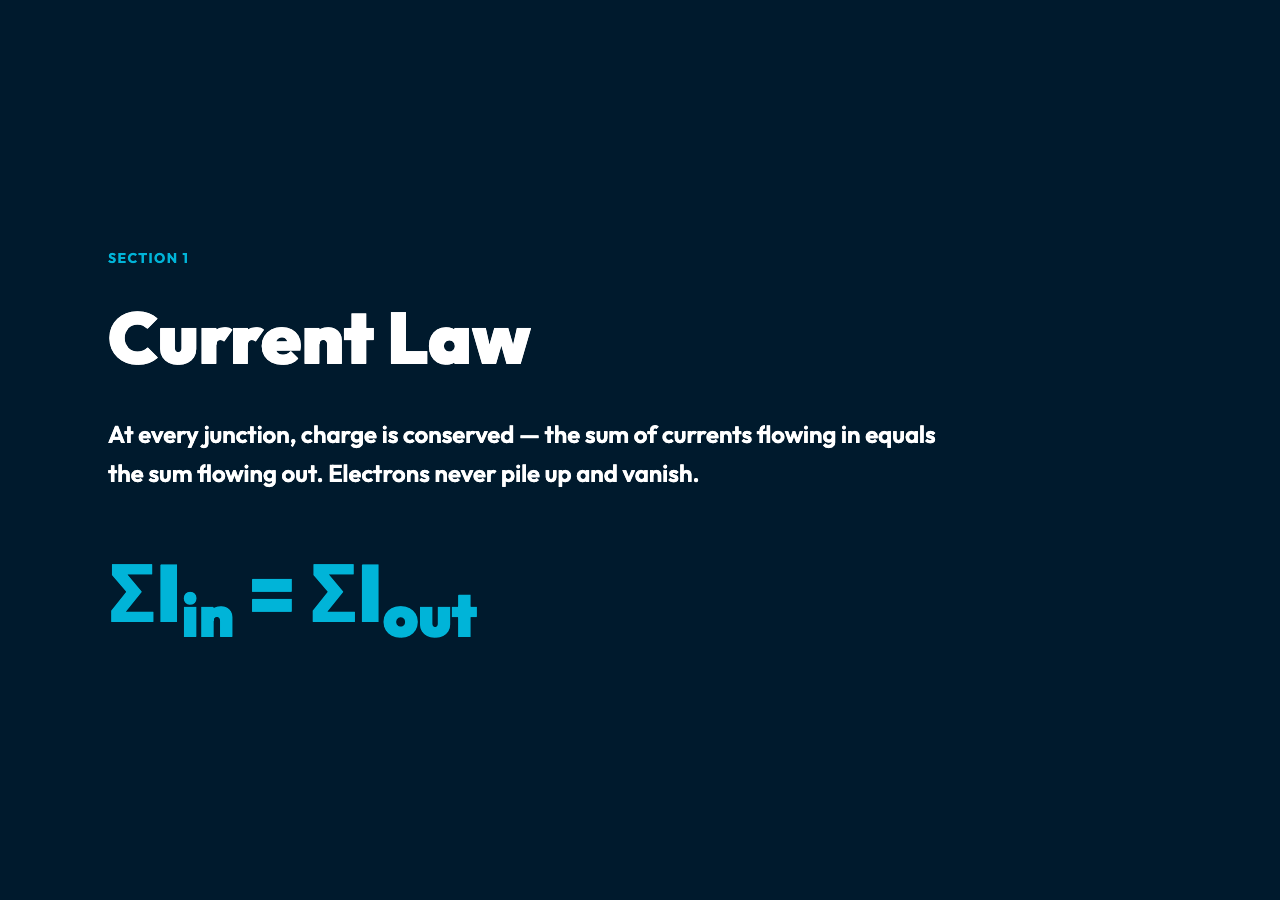
Kirchhoff’s Current Law (KCL) states: at any electrical node (a junction where wires meet), the sum of all currents flowing into the node equals the sum of all currents flowing out.
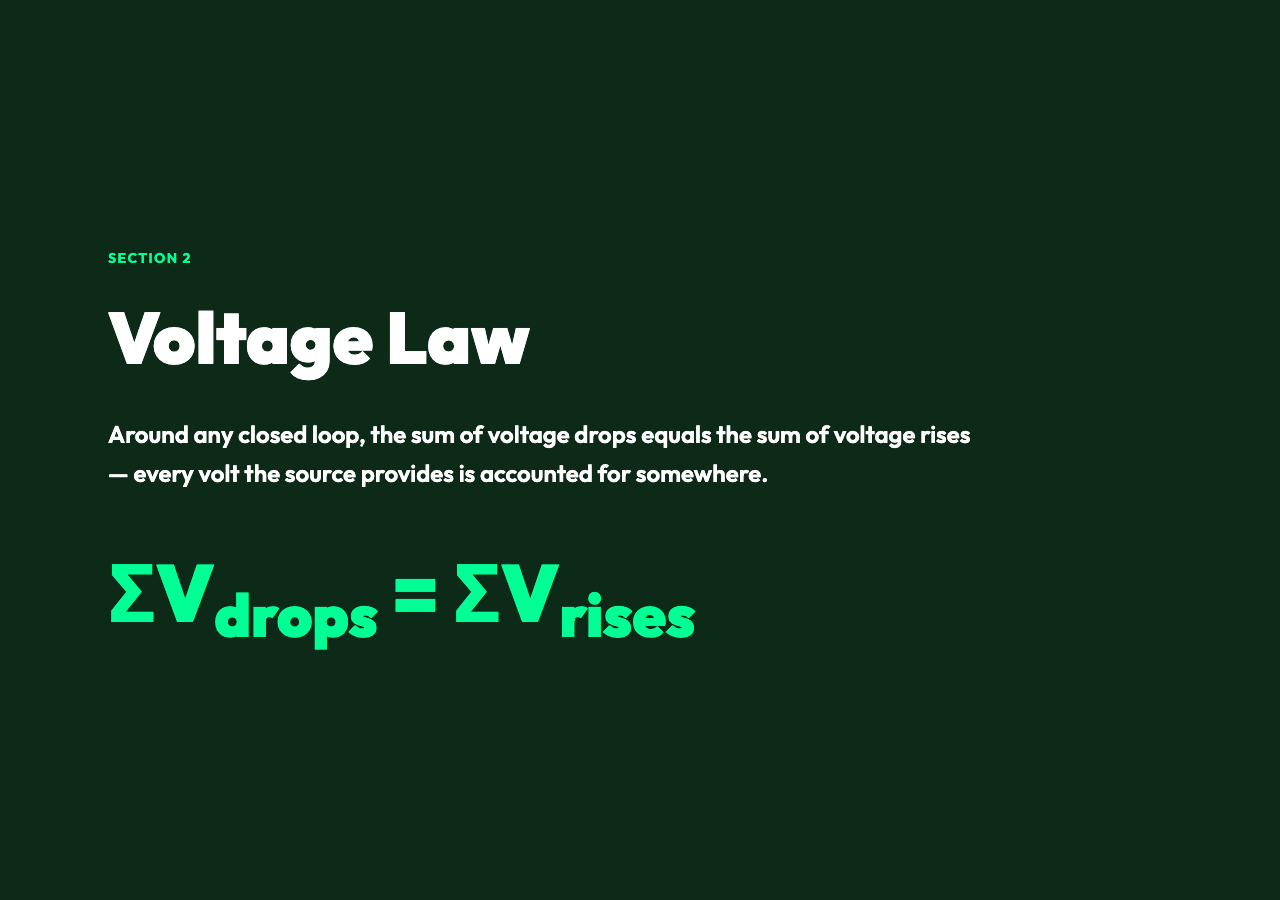
sum I_{in} = sum I_{out}
Another way to put it: charge is conserved. Electrons do not pile up at a junction and vanish into thin air.
Look at a Y-shaped junction in a circuit. Say 2 amperes flow in from the left branch. If one branch going out carries 1.2 amperes, the other must carry 0.8 amperes. The math checks out, or the circuit violates conservation — which nature does not allow.
This law is not an approximation. It is an identity, as certain as 2 + 2 = 4.
Kirchhoff’s Voltage Law: Every Volt Has a Home
Kirchhoff’s Voltage Law (KVL) states: around any closed loop in a circuit, the sum of all voltage drops equals the sum of all voltage rises.
sum V_{drops} = sum V_{rises}
The voltage provided by a battery is not lost. It is redistributed — dropped across resistors, consumed by components. Walk around a complete loop in your mind and add up every drop. The total must equal what the source provided. If it does not, you have made an error in your analysis.
Think of it like a hike: you climb 300 meters up a hill, then descend 300 meters. Your net elevation change is zero. You are back where you started. Voltage works the same way around a closed loop.
The Parallel Resistor Problem: KCL and KVL in Action
The most illuminating test of Kirchhoff’s laws is a circuit with parallel resistors — two or more branches splitting the same voltage.
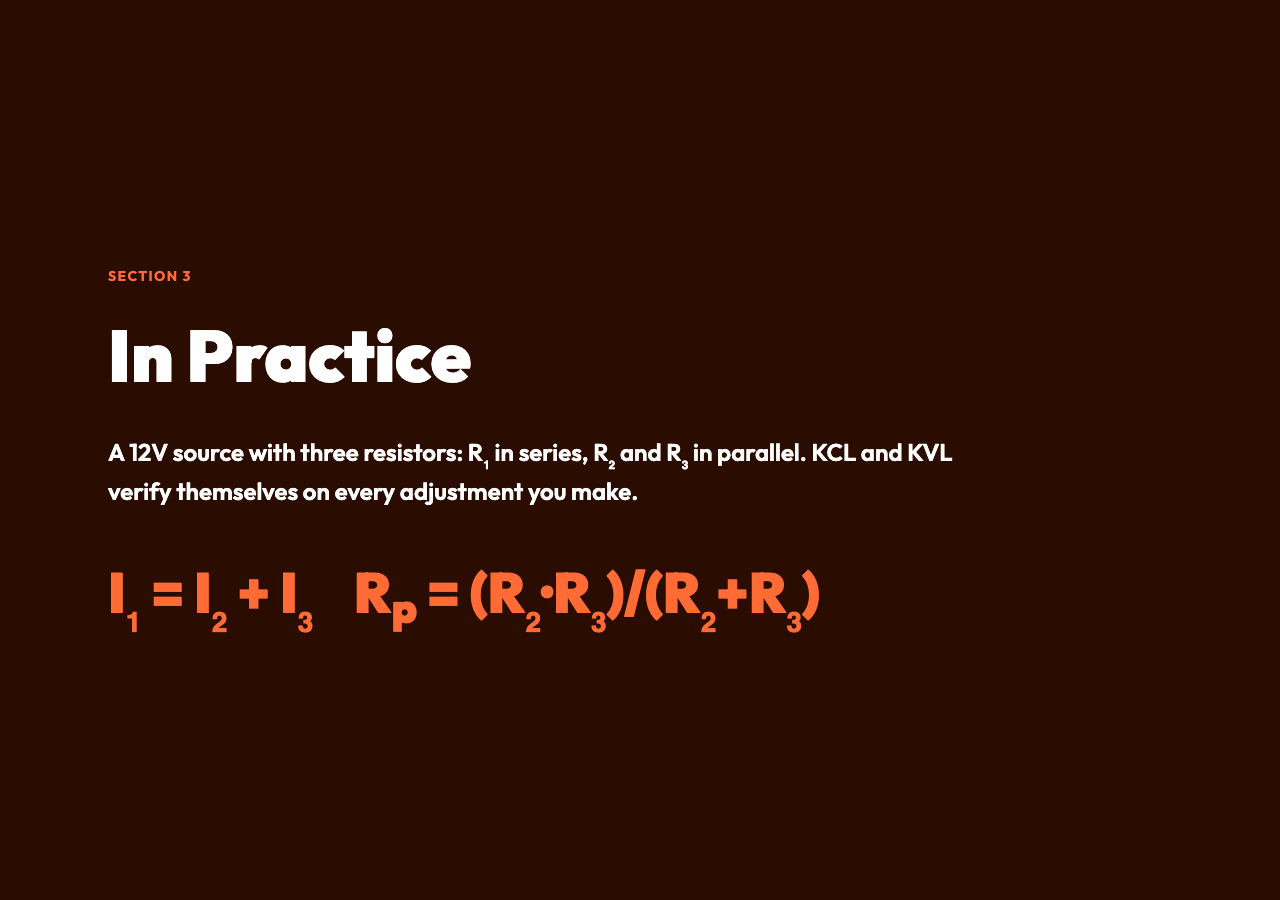
Consider a circuit with a 12-volt source and three resistors:
- R1 = 10 Ω (in series with the source)
- R2 = 20 Ω (parallel branch 1)
- R3 = 30 Ω (parallel branch 2)
Start with the parallel combination. Two resistors in parallel share the same voltage but split the current. Their equivalent resistance follows:
R_{parallel} = R2 × R3/R2 + R3 = 20 × 30/20 + 30 = 600/50 = 12 Omega
The total resistance of the circuit is R1 plus the parallel combination:
R_{total} = R1 + R_{parallel} = 10 + 12 = 22 Omega
Apply Ohm’s Law (V = IR) to find the total current drawn from the source:
I1 = V/R_{total} = 12/22 approx 0.53 A
Now apply KVL around the loop: the 12V source raises the potential, and R1 drops some of it. The remaining voltage is available across the parallel branches. By Ohm’s Law:
V_{R2} = V_{R3} = I1 × R_{parallel} approx 0.53 × 12 approx 6.4 V
Now apply KCL at the junction: the total current splits into two branch currents:
I2 = frac{V_{R2}}{R2} = 6.4/20 approx 0.32 A I3 = frac{V_{R3}}{R3} = 6.4/30 approx 0.21 A
Verify with KCL: I₁ = I₂ + I₃ → 0.53 ≈ 0.32 + 0.21 ✓
The numbers confirm what the laws guarantee: every ampere that enters the junction leaves it. Every volt the battery provides is accounted for.
Why These Laws Are Not Just Textbook Rules
Some students wonder: aren’t KCL and KVL just derived from Ohm’s Law? Don’t we only need V = IR?
Not quite. Ohm’s Law describes the relationship between voltage and current for a single resistor. Kirchhoff’s laws are topological — they apply to the structure of the circuit itself, regardless of what components are inside it. They hold for circuits with diodes, transistors, capacitors, and elements we have not invented yet.
KCL and KVL are the reason we can analyze a circuit with a billion components using a computer. SPICE (Simulation Program with Integrated Circuit Emphasis) — the software behind every chip design — is built on Kirchhoff’s laws as its founding equations.
The Visualization That Makes It Real
Turn on the interactive Kirchhoff’s Circuit Laws visualization. Set the voltage to 12V, R1 to 10Ω, R2 to 20Ω, R3 to 30Ω. Click start. Watch electrons flow through the series branch, then split at the junction — more going through the 20Ω branch (lower resistance, easier path), less through the 30Ω branch.
Adjust R2 to 10Ω. The current distribution shifts immediately. The total current changes. Every number on the display shifts, but every relationship — KCL at the junction, KVL around the loop — remains perfectly satisfied. The equations and the physics never fall out of step.
This is what makes Kirchhoff’s laws so remarkable. They do not tell you what the circuit will do. They tell you what the circuit must do, regardless of the details. They are constraints that any valid circuit must obey. And because they are constraints, not just descriptions, they give engineers a powerful way to check their work, catch errors, and design systems that actually function.
The Two Ideas That Run the Modern World
The next time you charge your phone, think about what is happening inside that cable. Electrons are flowing — but more precisely, they are redistributing in a way that satisfies two non-negotiable laws: current sums to zero at every junction, and voltage sums to zero around every loop.
Every charger is a proof of Kirchhoff’s laws. Every circuit board, every power strip, every solar panel is operating within the constraints that Gustav Kirchhoff laid out in 1845 — before the transistor, before the laptop, before the smartphone.
He gave us the grammar. The devices we build are the sentences.
The interactive visualization of Kirchhoff’s Circuit Laws lets you build circuits, adjust voltage and resistance, and watch KCL and KVL verify themselves in real time. Open it, adjust the sliders, and follow the current.