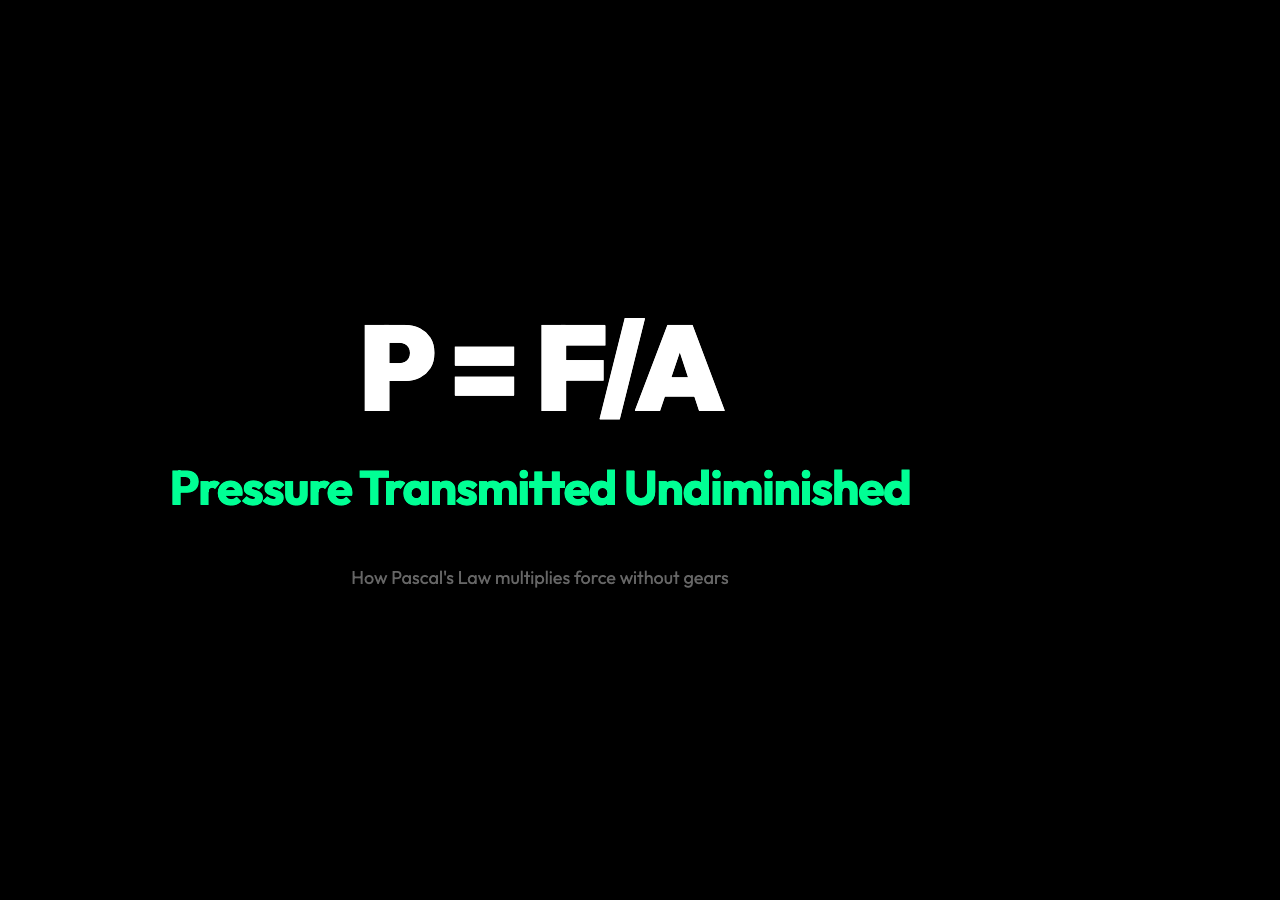
Why One Equation Explains the Force Multiplier Behind Every Hydraulic Jack
Push a syringe filled with water, and the water squirts out the tip. Now cap both openings and push again. Nothing moves — the pressure you apply to one end appears instantly at the other. This is Pascal’s Law, and it is the silent engine behind car jacks, excavators, and the brakes on every vehicle you have ever been in.
The Core Principle: Pressure, Not Force
The crucial word in Pascal’s Law is pressure — not force. Pressure is force distributed over an area: P = F/A. When you squeeze a sealed fluid, the molecules inside have nowhere to escape, so they push in every direction at once. The walls of the container feel it. Every part of the fluid feels it. And critically, every part of the fluid experiences the same pressure, not the same force.
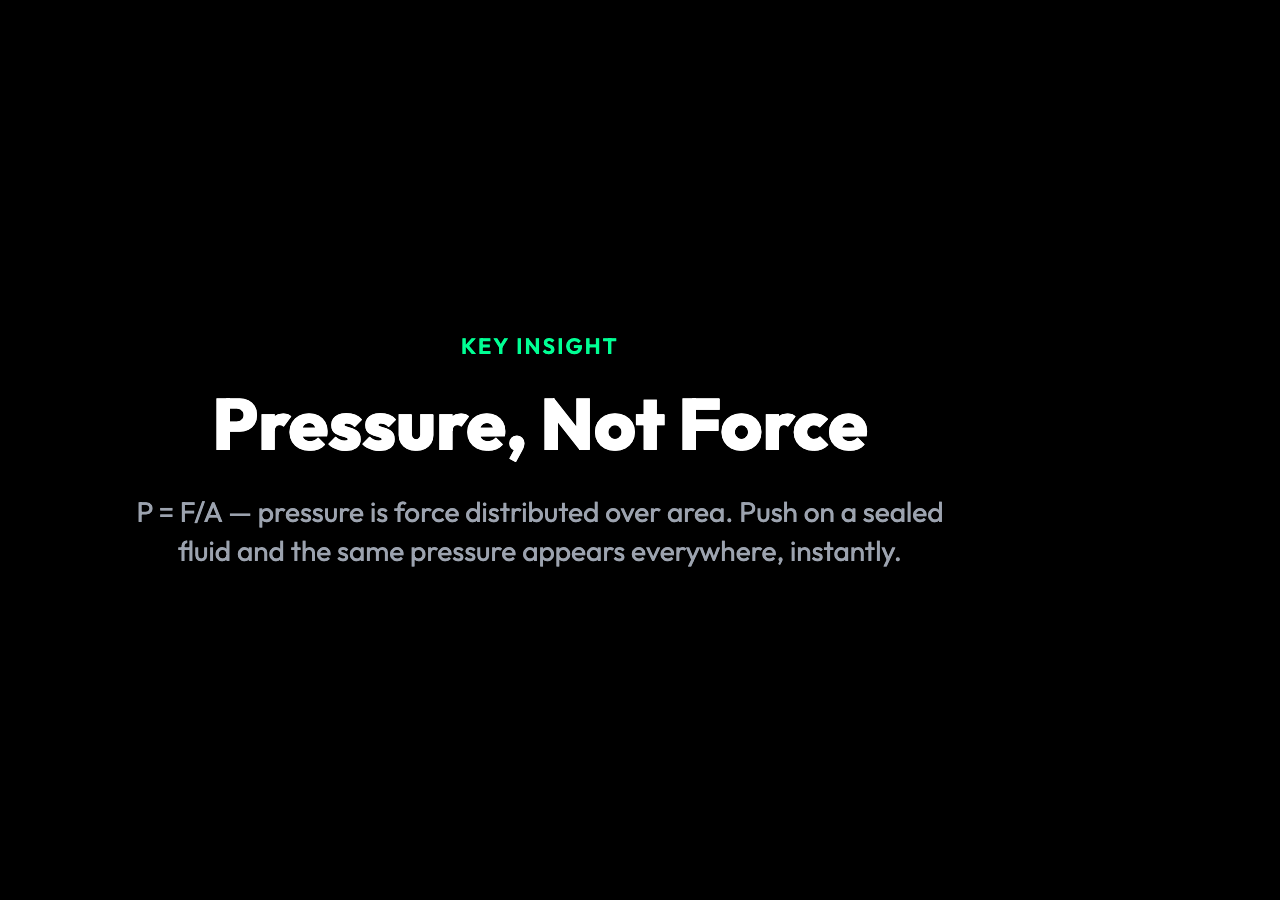
This distinction matters. A 100 N push on a small piston creates a pressure of 100 N / 0.01 m² = 10,000 Pa. That same pressure acting on an area ten times larger produces a force ten times larger — 1,000 N — without any extra input from you.
The Hydraulic Press: Pressure In, Force Out
The classic hydraulic press setup is two pistons connected by a fluid-filled tube, like two syringes joined at their barrels. When you push the smaller piston down, you increase the pressure in the fluid by a tiny amount. That pressure appears simultaneously at the large piston. Because the large piston has ten times the area, it experiences ten times the force.
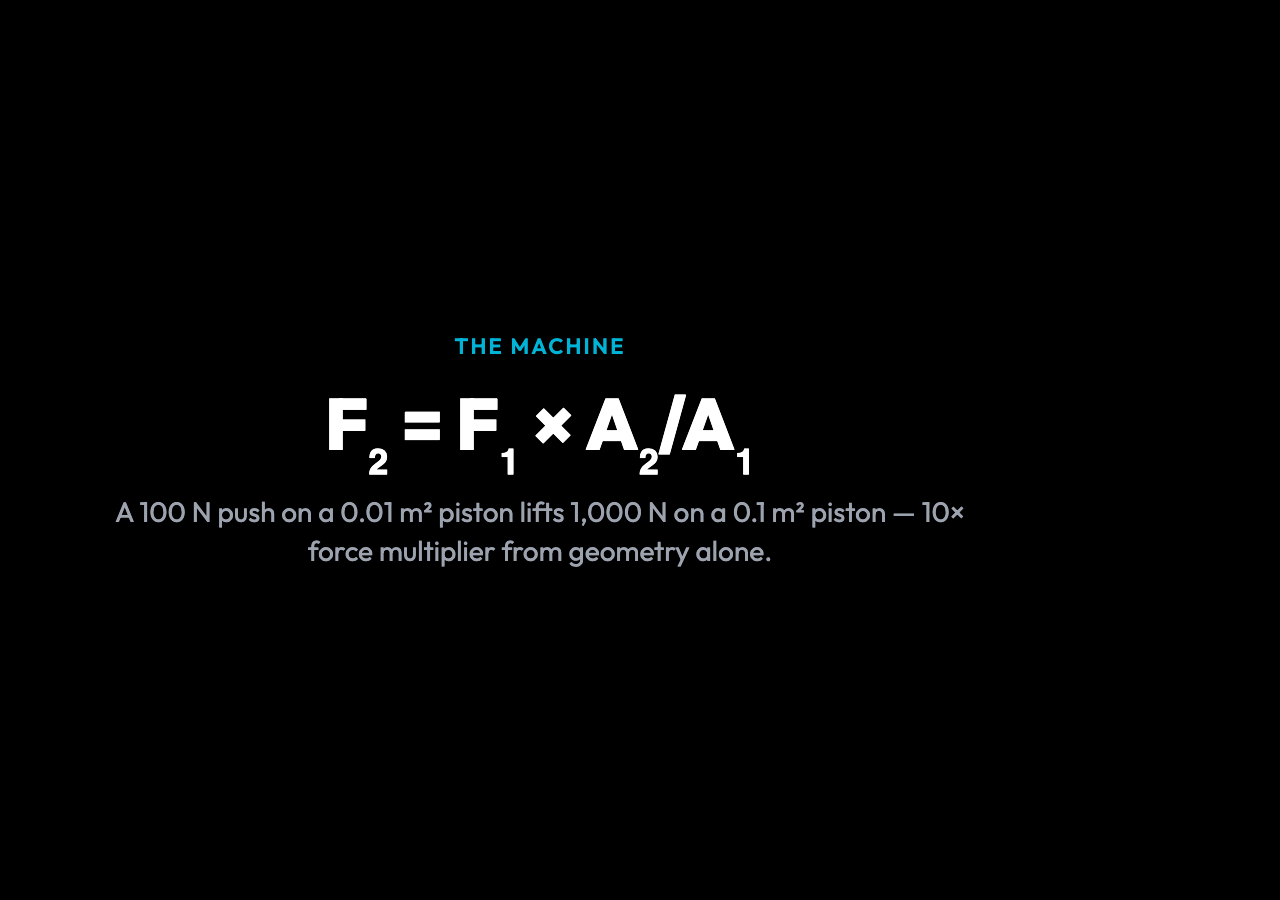
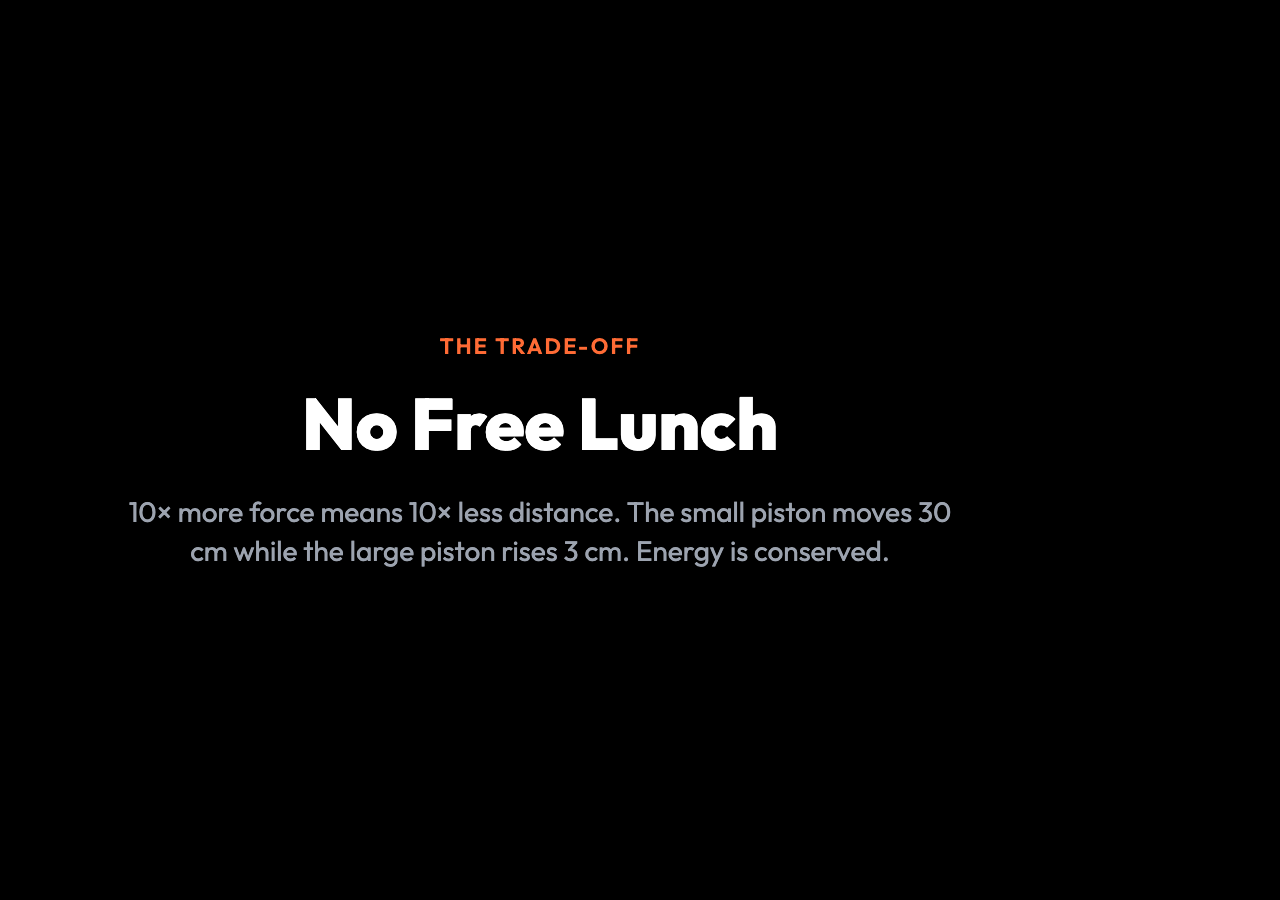
The simulation above demonstrates exactly this: with an input area of 0.01 m² and output area of 0.1 m² — a ratio of 1 to 10 — an input force of 100 N generates an output force of 1,000 N. The fluid does not create energy from nothing. Conservation of energy still holds. What changes is the distribution: a small force applied over a large distance on the input side becomes a large force applied over a correspondingly small distance on the output side. You push the small piston down 30 cm. The large piston rises 3 cm. The work done on both sides is equal.
Why the Equal-Pressure Condition Matters
You might ask: if pressure equalizes throughout the fluid, does that mean a hydraulic jack can never lift more than the force I apply? The answer lies in the geometry, not the pressure itself. The equal-pressure condition is the constraint that makes the force multiplier possible. Without it — for example, in a leaky or compressible system — the output force would be lower than the theoretical prediction because pressure would not transmit uniformly.
In practice, real hydraulic systems lose efficiency due to fluid friction, seal deformation, and thermal expansion. A system rated at 100% efficiency (the theoretical ideal) would produce F₂ = F₁ × (A₂/A₁) exactly. Real systems typically achieve 85–95% efficiency, which is why high-pressure hydraulic fluid is chosen: it resists compression and flows at manageable viscosities even under thousands of PSI.
Pascal’s Principle in Everyday Life
Pascal’s Law is not confined to industrial presses. The same principle governs:
- Vehicle brakes: A brake pedal moves a small piston at very low pressure. That pressure acts on all four brake calipers simultaneously, pressing pads against rotors with proportional force.
- Medical presses: Syringes and infusion pumps use fluid pressure to deliver precise volumes without valves or mechanical linkages.
- Heavy machinery: Excavator arms, garbage truck lifts, and aircraft landing gear all rely on hydraulic circuits where one actuator powered by a small pump extends or retracts multiple cylinders.
The consistency of the underlying principle is what makes hydraulic systems reliable: you design the system around area ratios, and the fluid handles the rest.
The Limiting Factor: Container Strength
No fluid can hold infinite pressure. At some point the container ruptures, the seals fail, or the fluid itself becomes compressible enough that the pressure-transmission model breaks down. This is why hydraulic systems are rated for maximum working pressure — and why the pistons, seals, and hoses are sized accordingly. Pascal’s Law tells you what force you can get from a given geometry; material strength tells you what the system can survive.
What This Equation Cannot Do
It is tempting to see the hydraulic press as a magic force multiplier. But energy is never created for free. The work input equals the work output (ignoring losses). If you gain 10× in force, you pay with 10× less distance traveled. This trade-off is non-negotiable — it is the same conservation law that governs levers, pulleys, and every other simple machine.
The hydraulic press is a direct consequence of one sentence: pressure applied anywhere to an enclosed fluid is transmitted undiminished to every other part of the fluid. From that single principle, engineers built machines that can multiply force tenfold, a hundredfold, or more — without any gears, levers, or exotic materials. The mathematics is straightforward: F₂ = F₁ × (A₂/A₁). The practical implications are not. What Pascal revealed was that a fluid is not just a passive medium for transporting force — it is a force multiplier limited only by the mechanical tolerance of the container. In a world increasingly obsessed with software solutions to physical problems, Pascal’s Law is a reminder that sometimes the most powerful machines are also the simplest.