The ionosphere is not a passive mirror. It is a living medium — one that doesn’t just reflect radio waves but reshapes them, splitting them into two streams that travel at fundamentally different speeds depending on their frequency.
This is plasma wave dispersion, and it is why your car radio cuts out in the exact same place every time you drive under a bridge, why shortwave signals bounce unpredictably across continents, and why scientists can probe the outer reaches of the Sun without ever leaving Earth. The same mathematics governs all of it.
What a Plasma Actually Does to Light
A plasma is an ionized gas — electrons ripped free from their parent atoms, buzzing around in a soup of positive ions. Light cannot propagate through it the way it travels through air or glass. The electromagnetic wave pushes on the free electrons, which then push back, creating a collective oscillation that fights the incoming radiation.
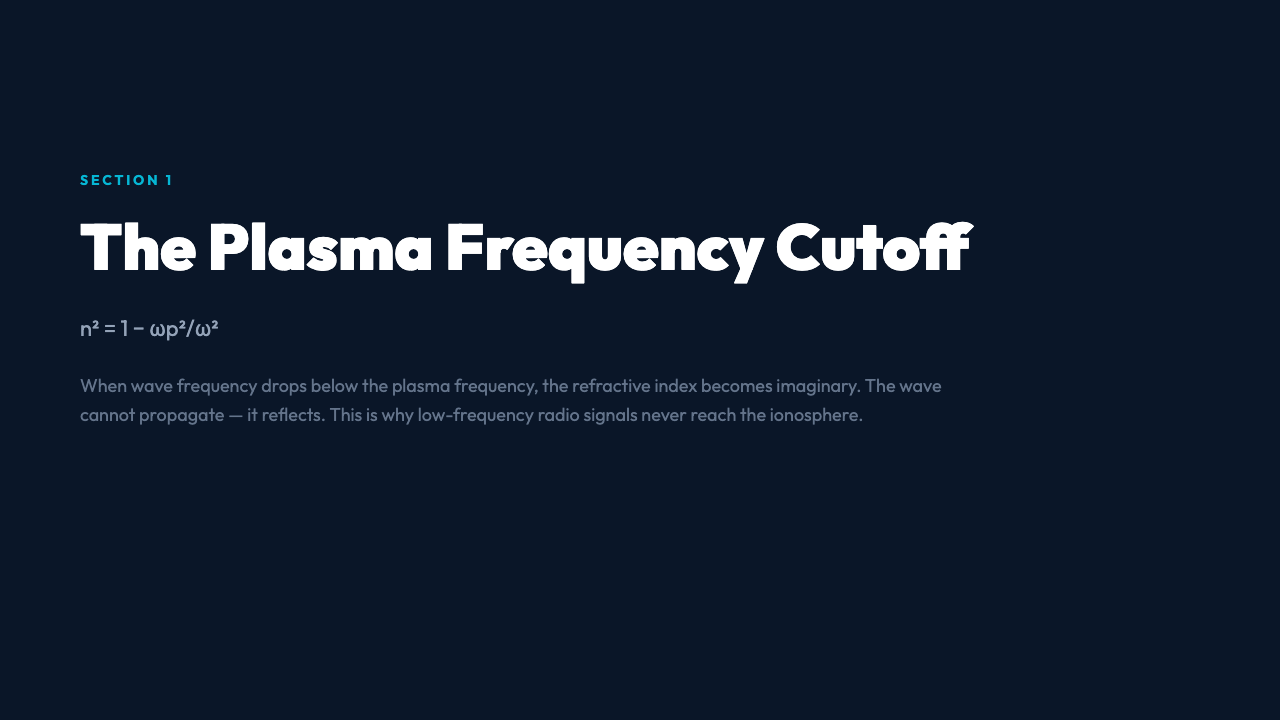
The result is a refractive index that depends on frequency. Not weakly, not approximately — fundamentally. For a cold unmagnetized plasma:
n² = 1 − ωp²/ω²
where ωp is the plasma frequency and ω is the wave’s own frequency. When ω is much larger than ωp, the term ωp²/ω² becomes small and n² approaches 1 — the wave propagates freely, as if through vacuum. But when ω drops below ωp, the right-hand side goes negative, n² becomes imaginary, and the wave cannot propagate at all. It is reflected.
This is the plasma frequency cutoff. Any wave arriving at a plasma with frequency below ωp simply bounces off, like light hitting a mirror made of mathematics.
The Extraordinary Case of Magnetized Plasma
Reality is rarely unmagnetized. Space plasma — in the ionosphere, in the solar wind, in tokamak fusion reactors — is threaded by magnetic field lines. And when a magnetic field is present, the plasma splits a single incoming wave into two output streams.
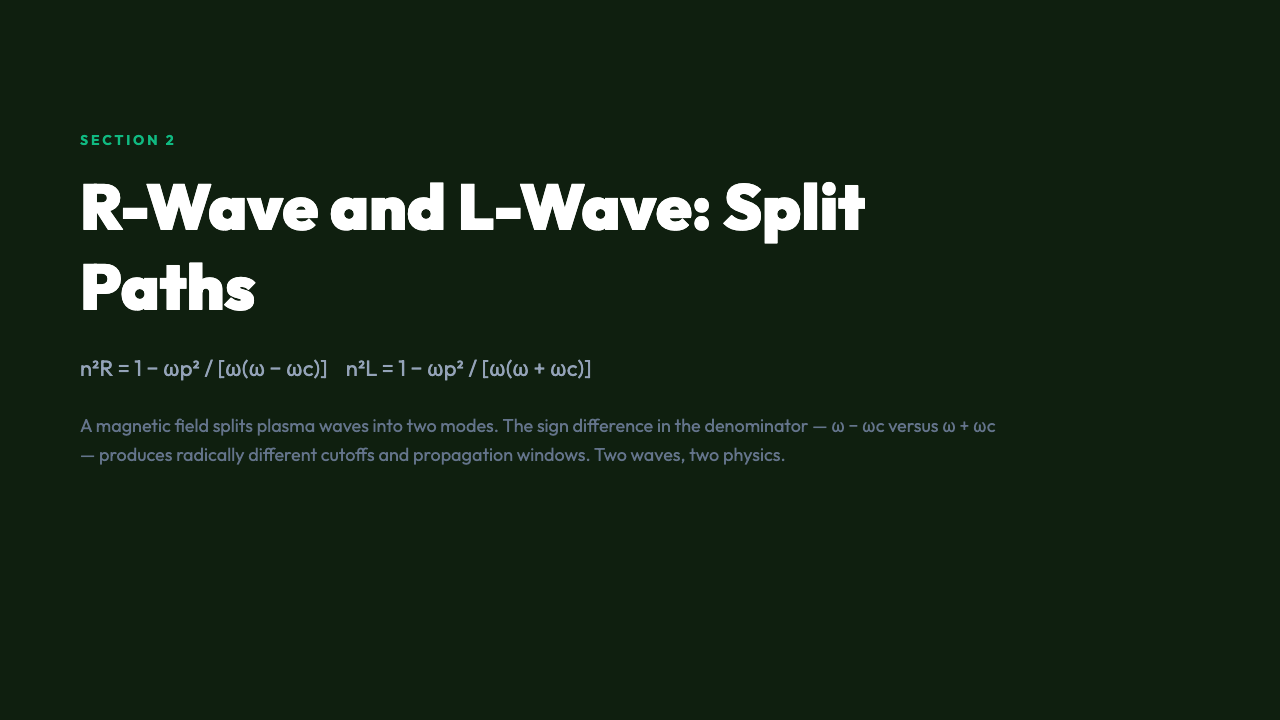
The wave interacts with the electrons spiraling around those field lines. The result is two characteristic modes, named after their discoverer: the ordinary (O) mode and extraordinary (X) mode. More fundamentally, in magnetized plasma theory we identify the R-wave (right-handed) and L-wave (left-handed) modes — and they obey different dispersion relations entirely.
The R-wave:
n²R = 1 − ωp² / [ω(ω − ωc)]
The L-wave:
n²L = 1 − ωp² / [ω(ω + ωc)]
where ωc is the cyclotron frequency — the rate at which electrons spiral around the magnetic field lines.
These two equations look almost identical. The difference is the sign on ωc in the denominator. But that sign flip produces radically different physics. Each mode has its own cutoff frequency, its own frequency range where propagation is forbidden, its own group velocity curve.
The radio engineer who forgets this writes receiver systems that fail in the field. The plasma physicist who ignores it miscalculates energy transport in a stellar corona by orders of magnitude.
Two Velocities, One Wave
For any wave propagating through plasma, two velocities matter: the phase velocity vφ = ω/k and the group velocity vg = dω/dk. In a vacuum, both equal c. In plasma, they diverge.
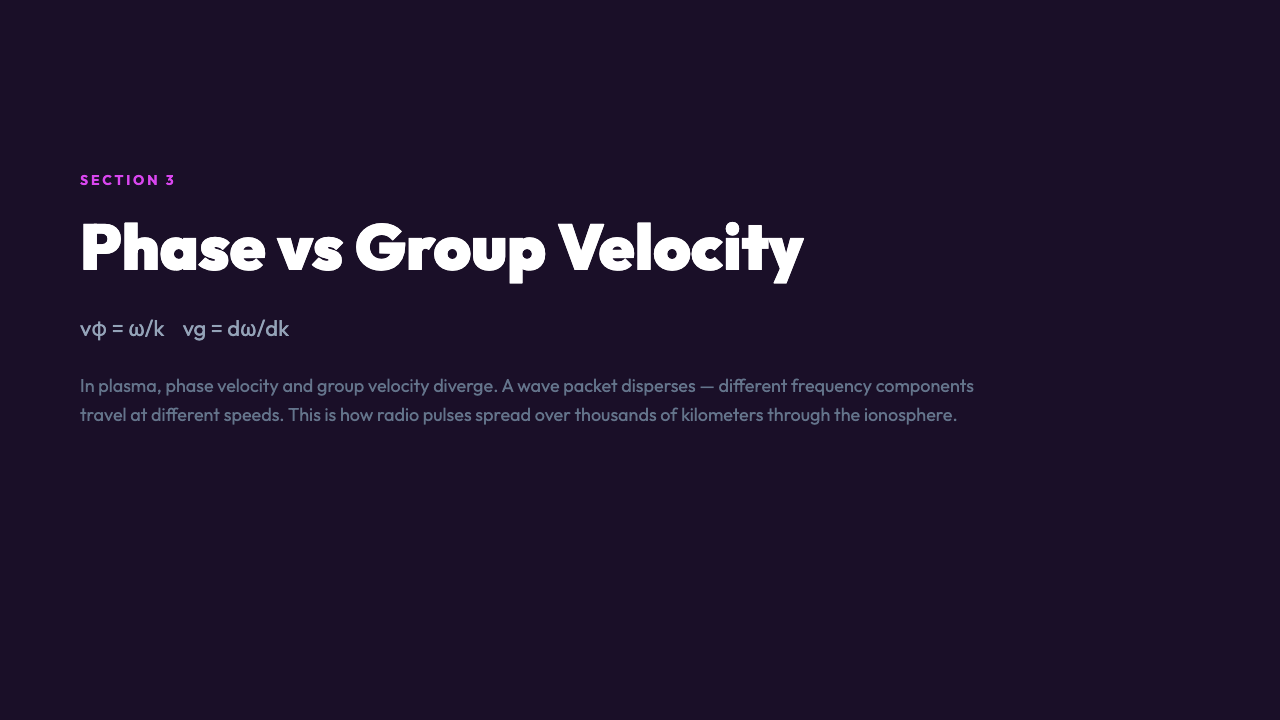
Because n depends on ω, the dispersion relation k(ω) is not linear. This means vφ ≠ vg. A wave packet — a brief pulse of radio energy — will spread out as it travels, because different frequency components within the pulse travel at different group velocities. The pulse disperses.
This is the same mathematics that gives a prism its power. White light enters glass, different frequencies refract by different amounts, and the colors separate. Plasma does the same thing to radio waves, but without any glass surface to see — the dispersion happens in open space, over hundreds or thousands of kilometers.
Why This Matters Beyond the Textbook
The ionospheric skip that amateur radio operators exploit is a plasma dispersion phenomenon. So is the radio blackouts that occur during solar storms, when intense bursts of ultraviolet and X-ray radiation suddenly increase the ionospheric plasma density, pushing ωp upward and swallowing frequencies that previously propagated. Emergency communications systems that rely on specific frequencies can go silent within minutes of a solar flare.
In fusion research, the same equations determine whether heating waves will penetrate the plasma and reach the core of a tokamak, or reflect prematurely from the edge and waste the energy of a hundred microwave ovens. The success of ITER and future fusion reactors depends in part on understanding plasma wave dispersion well enough to design wave injection systems that actually work.
And in space physics, the solar wind carries plasma from the Sun’s corona past spacecraft at millions of kilometers per hour. The dispersion relation of that plasma determines how interplanetary scintillation — the twinkling of radio sources caused by density irregularities in the solar wind — behaves. By monitoring that scintillation, scientists infer plasma conditions tens of millions of kilometers away.
The ionosphere is not a passive mirror. It is a living medium — one that doesn’t just reflect radio waves but reshapes them, splitting them into two streams that travel at fundamentally different speeds depending on their frequency. What looks like a limitation — signal fading, frequency-dependent delay — is actually the universe giving us a diagnostic tool. We read the dispersion curve the way a doctor reads a patient’s pulse: it tells us what the medium is made of, how dense it is, how strong its magnetic field runs, and whether it is changing.
Every time you hear your car radio fade in and out in exactly the same spot, the plasma of the ionosphere is telling you something about the Sun’s activity right now, in real time. The conversation has been going on for as long as there have been radio waves and plasma in the same universe.