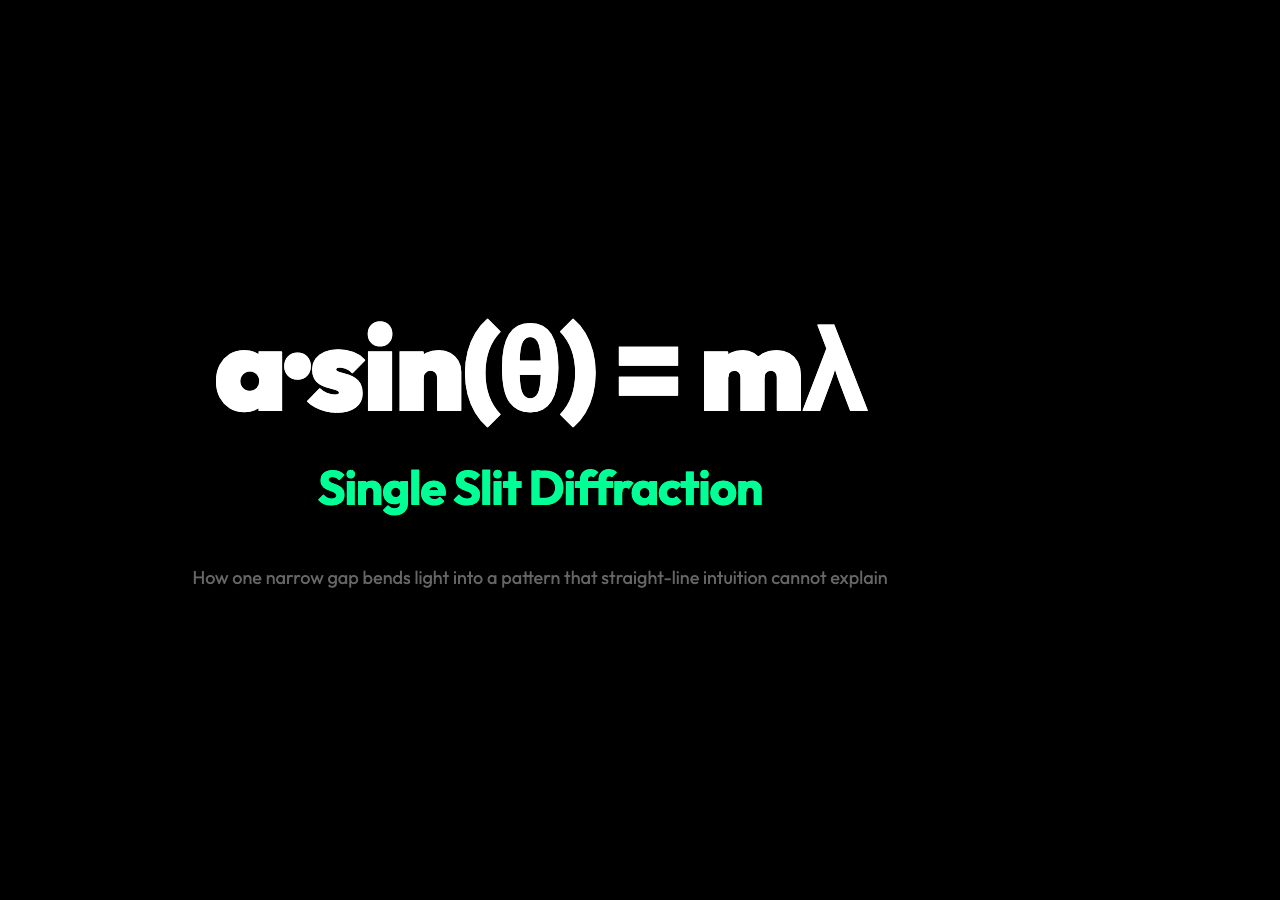
Every textbook diagram shows light as a clean arrow flying from point A to point B. Nice. Simple. Wrong.
The moment you let light through a single narrow slit — any slit, even one carved into a piece of foil so thin you can barely see it — the straight line disappears. What shows up on the screen downstream is a crosshair: one blazing central band, flanked by darkness, then dimmer bands stretching outward on both sides.
This is single-slit diffraction. And it is one of the most honest experiments in physics — because it breaks every “common sense” prediction about how light moves, and it does it with perfect mathematical reliability.
The Setup: One Slit, One Screen, One Equation
A light source on one side of a barrier. A single narrow aperture cut into it. A screen on the far side. That’s the entire experiment.
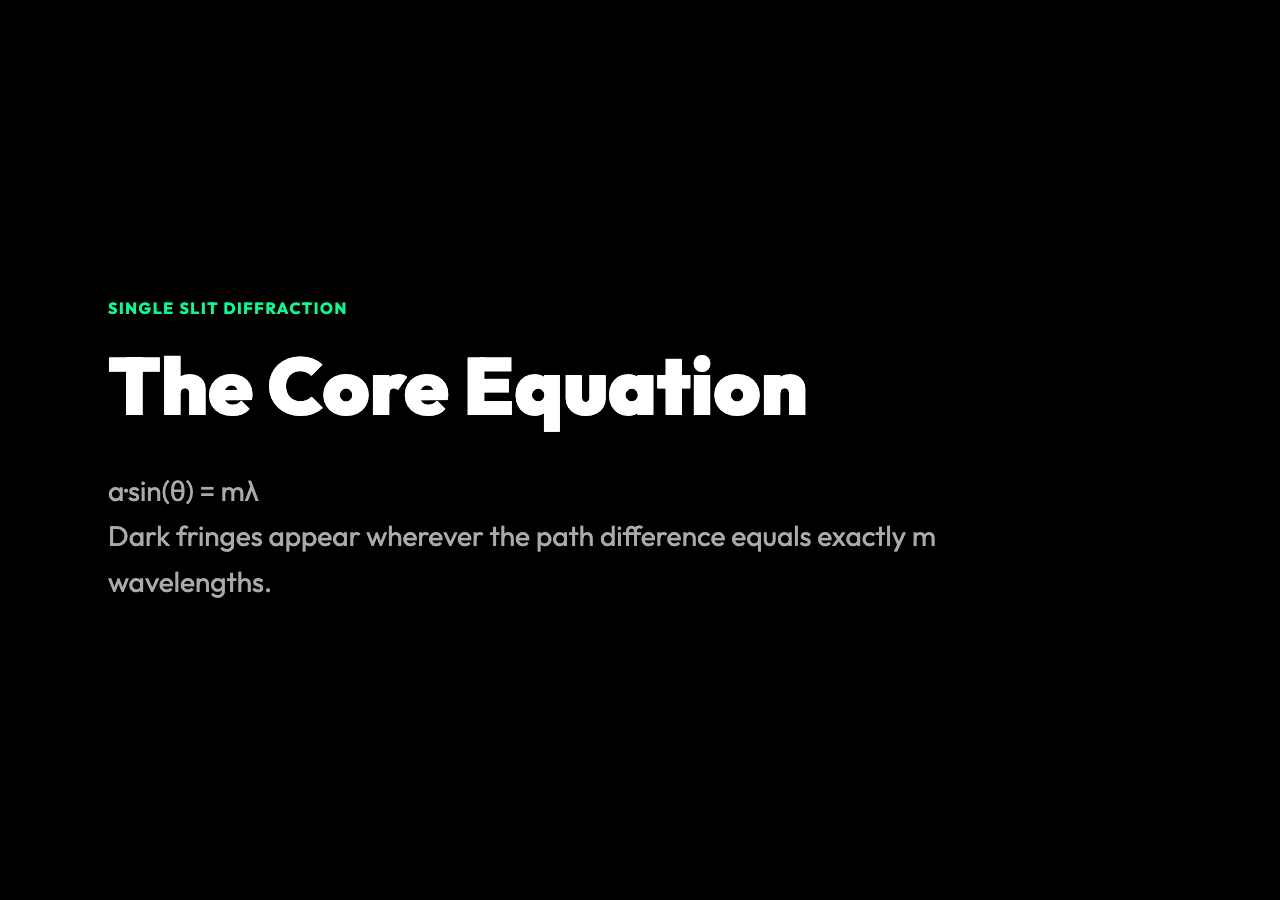
The dark fringes — points where light cancels completely — appear wherever this condition holds:
a·sin(θ) = mλ
a is the slit width. λ is the wavelength. m is the order number (1, 2, 3…). The central maximum is always twice as wide as each side maximum. No adjustment of light intensity changes this. Pure geometry.
The central fringe width on the screen:
Δx = 2λL / a
L is the distance from slit to screen. Three quantities multiplied together, divided by slit width. No correction terms. No quantum mechanics.
Why Narrower Slits Produce Wider Patterns
Widen the slit and the pattern narrows. Narrow it and the pattern expands. A 2-micrometer slit at 1 meter distance produces a central maximum roughly 1.1 millimeters wide for green light (550 nm). Widen that slit to 10 micrometers — still narrow by everyday standards — and the central maximum collapses to about 0.22 millimeters.
The reason: when the aperture is comparable to the wavelength, the wave can’t pass through without spreading. When the aperture is much larger than the wavelength, the spreading is barely noticeable.
This is why radio waves — with wavelengths of meters to kilometers — diffract around buildings without issue. Why satellite dishes are meters wide when the signals they receive are only centimeters. And why visible light doesn’t diffract around doorways — the openings are enormous compared to the wavelengths involved.
Wavelength Determines Spread: Red Spreads More Than Blue
Every diffraction pattern is color-coded by wavelength. Red light (~650 nm) produces wider dark fringes than blue (~450 nm). Red’s first minimum sits roughly 44% further from center than blue’s.

The reason sits directly in the equation: λ is in the numerator. Longer wavelength = more spreading.
This isn’t just textbook trivia. It’s why the sky is blue. Why police radar uses long microwaves to track speeding cars from far away. Why radio telescopes are enormous structures, because long wavelengths need large collectors to achieve useful resolution. If you measured the diffraction pattern width from an unknown source without seeing its color, you could still estimate the dominant wavelength. The pattern doesn’t lie about what made it.
The Huygens-Fresnel Principle: Every Point Is a New Source
The mechanism behind the pattern is the Huygens-Fresnel principle: every point in the aperture acts as a source of secondary spherical waves. Their superposition at the screen creates the bright and dark fringes.
At the screen’s center, all secondary paths are nearly equal in length — waves add constructively. At the first minimum, the path difference between the top and bottom of the slit is exactly one wavelength: complete cancellation. At the second minimum, two wavelengths — again, complete cancellation. No other physics enters. The pattern is pure geometry made visible.
Real Consequences: Hubble, Blu-Ray, Medical Imaging, and Silicon Chips
Single-slit diffraction sets the resolution limit on every wave-based imaging system.
Hubble Space Telescope: Its 2.4-meter mirror was a physical necessity. At ~500 nm visible wavelengths, a smaller mirror would diffract starlight beyond usable resolution. The diffraction limit is unforgiving.
Blu-ray disc players: They use blue-violet lasers (405 nm) instead of DVD red lasers (650 nm) because shorter wavelength produces a smaller spot size, allowing more data in the same area. The physics of diffraction is why your movies look sharper than they did twenty years ago.
Medical ultrasound: Imaging at 1–20 MHz has resolution fundamentally limited by the diffraction of sound waves in tissue. No software processing overcomes this. To get finer medical images, you need shorter wavelength — which means higher frequency — which means more penetration loss. There is always a tradeoff.
Optical lithography: The chips in your devices are etched using ultraviolet light (~193 nm wavelength). Feature sizes the industry can produce are fundamentally limited by this wavelength. The entire semiconductor industry is, at its core, a race against the diffraction limit.
The Deeper Lesson
Classical intuition says: particles go straight unless something blocks them. Open a slit and the particles that pass through should fan out in roughly the same direction.

But light isn’t a classical particle here. It’s a wave. And waves don’t respect boundaries the way intuition expects. They spread. They interfere. They cancel. The pattern on the screen is the signature of that spreading — written in light and dark with mathematical precision.
The equation a·sin(θ) = mλ doesn’t approximate behavior. It is the behavior. No quantum mechanics, no hidden variables. Just the geometry of waves.
Sharp edges are an illusion the universe doesn’t keep. Open a slit and the universe immediately begins filling the space beyond it with order that looks, to the untrained eye, like chaos. Look closer. It’s not chaos. It’s interference.
The question worth sitting with: if even a single narrow slit produces a pattern that pure straight-line reasoning cannot explain, what does that tell you about every “obvious” assumption your classical intuition makes about how the physical world works?