Every photon traveling through the universe bends. Not slightly — measurably, predictably, exactly as general relativity requires. The Sun deflects starlight by 1.75 arcseconds at its edge. A galaxy cluster deflects it by degrees. Every massive object in space distorts the path of every photon that passes near enough, as if space itself were a lens.
This is gravitational lensing — one of the most counterintuitive yet empirically indispensable phenomena in astrophysics. The physics is elegant, the formula is compact, and the observable consequences range from near-perfect rings of light to shattered arcs of distant galaxies.
Einstein‘s Core Insight: Gravity Is Geometry
Before 1915, gravity was a force that acted at a distance — like magnetism, it pulled objects toward each other across empty space. Einstein’s general relativity replaced this picture with something far more radical: mass does not exert a force. Mass curves spacetime, and objects — including light — follow the straightest possible path through that curved geometry.
This means a photon’s trajectory bends not because something is pulling it, but because the space it is traveling through is curved. Think of a marble rolling across a stretched rubber sheet. The marble does not feel a “pull” toward the center depression — it simply rolls along the curved surface, its path determined by the geometry of the sheet itself. This is the geometry of gravitational lensing.
Einstein’s field equation — the core of general relativity — quantifies exactly how much a given mass curves the spacetime around it. For lensing purposes, the most important consequence is the Einstein radius: the characteristic angle by which light from a distant source is deflected by a massive foreground object.
The Einstein Radius Formula
The Einstein radius for a point mass is:

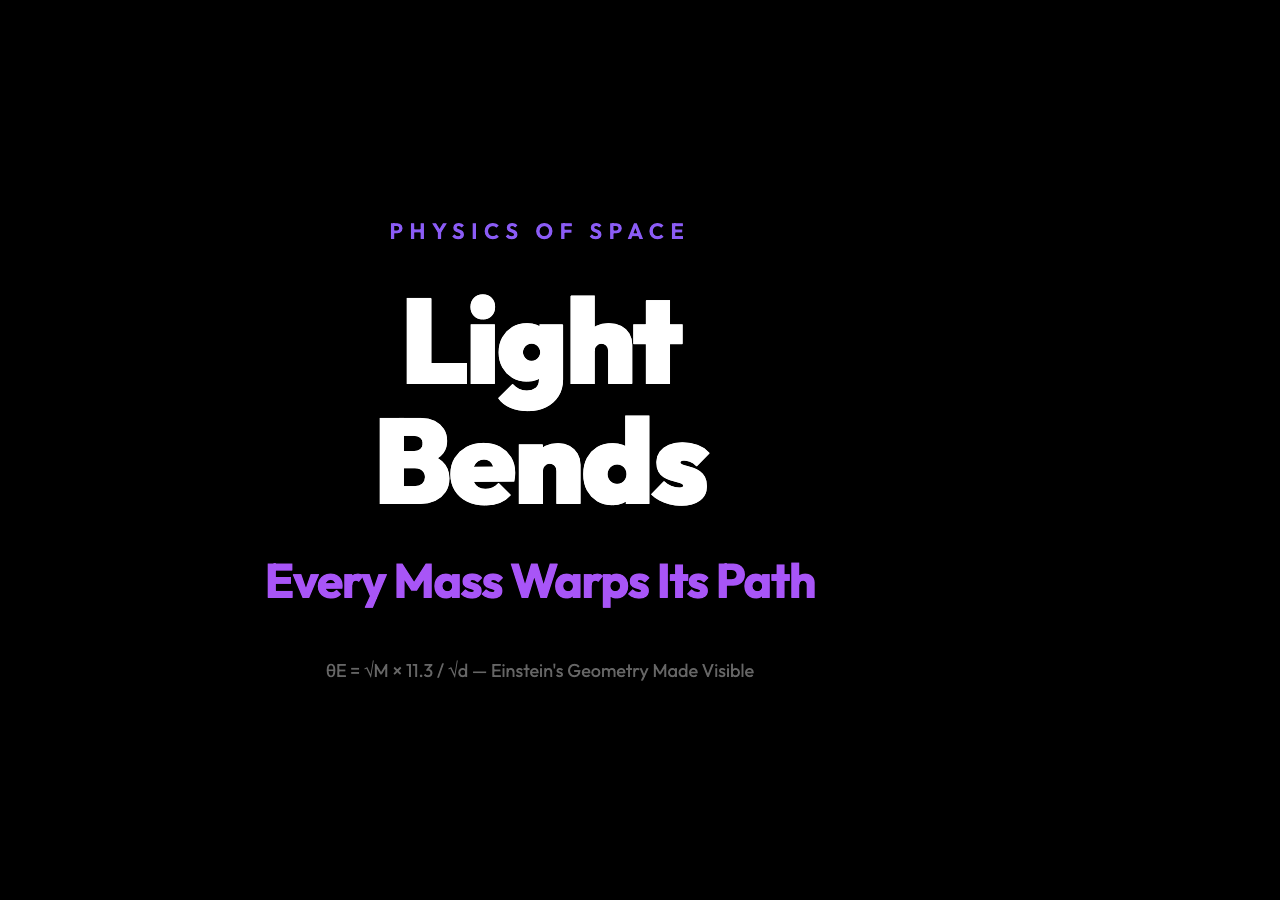
θE = √(mass) × 11.3 / √(source distance)
where mass is measured in simulation units (arbitrary scale), source distance is the distance to the background light source, and the constant 11.3 arises from the gravitational constant and geometry of the configuration.
In the gravitational lensing simulator, the default parameters are mass = 50 and source distance = 1.0, giving:
θE = √50 × 11.3 / √1.0 ≈ 7.07 × 11.3 ≈ 79.9 (simulation units)
The formula makes precise predictions that are easy to verify interactively:
- More lens mass → larger Einstein radius. Double the lens mass and the light bend angle increases by √2 ≈ 1.41×.
- Closer source → larger Einstein radius. Halve the source distance and the bend angle increases by √2 ≈ 1.41×.
- Ellipticity and shear modify the simple circular ring into elongated arcs and distorted images.
This is why the simulator’s Einstein radius updates in real time as you adjust the mass, source distance, ellipticity, and shear parameters. The geometry is not approximate — it is exact for this idealized configuration.
Why Light Never Travels in a Straight Line (in the Full Sense)
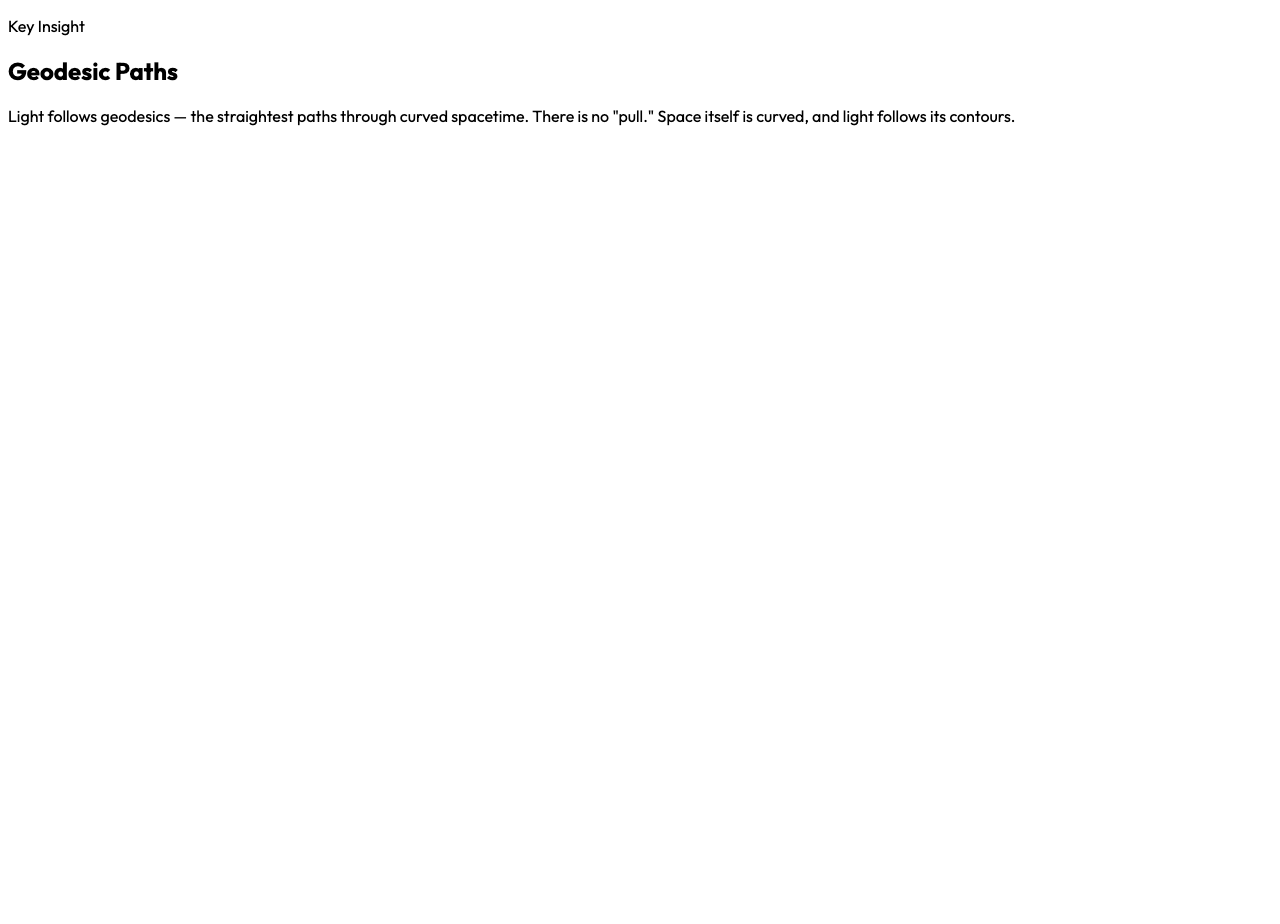
The straightest path through curved spacetime is called a geodesic. For photons — which always travel at c, the speed of light — the geodesic is the closest thing to a “straight line” that curved geometry allows. But even in empty space far from any mass, a photon following a geodesic is, in a sense, still being bent — by every mass in the universe it has passed.
This is not a practical concern for most everyday photons. The cumulative deflection from the Sun alone is only about 1.75 arcseconds at the limb — a tiny angle, but measurable. At solar eclipse time, this tiny deflection was what Arthur Eddington measured in 1919 to confirm Einstein’s theory. A beam of starlight skimming the Sun’s edge is bent by 1.75 arcseconds, causing the star’s apparent position to shift slightly compared to its actual location. That shift was General Relativity’s first empirical triumph.
For more massive objects — galaxy clusters, for example — the deflection angles are hundreds of times larger. A galaxy cluster acting as a lens can produce multiple images of a single background galaxy, each image distorted into an arc and each arriving at a slightly different time.
What the Simulator Actually Shows
The gravitational lensing simulator displays three key elements as you interact:
The lensed grid: A regular grid of lines is shown distorted around the lens mass. This is the geometric effect in its purest form — the grid lines follow the geodesic paths that light would take through the curved spacetime around the lens. Near the lens, lines curve sharply. Far from the lens, they approach straightness.
The Einstein ring: When a background source is almost perfectly aligned with the lens along the line of sight, the lensing effect produces an almost-complete ring of light — the source’s light wrapped around the entire circumference of the lens. This is the strongest lensing configuration, where alignedBeta < 1.2 in the simulation.
The source and image positions: When the source is not perfectly aligned, the lens produces 1–4 distinct images of the source, arranged around the lens in a characteristic pattern. The magnification of each image depends on how close the light path passes to the lens center — the closer the approach, the greater the magnification.
The Lens Equation: Deflection as a Vector Field
The core computation in the simulator is the deflection field α = (α_lens + α_shear):
- α_lens: The primary lensing deflection from the lens mass. For a circular lens, α_lens scales as 1/r — the deflection decreases as the perpendicular distance from the lens axis increases.
- α_shear: A secondary correction representing external gravitational tidal fields — the influence of other masses near the lens. This elongates the ring into an ellipse and breaks the circular symmetry.
The deflection vector at any point (θX, θY) is:
α = (θE × q × dx / √(q²dx² + dy² + ε²), θE × dy / (q × √(q²dx² + dy² + ε²))) + shear contribution
where q is the axis ratio (1 − ellipticity), ε is a small softening parameter to prevent division by zero, and the two components represent the deflection in the x and y directions respectively.
This is the Newtonian limit of gravitational lensing — valid when the deflection angles are small, which is true for nearly all astrophysical systems except black holes and neutron stars.
Applications: Why Lensing Matters Today
Gravitational lensing is not just a theoretical curiosity — it is one of astrophysics’ most powerful observation tools:
Dark matter mapping: Because lensing measures total mass (not just luminous mass), it is the primary method for mapping dark matter distribution in galaxy clusters. The lensing distortion pattern around a cluster reveals exactly how much mass is there, even if the mass is entirely invisible.
Exoplanet discovery: Microlensing — where a foreground star amplifies the light from a more distant star briefly — has discovered dozens of exoplanets. When a planet orbiting the lens star passes through the lensing zone, it produces a detectable spike in magnification.
Cosmology: The bending of light from distant galaxies by foreground structures provides a direct measure of the universe’s matter distribution at different cosmic epochs. The distortion pattern (called shear) is statistically measured across millions of galaxies to constrain cosmological parameters.
High-redshift galaxy imaging: The magnification from lensing effectively turns a galaxy cluster into a natural telescope, boosting the apparent brightness of lensed galaxies behind it by factors of 10–50×. This allows astronomers to study galaxies too faint to see directly, including some of the earliest galaxies in the universe.
Mass, Distance, and the Shape of the Universe
The Einstein radius formula θE = √M × 11.3 / √d carries a profound implication: mass and distance compete in determining how much light bends. A modest mass at just the right distance can produce a larger Einstein radius than a large mass that is very far away.
This is why lensing systems are not random. They require a fortuitous alignment — a massive foreground object and a bright background source nearly perfectly positioned along the line of sight. These alignments are relatively rare in a given patch of sky, which is why most individual stars do not produce observable lensing of background sources. But across the sky, billions of stars mean billions of opportunities — and the statistical ensemble of lensing events reveals the mass distribution of the entire galaxy.
Mass tells spacetime how to curve. Spacetime tells light how to move. That is Einstein’s geometric theory of gravity in one sentence — and it explains everything from the bent beams around a black hole to the shattered galaxies in deep-field photographs. The universe is not a stage where matter lives. It is a malleable fabric that every mass permanently reshapes and every photon must navigate.
The Einstein radius formula — θE = √M × 11.3 / √d — quantifies the bend: more mass, larger angle. Closer source, larger angle. This is why astronomers used lensing to weigh galaxy clusters they could not see at all, why dark matter was identified before a single particle of it was ever detected, and why James Webb’s most dramatic deep-field images show ancient light curved around foreground masses into arcs and rings that no straight-line prediction would have expected.
The universe is not passive geometry. Every massive object in space is an active lens.
Physics core: θ_E = √(mass) × 11.3 / √(source distance), lens equation α = computeDeflection(θ), Einstein ring when alignedBeta < 1.2