Every shadow you’ve ever seen — on the ground at noon, on a wall during a movie, or cast by an eclipse — is a direct consequence of one rule: light travels in straight lines. That single fact, derivable from Fermat’s principle, produces the full geometry of umbra and penumbra without any quantum mechanics, without any wave optics. The shadow is the simplest laboratory the universe ever built. Understanding it properly means never looking at one the same way again.
The shadow doesn’t just mark an object’s position — it encodes the light‘s size, the light’s distance, and the screen’s distance, all through pure geometry. Move any of the three and the shadow morphs. This is why eclipses vary from total to partial depending on the moon’s distance, and why a streetlight casts a sharper shadow when you’re close and a fuzzier one when you’re far. The physics is immediate, visible, and exact. Turn on a lamp, hold up your hand, and watch the lecture unfold.
Light Travels in Straight Lines — And Everything Else Follows
The foundation of shadow formation is the rectilinear propagation of light: in a uniform medium, light rays travel in straight lines. This was implicit in Euclid’s optics work around 300 BCE and was formalized in Kepler’s analysis of camera obscuras. No exceptions, unless you bend the light — with a mirror, a lens, or a gravitational field.
When a point source emits light in all directions, every point in space receives rays along specific paths. Place an opaque object in those paths and it blocks whatever rays would have passed through it. The screen behind the object receives no light from the source in the region it blocks — that region is the shadow.
A point source (an infinitely small light, like a distant star) casts a perfectly sharp shadow. Every ray that misses the object continues straight, so the shadow edge is clean. Real light sources are never truly point-like — they’re extended, which is where things get interesting.
Umbra and Penumbra: The Two Shadows You Always See
An extended light source doesn’t cast one shadow — it casts two. The umbra is the region of total darkness, where the light source is completely blocked. The penumbra is the region of partial shadow, where only part of the light source is blocked.
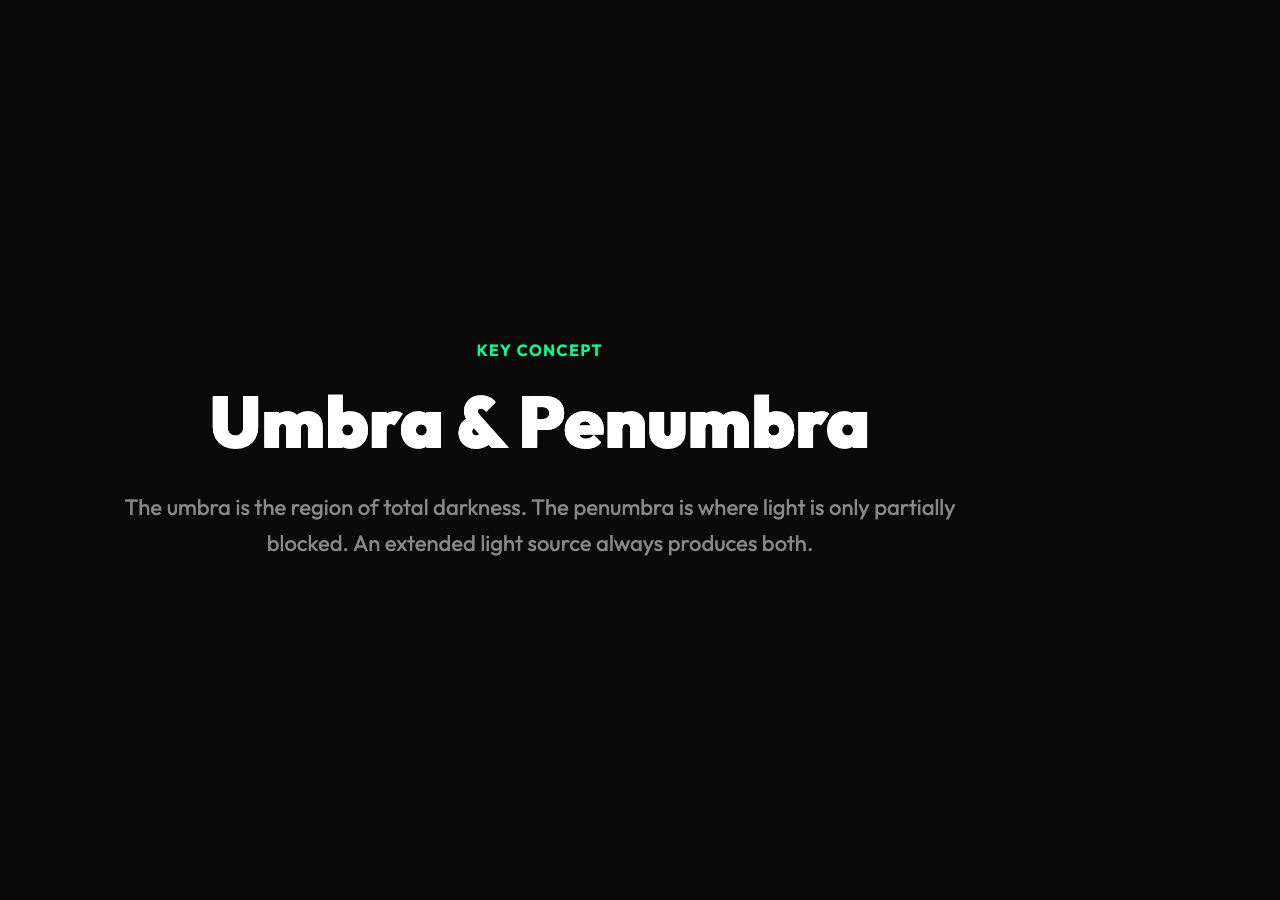
Here’s why: take a light source with some size — say the sun, with a diameter of 1.4 million kilometers. From any point behind an occluding object, some rays from the sun’s top edge can still reach you, while rays from the sun’s bottom edge are blocked. You see part of the sun, not none of it. That’s the penumbra.
Move closer to the occluding object and the sun subtends a smaller angle. Eventually you reach the umbra — the region where no rays from any part of the sun can reach you. You see total blockage.
The geometry is straightforward. The angular size of the light source as seen from the occluding object determines the penumbra’s width. A larger angular size (bigger or closer light source) means a wider penumbra. A smaller angular size means a sharper shadow.
The Eclipse Is a Shadow in Motion
An solar eclipse is nothing more than the moon’s shadow falling on Earth. When the moon passes between the sun and Earth, its shadow sweeps across the surface. If you’re in the umbra, you see a total eclipse — the sun completely hidden by the moon. If you’re in the penumbra, you see a partial eclipse — part of the sun still visible around the moon’s edge.
What makes eclipses rare is the geometry: the moon is about 400 times smaller than the sun but also about 400 times closer, so their angular sizes almost exactly match (both about 0.5 degrees). The alignment has to be nearly perfect.
The moon’s distance varies enough that sometimes the umbra barely reaches Earth (a near-miss total eclipse) and sometimes it doesn’t reach at all (an annular eclipse, where the moon looks smaller than the sun and a ring of light remains visible). This distance variation is why not every solar eclipse is total, and why the duration of totality can range from seconds to over seven minutes.
The Shadow Equation: What the Geometry Actually Says
For a point source, the shadow size follows a simple proportional relationship:
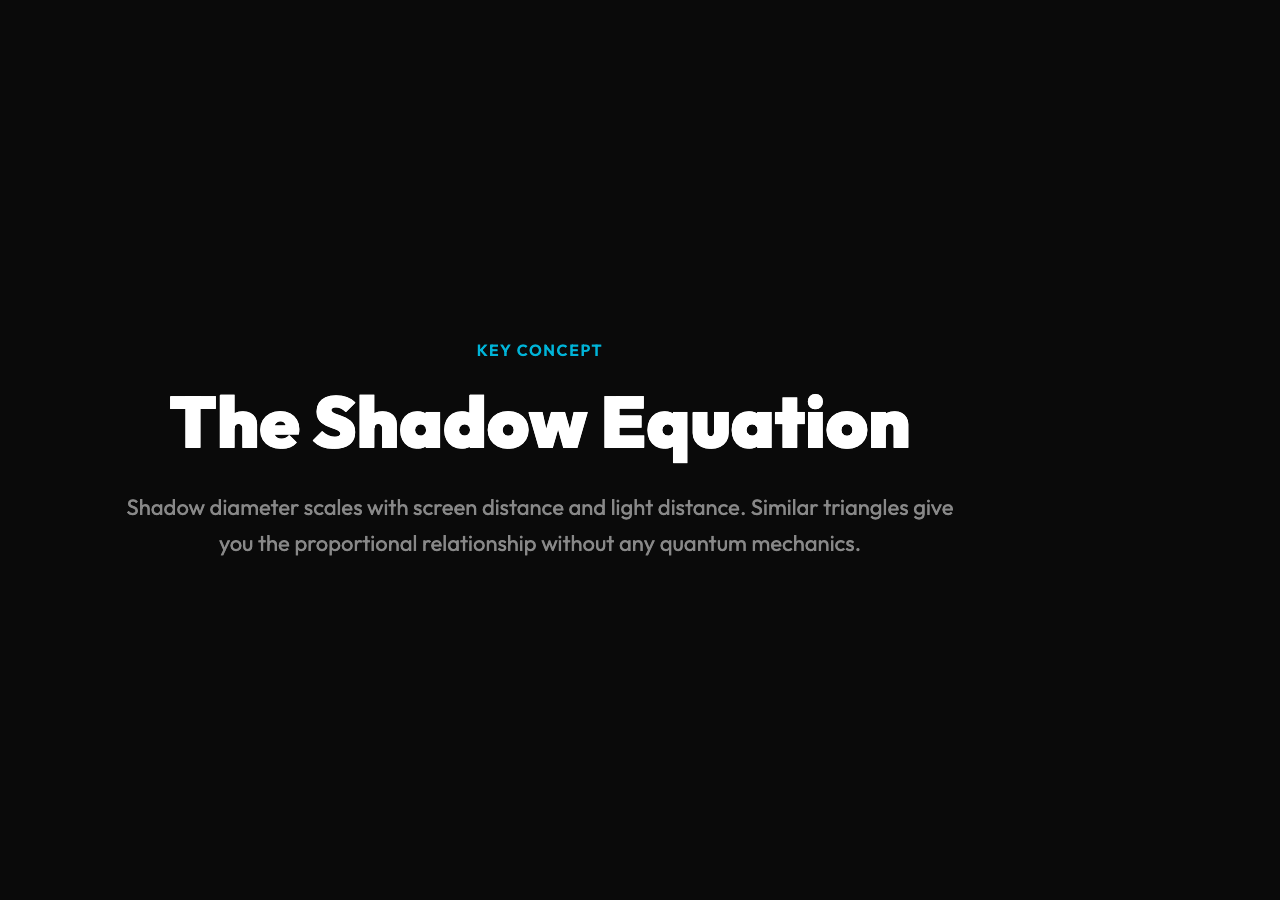
Shadow diameter / Object diameter = Screen distance / Light distance
This comes from similar triangles. The light, the edge of the object’s shadow, and the screen form two proportional right triangles. As the screen moves farther from the object, the shadow grows. As the object moves farther from the light, the shadow shrinks.
With an extended source, the calculation becomes a geometry problem involving the light source’s angular size. The penumbra width equals roughly (Light size / Light distance) × Screen distance, scaled by the geometry of the specific setup. In the shadow formation visualization, adjusting the light size parameter shows this directly — a larger light source produces a wider penumbra zone.
Why Shadows Are Never Completely Sharp
In the real world, shadows always have some penumbra. No light source is a perfect point. Even a laser, often cited as the most collimated light available, has a finite beam divergence — it spreads over distance. The sun’s light, after traveling150 million kilometers, arrives nearly parallel, but not perfectly parallel. Shadows cast by the sun at Earth’s surface have penumbras measurable in millimeters.
Inside a room with ordinary lighting, shadows are visibly fuzzy because the light source (a light bulb or lamp) is large relative to the distance to the shadow-casting object. Hold your hand close to a wall under a room light and the shadow edges are soft. Move your hand closer to the light and the shadow sharpens. Move your hand farther from the light and the shadow blurs again — the angular size of the light source as seen from your hand increases.
This is the same effect that governs the eclipse. When you stand in the moon’s umbral shadow, you’re so far from the moon (and it subtends so small an angle) that the sun’s disk is almost a point source — you get near-perfect darkness. In the penumbra, you’re off-axis and the sun’s disk is only partially blocked.
The Interactive Dimension: Why Simulations Help
Seeing the shadow form in real time — with sliders for light size, object size, and distances — makes these relationships concrete. Adjust the light source size from a point to an extended disk and watch the umbra shrink while the penumbra grows. Move the screen closer to the object and watch the entire shadow shrink proportionally.
The shadow formation visualization lets you switch between point and extended light sources, toggling the umbra and penumbra displays independently. This matters because in a real eclipse, you don’t just see darkness — you see the gradient from full blockage to partial illumination, and that gradient encodes the geometry of the sun, moon, and observer.
What the Shadow Reveals
Every shadow contains three pieces of information: the size of the light source, the distance from the object to the light, and the distance from the object to the screen. Given any two, you can calculate the third. This is why astronomers can estimate the size of the sun’s disk from shadow measurements on Earth, and why ancient observers used shadow lengths to estimate the Earth’s circumference (Eratosthenes did this around 200 BCE).
The shadow is a natural pinhole camera. The smaller the light source (in angular terms), the sharper the shadow. This is the same principle as the camera obscura — the smaller the pinhole, the sharper the image. But the shadow is simpler: no pinhole needed, just an opaque object blocking direct light.
The physics of shadows connects directly to radiative heat transfer, to solar energy system design (where shadow avoidance maximizes panel output), and to the design of everything from telescopes to architectural lighting. The same geometry that predicts your shadow’s length at noon predicts the duration of an eclipse’s totality.
Every shadow you’ve ever seen is a geometry problem the universe wrote for free. The variables are light, object, and screen. The answer is always the same: straight lines, similar triangles, and the angular size of the source. Look at your shadow on the ground and read the equation.