The muon should not reach the ground. Born in the upper atmosphere, 10 kilometers up, traveling at 0.98c, it has only 2.2 microseconds before it decays. At light speed, that gets you less than a kilometer. Yet we detect muons at the surface all the time. The reason is not that they live longer — at least, not in their own frame. In ours, time itself stretches.
This is time dilation, the counterintuitive prediction of special relativity that has been confirmed so many times it barely raises eyebrows anymore. But the question worth asking is not whether time dilation exists — the GPS satellites correct for it every second — but why it happens, what it actually does to clocks, and why you feel nothing at 900 kilometers per hour on a transatlantic flight.
The Light Clock That Started It All
Einstein‘s simplest argument for time dilation uses a light clock: two mirrors facing each other, a photon bouncing between them. When the clock is still, the photon traces a vertical path — up, down, up, down. Define one tick as a round-trip.
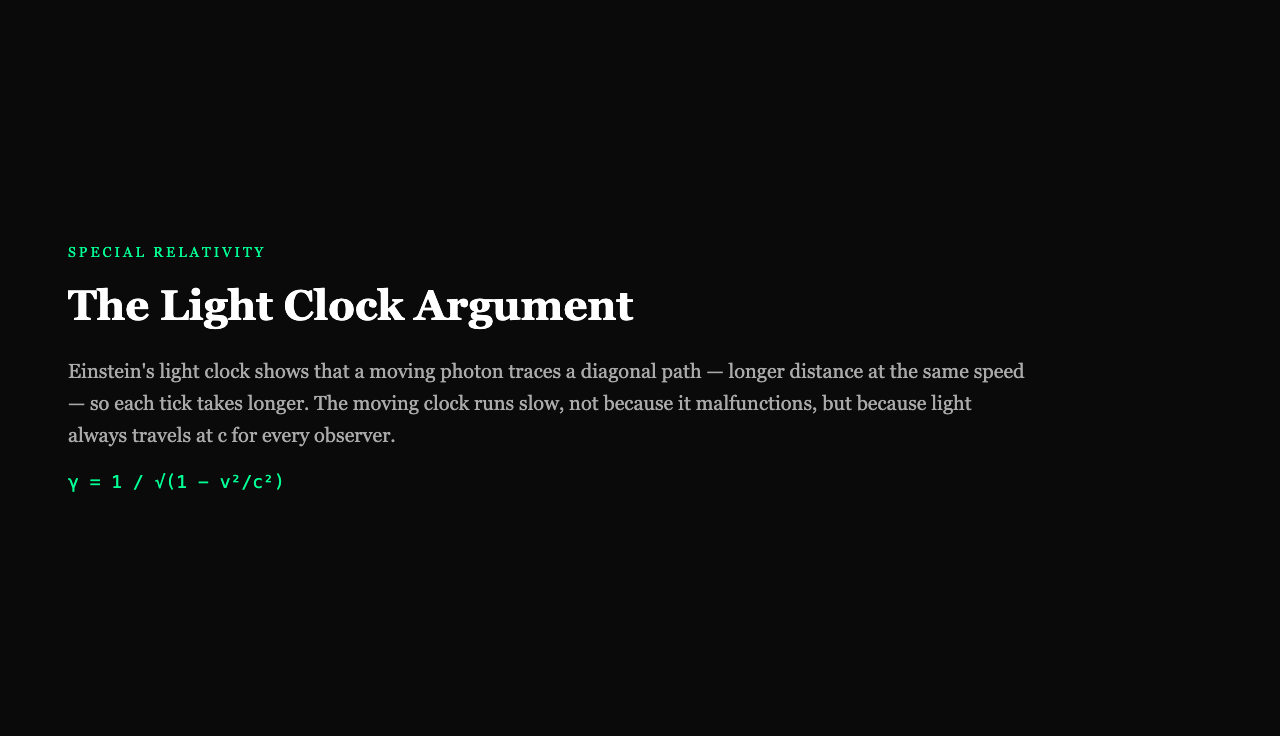
Now set the clock moving horizontally. From a stationary observer’s perspective, the photon no longer travels straight up and down. It follows a diagonal path — a longer distance per tick. The speed of light is constant for all observers, so if the distance the photon travels has increased, the time per tick must increase too. The moving clock ticks slower.
This is the core of time dilation. Not a malfunction of clocks, but a geometric fact about spacetime. Every moving object experiences time at a different rate relative to observers in relative motion.
The Lorentz Factor: Just a Number Until It Isn’t
The quantitative relationship is γ = 1/√(1 − v²/c²). The Greek letter gamma — γ — appears in every relativistic equation for a reason. It is the factor by which time, length, and mass change for a moving object.
At everyday speeds — the speed of a car, a commercial airplane, even a bullet — γ is indistinguishable from 1. At 900 km/h, the speed of a transatlantic jet, γ = 1.00000000014. You gain about 0.000000001 seconds per flight hour. Not noticeable. Not even measurable with consumer technology.
At 0.5c (half the speed of light), γ = 1.15. Time on the moving object runs 15% slower than in the stationary frame. At 0.87c, γ = 2. Time runs at half speed. At 0.99c, γ = 7.1. Time runs seven times slower.
These are not abstractions. Particles in accelerators reach 0.9999c routinely. The LHC accelerates protons to γ ≈ 7,000. Muons created in particle collisions survive long enough to be detected precisely because their internal clocks run slow relative to ours.
The muon is the clearest example. A muon at rest has a mean lifetime of 2.2 microseconds. At 0.98c, its mean lifetime in our frame stretches to 11 microseconds. In that time, traveling at 0.98 × 299,792,458 m/s, it covers about 3,200 meters — enough to reach the ground from 10 kilometers up. Without time dilation, the muon would decay after 660 meters. With it, it arrives.
Why You Don’t Feel It
The short answer is that your body has no reference frame that notices. You feel acceleration — a change in velocity — because that creates an imbalance in the inner ear. But uniform motion at constant velocity is, by Einstein’s principle of relativity, indistinguishable from rest. There is no experiment you can do inside a sealed cabin to determine whether you are moving at constant velocity or sitting still.
Your biological processes — heart rate, neural firing, cellular metabolism — all slow by the same factor as the clocks on the wall. There is no internal sensation of time dilation because there is no “now” external to compare against. You are always in your own proper time, and it always feels normal.
The subtlety is that the effect is symmetric. From the muon母s frame, it is our clocks that are slow. The muon thinks our atmosphere is thinner and its journey shorter. Both perspectives are correct — each observer sees the other’s time as dilated. This is not a contradiction; it is how spacetime works. The symmetry only breaks when the paths diverge and reunite, which is where the famous twin paradox lives.
The Twin Paradox Is Not a Paradox
The classic setup: one twin stays on Earth, the other travels at near-light speed to a distant star and returns. The traveling twin is younger upon reunion. Why? Because the traveling twin changed inertial frames twice — once when accelerating away from Earth, once when decelerating to turn around — while the stay-at-home twin remained in a single inertial frame throughout.
This is not symmetrical. The traveling twin experienced acceleration; the Earth twin did not. The traveling twin took a path through spacetime that covered less proper time. The Earth twin took the longest possible path between the same two events. In spacetime, the longest path between two events is a straight line at constant velocity. The traveling twin’s accelerated path is shorter in proper time.
The resolution is not that acceleration is the key — it is that the two paths through spacetime are not equivalent. Only one involves a reunion. Only the traveling twin returns to compare clocks. That asymmetry is what resolves the paradox.
GPS and the Real-World Consequence
The Global Positioning System is the most precise everyday demonstration of time dilation at work. The satellites orbit at about 20,200 kilometers altitude, moving at roughly 14,000 km/h. At that speed, special relativistic time dilation would make their clocks run slow by about 7 microseconds per day. But at that altitude, the gravitational potential is different — general relativity says clocks run faster in weaker gravity. That effect adds about 45 microseconds per day. Net effect: GPS satellites’ clocks run fast by 38 microseconds per day relative to ground clocks.
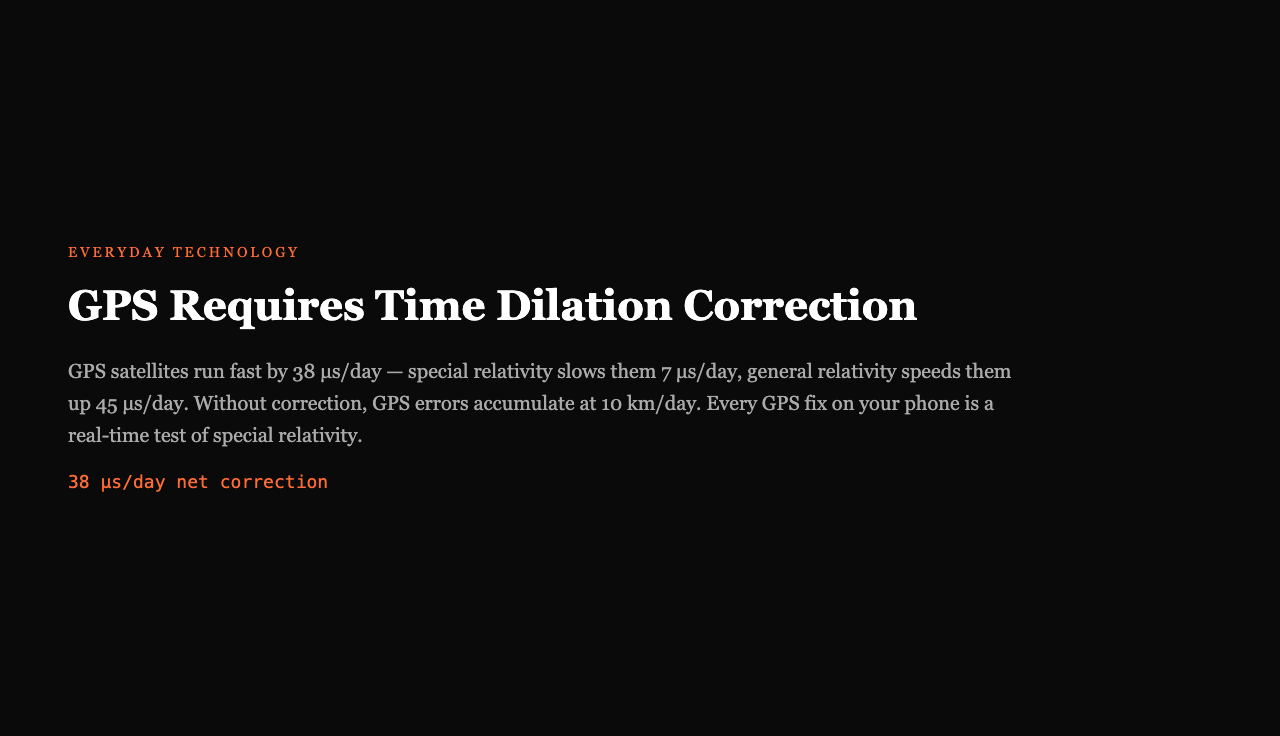
Without correction, GPS errors would accumulate at about 10 kilometers per day. The system would fail within hours.
And it is not just GPS. Any precision timing system — cellular networks, financial trading timestamps, scientific instruments — must account for the fact that time is not universal. Moving clocks disagree. Gravity changes the rate. The universe has no master clock.
What Remains After the Fact
The most striking thing about time dilation is how mundane it becomes in the mathematics. A single factor — γ — describes how much time stretches for a moving object. Plug in the velocity, get the factor, multiply the elapsed time. The equations are not complicated. What is complicated is letting your intuitions go.
We evolved in a world where light speed is unreachable and gravity is weak. Our intuitions about time come from living in a narrow band of speeds and gravitational potentials. Special relativity pushes against those intuitions every time you think about a muon surviving a 10-kilometer fall, or a GPS satellite correcting its clock by 38 microseconds per day.
The photon bouncing between mirrors is still the clearest picture. Light always moves at c. Distance and time are not fixed — they adjust so that the speed of light stays the same for every observer. That adjustment is time dilation: the price of having a universal speed limit.
Your clock runs slow because you are moving relative to someone else, and their clock runs slow because they are moving relative to you — until one of you turns around and comes back. Then the asymmetry becomes measurable, and one twin ages faster. Not because time is a social construct or a matter of perspective, but because spacetime has a geometry, and moving through it at different speeds produces different elapsed times along different paths. The muon arrives because time, at 0.98c, runs slow enough for the journey to matter.
The universe does not care what feels intuitive. It runs on Lorentz invariance.
The Muon Still Arrives
Standing at sea level, watching for cosmic ray muons, you are watching a particle that should have decayed kilometers above your head arrive anyway. It is not magic. It is special relativity. γ = 1/√(1 − v²/c²), applied to the muon母s internal clock. Time at 0.98c runs slow by a factor of about 5 in our frame. Enough for the muon母s 2.2-microsecond mean lifetime to stretch into 11 microseconds of our time. Enough to travel 3,200 meters instead of 660.
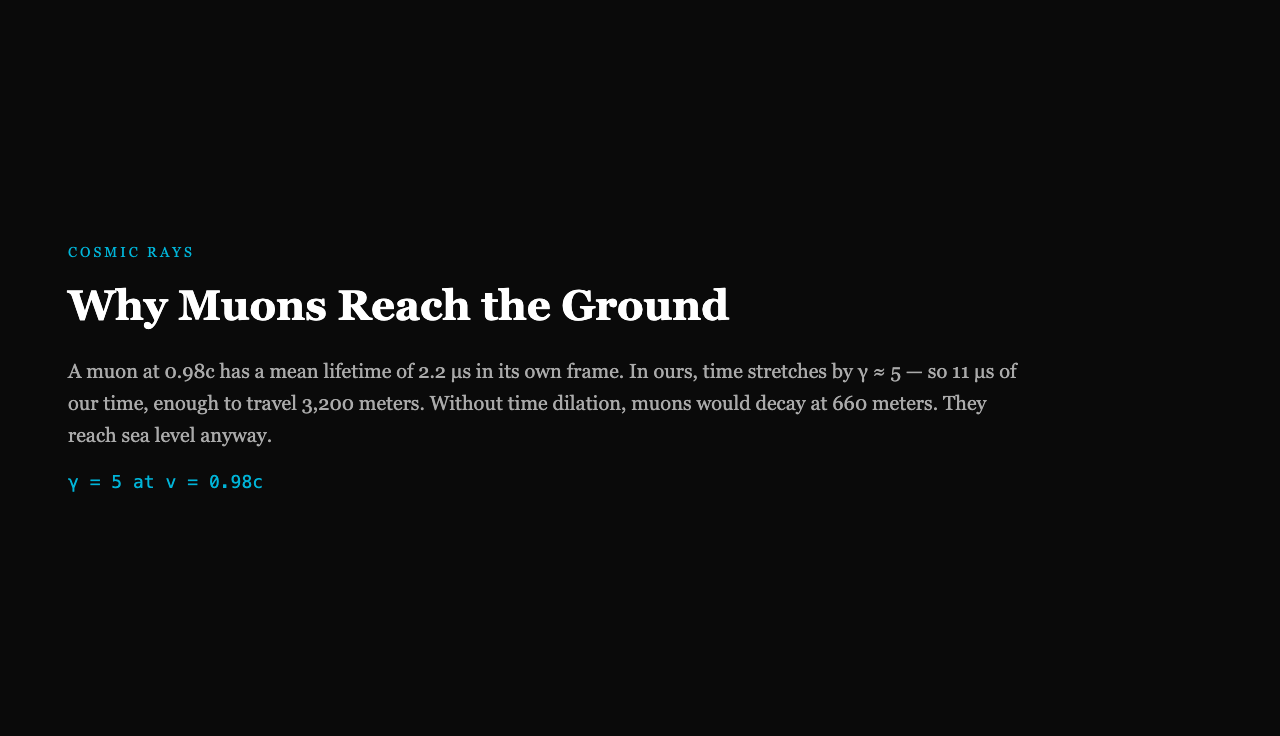
The atmosphere is 10 kilometers deep. The muon still makes it. That is the one-sentence summary of time dilation at cosmic ray energies — and it is still remarkable, every time.