The truth is, every ISBN is a quiet agreement between a publisher, a scanner, and a math problem. A bad digit is caught the moment it touches a barcode reader; a good digit sails through checkout and lands a book in a warehouse. We rarely think about it, and that is the point — ISBNs work because the checksum is invisible until it isn’t. The next time you read a barcode on the back of a paperback, remember: the last digit isn’t decoration. It’s the answer to a question the number has been asking since 1970.
The 13 digits on the back of every book you own
Walk over to the nearest bookshelf and pull any book published after 2007. Turn it over. On the back cover, beneath the barcode, you’ll see a number that looks like 978-0-306-40615-7. That is an ISBN-13. It is not random. It is not a serial number assigned in order. It is a small piece of structured data that, in 13 characters, tells a checkout scanner what country the publisher is based in, what language group the book belongs to, who published it, which title it is, and whether the whole string was typed correctly.
Most readers treat the ISBN like a serial number — a unique label that no one has to think about. It is, in fact, a checksum-validated identifier with a five-layer hierarchy baked into its digits. The same is true of the older ISBN-10 format (0-306-40615-2), which used a different checksum algorithm and is still printed on many used-paperback spines. Both formats have a check digit at the end, and that digit isn’t decoration — it is computed from every other digit in the number. Type a single digit wrong, and the checksum will tell you so.
What an ISBN actually contains
The 13 digits in a modern ISBN are not interchangeable. They break into five fixed-width fields, each with a different job:
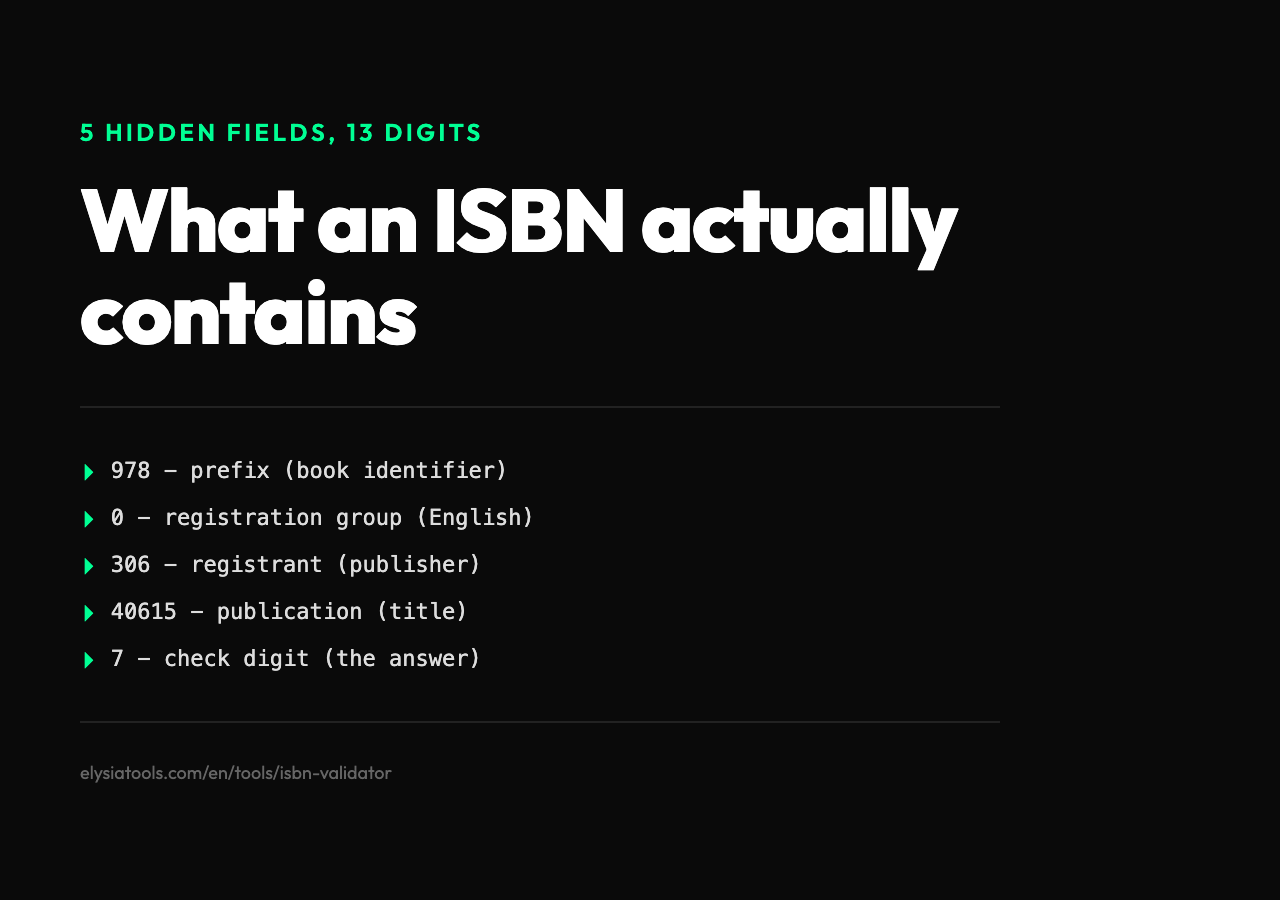
- Prefix (3 digits): Always
978or979. The978block was assigned to books already covered by the older ISBN-10 system;979was opened up in 2007 when the978block started to run out of room. A new book will always begin with one of these two prefixes. - Registration group (1–5 digits): Identifies the country or language region.
0and1are English-speaking countries,2is French,3is German,4is Japan,5is Russian,7is China,80is Czech,88is Italy,89is Korea,950is Argentina, and so on. The length of this field is variable, which is why the total can sometimes look asymmetric. - Registrant (variable): The publisher. The length of this field is determined by how many books the registrant publishes — a small press gets more digits, a major publisher like Penguin or Springer gets fewer.
- Publication (variable): The title. Whatever length is left after the first three fields goes here.
- Check digit (1 digit): The computed answer. This is the one digit that is not assigned; it is derived from the rest.
A book from Random House in the United States might look like 978-0-679-72019-1. A book from a small Korean press might be 978-89-1234-567-8. Same structure, same algorithm, different allocations.
The fact that the prefix, group, registrant, and publication fields have variable widths is what makes the ISBN look like noise to a human reader. To a scanner, the prefix 978 says “this is a book,” the next digits triangulate the publisher and title, and the final digit says “the math checks out.”
The ISBN-13 checksum, in plain English
The check digit at the end of an ISBN-13 is computed with the same algorithm used by credit card numbers and the EAN-13 barcodes on every cereal box. It is a single weighted-sum mod 10. Here is the rule, written in a way that doesn’t require a math degree:
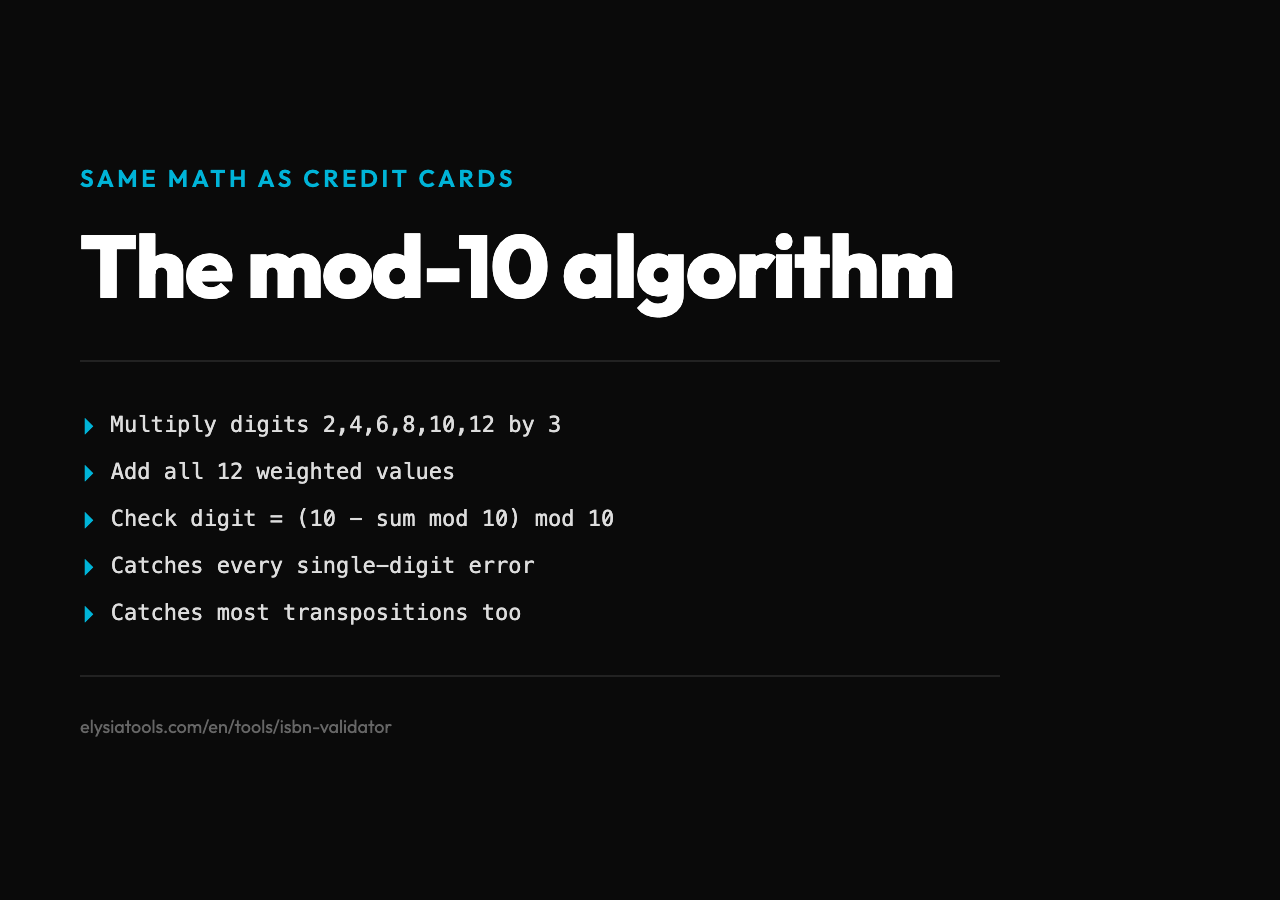
1. Take the first 12 digits of the ISBN. 2. Multiply every other digit by 3, starting with the second. So digit 2, 4, 6, 8, 10, and 12 get multiplied by 3. Digits 1, 3, 5, 7, 9, and 11 stay as they are. 3. Add all 12 weighted values together. 4. The check digit is the smallest number you can add to that sum to make it divisible by 10.
Take 978-0-306-40615-? and run it:
– 9×1 + 7×3 + 8×1 + 0×3 + 3×1 + 0×3 + 6×1 + 4×3 + 0×1 + 6×3 + 1×1 + 5×3 – = 9 + 21 + 8 + 0 + 3 + 0 + 6 + 12 + 0 + 18 + 1 + 15 – = 93 – 93 + 7 = 100. 100 mod 10 = 0. The check digit is 7. The full ISBN is 978-0-306-40615-7.
Now change the seventh digit from 6 to 7: 978-0-307-40615-?. Run the same algorithm: 9 + 21 + 8 + 0 + 3 + 0 + 7 + 12 + 0 + 18 + 1 + 15 = 94. The check digit is 6, not 7. The scanner flags the discrepancy. One wrong digit, one caught error, no database lookup required.
This is why the algorithm is so widely used. It catches every single-digit error. It catches most two-digit transpositions. It costs almost nothing to compute. And it is impossible to forge a valid ISBN by accident — you have to do the math, or it won’t pass the scanner.
ISBN-10: the older system with an X check digit
Before 2007, books were assigned 10-digit ISBNs. The structure was simpler — group, registrant, publication, and check digit, with no 978 prefix — but the checksum was different. ISBN-10 uses a weighted-sum mod 11:
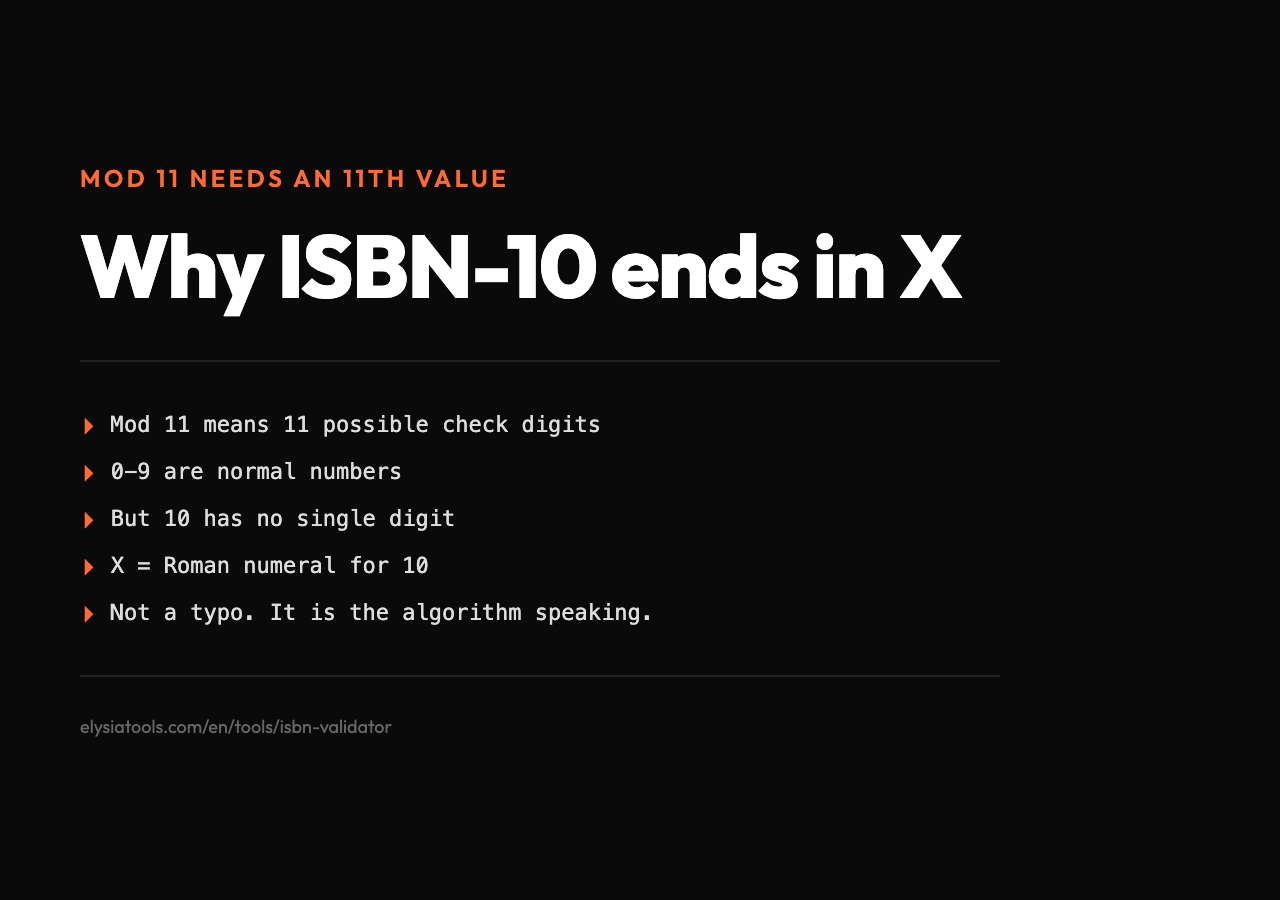
– Multiply each of the first 9 digits by its position: 10, 9, 8, 7, 6, 5, 4, 3, 2. – Add them up. – The check digit (the 10th character) is the number that makes the total divisible by 11. Because 11 is prime, the check digit has 11 possible values: 0 through 10. The value 10 is printed as the letter X.
Take 0-306-40615-?. The first 9 digits, weighted:
– 0×10 + 3×9 + 0×8 + 6×7 + 4×6 + 0×5 + 6×4 + 1×3 + 5×2 – = 0 + 27 + 0 + 42 + 24 + 0 + 24 + 3 + 10 – = 130 – 130 mod 11 = 9. 11 − 9 = 2. The check digit is 2. The full ISBN-10 is 0-306-40615-2.
Now change the third digit from 0 to 5: 0-365-40615-?. The sum becomes 145, 145 mod 11 = 2, 11 − 2 = 9. The check digit changes from 2 to 9. The number is no longer valid.
The X is the part that surprises people. Every other digit is a number, and then suddenly the last one might be a letter. It is not a typo or a publisher’s branding choice. It is the algorithm saying “I need an 11, and digits only go up to 9, so I’ll use X as shorthand for 10.” The letter was chosen because it is the Roman numeral for 10 — the same reason it shows up in the names of monarchs, centuries, and Super Bowls.
If you’ve ever looked at an old paperback and wondered why the last character looked like a vowel, that is why. It is the checksum doing its job.
Converting between the two formats
For a long time, ISBN-10 and ISBN-13 coexisted. Any book published between 1970 and 2006 has only an ISBN-10; any book published after 2007 has only an ISBN-13; books from the transition period often have both printed on the cover. To bridge the two systems, the algorithm defines a clean conversion in both directions.
To convert ISBN-10 to ISBN-13: prepend 978 to the first 9 digits of the ISBN-10, drop the old check digit, and recompute the ISBN-13 check digit using the mod-10 algorithm above. So 0-306-40615-2 becomes 978-0-306-40615-7. The 7 was computed from the first 12 digits 978-0-306-40615 exactly as in the worked example above.
To convert ISBN-13 to ISBN-10: this only works for books with the 978 prefix. Drop the 978, drop the check digit, recompute the ISBN-10 check digit using the mod-11 algorithm, and append it. So 978-0-306-40615-7 becomes 0-306-40615-2. Books with the 979 prefix have no ISBN-10 equivalent — they were assigned after the transition window closed.
The conversion is not a database lookup. It is pure arithmetic. You do not need a registry, an API, or an internet connection to convert an ISBN-10 to its ISBN-13 form. The math is the spec.
What the validator actually checks
A real ISBN validator — like the Elysia Tools ISBN Validator — does four things in sequence:
1. Strips spaces and hyphens so users can paste in any reasonable formatting (978 0 306 40615 7, 978-0-306-40615-7, 9780306406157 all work). 2. Detects the format from the length and the leading digits: 10 characters with an optional trailing X is ISBN-10; 13 characters starting with 978 or 979 is ISBN-13. 3. Runs the appropriate checksum — mod 11 for ISBN-10, mod 10 for ISBN-13 — and compares the result to the last character. 4. If the input was ISBN-10, returns the ISBN-13 equivalent; if it was ISBN-13 with a 978 prefix, returns the ISBN-10 equivalent.
The validator also decomposes the number into its five (or four) component fields, so a user can see, at a glance, which country the publisher is in, which publisher assigned the title, and which check digit the algorithm expected. This is useful for two real-world situations. First, librarians and inventory staff who need to look up a book by publisher. Second, anyone trying to spot a typo: if the prefix says 978 but the registration group is 9 (which is reserved for a country that doesn’t issue books through that channel), something is wrong even before the checksum fires.
Why this matters outside of books
The ISBN checksum is not unique. The mod-10 algorithm it uses is the same algorithm used by credit card numbers, the EAN-13 codes on retail products, and the tracking numbers on most shipping labels. ISBN-10’s mod-11 algorithm is rarer, but the principle — a final digit computed from everything that came before it — is universal in modern commerce.
That is the deeper point. The next time a checkout scanner beeps and accepts a bar code, the math that protects your credit card number is the same math that protects the back of your paperback. The reason the cashier doesn’t have to type 13 digits by hand, the reason the wrong book doesn’t end up in the wrong warehouse, the reason a used-book store can sort 10,000 paperbacks by typing in one number each — the reason for all of that is a 30-year-old algorithm that fits in four lines of code. A small piece of invisible math, running millions of times a day, in every bookstore and library and warehouse on earth, doing its job without anyone asking.
The next time you scan a book, the answer to “is this number real?” is the same math that guards your credit card. Same algorithm. Same one-digit error catching. Same ten-millisecond cost. A small piece of invisible arithmetic that has been quietly running checkout scanners, library catalogs, and warehouse sorters for decades. Pick up a book, read the last digit, and try to compute what the next one should be — the algorithm is in your hands, the only question is whether you’ll see it. Run the Elysia Tools ISBN Validator on the next book you pick up, or explore more validation tools at elysiatools.com.