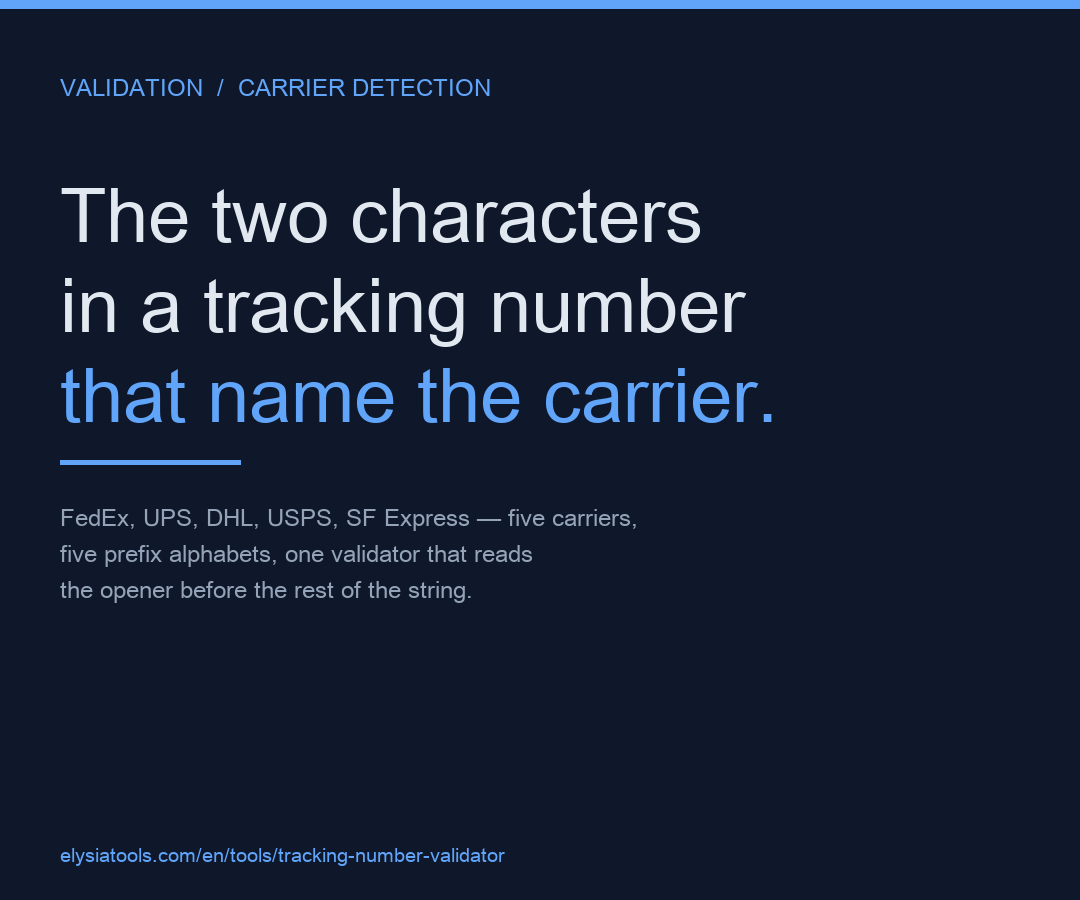
Every tracking number carries its own passport. The first two characters — sometimes three, rarely four — are the carrier's signature, baked in before the package ever leaves the warehouse. By the time a rep pastes an order ID into a search box, that signature has already decided which carrier API to call, which tracking page to open. Most validation logic never needs to hit an upstream API. It just needs to read the prefix.
The Elysia Tools Tracking Number Validator is built around that observation. Drop in any major carrier format — FedEx, UPS, DHL, USPS, SF Express — and the validator identifies the carrier, checks the shape, and reports validity in the same pass. No external lookups, no rate-limited APIs, no risk of leaking a customer's tracking number through a third party. The prefix does the work because the prefix was designed to.
How each carrier encodes itself in the first bytes
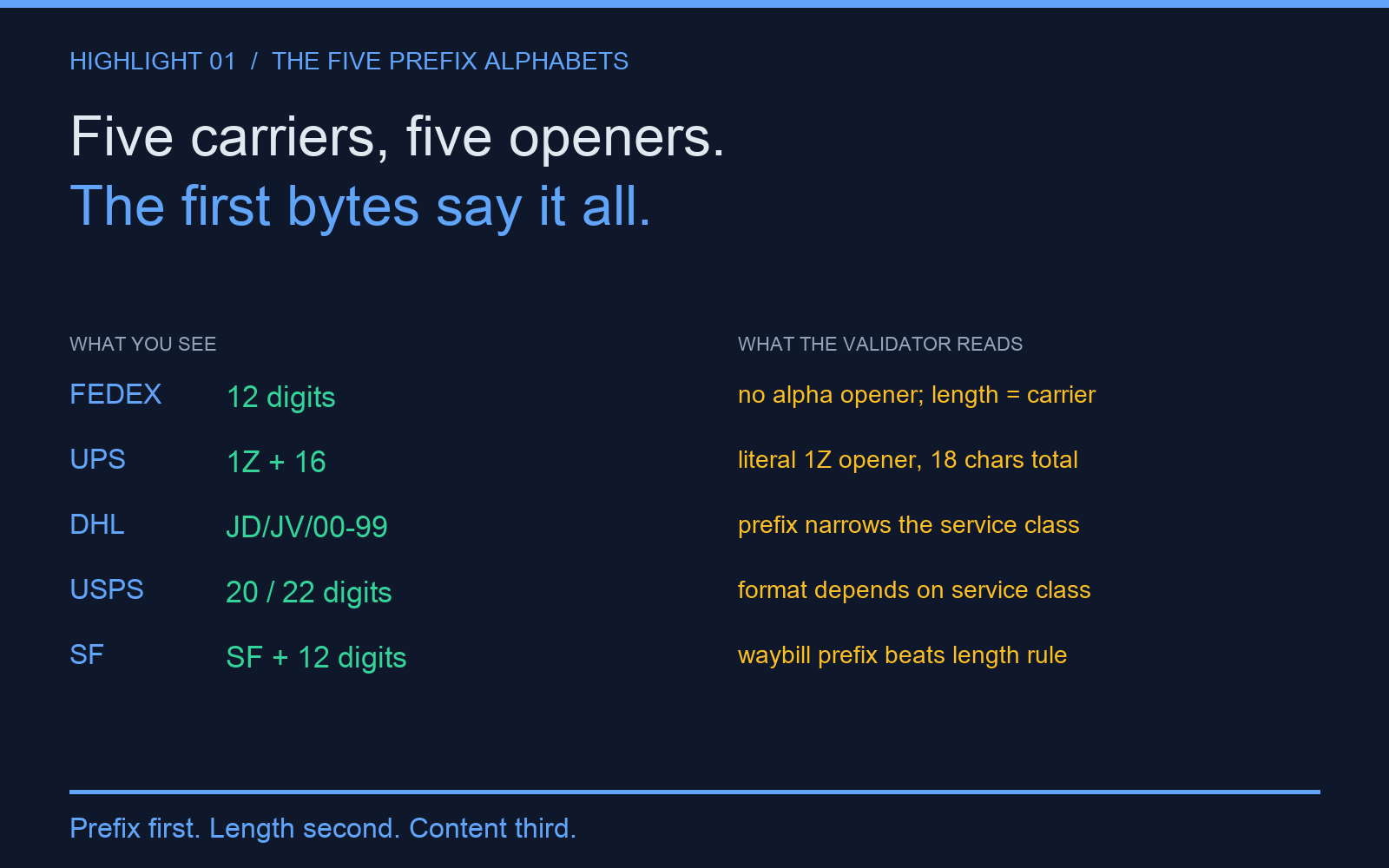
Five carriers cover most global e-commerce volume, and each one carved out a recognizable opening decades ago. The shapes overlap enough to confuse a casual reader but diverge enough that a short prefix scan is decisive.
- FedEx uses 12 digits for Express, 15 for Ground Economy, with the SmartPost variant starting
92. Pure numeric, no alphabetic opener — the validator sorts by length and the92prefix. - UPS opens with the literal
1Zfollowed by 16 alphanumeric characters. The1Zopener is unique among major carriers — it never appears at the start of any other format — which makes UPS the easiest signature to recognize. - DHL varies by service: international air waybills are 10 or 11 digits starting
JDorJV; domestic German shipments are 20 digits starting1; express waybills are 10 digits starting00through99. The opener breaks the tie before length rules apply. - USPS is the wildcard. Format depends on service class: 20 digits for Certified Mail, 22 alphanumeric ending
USfor Priority Mail Express International, 13 alphanumeric for Global Express Guaranteed. The validator runs the longest match first because long-form rules are tighter. - SF Express uses 12 digits that look identical to FedEx Express at a glance. The discriminator is the
SFwaybill prefix and the regional pattern for international shipments. The validator tries SF before falling back to FedEx when the opener is ambiguous.
The point isn't to memorize the shapes — it's to notice how cleanly each carrier chose a unique opener. A validator that reads the prefix identifies the carrier in O(1) without consulting any external service.
Why prefix detection beats length heuristics
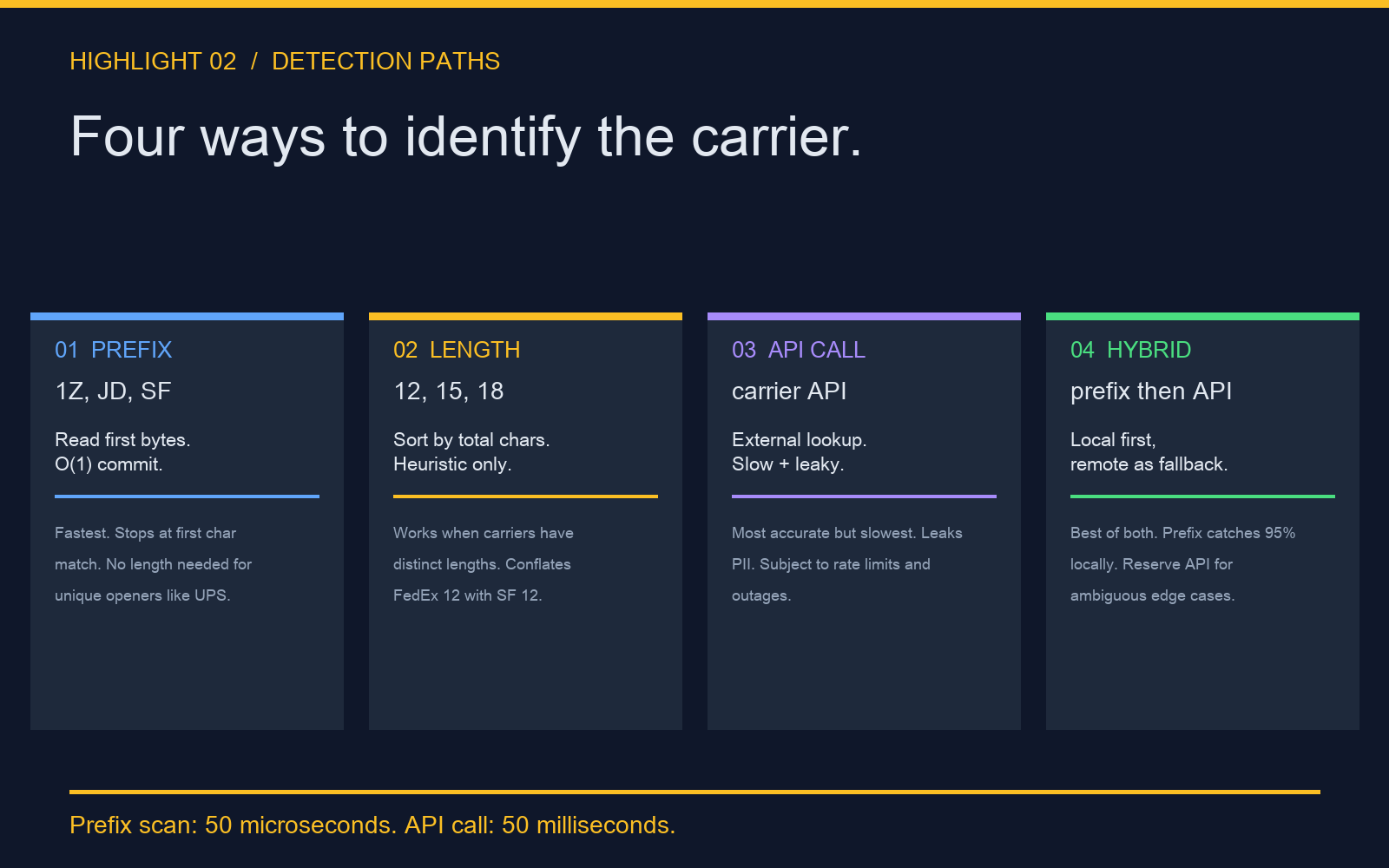
Naive validators sort tracking numbers by total length. UPS is 18, FedEx is 12 or 15, USPS varies — so a length-first heuristic either conflates formats or builds a decision tree so deep it becomes a maintenance burden. The prefix scan reverses the priority: identify the carrier first, then validate the shape within that carrier's rule set.
Two numbers that share a length can belong to different carriers. A 12-digit number starting 1 could be FedEx Express, a DHL domestic shipment, or an SF Express waybill — three different carriers, three different downstream APIs, three different status namespaces. Sorting by length alone forces the validator to ask the user, or worse, to guess and commit to the wrong API.
The validator reads the prefix first, length second, content third. The first two checks are deterministic and run in microseconds; the third (content) catches edge cases like embedded check digits. That ordering is the difference between a validator that feels instantaneous and one that makes the user wait.
The four edge cases that catch naive validators
Even with a clean prefix-first design, certain inputs slip past simple regex matchers. The validator handles each as a first-class case rather than a corner case.
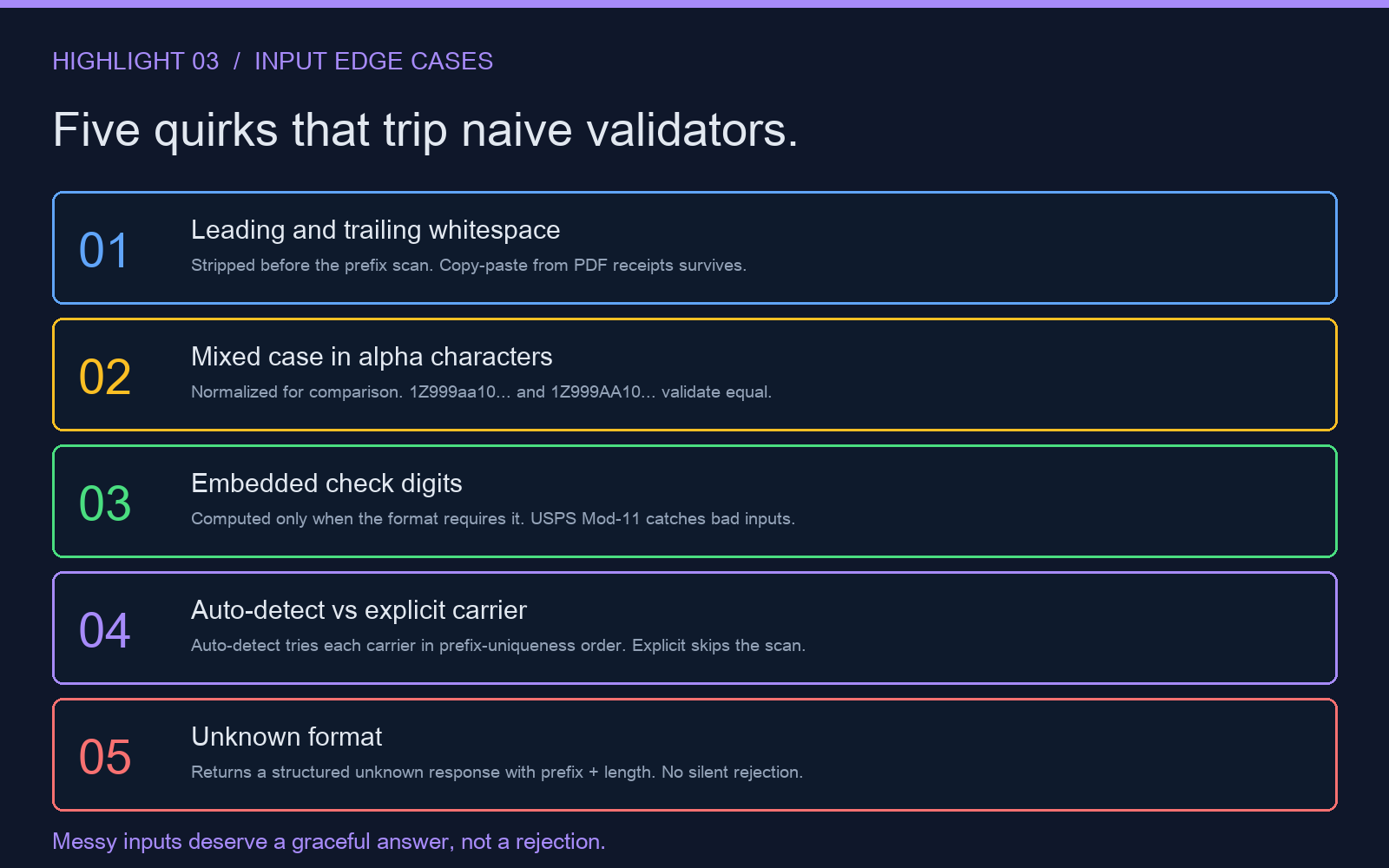
Leading and trailing whitespace. Tracking numbers copied from email clients, browser autofill, or PDF receipts arrive with stray spaces, tabs, or newlines at either end. A validator that doesn't trim reports invalid even when prefix and shape are perfect. The validator strips whitespace before the prefix scan, then validates the cleaned string.
Mixed case. UPS tracking numbers include uppercase letters, but case isn't meaningful — 1Z999aa10123456784 and 1Z999AA10123456784 point to the same package. The validator normalizes case for the prefix comparison while preserving the original string for display. This avoids false negatives when users paste from a source that lowercased the alpha characters.
Embedded check digits. Some carriers encode a check digit at a fixed position — USPS uses Mod-11 at the end of some formats. The validator checks opener and length first, then computes the check digit only when the format requires it. This skips the expensive check for carriers that don't use one while still validating USPS Certified Mail correctly.
Auto-detect vs explicit carrier. When the user knows the carrier, the validator skips the prefix scan and applies that carrier's rule directly. When the user doesn't know — the common case in support — the validator tries each carrier in order of prefix uniqueness until one matches. The auto-detect path is slightly slower but still completes in under a millisecond for the five major carriers.
Where prefix validation fits in a real workflow
The validator's primary use is the customer-facing tracking page: a shopper pastes an order ID, the page detects the carrier, the link goes to the right dashboard. But the same prefix scan powers three other workflows that ship at scale.
Returns portals use the prefix to route return labels to the correct carrier API. Support inboxes use it to auto-tag incoming tickets — 1Z opener goes to the UPS team, USPS formats to the domestic team, SF Express to the APAC team. Logistics dashboards use it to detect carrier misrouting before the package leaves the origin sort facility. In each case the validator runs on the client side or in a single server hop, with no external API call and no customer PII leaving the boundary.
That last point matters more than it sounds. Tracking numbers are PII in many jurisdictions — they correlate with names, addresses, order history. A validator that doesn't call out to a third party keeps that correlation local. Eliminating the external API call also eliminates the rate limit, the latency variance, the occasional upstream outage.
How to integrate the validator without breaking the existing flow
The validator exposes three integration points: a paste-and-go web interface for one-off validation, a JSON endpoint for batch validation, and a copy-pasteable regex bundle for embedding in forms. Each is built around the same prefix-first detection logic, so a result from one is identical to a result from another.
For the common case — a tracking input on a checkout confirmation page or a returns portal — the integration is a single function call: pass the string, get back the carrier name, the format, the validity flag. The function is pure, synchronous, dependency-free. A webhook handler processing incoming shipping notifications can call it inline before deciding which downstream queue to push the event into.
The validator handles the messy inputs gracefully — whitespace, mixed case, embedded check digits — without surfacing those edge cases to the user. When the format doesn't match any known carrier, the validator returns a structured unknown response that includes the prefix and length, enough for a support engineer to debug without re-keying.
The difference between a tracking number validated in fifty milliseconds and one that gets bounced, re-keyed, or misrouted comes down to about ten bytes of pattern recognition. Whether that recognition lives in your checkout flow, your support inbox, or your returns page, the prefix alphabet does most of the work. A good validator doesn't need to call a carrier API to recognize that 1Z999AA10123456784 is a UPS Express tracking number — it sees the 1Z opener and the eighteen-digit shape and commits before the user finishes pasting. That commitment is the whole product. Try the validator at Elysia Tools with a handful of your own numbers and watch the auto-detect handle the messy ones — tracking IDs copy-pasted from forwarders, receipts with stray whitespace, the occasional SF Express number that slips into an international queue. The longer the list you throw at it, the more obvious the value of catching the carrier at the prefix instead of guessing at the dashboard.