Most meditation apps treat relaxation as a content problem. They give you a voice, a soundscape, a streak counter, and assume the user will relax because the screen says so. Schultz Autogenic Training, the technique the Autogenic Training tool is built around, treats it as a load-balancing problem — six physiological subsystems, three passive phrases per subsystem, a cadence that has to be honest about what your nervous system can actually absorb in a single session.
The interesting engineering question is not whether the technique works (it has seventy years of clinical literature behind it, and the tool’s design has to respect that). The interesting question is what shape the practice has to take inside a browser tab, where there is no therapist watching your shoulders, no metronome counting your respiratory rate, and no way to know whether the user actually paused at the heaviness phrase or just scrolled past it.
Three decisions in the tool’s design quietly decide whether a browser-based session produces the same end state as the in-clinic version. Get them wrong, and the user gets a slightly fancier breathing exercise with a German name. Get them right, and you have something that scales the technique to a population that would never sit across from a clinician in the first place.
What Schultz Autogenic Training actually is, and why “meditation app” is the wrong frame
Johannes Heinrich Schultz was a German psychiatrist who, in the 1930s, synthesized a relaxation protocol out of two older observation streams: the self-suggestion work of Oskar Vogt and the auto-hypnosis research of the Berlin school. The protocol he landed on is structurally simple and mechanically precise. There are six standard exercises, each targeting one physiological subsystem: heaviness in the limbs, warmth in the limbs, cardiac regulation, respiratory regulation, abdominal warmth, and forehead coolness. The user repeats a passive phrase tied to each subsystem — “my right arm is heavy”, “my right arm is warm” — and lets the body catch up to the suggestion rather than forcing the sensation.
The technique is not a meditation. It does not ask the user to clear the mind, observe the breath, or achieve a particular phenomenological state. It is closer to a structured biofeedback session without the electrodes: the user provides the verbal input, the body provides the measurable output, and the protocol provides the cadence that ties the two together. The clinical literature treats it as a regulatory technique, not a contemplative one, and that distinction matters when you are deciding how to implement it.
Most “relaxation” tools collapse this into a generic breathing timer with a calming background. The Autogenic Training tool does not. It implements the six-exercise structure, the passive-phrase cadence, the position transition (lying down, then seated), and the multi-language support that the original protocol requires for clinical use. The frame is “regulatory protocol”, not “meditation app”, and the three decisions below are all about preserving that frame inside a web surface.
Dial 1: whether the cadence respects passive concentration or drifts into guided visualization
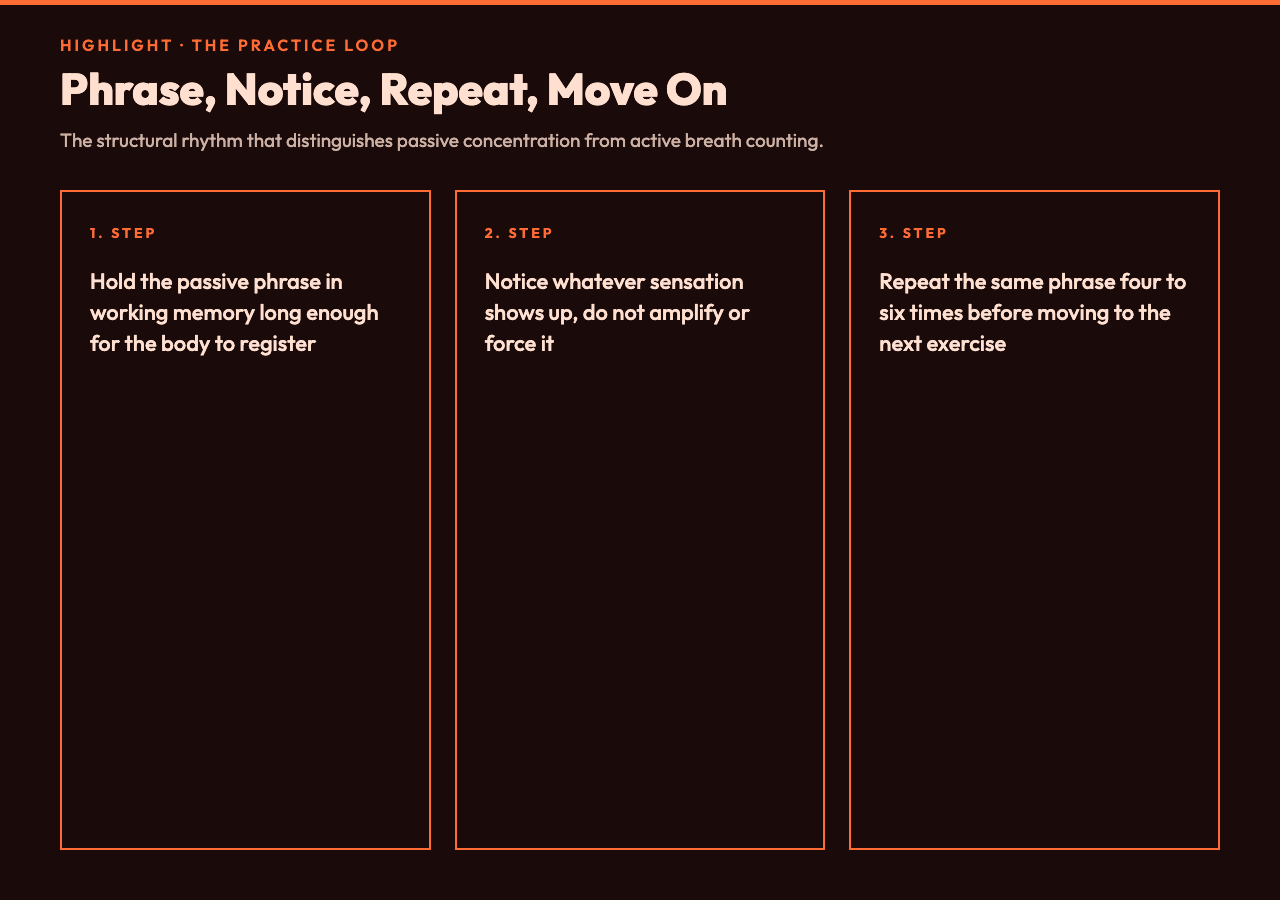
The first dial is the cadence. Schultz’s protocol is built on passive concentration: the user repeats the phrase, notices whatever happens, and does not try to amplify the sensation. A typical clinical cadence is roughly 30 to 60 seconds per phrase repetition, with the same phrase repeated four to six times before the practitioner moves to the next exercise. The repetition is not a stylistic choice; it is the mechanism. The body is being given enough time to register the suggestion, the user is being given enough time to notice the registration, and the protocol is being given enough time to demonstrate that the registration actually happened.
Most guided meditation apps collapse this into a 4-second inhale, 6-second exhale loop. That cadence is fine for box breathing. It is structurally wrong for autogenic training, where the user is supposed to be holding the heaviness phrase in working memory for the better part of a minute while the parasympathetic nervous system has time to engage. A 4-second loop forces the user to abandon passive concentration and switch to active breath counting, which is a different technique entirely.
The Autogenic Training tool’s implementation choice here is to let the phrase duration scale independently of any breath timer, and to let the user pick the rest interval between phrase repetitions. The cadence is in the user’s hands, but the structural ratio is not: there is a minimum dwell time on each phrase, there is a recommended total session length of roughly 20 minutes for the standard sequence, and the tool does not let the user compress the protocol into a 90-second “relax break” that would defeat the regulatory mechanism. The dial is the ratio between freedom and structure, and the right setting is much closer to structure than most relaxation tools would tolerate.
Dial 2: whether position transitions are treated as protocol steps or as UX flourishes
The second dial is position. The standard Schultz sequence begins with the user lying down in a quiet room with limbs slightly uncrossed. After the first three exercises (heaviness, warmth, cardiac regulation), the user is asked to transition to a seated position with the spine upright but not rigid, and the final three exercises (respiratory regulation, abdominal warmth, forehead coolness) are done from the seated position. The transition is not cosmetic. Lying down maximizes parasympathetic engagement for the limb and cardiac exercises; sitting up engages the postural muscles just enough to keep the user from sliding into a nap during the respiratory exercise, where the goal is breath pattern awareness, not sleep.
A browser-based implementation that ignores the position transition will still technically deliver the phrases. It will not deliver the regulatory shift, because the user is sitting in an office chair with their shoulders hunched the entire time, the parasympathetic engagement ceiling is much lower, and the cardiac regulation phrase is asking the body to do something it cannot easily do from that posture. The tool is not a relaxation app that happens to mention Schultz; it is a protocol runner, and protocol runners have to respect the positions the protocol specifies.
The implementation choice in the Autogenic Training tool is to mark the position transition as a discrete step in the sequence rather than as ambient advice. The tool pauses at the boundary between the third and fourth exercise, prompts the user to shift to seated, and gives them a moment to do so before the next phrase begins. The dial is whether the tool treats position as protocol or as decoration, and the right setting is the one that holds the user to the protocol even when they would rather not get up from where they are.
Dial 3: whether the language layer supports passive suggestion or assumes English fluency
The third dial is language. Autogenic training was developed in German, and the original phrases are German (“Mein rechter Arm ist schwer”). The passive voice construction matters: the phrasing is declarative but non-imperative, present tense, first person, and tied to a body part. The construction is what makes the phrase a suggestion rather than a command, and that distinction is the whole point of passive concentration. A user repeating “make my arm heavy” is doing autogenic suggestion; a user repeating “my right arm is heavy” is doing autogenic training, because the second form lets the body disagree without the user feeling like they failed.
Translate the phrase into English with a sloppy rendering — “relax your right arm”, “let your right arm relax” — and you have lost the passive construction. The user is now issuing an instruction rather than observing a state, and the protocol has degraded into progressive muscle relaxation, which is a different technique with a different mechanism and a different evidence base. The tool’s language layer has to be a translation of the protocol, not a translation of the words, and that requires native-speaker review of every phrase in every supported language.
The Autogenic Training tool ships with multi-language support for this reason. The phrases are translated as protocol elements, not as content strings, and the tool defaults to the language the user actually practices in rather than to a fallback that quietly corrupts the technique. The dial is whether the tool treats localization as a UI concern or as a clinical concern, and the right setting is the one that makes the localization layer as carefully reviewed as the protocol itself.
Why these three dials matter more than the rest of the design
There are dozens of other design choices inside a tool like this: the background gradient, the typography weight on the passive phrase, whether to play a soft chime at the exercise boundary, how to handle session interruption when the user closes the laptop mid-practice. None of them are wrong, but none of them are load-bearing. The technique survives a mediocre chime. It does not survive a compressed cadence, a skipped position transition, or a phrase that has been rephrased into a command.
What the three dials have in common is that they each protect a specific property of the original protocol: the dwell time on each phrase protects passive concentration, the position transition protects the physiological ceiling of the regulatory shift, and the language layer protects the passive voice construction that distinguishes autogenic training from autogenic suggestion. Remove any one of them, and the tool becomes a relaxation app with a German accent. Keep all three, and the tool becomes a credible browser-based delivery vehicle for a technique that was designed for a clinical room seventy years ago.
What to look for when you evaluate any “autogenic training” app
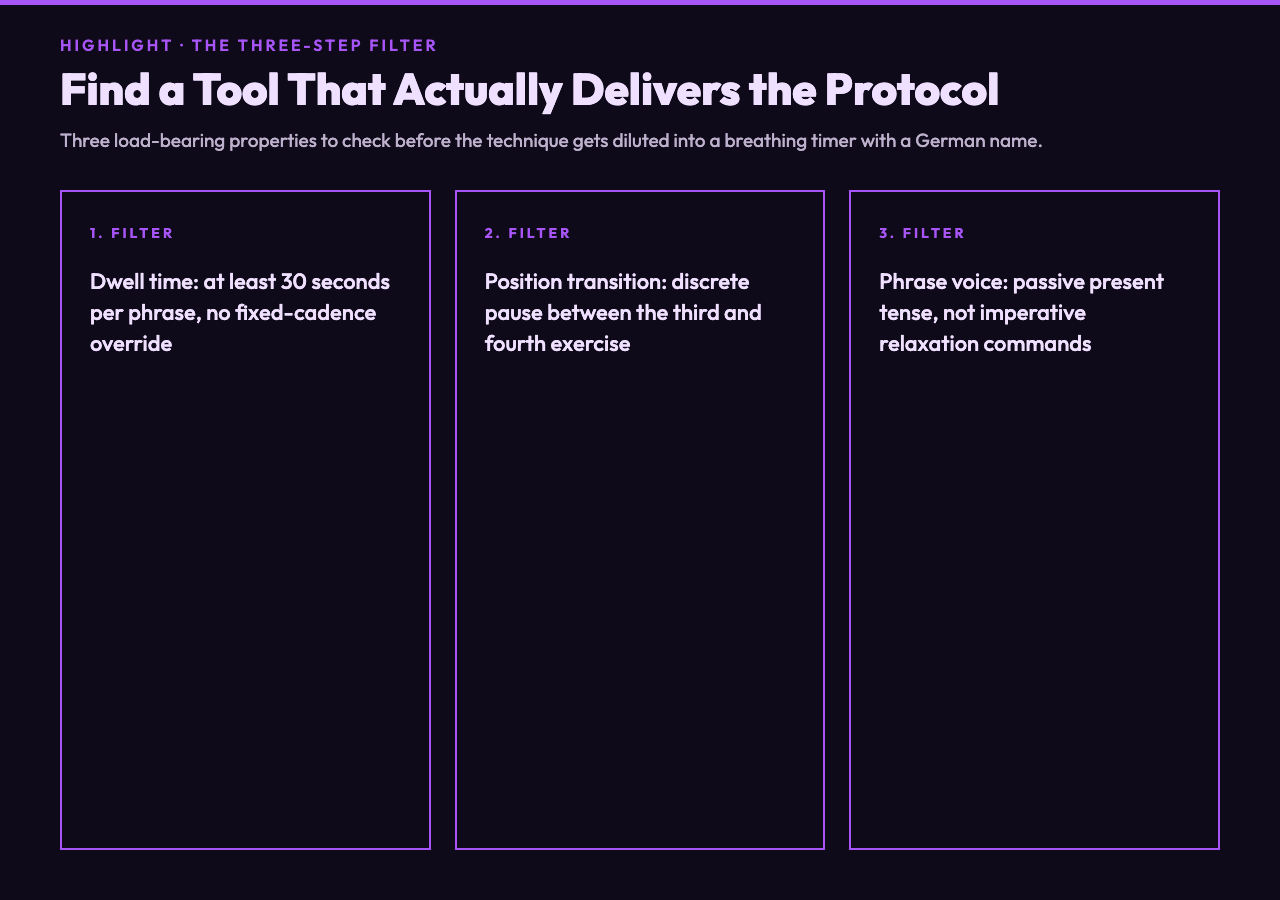
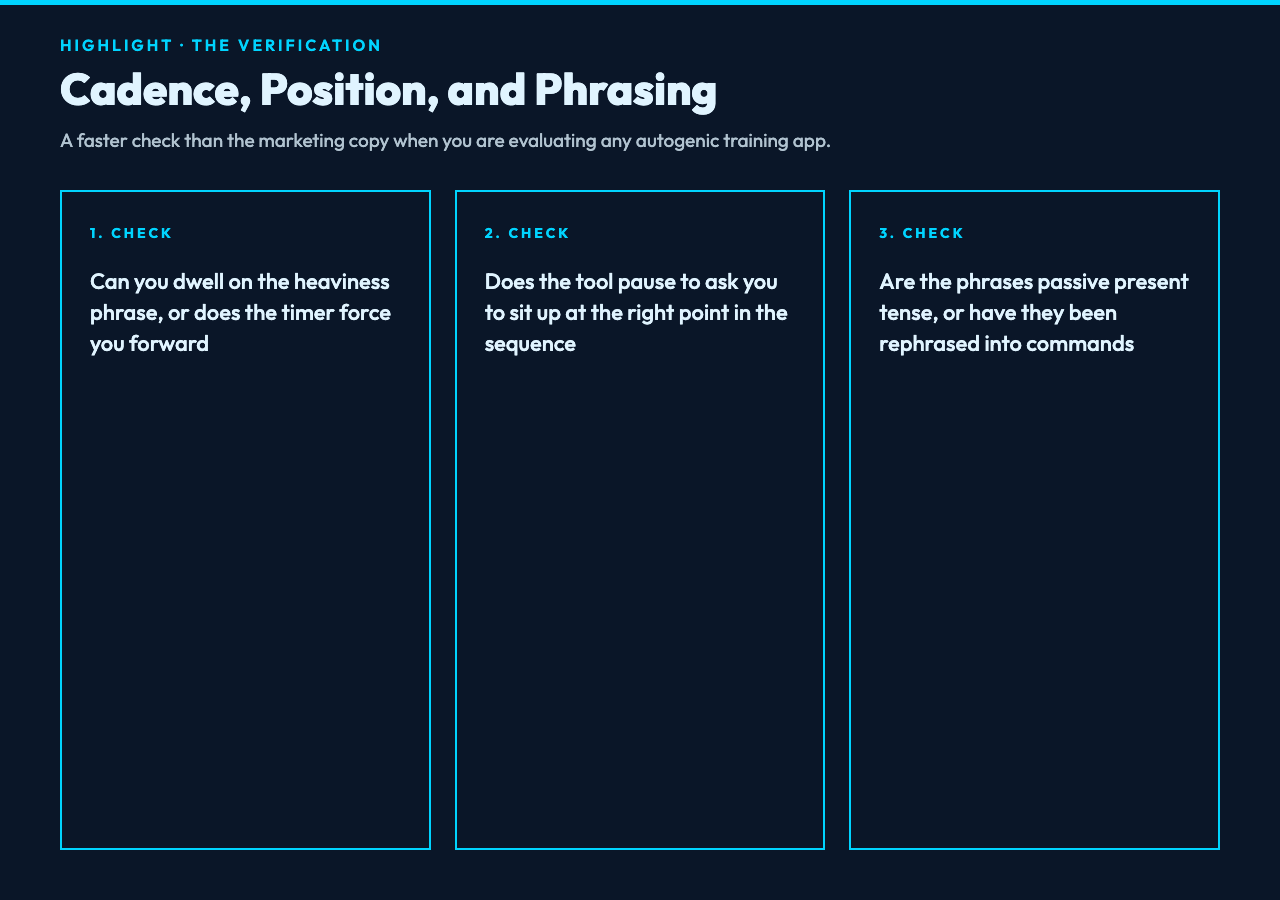
If you are evaluating a tool that claims to deliver Schultz autogenic training — and there are several in the wellness app stores that do — the three-dial test is a faster filter than the marketing copy. Open the tool, start a session, and check three things. First, can you dwell on the heaviness phrase for at least 30 seconds, or does the tool force you to the next phrase on a fixed timer? Second, does the tool pause at the position transition between the third and fourth exercise and ask you to sit up? Third, are the phrases written in the passive present tense (“my right arm is heavy”) or in the imperative (“relax your right arm”)? If the answer to any of those is the wrong one, the tool is delivering autogenic suggestion, autogenic-flavored breathing, or autogenic-flavored progressive muscle relaxation, and the regulatory mechanism you are looking for is not the one you are getting.
The Autogenic Training tool is built to pass that test, and the design decisions above are the reason it does. The technique itself is robust, the clinical evidence is well-established, and the protocol is teachable. The hard part is preserving the protocol’s load-bearing properties inside a medium that has no therapist to enforce them, and the three dials are the levers that make that preservation possible.
Try the full six-exercise sequence in your browser at elysiatools.com/en/tools/autogenic-training. The session takes about 20 minutes, the position transition happens at the right point in the sequence, and the phrases are written in the passive present tense in every supported language. If you have practiced autogenic training in a clinical setting, the protocol will feel familiar. If you have not, the three-dial filter above is the way to know whether the tool you are using is actually delivering the technique or just borrowing its vocabulary.