What if a file that looks clean begins with 3 bytes your editor refuses to show? We tend to blame a CSV parser, a broken header, or an upstream export. But the real fault is often an invisible byte order mark. It is tiny, valid in some contexts, and destructive in others. That is why a BOM is not merely an encoding curiosity: it can change a field name, break JSON parsing, and force an otherwise sound pipeline to reject the first record.
The failure hides in the first field
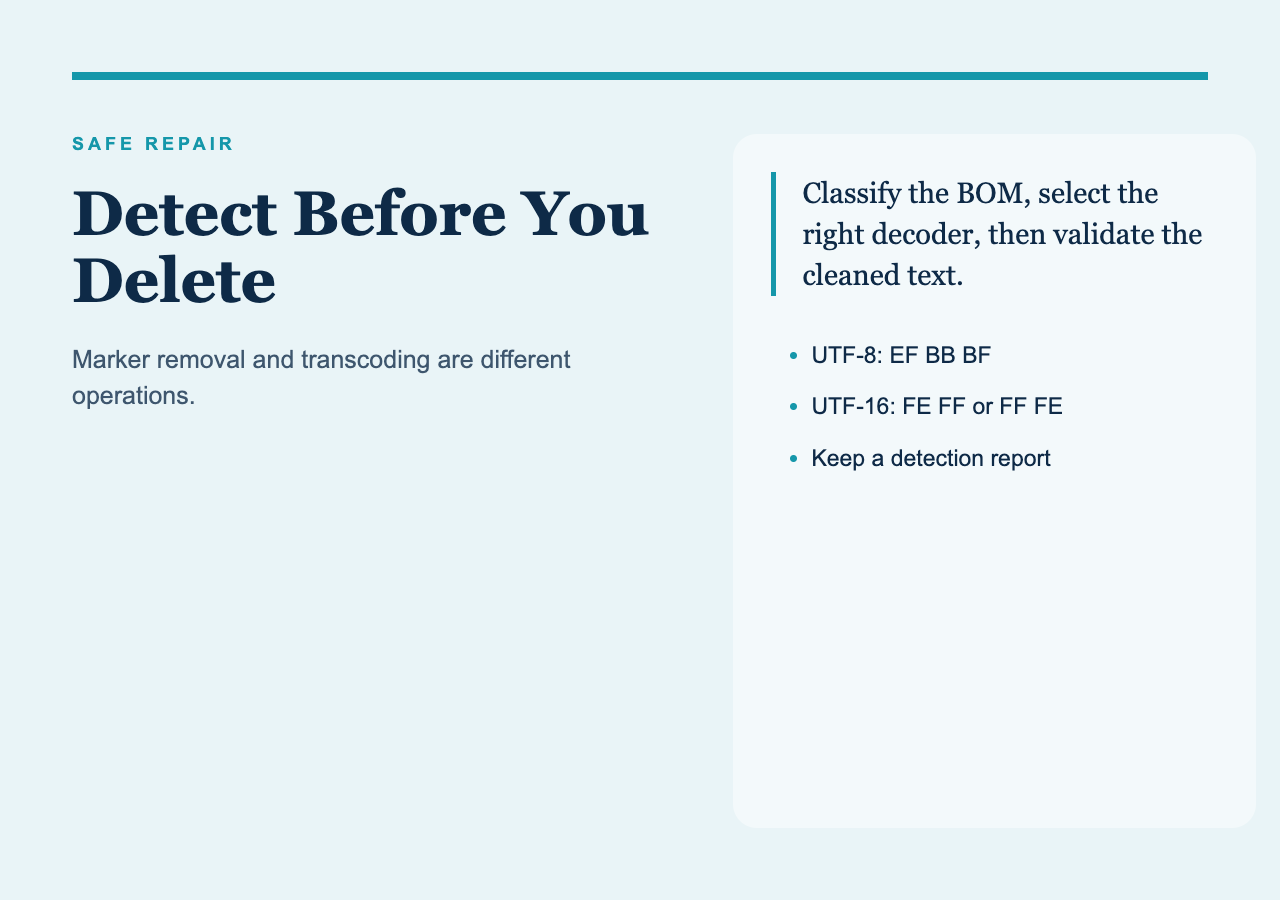
A byte order mark sits at the beginning of a text stream. In UTF-8 it is the three-byte sequence EF BB BF. In UTF-16 it can be FE FF or FF FE; UTF-32 uses 00 00 FE FF or the reverse ordering. The marker originally helped software infer byte order, but UTF-8 has no byte-order ambiguity. There, the marker is optional—and often unwelcome.
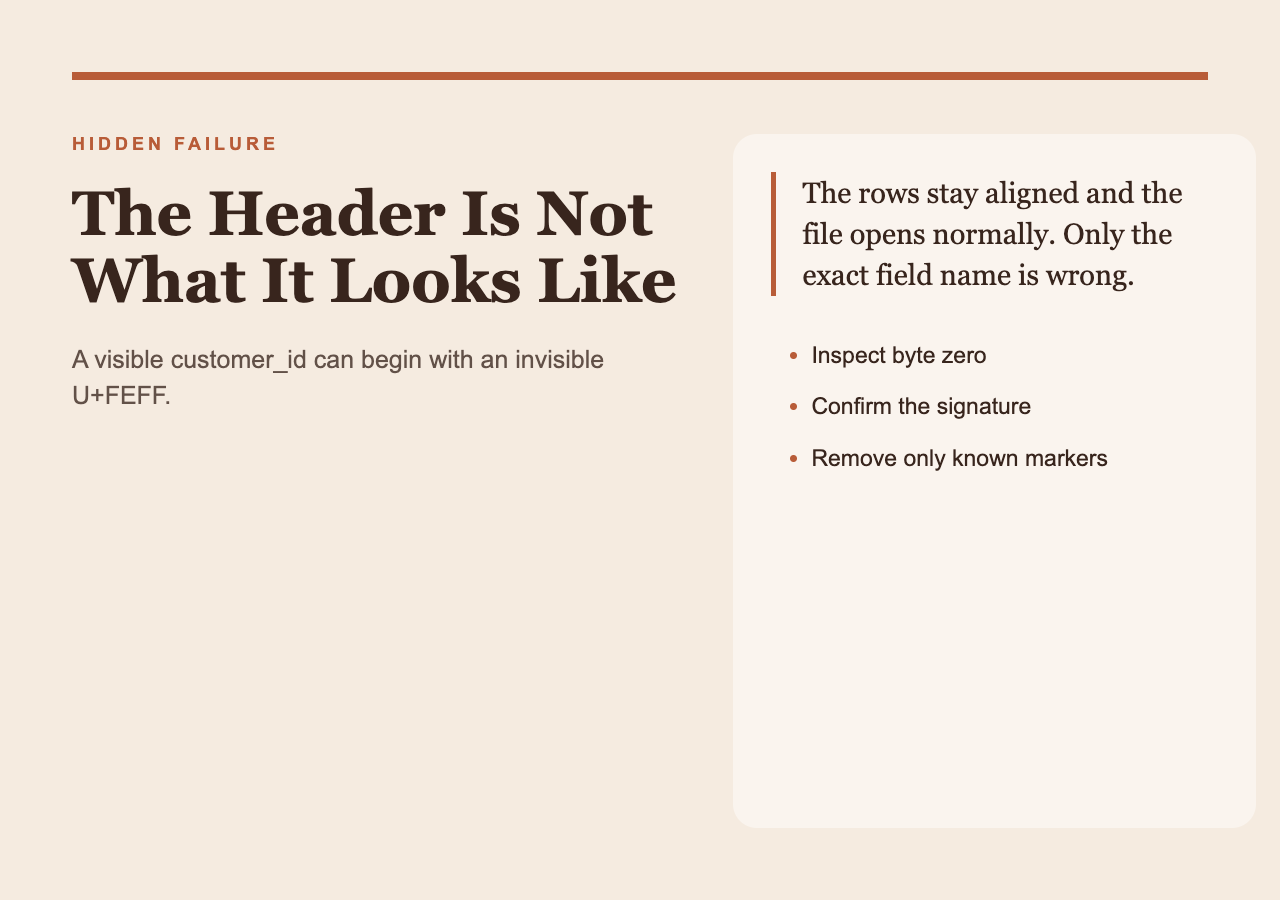
The trap is visual. Open a CSV and the first header appears to be customer_id. Read the raw field and it may actually be U+FEFFcustomer_id. A database loader looking for an exact customer_id column does not see a match. A schema mapper may create an unexpected field. A command-line filter can miss the first column while every later column works.
That mismatch matters because the content is not visibly corrupt. The bytes decode, the rows remain aligned, and casual inspection shows the expected text. The failure looks like an application bug until someone inspects the stream in hex.
Detect before you delete
Blindly trimming the first character is unsafe. A file may not contain a BOM, and the first character may be real data. The reliable workflow starts by identifying the signature at byte zero, recording what was found, and removing only a known marker.
The BOM Character Remover supports UTF-8, UTF-16, and UTF-32 signatures. Its detection modes let you remove all supported markers or restrict the operation to one family. That distinction helps when you know what an upstream system promised and want a mismatch to remain visible rather than silently normalized.
For example, imagine a partner uploads a product catalog whose first column is sku. The header passes a visual review, but an import reports that sku is missing. A detailed detection report can prove that the file starts with a UTF-8 BOM; a hex view shows EF BB BF immediately before 73 6B 75. Remove those 3 bytes, rerun the same import, and the expected header returns without changing any row data.
Use realistic files, not a toy string
Encoding bugs often disappear in hand-written fixtures. A developer types name,price into a test, while production receives exports from spreadsheet software, ERP systems, and scripts running on different operating systems. The useful test is the same shape as the failing file.
The CSV Samples hub includes simple student data, product catalogs, employee records, sales records, and web access logs. Those examples give you headers, quoted fields, numbers, dates, and multilingual values to carry through a cleanup check. Add a known BOM to a copy, run the remover, then prove that row count, column count, and decoded values remain unchanged.
Text fixtures broaden the test. A Chinese UTF-8 file and an English ASCII file should not be treated as equivalent merely because both open in an editor. The Txt Samples collection includes different languages and encodings, which makes it useful for checking that BOM removal is surgical rather than a disguised re-encoding step.
Separate marker removal from transcoding
Removing a BOM does not convert UTF-16 text into UTF-8. It removes a signature; the remaining bytes still require the correct decoder. Confusing those operations can replace one clean failure with mojibake, lost characters, or invalid output.
A safe pipeline therefore makes four decisions explicit:
1. Inspect the leading bytes and classify the BOM. 2. Choose the decoder that matches the actual encoding. 3. Remove the marker without changing the payload. 4. Validate the cleaned text against the next consumer.
This separation clarifies ownership. The BOM-removal step fixes an unwanted prefix. The decoding step interprets bytes. The schema or parser step verifies the resulting content. When each stage emits a small report, the next failure tells you which contract broke.
Pick an output that fits the investigation
Cleaned text is useful when the cause is already known and you need a repaired artifact. A detailed report is better for support tickets and repeatable incident notes. Hex view helps when an editor masks the character. JSON analysis fits automated pipelines that need a machine-readable finding before they accept or quarantine a file.
In our case, a batch job can first request JSON analysis, reject files with an unexpected UTF-16 or UTF-32 marker, and clean only the permitted UTF-8 BOM. That policy prevents a broad “fix encoding” step from hiding a supplier regression. It also creates evidence: which marker was found, which rule ran, and whether the output changed.
The same principle applies beyond CSV. A BOM can interfere with a JSON parser that expects { at byte zero, an XML consumer that has strict declaration handling, or an API signature computed over exact bytes. One invisible prefix can therefore break several systems in different ways. A single detection stage at ingestion can cut repeated debugging across the stack.
Put the check at the boundary
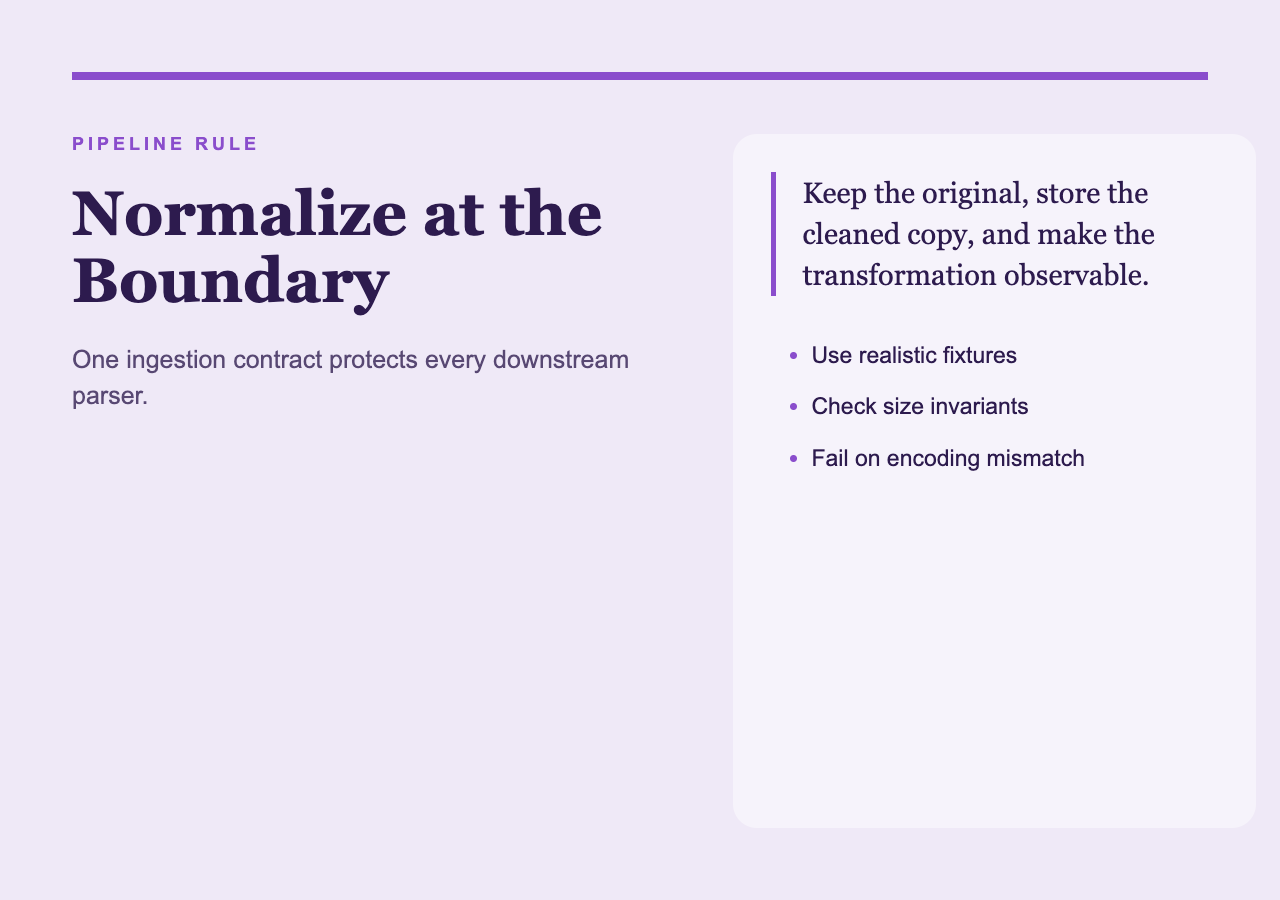
The best place to remove an unwanted BOM is where external text enters your system: upload handling, object-storage ingestion, an ETL landing zone, or an API adapter. Cleaning at the boundary creates one normalized contract for every downstream consumer.
Keep the original file when auditability matters. Store the cleaned version separately, attach the detection report, and compare hashes or sizes so the transformation is visible. For a UTF-8 BOM-only repair, the byte length should usually fall by exactly 3 while decoded content remains the same. That simple invariant can prove the cleanup did not rewrite the document.
Do not scatter ad hoc replacements through parsers. They make behavior depend on which code path happened to read the file. Centralize the rule, test it with real CSV and multilingual text fixtures, and fail loudly when the marker contradicts the promised encoding.
The smallest bytes deserve a real contract
Ultimately, the point is not to fear every invisible character. It is to make the boundary observable. A BOM should be detected, classified, and removed only when policy allows it; the remaining text should then be decoded and validated as a separate operation. If 3 hidden bytes can change a header and stop an import, what happens when your pipeline treats them as nobody’s responsibility? Give those bytes an explicit contract, and the next “mysterious” CSV failure becomes a short, provable repair instead of a day of guesswork.