
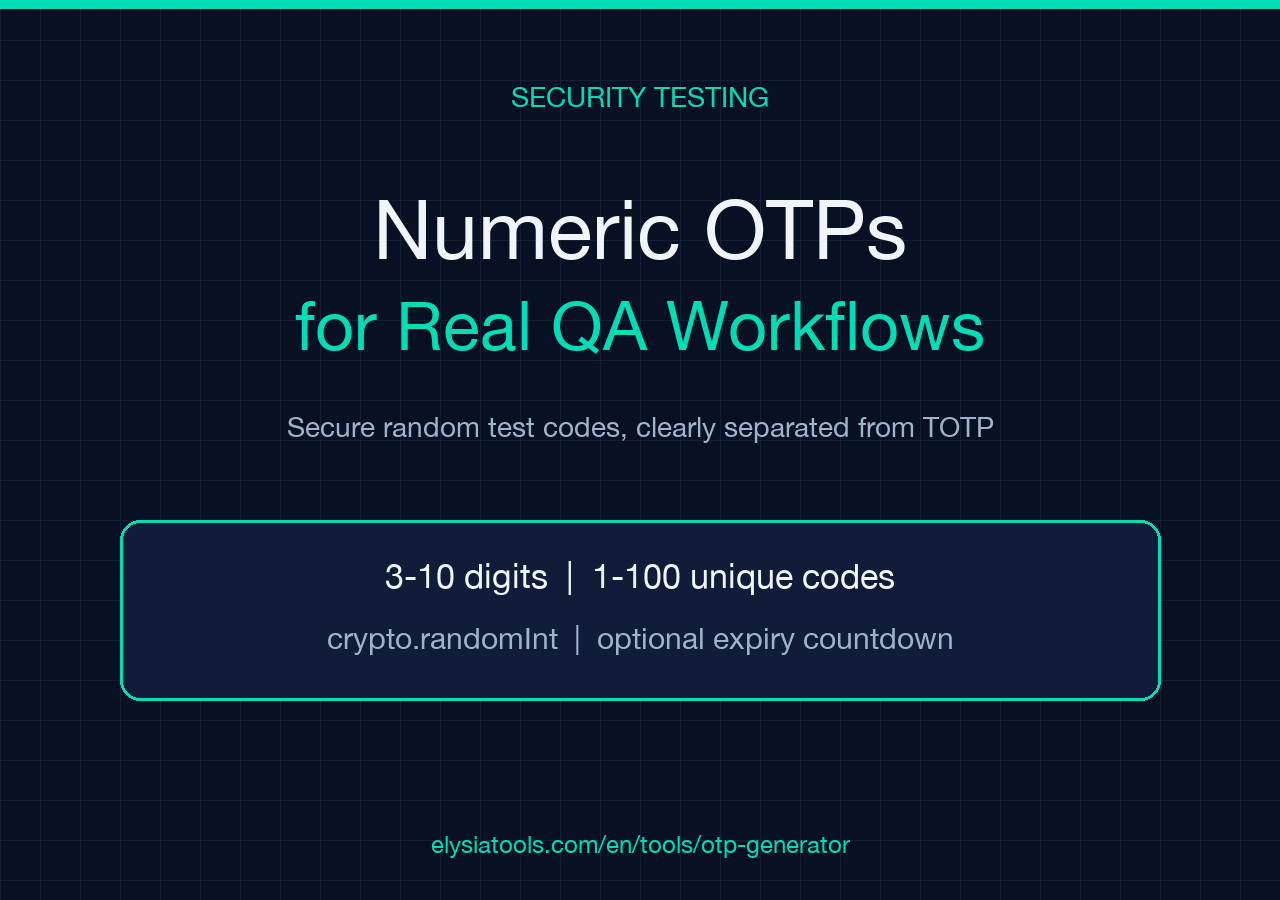
The six-digit box hides a system, not a number
A verification code looks trivial because the user sees only a few digits. The surrounding system still has to generate an unpredictable value, bind it to the right account and purpose, deliver it through an imperfect channel, limit guesses, expire it, and consume it exactly once. QA teams often need realistic codes long before the production messaging stack is ready. That is where a focused generator earns its place: it supplies controlled test material without implying that code generation alone is a complete authentication design.
What the Numeric OTP Generator produces
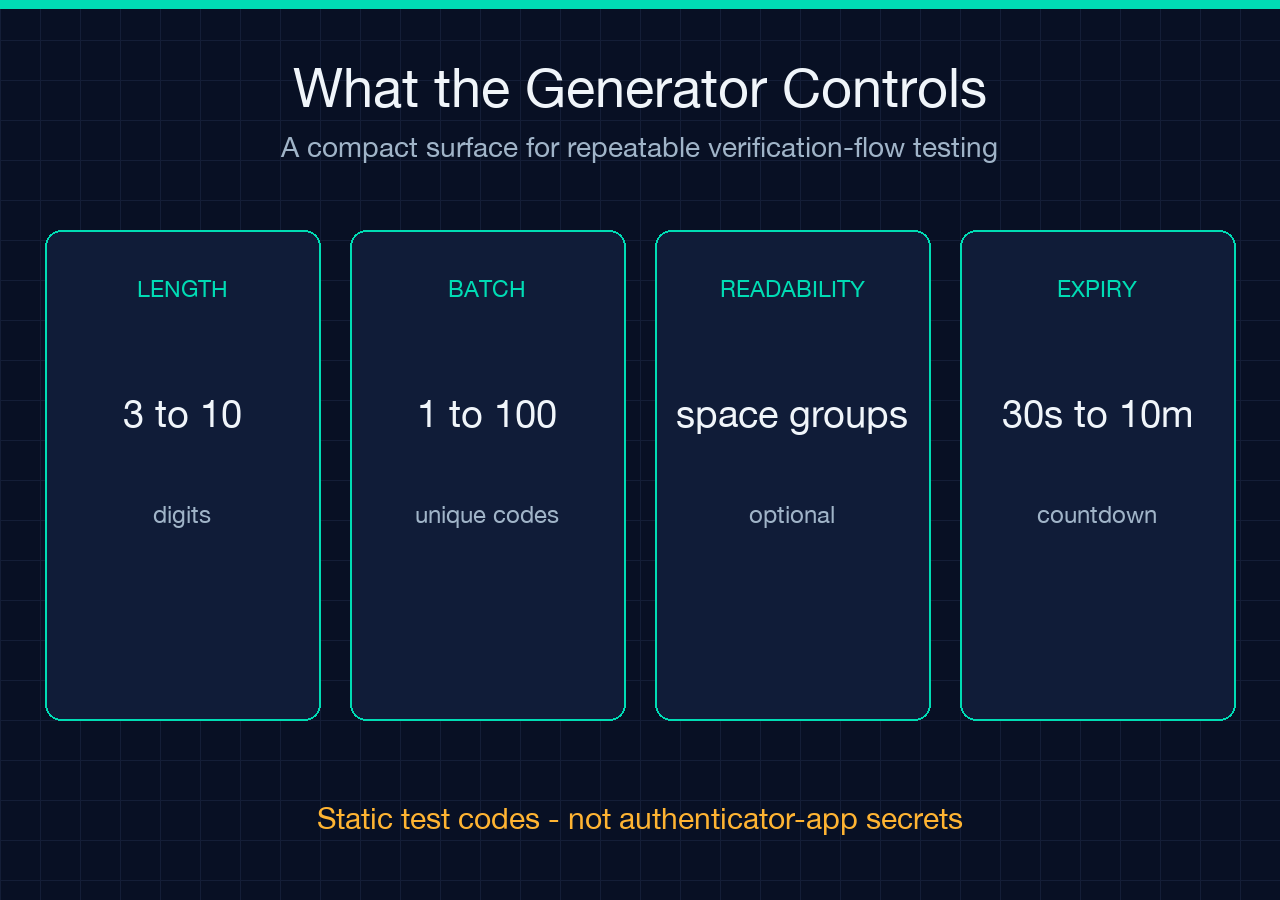
The Numeric OTP Generator creates static one-time numeric codes for SMS, email verification, raffle codes, event PINs, and test fixtures. Its real options are unusually practical: choose 4, 6, or 8 digits, or a custom length from 3 through 10; request one to 100 outputs; group digits with spaces; exclude 0 and 1 when verbal clarity matters; and display an optional countdown of 30 seconds, one minute, five minutes, or ten minutes. The implementation deduplicates the batch so each generated code is distinct.
Why crypto.randomInt changes the threat model
The source uses Node’s crypto.randomInt rather than Math.random. That distinction is substantive. Math.random is designed for simulation and general application behavior, not security tokens; its output can be predictable when an attacker learns enough about generator state. A cryptographically secure random source is designed to resist that inference. For QA, this also means the test fixture resembles the production primitive developers should reach for, rather than normalizing an unsafe shortcut that later escapes into shipping code.
A concrete login-flow test
Suppose a team is testing an email sign-in flow. Generate five six-digit codes, enable spacing for readability, exclude ambiguous digits, and choose a five-minute countdown. Feed one code into the success path, one into a wrong-account test, one after simulated expiry, one twice to test replay rejection, and one into the retry-limit path. The generator’s built-in example describes this same batch shape: five grouped six-digit codes for a login flow, with ambiguous digits removed and a five-minute display window.
Static OTP is not TOTP or HOTP
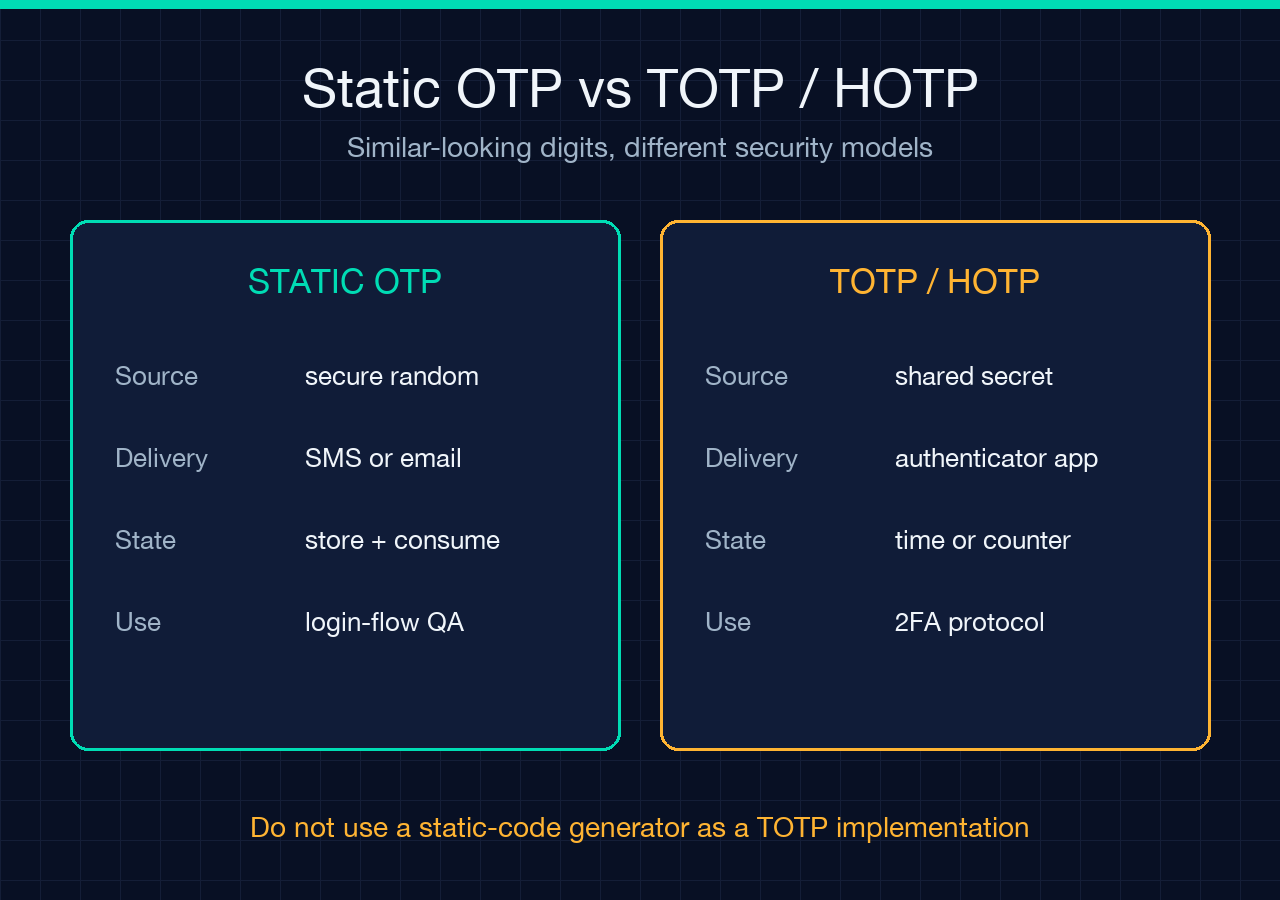
The tool is explicit about its boundary: these are static random codes, not RFC 6238 TOTP values or RFC 4226 HOTP values. TOTP and HOTP derive outputs from a shared secret plus time or a counter, which is why authenticator apps can independently reproduce the expected value. A static SMS or email code is generated, stored or represented server-side, delivered, checked, then consumed. Similar-looking digits do not make the protocols interchangeable. Use a dedicated TOTP/HOTP implementation when testing authenticator-app enrollment or verification.
The countdown is presentation, not enforcement
An expiry countdown helps humans understand the intended test window, but the source generates it in the rendered result. Production expiry must be enforced by the server against trusted time. Closing the browser, changing a local clock, or suppressing JavaScript must never extend validity. Test the boundary on both sides: a code should work just before the deadline and fail at or after it. Also verify that requesting a new code invalidates the old one when that is your product policy.
Code-space math and ambiguous digits
A six-digit decimal code has one million possible values when leading zeroes are allowed. Removing 0 and 1 leaves eight choices per position, reducing the six-digit space to 262,144 combinations. That trade can improve phone readability but also lowers brute-force resistance. The right response is not to rely on digit count alone. Apply attempt limits, account and network throttling, short server-enforced lifetime, purpose binding, and one-time consumption. The generator caps requests and tracks uniqueness, but those controls do not replace defenses in the system under test.
What production code still has to do
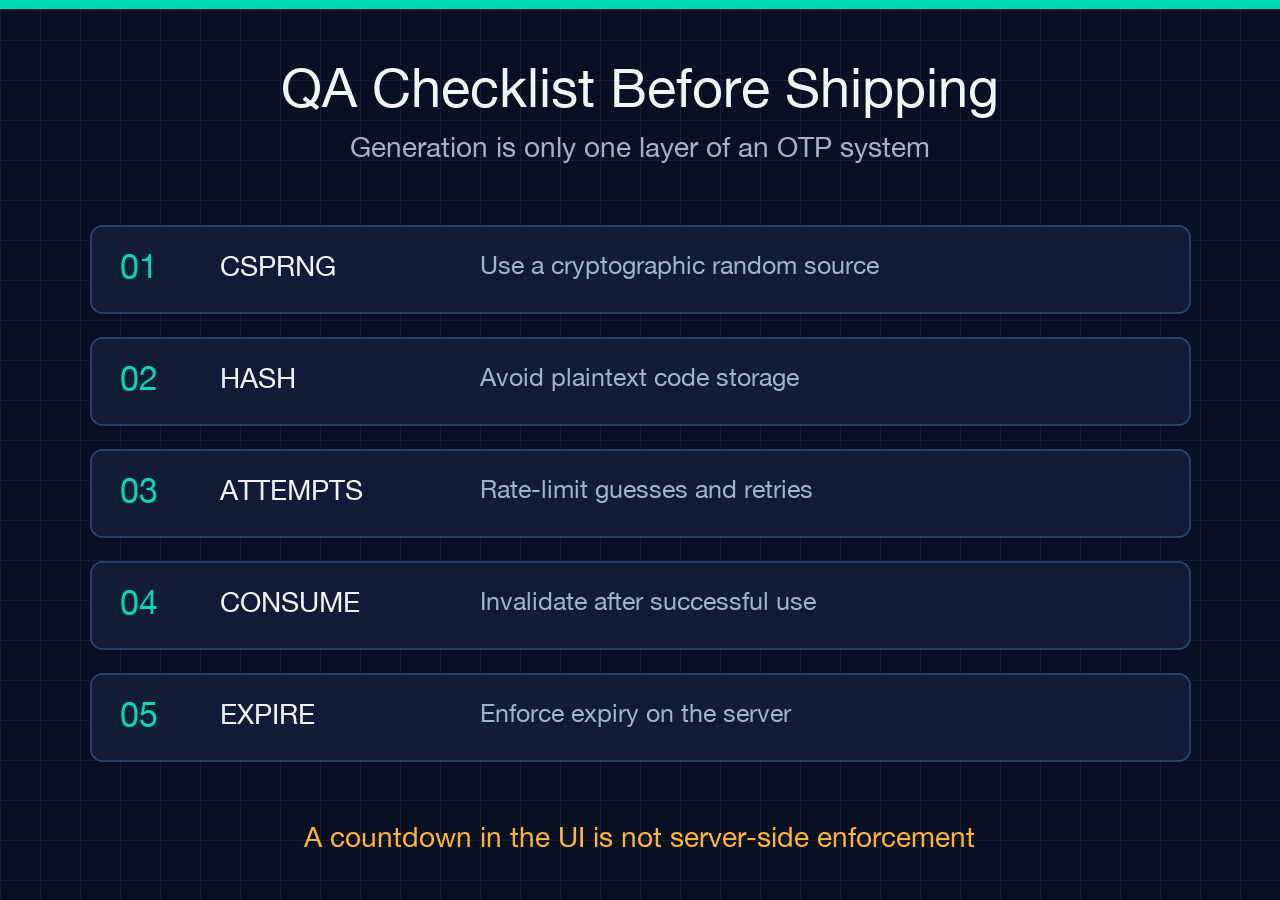
Treat generated values as disposable fixtures. A production service should avoid logging them, avoid plaintext persistence where possible, compare safely, bind each value to an account and action, track failed attempts, and erase or invalidate the record after success. Delivery channels add their own risks: SMS can face SIM swaps and interception, while email security depends on mailbox control. A polished code card does not solve those problems. It gives the team a repeatable input for testing whether their surrounding controls behave correctly.
Where this tool fits in a QA toolkit
Use the browser-based generator for manual smoke tests, screenshots, demos, acceptance-test data, raffle or event PIN batches, and exploratory edge cases. Use deterministic fixtures in automated unit tests when repeatability matters more than random coverage. For broader one-off developer utilities, browse Elysia Tools. No Samples or visualization page is linked here because the manifest contains no sample tied directly to this tool, and forcing an unrelated workflow would make the article less useful.
The useful boundary
A good OTP test begins with realistic code material and ends with proof that the surrounding system rejects misuse. Generate secure random values, then test expiry, replay, account binding, attempt limits, delivery failures, and one-time consumption. Keep the protocol boundary visible: static SMS or email codes are not TOTP or HOTP. Used that way, the generator is a precise QA instrument—not a substitute for an authentication service, but a fast way to expose whether one has been designed carefully.
