
Quoted-Printable encoding is the bridge that lets 8-bit email survive a 7-bit SMTP pipe. Every RFC 822 message with non-ASCII characters falls back on it when MIME multipart isn’t worth the overhead. This field guide walks through the spec, the soft-line-break trick, and the corner cases that bite hand-rolled implementations, with hands-on examples you can verify against the Quoted-Printable Encoder.
How Quoted-Printable works
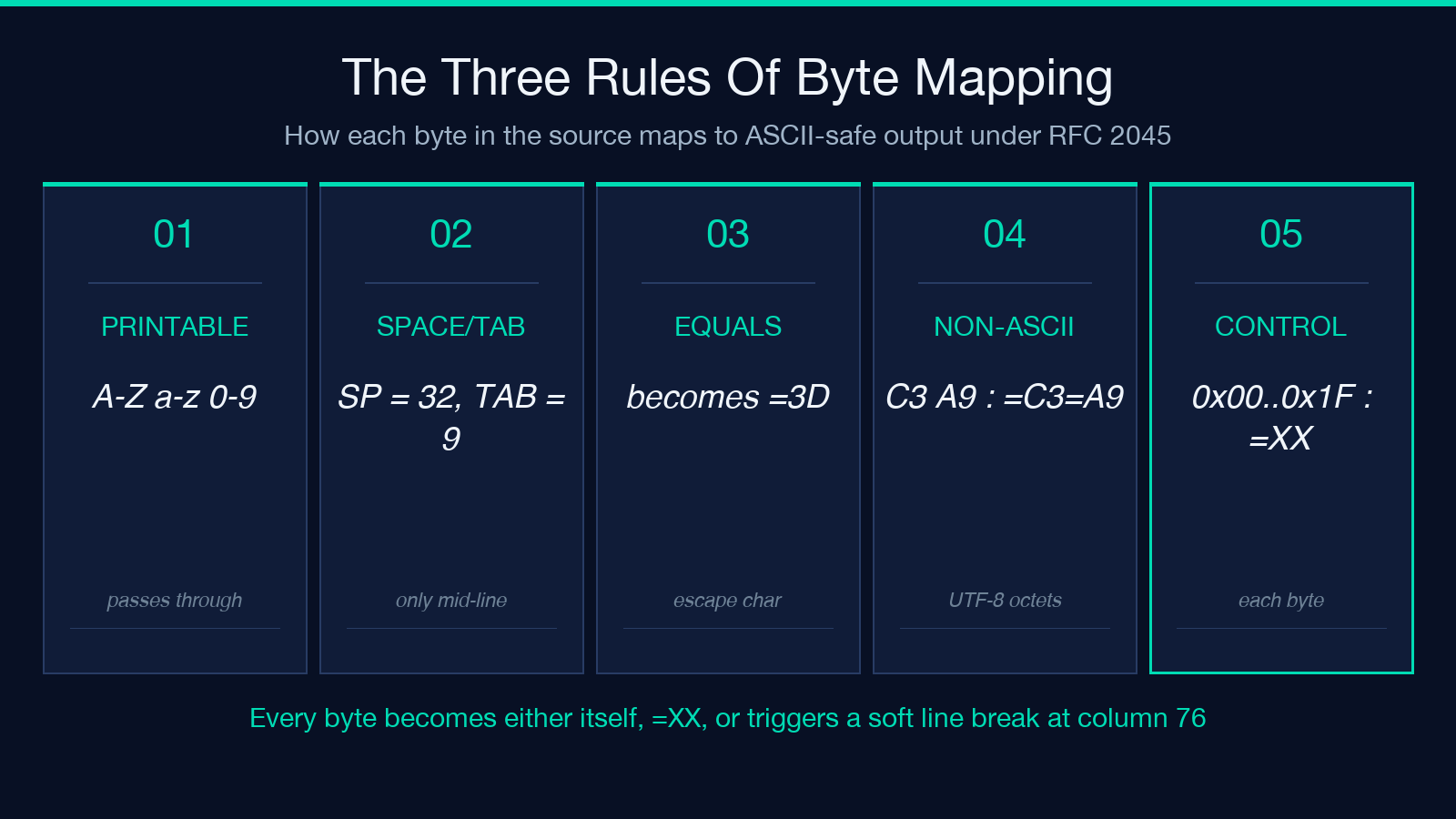
Quoted-Printable replaces each non-printable byte with =XX where XX is the byte’s two-digit uppercase hex. Printable ASCII (33 through 126, minus the special characters = itself) passes through untouched. The format keeps the body human-readable for the vast majority of characters while guaranteeing that any byte that survives SMTP’s 7-bit pipe will still produce the correct UTF-8 octets at the receiving end.
The encoding was published in RFC 2045 as one of two Content-Transfer-Encoding schemes; the other is Base64. Quoted-Printable dominates when text is mostly ASCII with occasional non-ASCII characters (most email), while Base64 dominates for binary attachments (most attachments).
Two rules drive every byte’s fate:
- Bytes 33-126 except
=stay as-is. Tab (9) and space (32) are technically allowed through, but only outside trailing whitespace in lines. - Everything else, plus
=itself, becomes=XX. The=glyph is the escape character, so it has to escape itself when it appears in the source text (=becomes=3D).
A short example illustrates the asymmetry. The literal text Café au lait encodes as Caf=C3=A9 au lait — the é is two UTF-8 bytes (0xC3 0xA9), each becomes its own =XX triplet, while the surrounding ASCII letters stay untouched. The encoded line is still readable in a terminal that doesn’t speak UTF-8; the escape triplets are the only “garbled” portion.
The soft line break trick
SMTP limits lines to 998 octets with a 76-octet soft recommendation. Quoted-Printable enforces the stricter rule itself: encoded lines must not exceed 76 characters. When the encoder is about to overflow, it inserts a soft line break — a literal = at the end of the current line — and continues on the next line. The receiving MUA strips the trailing = during decoding and rejoins the two halves as if the break were never there.
A worked example makes the rule concrete. Encoding the 100-byte string The quick brown fox jumps over the lazy dog and then takes a nap in the sun. The quick brown fox jumps over the lazy dog. with = as the escape:
- Line 1 (76 chars):
The quick brown fox jumps over the lazy dog and then takes a nap in the sun. The qui - Soft break:
= - Line 2 (remaining):
ck brown fox jumps over the lazy dog.
Decoding drops the trailing = and concatenates, giving back the original 100-byte string byte-for-byte.
This is the single most-tested feature in any encoder, and the easiest one to get subtly wrong. Common pitfalls:
- Counting bytes after encoding, not before. A naïve counter that walks the source string and breaks at column 76 will silently truncate multi-byte UTF-8 characters whose second or third byte crosses the boundary.
- Forgetting the soft break on the boundary. If the encoder writes
...lazy do=ginstead of inserting the=, the decoder readsgas the start of a new triplet and corrupts the rest of the line. - Encoding the soft break itself. A second
=appended to the line would yield==, which the decoder interprets as=3D=(an encoded=followed by an empty triplet) — garbage on decode.
If you’re testing an implementation, the canonical input is a single line of exactly 77 ASCII characters; the encoder must split it into a 76-char line plus a soft break, with the trailing = on line 1 and the leftover k starting line 2.
Bytes, characters, and the UTF-8 gotcha
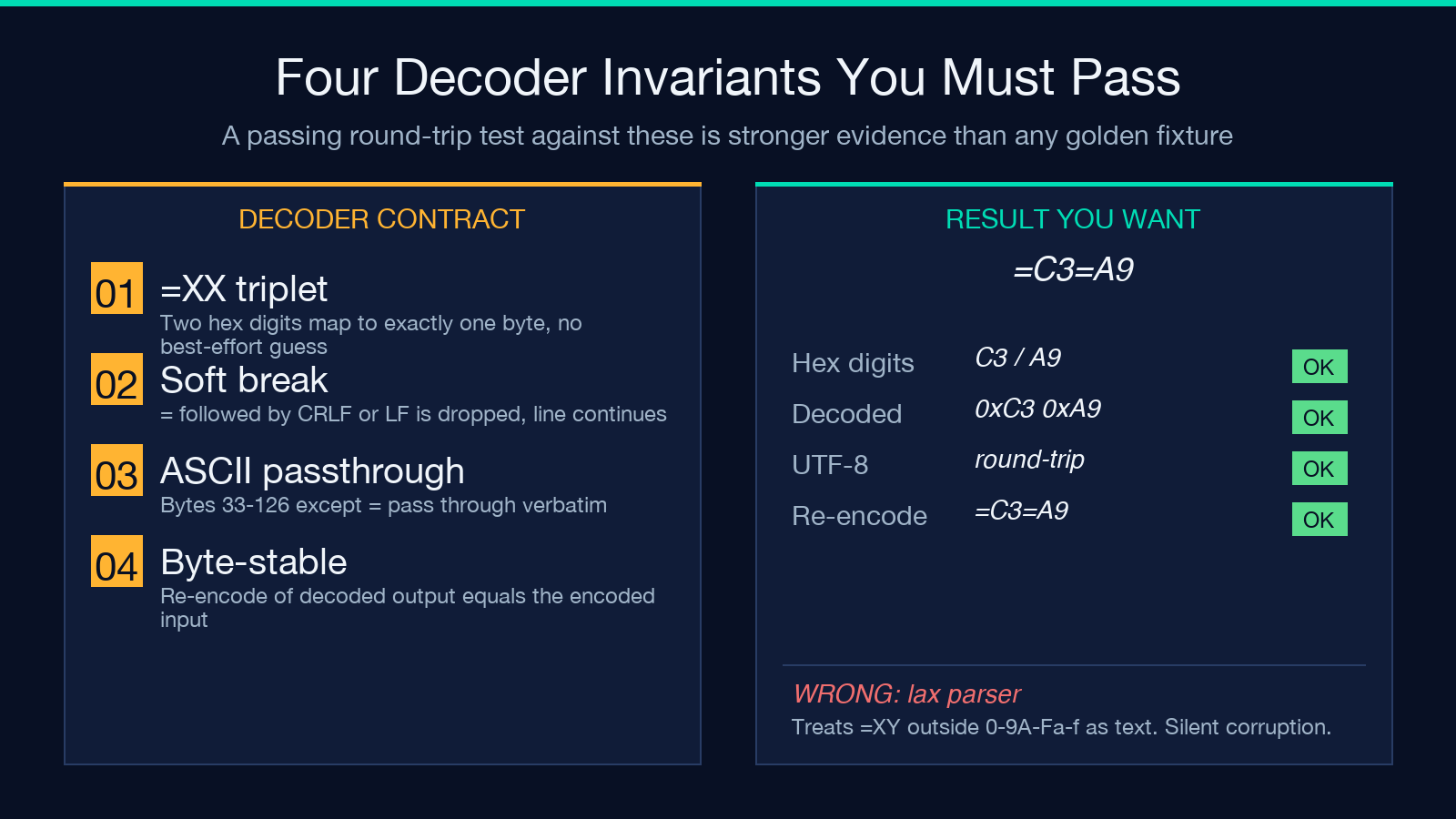
Quoted-Printable operates on bytes, not Unicode code points. The encoder must UTF-8 encode the source string before applying the =XX substitution, and the decoder must reverse the step. Get this order wrong and you’ll either under-encode (every non-ASCII byte becomes a single =XX, but the byte is the first octet of a multi-byte sequence and the rest comes through as Latin-1 garbage) or over-encode (you re-encode the already-encoded =XX triplets, producing =3DC3=3DA9 instead of =C3=A9).
The encoding sequence:
- UTF-8 encode the input string. JavaScript’s
TextEncoder, Python’sstr.encode('utf-8'), and Go’s[]byte(s)all do this by default. Java’sString.getBytes(StandardCharsets.UTF_8)requires explicit charset, and the default platform charset on Windows is the historical source of a million “Mojibake” support tickets. - Walk the byte stream. For each byte, check if it’s printable ASCII outside the
=glyph. If so, write it through; if not, emit=XX. - Apply line-length folding. Count output characters (the
=XXtriplet counts as 3), insert a soft break at column 76, continue.
The decoding sequence:
- Scan for
=XX. When found, parse two hex digits and emit the corresponding byte. - Recognize soft line break. A
=followed immediately by newline (CRLF or LF) means “drop both, continue”. Some encoders also emit=at the very end of input as a graceful EOF marker; the decoder must tolerate that. - UTF-8 decode the resulting byte stream.
TextDecoder,bytes.decode('utf-8'), andstring(b, 'utf-8')round-trip cleanly.
The most common production bug is treating the input as Latin-1 (“it works on my machine, all my users have Western European Windows”). When the same encoder meets a Russian or Japanese subject line, the bytes look fine until the receiving MUA decodes them and renders mojibake.
When to reach for Quoted-Printable (and when not to)
Quoted-Printable wins in three situations:
- Short text with rare non-ASCII. Email subjects, signatures, replies. The overhead is one
=XXper non-ASCII byte — typically 2-3% expansion for European languages, ~6% expansion for CJK. - Human readability matters. Headers, log messages, debug output. Quoted-Printable keeps the ASCII portion intact, so an operator skimming the encoded form can usually read most of it.
- Round-trip stability. Quoted-Printable → Quoted-Printable yields the same bytes; Base64 → Base64 does too, but Base64’s alphabet makes the encoded form opaque to humans.
Quoted-Printable loses in three other situations:
- Binary data. Base64 packs 3 source bytes into 4 output bytes (33% overhead). Quoted-Printable packs 1 source byte into 3 output bytes (200% overhead) for non-printable bytes. A binary attachment of any size becomes unreadable noise in Quoted-Printable; use Base64.
- High non-ASCII density. A CJK-heavy message doubles or triples in size; the encoded form has no readability benefit and the size overhead matters when the message crosses size-limited gateways.
- Streaming without buffering. Quoted-Printable requires the encoder to know line length up to 76, which means buffering at least the current line. A pure streaming pipeline can’t easily use it; Base64 has the same buffer requirement but the streaming code is shorter.
In practice, mail clients default to Quoted-Printable for text/plain parts and Base64 for everything else. The decision was made in the late 1990s when email was 99% text and 1% attachment; it still holds for the modern web where both formats coexist as the canonical MIME pair.
The decoder’s four invariants
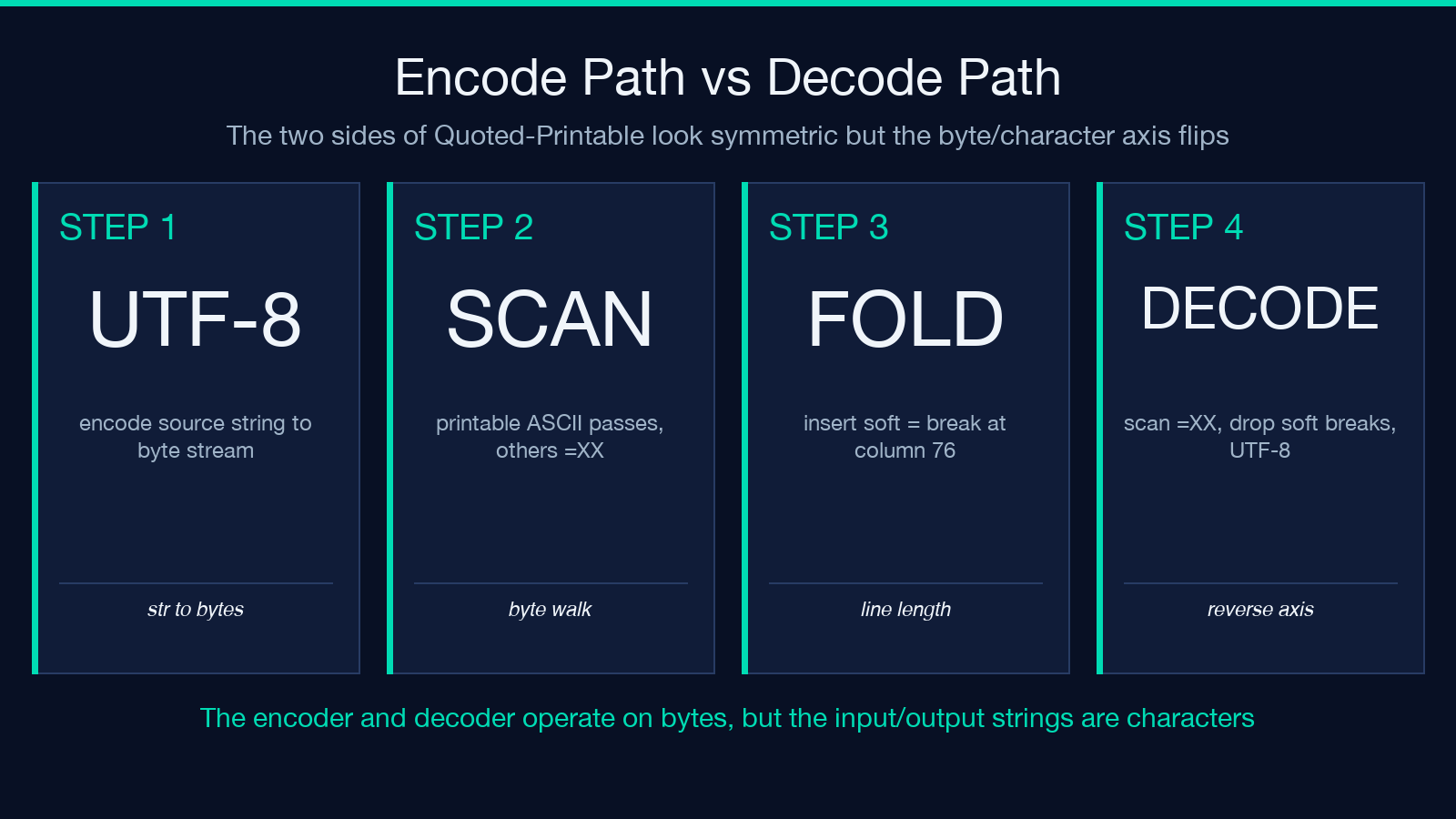
If you’re writing a decoder (or auditing one), four invariants must hold for any input. A passing round-trip test against these invariants is stronger evidence than a single golden-file fixture.
=XXwhere XX is two hex digits is always one byte. Lowercase hex must be accepted (RFC 2045 says uppercase, but the spec is loose here and most decoders are case-insensitive). Two hex digits outside0-9A-Fa-fis malformed and should produce an error, not a best-effort guess.=followed by CRLF or LF is a soft line break. The=and the line terminator are dropped; the next line continues the current line.- Plain ASCII bytes pass through verbatim. The decoder must NOT touch bytes 33-126 except
=(which always triggers escape handling). A common bug is “fixing up” whitespace or stripping trailing CR. - Encoded output is byte-stable. Decoding
=C3=A9produces the two bytes0xC3 0xA9, then UTF-8 decoding yields the single characteré. Decoding the same string twice yields the same character; re-encoding yields the same byte sequence.
If your implementation violates any of these, the failure usually surfaces as either (a) corruption of one specific message that the recipient’s MUA renders as garbled text, or (b) random test failures only on inputs that contain the boundary case. A simple property-based test harness — feed random UTF-8 strings through encode-decode and assert byte-equality — catches all four invariants in a few hundred iterations.
Common edge cases worth memorizing
Five edge cases appear in every serious Quoted-Printable implementation. They are not bugs in the spec; they are sharp edges that the spec explicitly delegates to the implementation.
=inside long lines. When the source already contains a literal=, the encoder must emit=3D(encoded=), then continue counting. A naïve encoder that only counts printable ASCII columns will mis-fold the line.- CRLF vs LF line endings. Per RFC 2046, Quoted-Printable operates on the byte stream; both CRLF and LF are valid line terminators in input and output. The decoder must accept either; the encoder should emit CRLF to match SMTP conventions.
- Trailing whitespace on a line. RFC 2045 forbids space and tab at the end of an encoded line because some transport layers strip them. The encoder must either remove trailing whitespace or escape it (space becomes
=20, tab becomes=09). - Empty lines. A blank line in the input must produce a blank line in the output. Some encoders mistakenly emit
=followed by CRLF for empty lines, which the decoder interprets as a soft break and silently concatenates — corrupting the line-count. - Lines longer than 76 chars that contain
=XXtriplets near the boundary. The encoder must count output characters, not source characters. A line of source that’s 60 ASCII characters but expands to 90 after encoding (because of oneé==C3=A9triplet inserted at column 50) MUST be soft-broken, even though the source was well under 76.
Each of these has bitten at least one production system. The fix is the same: write the encoder to operate on bytes after UTF-8 encoding, count output characters, and unit-test against the canonical inputs from RFC 2045 §6.7.
Verifying your encoder against the spec
The fastest validation is a three-step round-trip test that takes seconds to set up:
- Encode a fixed corpus. Use the RFC 2045 §6.7 examples: the French
Cafés, the Germanüber, the Japanese日本語. Compare your output byte-for-byte against the reference in the RFC. Any drift is a bug. - Round-trip random UTF-8. Generate 1000 random strings, UTF-8 encode, Quoted-Printable encode, decode, decode UTF-8, assert equality with the original. Property-based test frameworks (Hypothesis for Python, fast-check for JS, gopter for Go) make this trivial.
- Stress the soft line break. Generate strings of exactly 75, 76, 77, 152, 153 ASCII characters. Confirm the encoder produces the expected split (75 → single line, 76 → single line, 77 → 76+soft+1, 152 → 76+soft+76, 153 → 76+soft+76+soft+1). Off-by-one errors here are silent — they only show up when the encoded message crosses the 998-octet SMTP limit and the receiving MTA rejects it.
If those three steps pass, the encoder is RFC 2045 compliant for the vast majority of real-world traffic. The remaining 5% of edge cases (binary attachments disguised as text, charset-mismatch on input, custom line terminators from non-SMTP transports) are usually handled by the surrounding MIME layer rather than the encoder itself.
For a hands-on test harness, the Quoted-Printable Encoder at Elysia Tools accepts arbitrary UTF-8 input and shows the byte-exact encoded output with line folding applied per the RFC. Pair it with the Quoted-Printable Decoder for round-trip verification in the browser, no install required.
Putting it together
Quoted-Printable is the right tool when email carries a few stray non-ASCII characters in an otherwise-ASCII body — most real-world email. The encoding is straightforward to implement correctly once you internalize the four rules (printable ASCII passes through, everything else becomes =XX, line length stays at 76, soft breaks use trailing =). The pitfalls are all sharp edges rather than deep bugs: the soft-line-break boundary, the UTF-8 vs Latin-1 confusion, the trailing-whitespace trap, and the empty-line soft-break mistake.
If you’re rolling your own encoder for a new transport (an internal message bus, a webhook body, a log shipper), the cleanest test plan is the three-step round-trip suite from §7 plus the edge cases from §6. Both run in milliseconds on any modern laptop and catch every documented Quoted-Printable bug class. For a production-grade ready-made tool, see the Quoted-Printable Encoder at Elysia Tools.
Explore more text and format utilities at elysiatools.com/en/tools.
