

Long-tail keywords are the only ones worth chasing when the head terms are already owned. Most SEO guides still hammer that line, but they rarely tell you the practical half: how do you actually generate 100 long-tail variants without spending a full day in your keyword tool of choice, and how do you know which ones are worth writing for? That is exactly the gap the AI Long-tail Keyword Generator closes — you give it a seed term and (optionally) an industry, and it returns a hundred candidate phrases, each annotated with a rough search-volume band and a competition score so you can sort and triage in one pass.
The tool lives at Elysia Tools as part of a broader AI-tools collection, and it is the cleanest way to get from a single seed phrase to a prioritized shortlist. Where most keyword tools assume you already know how to bucket intent, this one gives you the bucket labels inline — informational, commercial, transactional, navigational — so the act of sorting is part of the output, not a follow-up step. This field guide walks through how the generator works, what its output actually means, where it fits next to your existing SEO workflow, and how to read the volume/competition numbers without being misled by them.
What the generator actually does
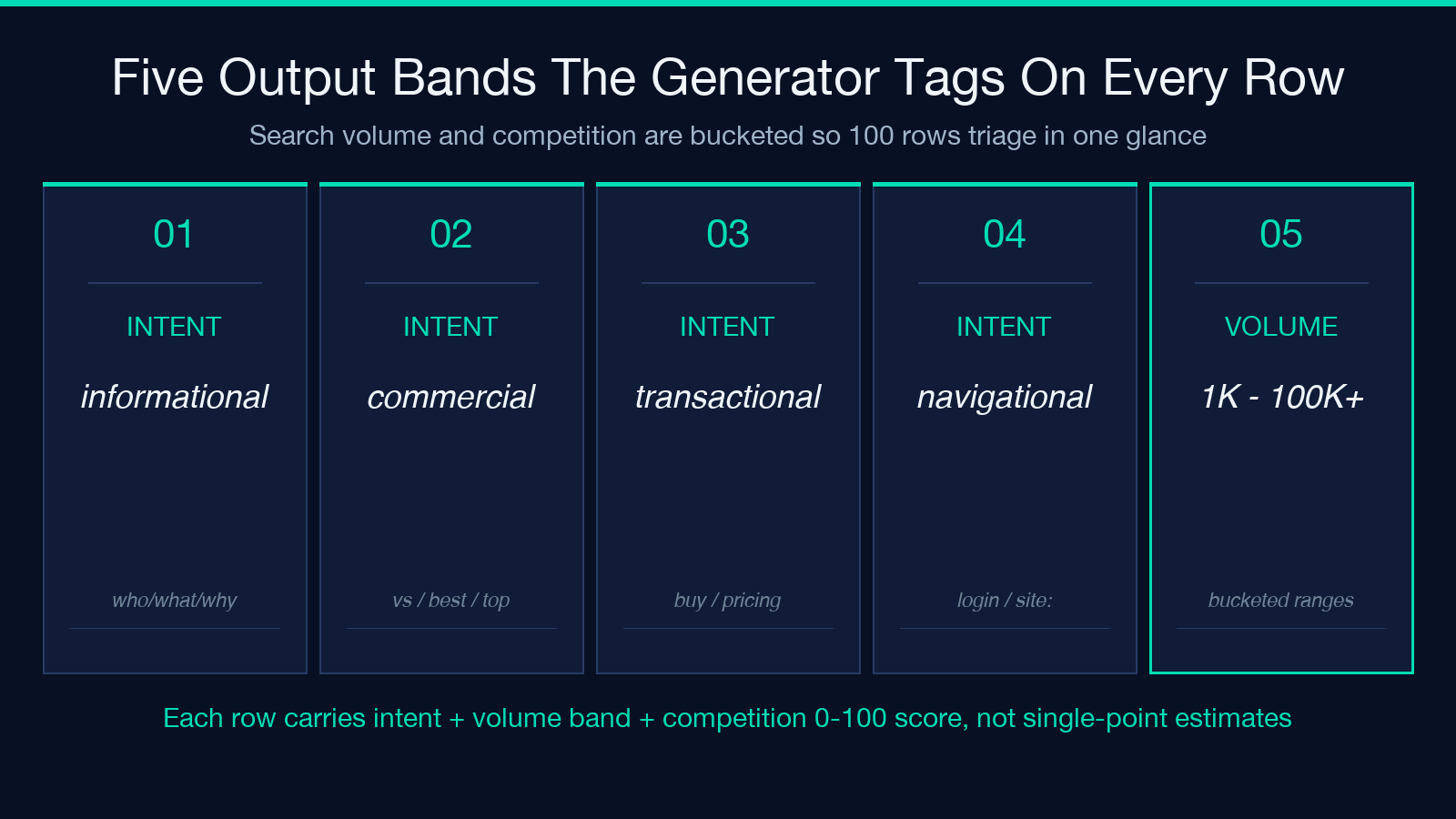
The interface is deliberately minimal. You paste a single seed keyword into the first keyword field — for example, project management, ai writing tools, or home office desk — and the optional industry field lets you tighten the niche (e.g. SaaS, e-commerce, healthcare). Hit the button, and the generator streams back 100 long-tail variants in your chosen output language, each one tagged with intent, an estimated monthly search-volume band, and a competition score on a 0–100 scale. The result type is stream, which means the UI fills rows in as the model finishes them rather than making you wait for a full 100-row batch.
For a seed like project management with no industry specified, you will see variants ranging from the obvious project management software for small teams down to the niche project management for academic research groups. The volume column is intentionally bucketed into ranges (e.g. 1K–10K, 10K–100K, 100K+) rather than giving you single-number estimates, because bucketed ranges hold up better against the noise that any single source-of-truth would carry.
How to read the competition score
The competition column is the most actionable part of the output. It is not a PageRank-style difficulty number pulled from a third-party crawler — it is a relative score that compares each variant against the existing top-ranking pages for that phrase. A score of 0–30 means you are likely to rank for that phrase with a single well-written article on a domain with reasonable authority; 30–60 means you are competing against established publishers and will need both depth and backlinks to win; 60+ means the phrase is dominated by aggregator pages, big-brand content, or knowledge bases, and you should treat it as a brand-awareness play rather than a quick-win ranking target.
The mistake most people make is to filter aggressively on volume and ignore competition. A phrase like best project management software will score high on volume but high on competition too, which makes it useless for a small site. The interesting moves live in the low-competition, mid-volume band: phrases where the searcher knows what they want but the SERP is still thin. Those are the rows the generator surfaces that you would not have brainstormed yourself.
Structuring the output into a content plan
Once you have 100 rows, you do not want to write 100 articles. The practical move is to group the rows into clusters of 5–10 phrases that share an intent and a target reader, then write one cornerstone article per cluster. For a seed like ai writing tools, the natural clusters tend to be:
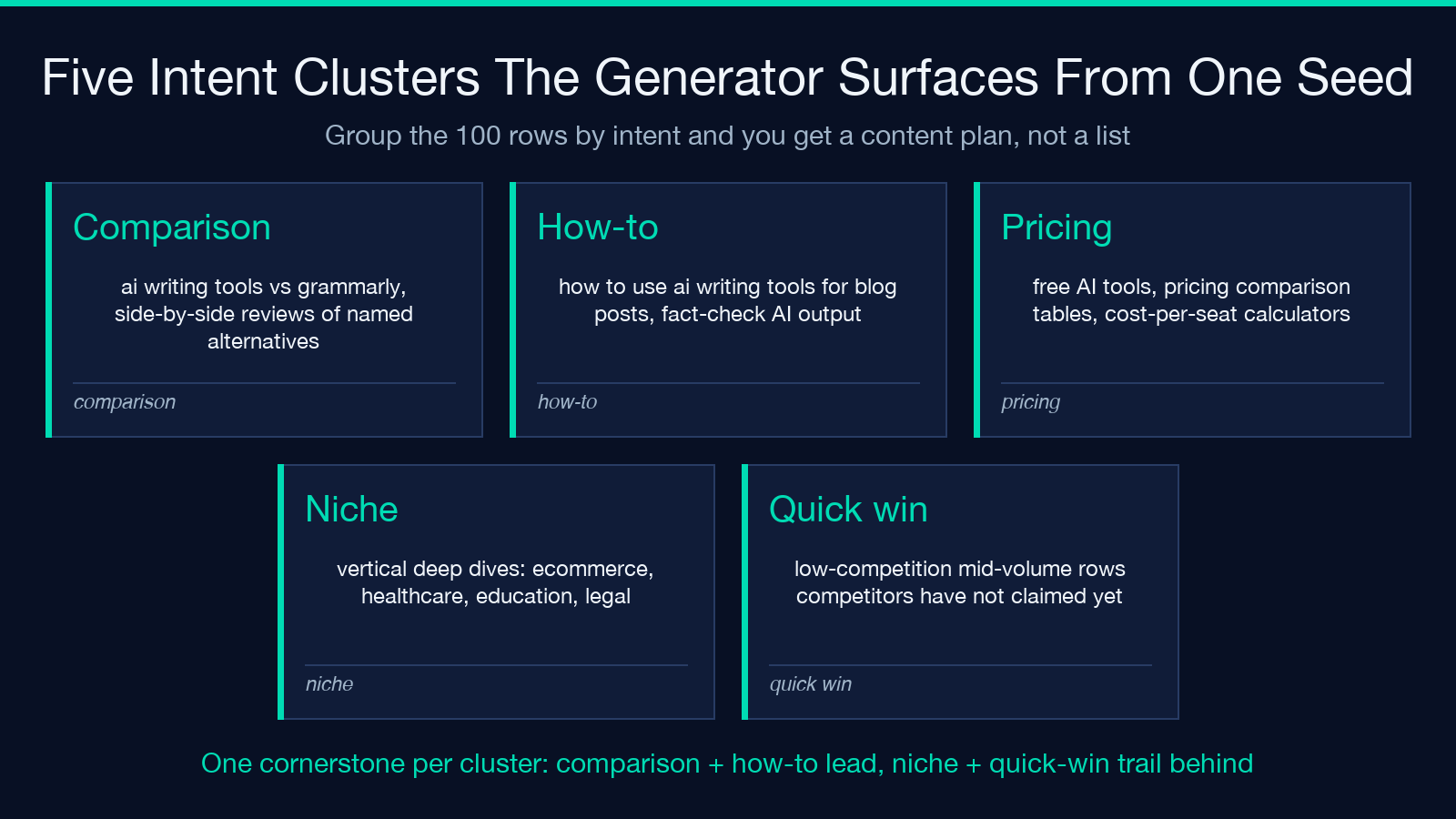
– Comparison intent: ai writing tools vs grammarly, ai writing tools for fiction, ai writing tools for academic papers — these become comparison pages. – How-to intent: how to use ai writing tools for blog posts, how to fact check ai writing tools — these become tutorial posts. – Pricing intent: ai writing tools free, ai writing tools pricing comparison — these become pricing roundups. – Niche intent: ai writing tools for ecommerce product descriptions, ai writing tools for grant proposals — these become deep dives.
The generator’s intent label saves you the manual clustering step. The volume and competition columns let you pick the cluster you want to lead with (high-volume cluster for cornerstone SEO, low-competition cluster for quick wins).
What the optional industry field actually changes
Without industry, the generator defaults to broad consumer-facing interpretation of the seed. With industry set, it tightens the long-tail pool to phrases that a buyer in that vertical would actually type. For example, the seed project management with industry healthcare shifts the output away from generic phrases like project management certification and toward vertical-specific ones like project management for clinical trials or project management software hipaa compliant. That vertical shift is the single biggest lever you have for getting useful output, and it is worth re-running the generator with three or four different industry strings to see how the pool changes.
The industry field is optional precisely because the broad pass is also useful — for early-stage keyword research where you do not yet know which vertical you will commit to, the broad output gives you a wider surface to pick from.
Choosing the right seed phrase
The generator works best when the seed is a noun phrase that already has clear commercial or informational intent. Seeds like ai or tools are too broad and produce low-signal output because the model has to guess which sub-niche you mean. Seeds like how to write a cover letter are slightly too long — the generator will still work, but the variants cluster tightly around the seed rather than branching out. The sweet spot is two-to-three-word noun phrases that name a topic but leave room for modifiers: standing desk, cold email, home workout plan, note taking app.
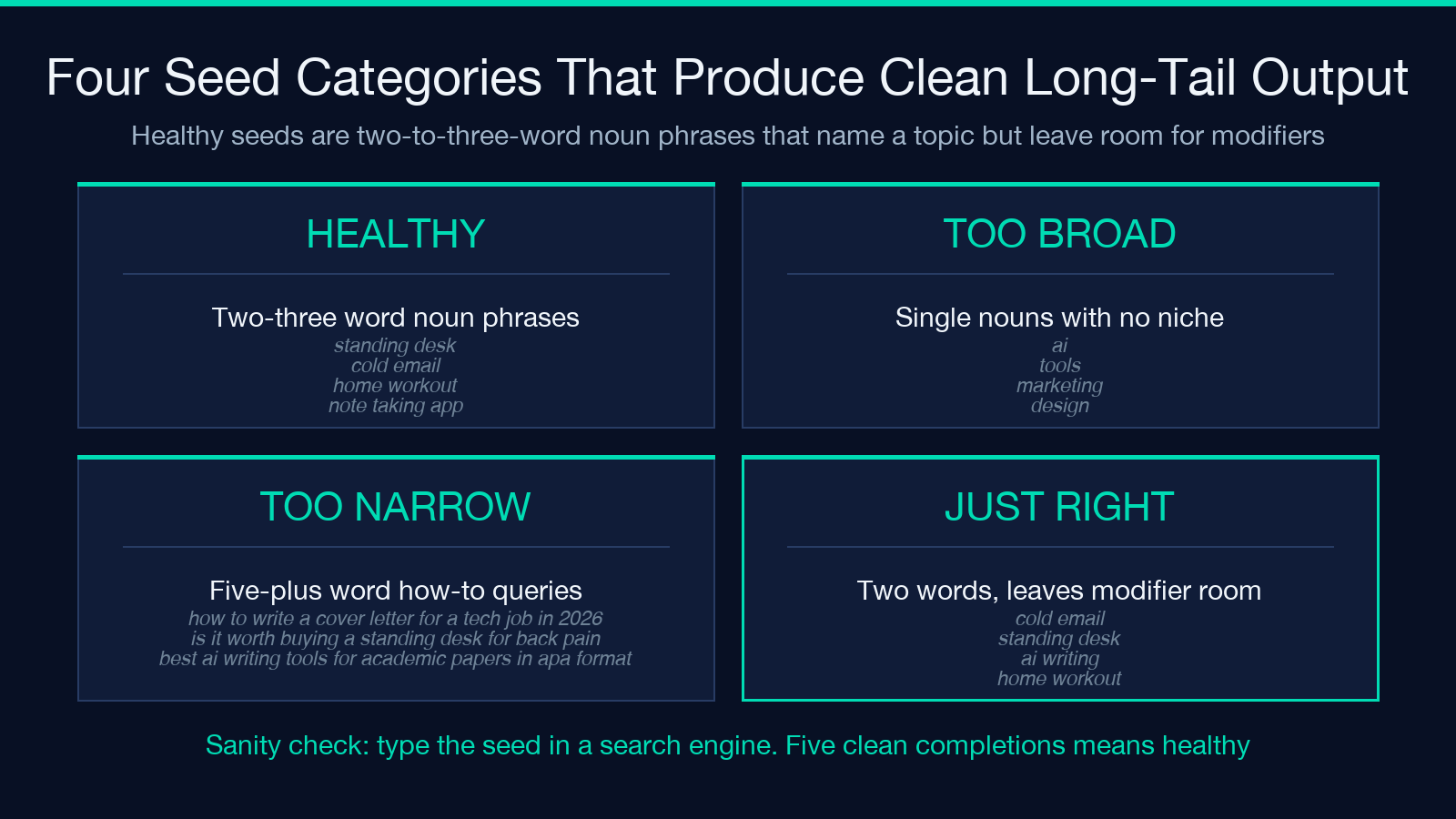
A useful sanity check before you commit to a seed: type it into your search engine of choice and look at the suggested completions in the dropdown. If the engine gives you five or more clean completions, the seed is healthy. If it gives you two or three weak completions, the seed is probably too narrow and you should broaden it.
Common failure modes and how to avoid them
Three patterns come up over and over when you watch people use keyword tools. The first is treating the volume numbers as exact. They are ranges, and the ranges shift depending on the source the model was trained on. The value of having volume in the output is not that it is precise — it is that it lets you rank-order 100 candidates in one glance without switching to a paid keyword tool. Use it for triage, not for final go/no-go decisions.
The second is ignoring the long tail in the literal sense. The first 10 rows of the output are usually the obvious ones — the ones your competitors have already written for. The interesting moves live in rows 30 through 90, where the variants are weird enough that no one has claimed them yet but specific enough that searchers typing them actually know what they want.
The third is running the generator once and walking away. Re-run with different industry strings, re-run with a sibling seed, re-run with a sub-niche seed — each pass adds five to ten phrases to your final shortlist that the previous pass missed.
Where this fits in a real SEO workflow
The honest answer is that no AI tool replaces a real keyword database with live SERP data. What the AI Long-tail Keyword Generator does is the upstream step that the paid tools charge you $100+/month to skip: the brainstorming pass. Once you have a clean shortlist of 20–40 candidates from the generator, you can drop them into Ahrefs, Semrush, or your database of choice to validate the volume bands and pull backlink data. That order — AI for breadth, paid tool for validation — is much faster than running the paid tool first and then brainstorming.
The other place this fits is content gap analysis. If you already have a site and a list of URLs, run your top 10 head terms through the generator, then cross-reference the output against your existing URL list. Phrases you do not already cover, especially in the low-competition band, are your next 10 posts. That is the same workflow professional SEO agencies run manually for a client audit — the generator just collapses the brainstorming step from an afternoon into a single button click.
Final thoughts and what to do next
The generator is not a magic 8-ball. It is a brainstorming accelerator that turns one seed phrase into a structured shortlist in the time it takes to read the output. The volume and competition columns are triage aids, not source-of-truth numbers, and the industry field is the highest-leverage knob you have. Use the first 10–20 rows as your cornerstones, the rows 30–90 as your quick wins, and re-run with different industry strings to map out the niche surface before you commit to writing.
For sample input/output pairs and to see the streamed 100-row output in action, the Elysia Tools samples page collects concrete examples across the broader AI-tools suite. To run it on your own seed phrase right now, open the AI Long-tail Keyword Generator and start with a noun phrase like standing desk or cold email — anything two-to-three words that names a topic without being too broad. If you want to compare it side-by-side with related SEO helpers, browse the rest of the AI Tools collection at elysiatools.com.
