

Validate the shape, then validate the semantics. Most UUID bugs are not malformed strings. They are perfectly well-formed strings that carry a version the system does not support, a variant bit pattern from a non-RFC generator, or a sentinel value that a regex happily waves through. A checker that reports version, variant, and structure — instead of a single true-or-false — turns a silent data-quality problem into a line item you can fix. That is the whole argument for reaching for a validator instead of writing one more pattern.
What a UUID validator actually checks
A UUID is 128 bits, normally written as 32 hexadecimal digits in five hyphen-separated groups of 8-4-4-4-12. The shape check is the easy part, and it is where most homegrown validation stops. The UUID Validator goes further: it validates the format, detects the version, and analyzes the structure including variant, timestamp, and node information. Those three extra outputs are what separate a syntax check from a usable diagnosis.
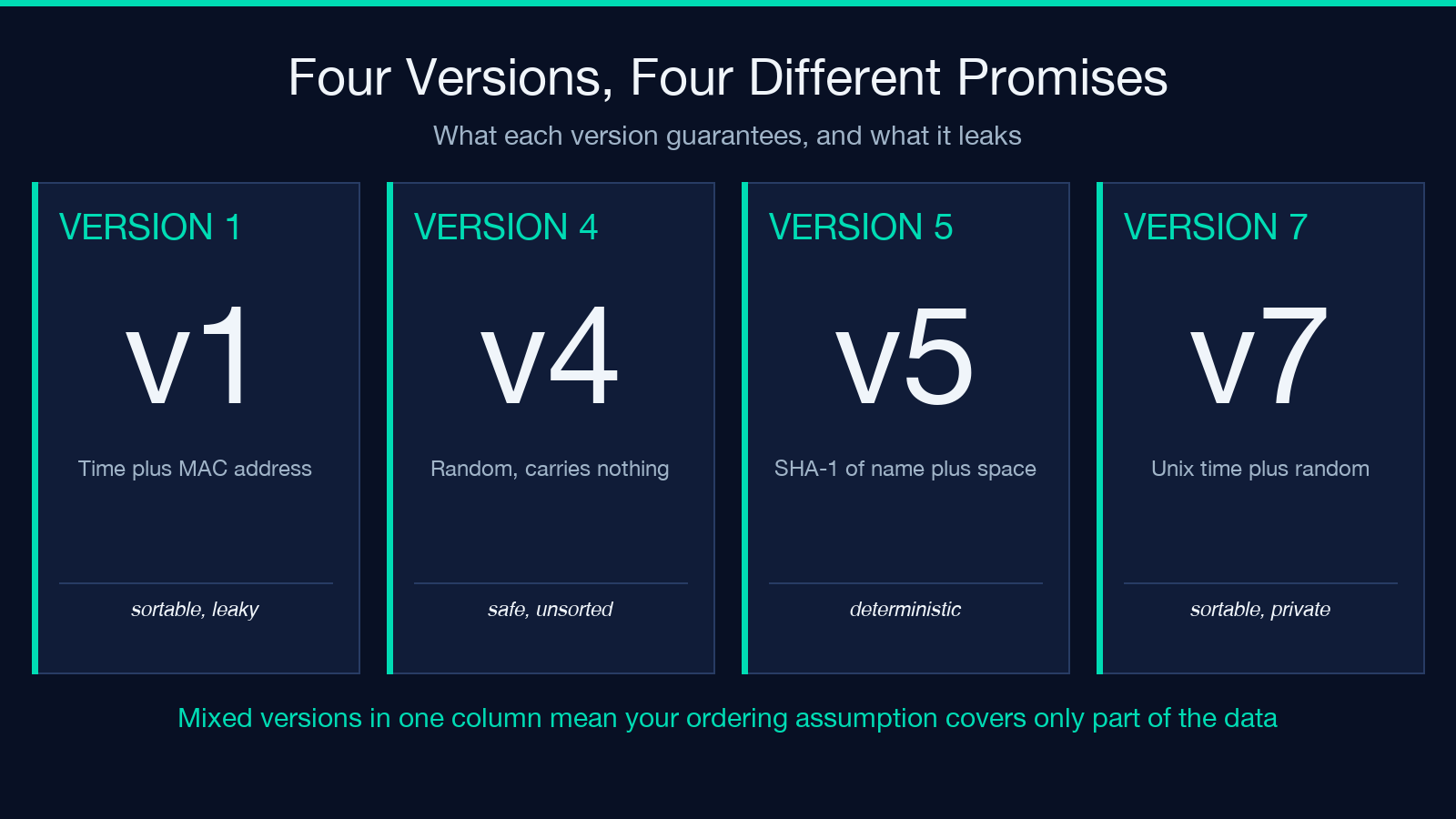
The distinction matters because a string can be structurally valid and still be wrong for your system. A v1 UUID leaks a MAC address and a timestamp. A v4 UUID is random and carries nothing. A v7 UUID sorts by time. If your index assumes monotonic ordering and someone hands you v4, nothing errors — your write amplification just quietly triples.
The version nibble is not the version you think
The version lives in a single hex digit: the first character of the third group. In 123e4567-e89b-12d3-a456-426614174000 that digit is 1, so this is a version 1 UUID. In f47ac10b-58cc-4372-a567-0e02b2c3d479 it is 4.
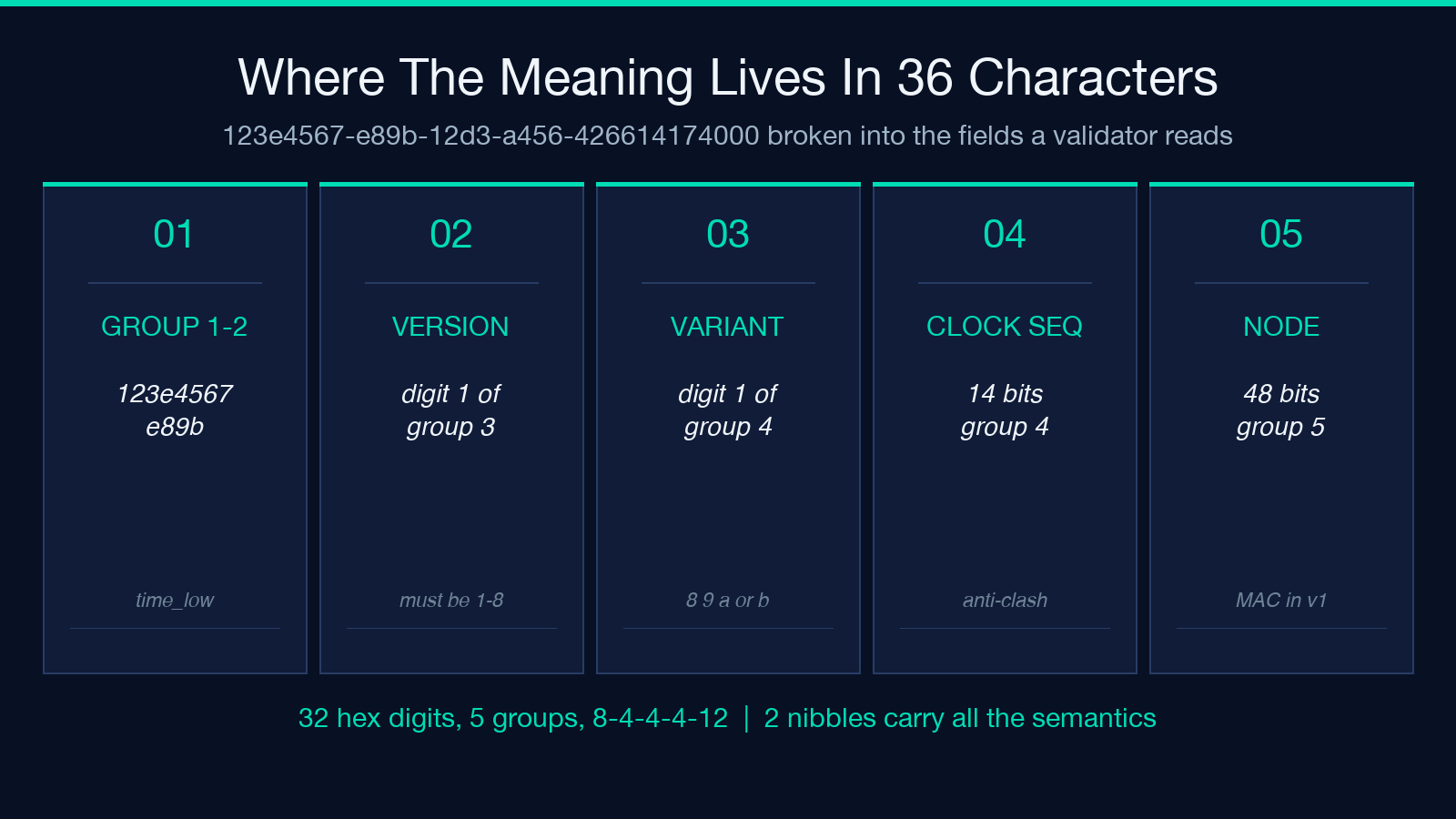
Two failure modes show up constantly. The first is people reading the wrong nibble — the leading digit of the whole string, or the last group — and concluding a v4 ID is v1. The second is treating any value in that position as legitimate. RFC 9562 defines versions 1 through 8; a nibble of 0 or 9 through f means the string was not produced by a conformant generator, even though it will pass every hex-and-hyphen regex ever written.
Practical consequence. If you accept arbitrary version nibbles, you cannot later assume anything about ordering, uniqueness guarantees, or collision probability, because you no longer know which algorithm produced the bytes.
Variant bits: the two most-ignored bits in the string
The variant occupies the two most significant bits of the first byte in the fourth group. For an RFC-conformant UUID those bits are 10, which means the first hex digit of the fourth group must be 8, 9, a, or b.
That single constraint rejects a large share of fake and hand-typed UUIDs. Test fixtures written by hand almost always land outside the set — a456 passes, c456 does not. Legacy Microsoft GUIDs from before the variant convention settled, and IDs produced by naive random-hex generators, land outside it too. A validator that reports variant explicitly tells you which bucket you are in; a boolean validator tells you nothing.
Nil, max, and the sentinel values that break naive regex
Two special values are structurally valid and semantically loaded:
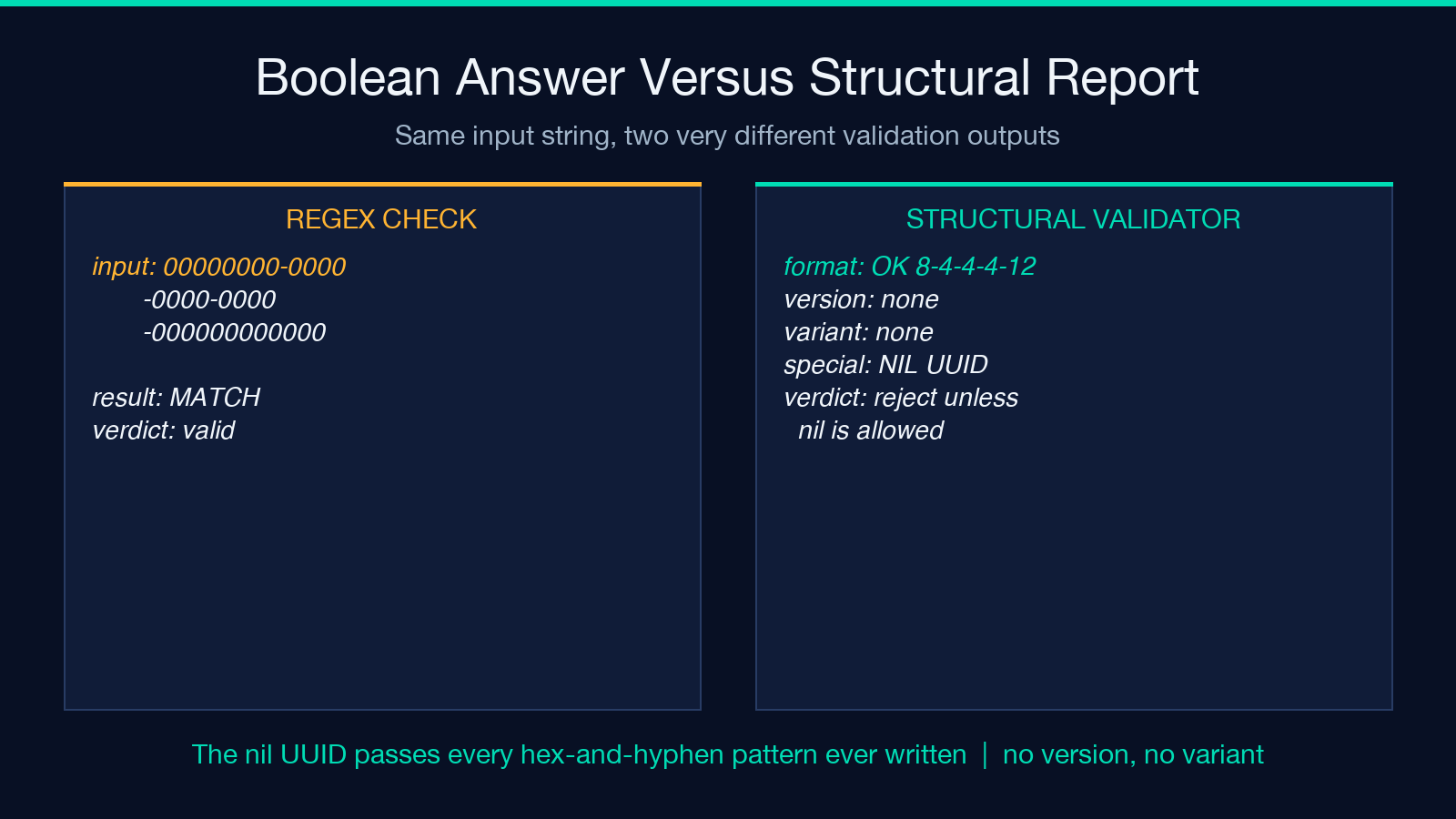
- Nil UUID —
00000000-0000-0000-0000-000000000000. All zero bits. Frequently means “unset” in code that forgot to initialize a field, and it has no version nibble at all. - Max UUID — thirty-two
fcharacters with hyphens. All one bits, defined in RFC 9562 as a sentinel at the opposite end of the range.
Both slip through the standard hex-and-hyphen pattern. Neither carries a valid version or variant. If your database contains a few thousand nil UUIDs, you almost certainly have a write path that silently substituted a zero value for a real identifier, and no exception was ever raised.
This is why the validator exposes options rather than a fixed policy. Allowing the nil UUID is correct for a system that uses it as a deliberate sentinel and wrong for a system where it can only mean a bug. The tool lets you decide instead of guessing on your behalf.
Timestamp and node data hiding in v1 UUIDs
Version 1 packs a 60-bit timestamp — 100-nanosecond intervals since 15 October 1582 — plus a 14-bit clock sequence and a 48-bit node identifier, which is usually the generating machine’s MAC address. That is real information, and it cuts both ways.
As a diagnostic it is excellent. Decode the timestamp from a v1 UUID and you know when the row was created even if the created_at column was never populated. Group by node and you know which host generated which records. When you are reconstructing an incident timeline from IDs alone, this is often the only evidence available.
As a privacy property it is a liability. Publishing v1 UUIDs in URLs publishes creation times and hardware addresses. Plenty of teams discover this during a security review, long after the IDs are in every log and cache. Pairing the validator with a UUID Generator makes the migration concrete: verify what version you actually have, then generate replacements in the version you actually want.
Case, braces, and urn prefixes: formatting variants in the wild
The same 128 bits arrive in at least four spellings. Lowercase hyphenated is the RFC-preferred form. Uppercase is what many Windows and .NET systems emit. Brace-wrapped form appears in Windows registry exports and COM interfaces. The URN form is prefixed with urn:uuid: and shows up in XML and RDF payloads.
The trap is comparison, not parsing. Two representations of identical bytes compare unequal as strings. If one service normalizes to lowercase and another does not, your cache keys fork, your joins miss, and your deduplication silently produces two rows where there should be one. The validator’s case option exists precisely so you can decide whether uppercase input is acceptable or a signal that normalization is missing upstream. For the surrounding cleanup — trimming, case folding, stripping the prefix — a general Data Cleaner pass before validation keeps the checker focused on semantics rather than whitespace.
Where validation belongs in a pipeline
Three positions are worth naming, and they are not interchangeable.
- At the boundary. Validate every UUID arriving from an external client, webhook, or CSV import. Reject with a specific reason — bad version, bad variant, nil value — not a generic parse failure.
- At migration time. Before switching a column type or introducing an ordering assumption, sample the existing values and confirm the version distribution matches what you believe is in there. This is where most surprises live.
- Never in a hot inner loop. If the value came from your own database and was validated on write, revalidating on every read buys nothing. Validation is a boundary concern.
For ad-hoc checks — one suspicious ID from a support ticket, a handful pasted from a log — the browser-based validator is faster than writing a script, and it reports version and variant rather than making you decode nibbles by hand. For v1 IDs specifically, decoding the embedded creation time is a job for a Timestamp Converter.
A five-minute audit for the IDs you already store
Pull a hundred UUIDs from your largest identifier column and run them through the validator. Then answer four questions.
- Is the version uniform? Mixed versions in one column mean multiple generators, and any assumption you hold about ordering or entropy applies to only part of the data.
- Are all variants conformant? Non-conformant variant bits point at hand-written fixtures or a non-RFC generator that reached production.
- Any nil or max values? Each one is a write path that failed without raising.
- Is the case consistent? Mixed case is a normalization gap waiting to become a duplicate-row incident.
None of those four questions is answerable from a boolean validator, which is the entire point. Explore the full catalogue at elysiatools.com.
