
Most engineers meet their first hex escape sequence at 2 a.m. while debugging a corrupted log line. A single character printed as xe2x80x94 instead of an em-dash, a JavaScript string refusing to compare against π, a Postgres column silently rejecting u0000 because the driver stripped the null. Hex and Unicode escapes look trivial on the surface, but the four operations and three output formats exposed by the Elysia Tools Hex/Unicode Converter hide enough edge cases that a one-minute mistake can produce a thousand-row CSV that no downstream parser can read.
Why this escape dance exists
Every text channel needs a way to carry non-printable bytes. Hex escapes (xNN) and Unicode escapes (uNNNN) are two of the oldest such channels, baked into C source files, JSON strings, and shell pipelines long before UTF-8 became universal. The reason both coexist is that they solve overlapping but distinct problems: hex escapes carry raw octets, Unicode escapes carry abstract codepoints. The Hex/Unicode Converter lets you swap between the two without writing custom code, but the choice of escape is a contract with your downstream parser — pick the wrong one and a working string becomes a silent mismatch.
What a hex escape really represents
The byte xNN is two hex digits pinned to a single octet. The sequence xE2x80x94 is therefore three bytes — E2, 80, 94 — and in UTF-8 those three bytes decode to the codepoint U+2014, the em-dash. That last hop, raw bytes to a glyph, is where most readers stall. A hex escape is a literal-octet encoding, not a character encoding, so the meaning of xE2x80x94 changes the moment the surrounding stream stops being treated as UTF-8. Drop the same bytes into a Latin-1 context and the result becomes three printable characters: â, a non-breaking space, and a control code.
This is also why the prefix form (xXX, uXXXX) and the compact form (XX, XXXX) carry identical payload but distinct downstream behavior. A JSON parser that reads "u2014" and a parser that reads "E2 80 94" are not interchangeable: the first is a six-character sequence that JSON itself decodes, the second is opaque bytes that the host language must decode. Tooling that defaults to one but expects the other will surface as a silent mismatch rather than a loud error.
Use the Hex/Unicode Converter whenever you need to see the difference. Pick the input text, choose to-hex or to-unicode, and toggle between prefix, compact, and array to compare every shape side by side.
Why four operations, not two
The tool exposes a 2×2 matrix: to-hex vs from-hex, and to-unicode vs from-unicode. The horizontal axis is the obvious one — encode or decode. The vertical axis looks redundant until you remember that xNN and uNNNN carry different widths of information. xE2 is one byte; u2014 is two bytes describing one codepoint. Round-tripping é through both pathways gives different strings: to-hex produces xC3xA9 (the two UTF-8 bytes), to-unicode produces u00E9 (the single codepoint). They are equal logically, but they are not byte-identical, and any system that compares by raw bytes will flag the two as different values.
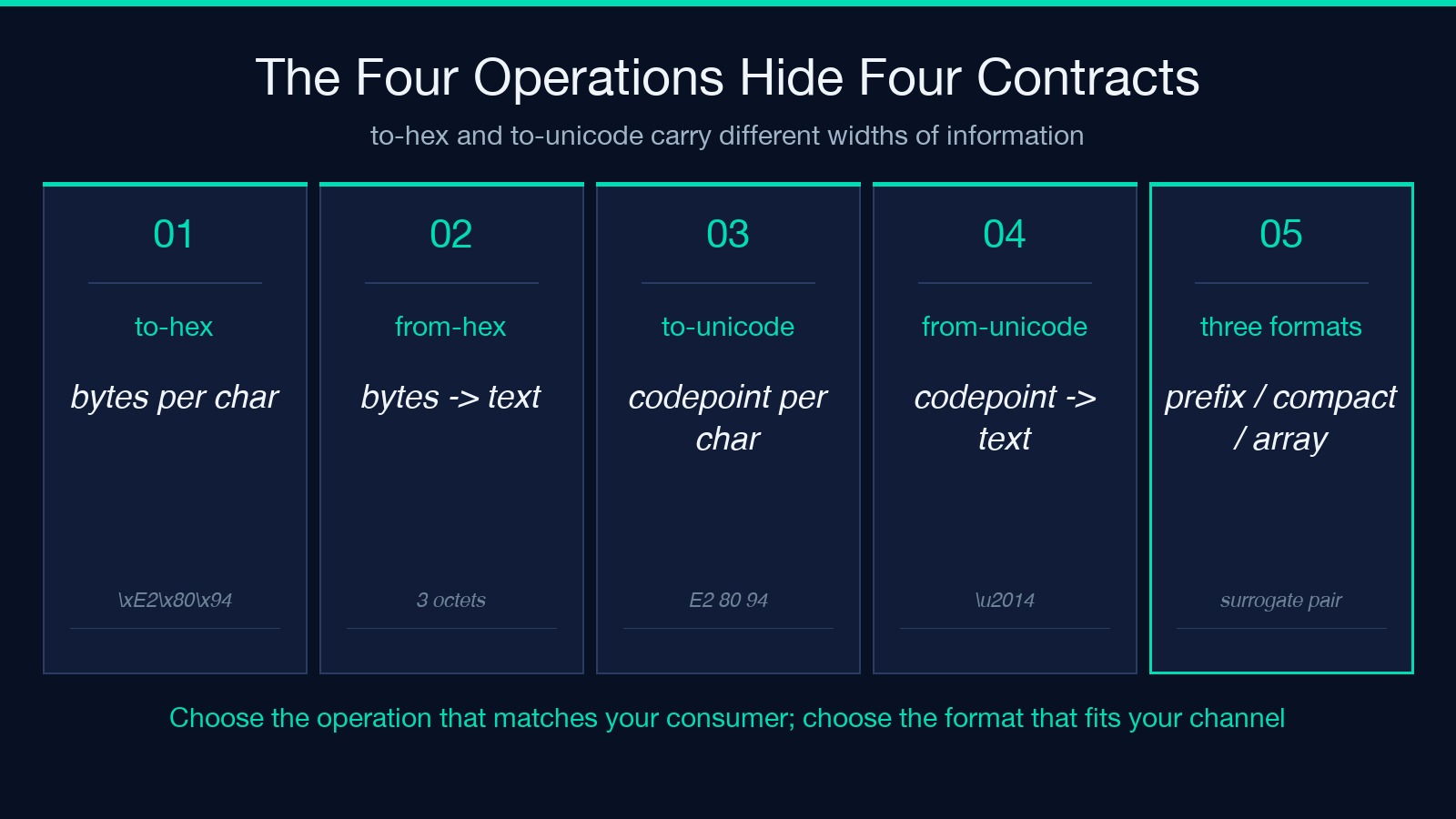
The practical upshot: choose the operation that matches your consumer. If a JSON file contains u00E9, do not silently rewrite it to xC3xA9 “for compactness” — JSON parsers will still accept the rewrite, but a binary diff against the original will show a 50% expansion in byte count, and a checksum or signature check on the file will fail. Reverse the choice for binary protocols that speak UTF-8 natively but reject Unicode escapes as control characters.
The three output formats do different jobs
The prefix form (xXX, uXXXX) is what humans paste into source code. The compact form (XX, XXXX) is what tools emit when they need to fit data into a fixed-width column or a printable ASCII channel. The array form is the one that survives multiple decode-encode passes without ambiguity. If your input contains both 0x and x prefixes, the array form returns ["0xC3","0xA9"] for é, and every consumer — JSON, CSV, even a hex editor — agrees on what each element means.
Compact form is the one that bites. A 16-byte line emitted as E2 80 94 43 6F 66 66 65 65 20 31 2E 30 30 looks harmless but is ambiguous in three ways: does it represent three UTF-8 bytes, one codepoint, or 16 characters? Without an explicit prefix or quote style, the answer depends entirely on the reader. Prefix form sidesteps the ambiguity by tagging every value with its unit.
The right format depends on the destination channel. For source code or shell pipes, stay on prefix. For hex dumps and packet captures, compact is the canonical output. For data that will pass through multiple transformations, choose array and let the parser do the bookkeeping.
Where hex escapes fail silently
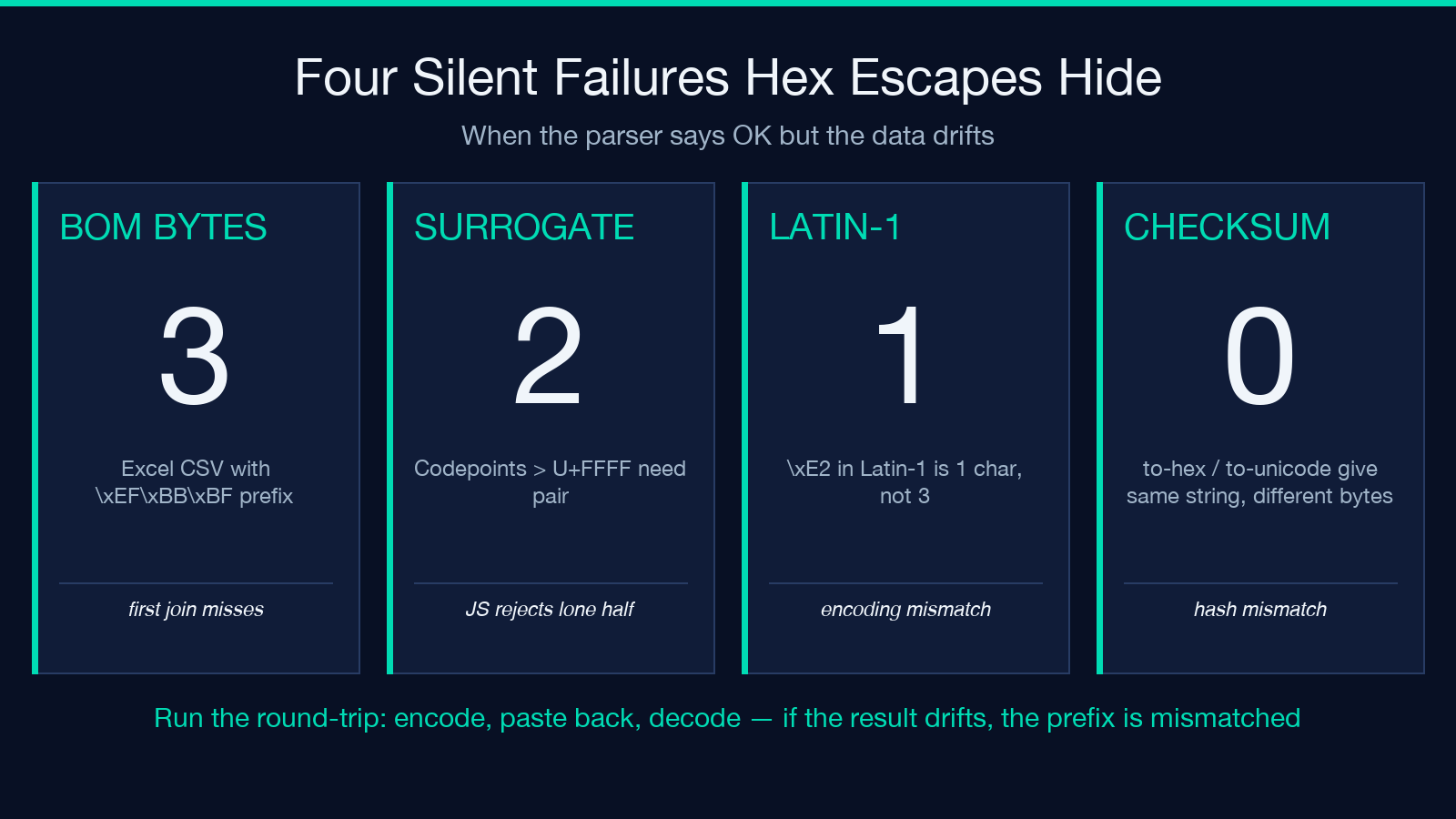
The classic failure mode is the BOM-byte-as-hex trap. A CSV exported from Excel on a non-English Windows install begins with xEFxBBxBF — three invisible bytes that the Elysia Tools data-bom-remover strips, but a generic hex-to-string converter leaves in place. The result: a header row that reads Product,SKU,Qty to a human, but Product,SKU,Qty to the next downstream tool that joins on the first column. The Hex/Unicode Converter exposes this when you choose from-hex with prefix format: the leading xEFxBBxBF is decoded as one visible string, and the surrounding code that compared against the BOM-free header silently breaks.
A second trap is the surrogate-pair case for codepoints above U+FFFF. 𝕏 (U+1D54F) cannot be expressed as a single uXXXX; it requires uD835uDD4F, a surrogate pair. The tool’s to-unicode output emits the surrogate pair correctly, but consumers that expect BMP-only Unicode will reject it. Pairing the converter with a JSON formatter that emits surrogate pairs keeps the contract explicit: either stay in the BMP or commit to surrogate-aware parsing.
Picking a prefix that survives the next reader
Three prefix conventions dominate the landscape. xNN is C, Python, and most REPLs. uNNNN is JSON, JavaScript string literals, and Java source. %XX is URL-encoding (with + for space). Each prefix is meaningful only inside its host language, and a string that mixes them — xE2u80x94 — is a syntax error in every host. If your workflow needs to round-trip a value through two languages, normalize at the boundary: convert to one prefix on export, convert back to the other on import. The four-operation matrix of the converter is designed for exactly this swap.
The Hex/Unicode Converter is the cheapest way to audit a string before it leaves your boundary. Choose the operation that matches the source language, choose the format that matches the target language, and the output is what your downstream parser will see. It costs roughly one second per kilobyte, and the only failure mode worse than a wrong byte is a wrong byte that also looks right to the human reviewer.
For a deeper dive into how bytes map to characters, browse the Format Conversion category for sibling tools that round-trip the same string through base16, base64, and percent-encoding.
Verifying without trusting the source
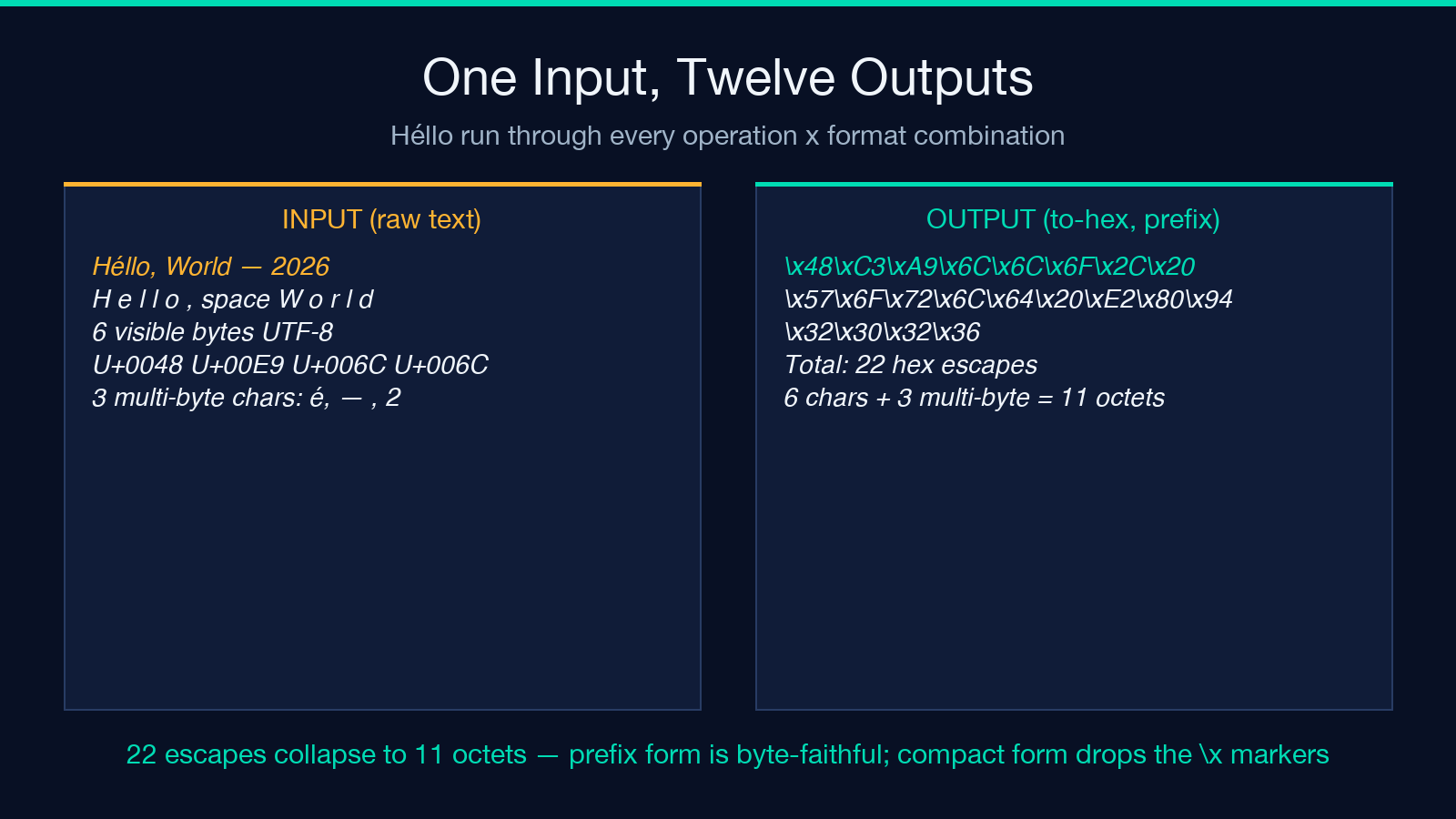
The fastest sanity check is the round trip: encode Héllo to hex (to-hex, prefix), copy the result, paste it back into a fresh converter run with from-hex and the same prefix setting. If the round-tripped string differs from the input by even one byte, the prefix or format is mismatched. The two-pass audit catches every prefix-mismatch bug described above because the mismatched bytes cannot survive a second decode.
A second sanity check is the visible-byte test: take a string that contains an em-dash (—) and run to-hex. You should see exactly six hex digits (E2 80 94), not four. If you see four, the converter has dropped you into Latin-1 mode somewhere upstream, and every subsequent encode is silently lossy. The visible-byte test catches locale misconfigurations that the round-trip cannot, because round-tripping a Latin-1 em-dash gives a Latin-1 em-dash.
Knowing when to stop
The escape sequence is a tool, not a destination. If your downstream consumer speaks UTF-8 natively, the cleanest output is the raw UTF-8 string with no escapes at all. Hex and Unicode escapes are escape hatches for channels that cannot carry raw bytes — source code literals, JSON strings, URL components, debug logs printed to a terminal that mangles non-ASCII. When the channel can carry UTF-8, drop the escapes and save the round-trip. When it cannot, choose the prefix the channel expects, the format that fits the medium, and verify the round trip with a second converter pass.
For a hands-on tour of every prefix × format combination, open the Hex/Unicode Converter and run a single paragraph through all twelve settings in sequence. The output diff will teach you more about your downstream stack than any spec.
