

ISO 8601 durations look simple until a parser silently accepts the wrong one. The PnYnMnDTnHnMnS string is governed by four quiet rules, and a single missed edge case can expire a customer trial in 18 hours. This field guide walks through those rules, the round-trip both directions, and the audit you should run before any value crosses an API boundary.
The ISO 8601 Duration Format Your API Contract Never Audited
A PnYnMnDTnHnMnS string looks simple — until a client sends P3Y2M14D for a 7-day free trial, your parser rejects it as “too long,” and a friendly support email asks why their trial expired in 18 hours. ISO 8601 durations sit in API contracts, billing systems, scheduling libraries, and RFC 5545 iCalendar payloads, and the rules that govern them are quiet, easy to ignore, and easy to break. This field guide walks through the four parsing rules that catch most implementations off-guard, then shows how Elysia Tools’ ISO 8601 Duration Builder enforces them in both directions — natural-language to ISO 8601 and back.
What ISO 8601 actually specifies for durations
ISO 8601-1:2019 defines the duration format as PnYnMnDTnHnMnS where the designators are case-sensitive:
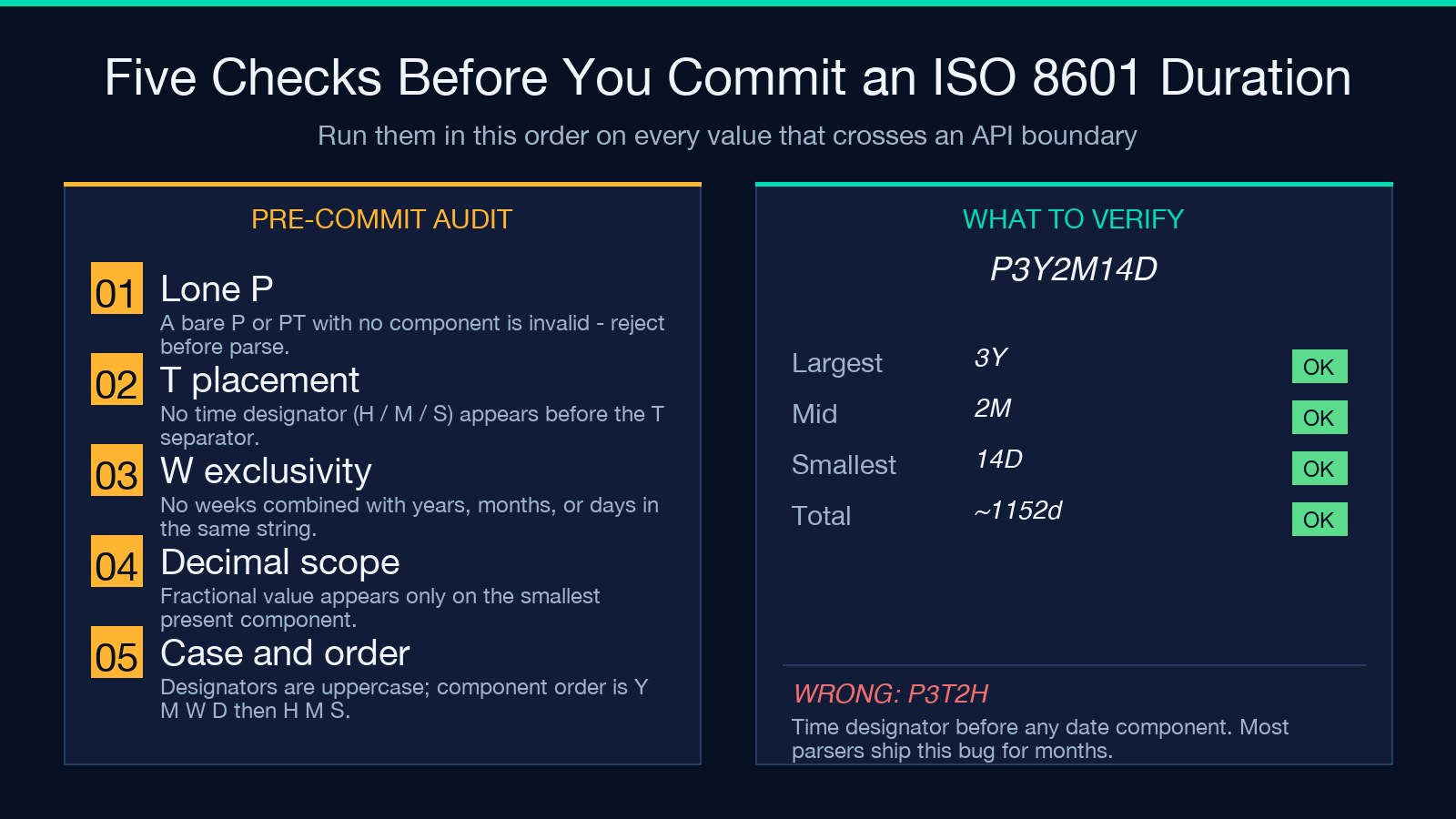
– P opens the string (a lone P is invalid — at least one component must follow). – Y, M, W, D are date components (years, months, weeks, days). – T separates date and time components; the time components that follow are H (hours), M (minutes), S (seconds) — note that M is reused for months before T and for minutes after T, with the position of T disambiguating. – Each component is n followed by its designator: 3Y, 6M, 14D, T4H, 30M, 45S. – A decimal fraction is allowed on the smallest component only: PT0.5H is valid, PT0.5H30M is not.
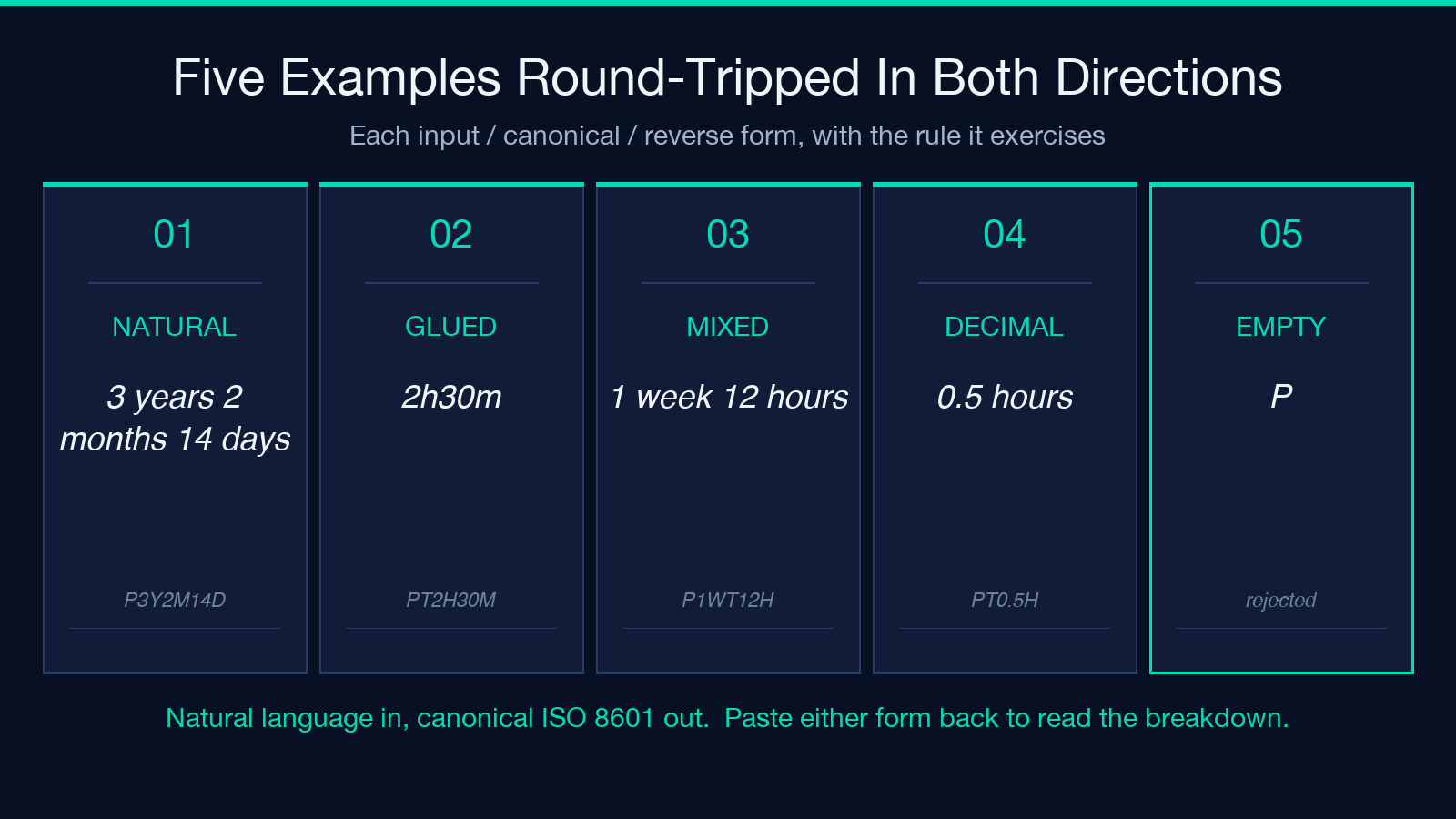
A natural-language approach — accepting "3 years 2 months 14 days" and emitting P3Y2M14D — looks obvious until the parser has to decide what to do with "2.5 hours" (decimal on hours, valid), "1 week 12 hours" (combines W with H — see rule 2 below), or a glued form like "2h30m" that drops the designator and the leading P. The ISO 8601 Duration Builder accepts all of these in a single input box; the tool then validates the canonical form before it ever reaches your storage layer.
The four rules that trip up most parsers
A surprising amount of ISO 8601’s complexity sits in four short rules. They are not optional, and they are not enforced by most string-search parsers.
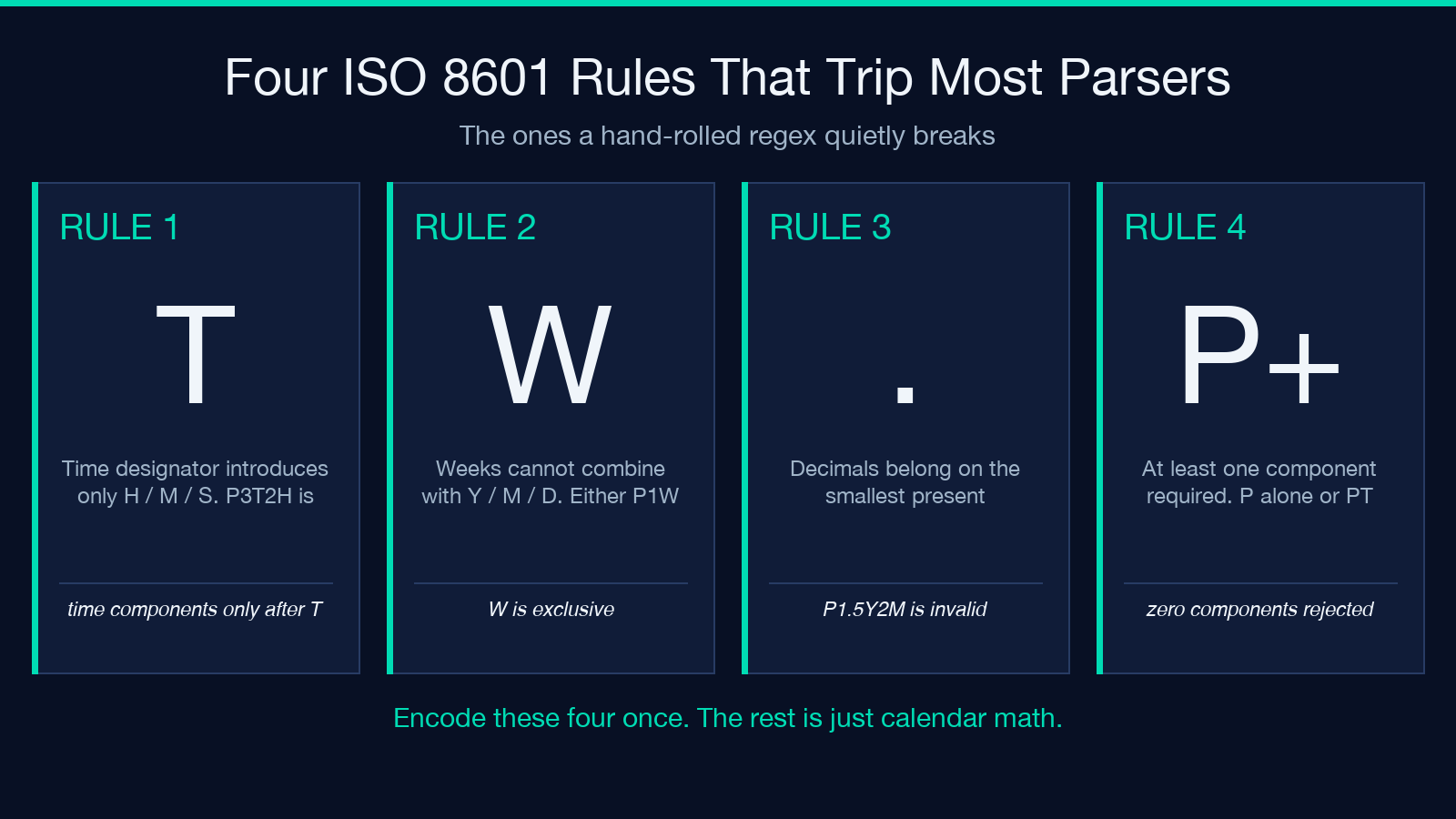
Rule 1: T must introduce only time components. A value like P3DT2H is correct; P3T2H is not, because there is no date component before T. The duration builder’s validator surfaces this as a “time designator before date” error rather than letting it silently land in your scheduler.
Rule 2: W is a week and cannot be combined with Y, M, or D. ISO 8601 says weeks are an alternative representation — once you commit to W, you cannot add 2Y3W. The tool flags this and offers the equivalent P95W or P1Y9M6D instead.
Rule 3: Decimals belong only on the smallest present component. P1.5Y is allowed (a year and a half), but P1.5Y2M is not. The smallest-component rule keeps the format unambiguous. When your client sends P0.5Y2M, the validator rejects it and shows the canonical rewrite.
Rule 4: At least one component is required. P alone is invalid. So is PT with nothing after. The most common cause is a code path that builds a duration string by concatenation and forgets to gate on a non-zero value — the tool catches that case and emits a friendly “no components” error before the value reaches an API.
Reading durations back: why the breakdown matters
Once you have P3Y2M14D in your database, somebody has to show it to a human. The reverse direction — ISO 8601 to natural language — sounds trivial until you have to choose between “3 years 2 months 14 days” and “3y 2m 14d” depending on the audience, or report the approximate total in a way the user can sanity-check.
The tool emits a per-component breakdown (years, months, days, hours, minutes, seconds) and a total using standard calendar conventions: 1 year ≈ 365.25 days, 1 month ≈ 30.4375 days. Those constants are the same ones pandas.Timedelta and java.time.Duration approximate, and they let the breakdown match what a user would compute by hand. For the opposite direction — turning a natural-language duration into the time point a calendar event will land on — the ISO 8601 Converter handles date-time points and Date Difference Calculator handles intervals between two named moments; the duration builder stays focused on the PnYnMnDTnHnMnS form.
How the round-trip holds up against a real free-trial flow
A standard 7-day free trial gives you P7D from the API and "7 days" in the UI. The interesting cases are around it:
– Trial with grace period (P7DT2H) — 7 days plus a 2-hour timezone buffer. The tool accepts and reports both date and time components, so the UI can render “7 days 2 hours.” – A weekly subscription with a billing anchor (P1W) — pure weeks, no day component. Many hand-rolled parsers split this as 7 days and lose the W provenance. – A long-running entitlement (P1Y2M15D) — the breakdown shows “1 year 2 months 15 days,” and the total in seconds is 1 × 365.25 × 86400 + 2 × 30.4375 × 86400 + 15 × 86400 ≈ 39,979,200 seconds. Sanity-check that against your entitlement ledger.
For adjacent problems — converting the duration into a cron schedule for a recurring reminder, or checking that a timestamp falls inside the trial window — Crontab Converter and Timestamp Converter sit one click away in the same toolkit.
Validation edges worth keeping in your test suite
Three edge cases show up in every ISO 8601 parser the moment it ships to production:
– P0D — a zero-day duration. The tool accepts it (a zero component is still a component) and emits the natural-language “0 days” so the UI does not render a blank string. – PT0S — zero seconds. Same rule: valid, and useful for “expires now” sentinels. – A lowercase p or t — the spec is uppercase only. The tool normalizes input casing on parse, so a sloppy "p3y" still becomes P3Y. If you ship a strict parser, this normalization is the difference between a friendly API and one that drops a customer’s trial on case mismatch.
If you want to compare the output against what your code emits, Time Duration Formatter reformats a duration in a chosen unit and Date & Time Validator catches malformed date-time points that the duration builder might be combined with. Together they form a small, focused set: format, parse, validate, format again.
Worked example: round-tripping "3 years 2 months 14 days"
A complete round-trip shows the rules in motion. Start with the natural-language input the customer types: "3 years 2 months 14 days". The duration builder’s parser tokenizes on the unit words, normalizes the order to Y M D, and emits the canonical ISO 8601 form P3Y2M14D. Pasting that string back in the same field, the reverse parser produces the breakdown:
- Years: 3
- Months: 2
- Days: 14
- Total (calendar): ~3 years + ~2 months + 14 days ≈ 1,152 days ≈ 99,532,800 seconds
The same round-trip on the time-component variant "2h30m" goes through a different path: the parser drops the unit words, normalizes "2h30m" to hours and minutes, and emits PT2H30M. Pasting PT2H30M back yields the natural form "2 hours 30 minutes" with a total of 9,000 seconds. Notice the leading T in the canonical output — it is required by rule 1 because every component in the duration is a time component, and the time designator marks the boundary even when no date components precede it. A leading P without a T (e.g. P2H30M) would be rejected.
The mixed example "1 week 12 hours" is the case rule 2 governs. The parser can either keep weeks (P1WT12H) or expand to days (P9DT12H) — both are valid ISO 8601, and the tool emits whichever is the smallest-component-friendly form. The reverse parser accepts both, so a downstream system can store the form that matches its indexing model without locking the input parser into one choice.
What to ship vs. what to keep on the client
The pragmatic split is to keep the four validation rules server-side (a 30-line parser) and let the user-facing input be as forgiving as the duration builder’s parser — accept "3 years 2 months", "2h30m", "P3Y2M", and case variants all in one field. The round-trip back to natural language stays server-side too, so the user always sees the canonical form. The only client-side check worth shipping is a regex that rejects P alone and a regex that flags a lowercase designator before the form even submits.
If you have been bitten by a silent P3Y2M14D vs P7D mismatch in a billing flow, or you have had to explain to a customer why their 7-day trial expired in 18 hours, the ISO 8601 Duration Builder is a fast way to see exactly what your parser will accept before you wire it into a contract. The four rules above — T introduces only time, W excludes other date components, decimals on the smallest component, at least one component — are the whole game; everything else is shorthand for a calendar the user already understands.
