
Two numbers decide almost every clinical question about an enterally fed adult. Whether the pump rate is safe to start, whether the formula on the shelf delivers enough protein, whether the team should accept a gastric residual of 480 mL, whether a “trophic” 10 mL/hr trickle is enough — every one of those decisions is downstream of kcal/kg/day and g/kg/day. The Enteral Nutrition Target Calculator computes both, then translates them into mL per hour against a formula density.
The mistake most early-career clinicians make is to grab a single rule — “25 kcal/kg, 1.5 g/kg” — and apply it to every patient regardless of category. The ASPEN/SCCM, ESPEN, and Boullata guidance already publishes category-specific bands for a reason: a critically ill patient on day 1 tolerates permissive underfeeding at 12–18 kcal/kg/day, a burn patient at 30–35, an obese patient at 11–14 kcal/kg actual or 22–25 kcal/kg ideal. Plug the wrong band in and the math produces a number the team is willing to act on — that is the dangerous part.
Why the per-kg multiplier matters more than total calories
A 70 kg well-nourished patient at 25 kcal/kg/day needs 1,750 kcal. A 70 kg critically ill patient on day 1 at 15 kcal/kg/day needs 1,050 kcal. A 70 kg major burn patient at 32 kcal/kg/day needs 2,240 kcal. The weight is the same; the multiplier is what changes. Every energy target in clinical nutrition is expressed per kilogram because total calories scale with body mass, not with admission diagnosis.
Three pitfalls show up when clinicians skip the per-kg step:
- Using total calories from a previous admission. The 1,800 kcal target that worked for a 60 kg patient last month is 30 kcal/kg; applied to a 90 kg patient it becomes 20 kcal/kg, which is below the maintenance band.
- Mixing kcal/day and kcal/kg/day. A 2,000 kcal target on a 50 kg patient is 40 kcal/kg/day — well above the burn range and into overfeeding territory.
- Forgetting weight changes. ICU patients on diuresis can lose 5–10 kg of fluid in a week; the per-kg target stays the same, the absolute target drops.
The Enteral Nutrition Target Calculator takes weight and the chosen per-kg multiplier and returns the kcal/day directly, which sidesteps all three.
Choosing the right kcal/kg band
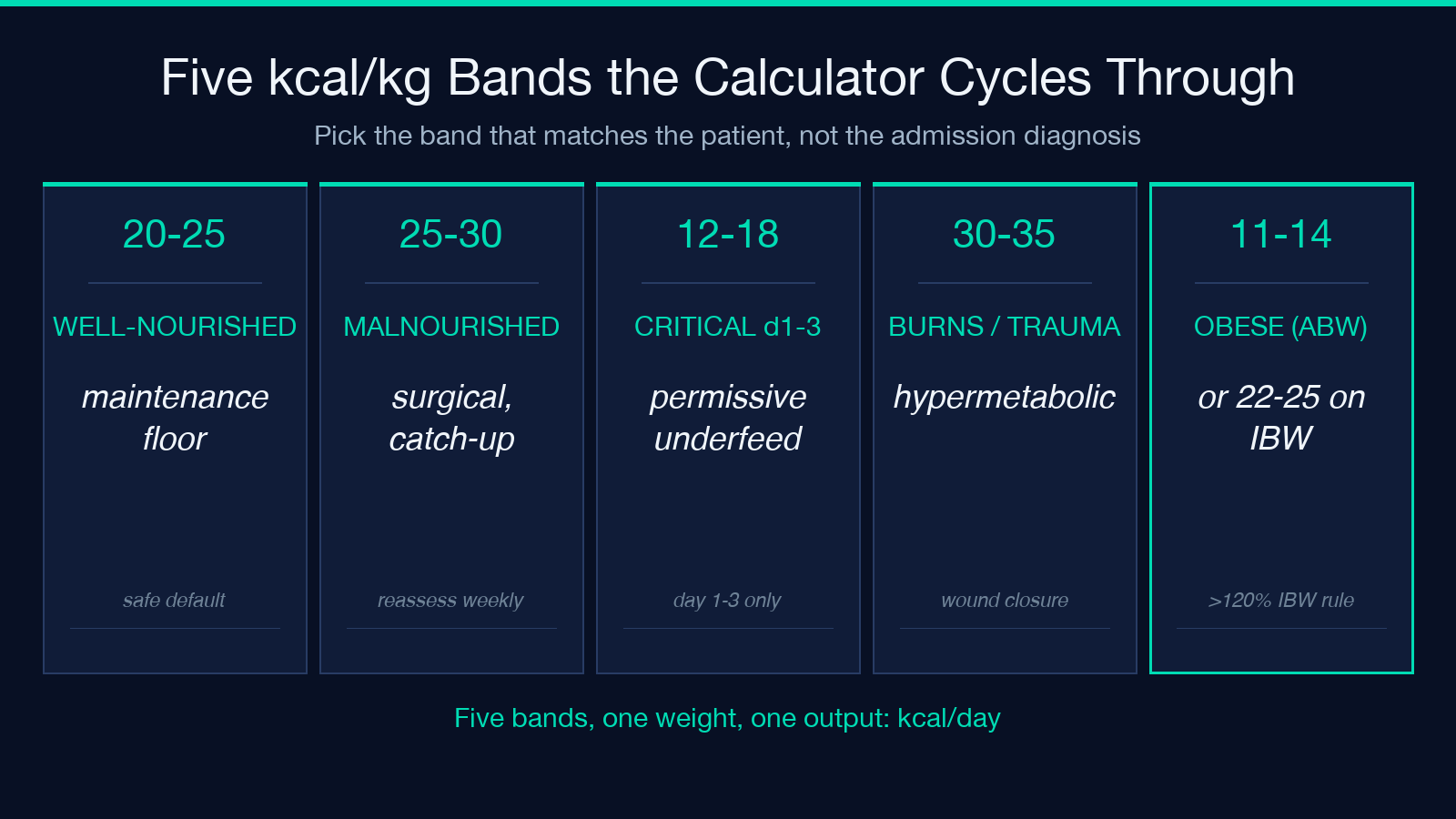
The five clinical categories the guidance documents cover — well-nourished, malnourished/surgical, critically ill early, recovery, and major burns/trauma — are not interchangeable. The table below captures the published bands:
| Category | kcal/kg/day | Notes |
|---|---|---|
| Well-nourished | 20–25 | Maintenance floor; safe default for stable patients |
| Malnourished or surgical | 25–30 | Catch-up range; reassess weekly |
| Critically ill, day 1–3 | 12–18 | Permissive underfeeding; avoid overfeeding early |
| Recovery / post-ICU | 25–30 | Build back to requirement |
| Major burns / trauma | 30–35 | Hypermetabolic; reassess at wound closure |
| Obese (BMI > 30) | 11–14 actual or 22–25 ideal | Use ideal weight when actual > 120% of ideal |
Two categories overlap at the edges. A malnourished surgical patient on day 5 of recovery can reasonably shift from 25–30 to 30 if the trend is toward catch-up. A critically ill patient who reaches day 4 should move out of the 12–18 permissive band into the 25–30 range regardless of whether ICU status has changed. The calculator does not enforce these shifts — the clinician does — but it does enforce that the chosen band is the one being multiplied.
Protein targets and the g/kg mistake
Protein is where the 0.8 g/kg/day floor does the most damage. That figure is the maintenance target for a healthy adult — not the target for an ICU patient, not for a burn patient, not for an obese patient. The published ranges:
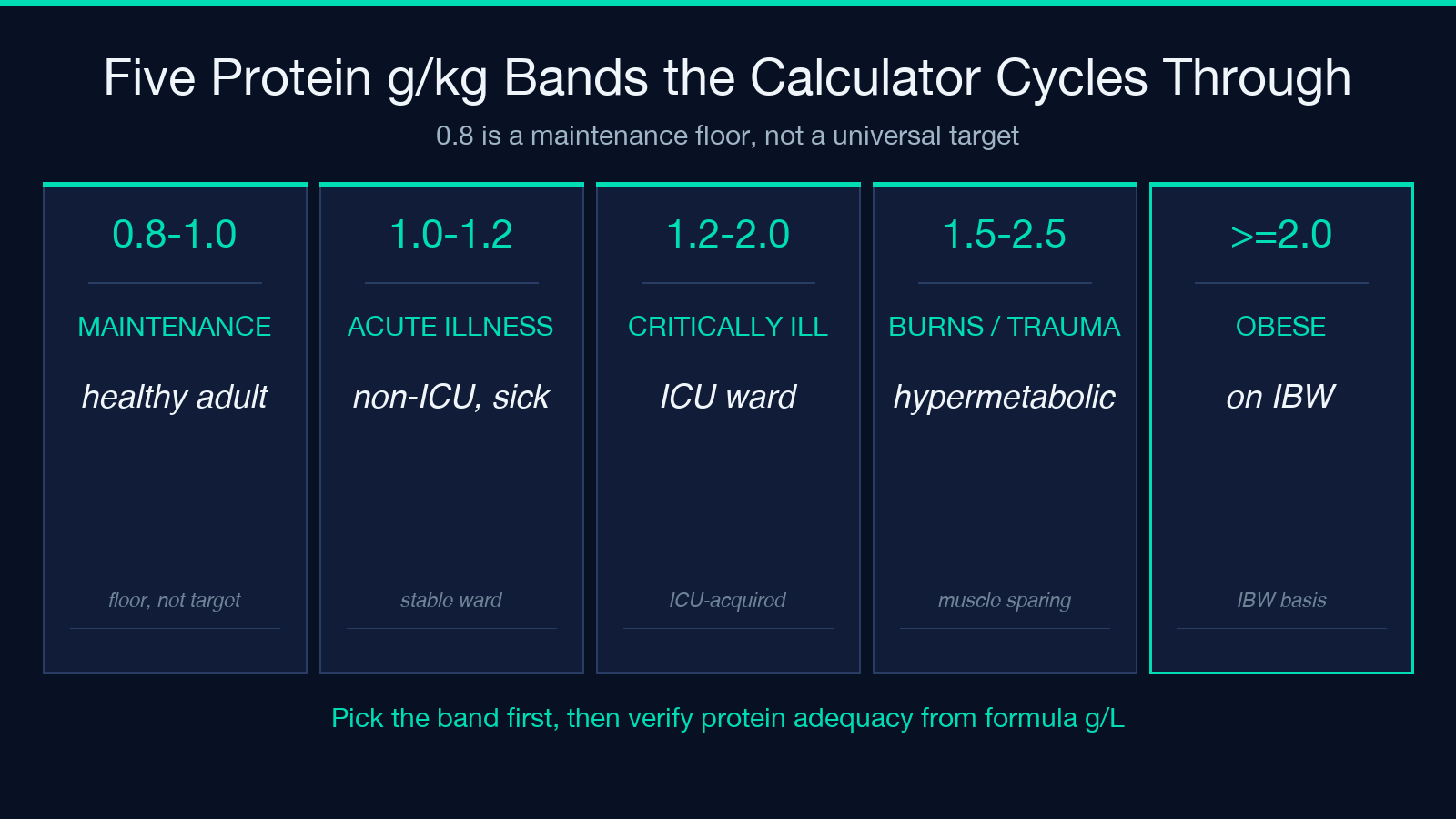
- Maintenance: 0.8–1.0 g/kg/day
- Acute illness (non-ICU): 1.0–1.2 g/kg/day
- Critically ill: 1.2–2.0 g/kg/day
- Burns / trauma: 1.5–2.5 g/kg/day
- Obese: ≥ 2.0 g/kg ideal body weight / day
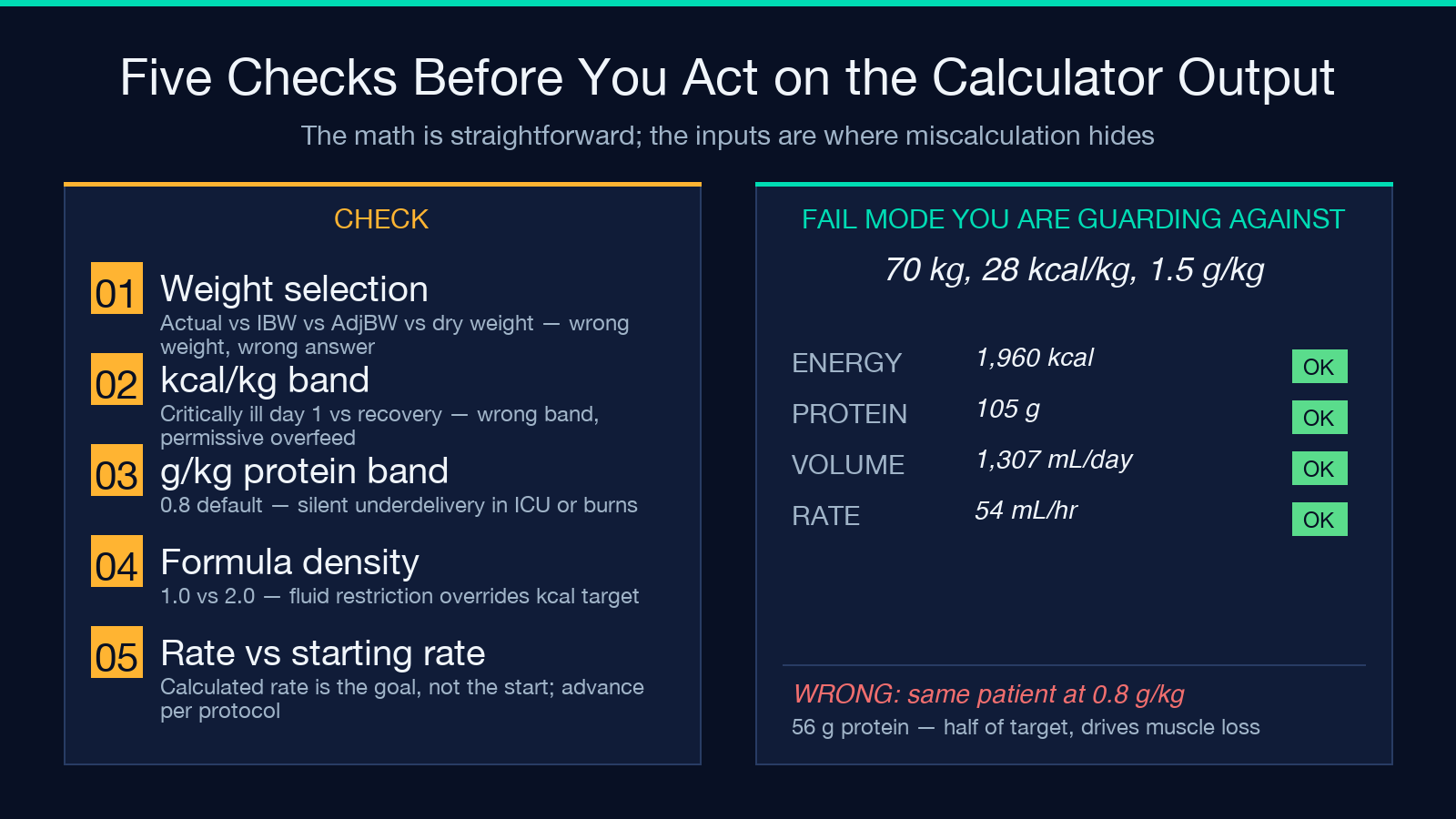
The mistake is treating 0.8 as a universal minimum. A 70 kg ICU patient at 0.8 g/kg/day gets 56 g of protein — half what the published range calls for, and almost certainly contributing to the muscle loss that drives ICU-acquired weakness. The calculator surfaces the protein target in the same display as the energy target so the team sees both numbers, not just one.
Translating kcal/day into formula volume
Once the daily target is set, the next question is volume — and volume is what the pump actually delivers. Formula densities cluster around four canonical values: 1.0 kcal/mL (standard polymeric), 1.2 kcal/mL (high-protein or moderately concentrated), 1.5 kcal/mL (high-energy), and 2.0 kcal/mL (very high energy, used when fluid restriction matters).
A worked example: a 70 kg malnourished surgical patient at 28 kcal/kg/day = 1,960 kcal. With a 1.5 kcal/mL formula, that is 1,307 mL per day — about 54 mL per hour over 24 hours, or 41 mL per hour over 32 hours if the team is using a cyclic overnight regimen. The Enteral Nutrition Target Calculator computes both the daily volume and a starting pump rate from volume / 24, which is the conservative starting point most protocols use.
Three practical notes on volume translation:
- Start at the conservative rate. Most ICU protocols start at 20–30 mL/hr and advance by 10–20 mL/hr every 4–6 hours. The calculated full-target rate is the goal, not the start.
- Watch the protein adequacy check. A 1.0 kcal/mL formula at 60 g protein per liter delivers 60 g per liter of feed — so the protein adequacy check (formula protein g/L × volume L) catches cases where the formula density is too low for the protein target.
- Flag fluid overload. A 2,400 mL/day target is 100 mL/hr; on a patient with a 1.5 L fluid balance the team should question whether the energy goal or the volume goal gives first.
Weight selection: actual, ideal, or adjusted
The calculator takes weight as a single input, but the clinical reasoning behind which weight to plug in is the most common source of miscalculation. The published rules:
- Actual body weight (ABW) is the default for normal-weight patients.
- Ideal body weight (IBW) is used when actual is > 120% of ideal — i.e., obese patients. The IBW formula: men 50 + 2.3 × (height inches − 60); women 45.5 + 2.3 × (height inches − 60).
- Adjusted body weight (AdjBW) is IBW + 0.4 × (ABW − IBW); used in mild obesity or when edema distorts ABW but actual is not > 120% of ideal.
- Fluid-overloaded patients. When a 70 kg admission weight includes 8 kg of third-spacing, the team should use dry weight (admission weight − estimated fluid overload) for the per-kg calculation.
The calculator does not enforce weight selection — the clinician picks the right weight for the patient and plugs it in. The audit step on the output is to verify the chosen weight matches the chosen kcal/kg band: a 110 kg patient on the 11–14 kcal/kg actual band means ABW × 11–14; the same patient on the 22–25 kcal/kg ideal band means IBW × 22–25.
Trophic feeding and gastric residuals
Two situations override the full-target calculation. Both deserve explicit handling rather than letting the calculated rate drive the protocol.
Trophic feeding. At ~10 mL/hr, the gut receives enough substrate to maintain mucosal integrity without attempting to meet full nutritional targets. The Enteral Nutrition Target Calculator returns a starting rate; the team should override it down to 10 mL/hr if the patient is on a trophic protocol, has just initiated feeds after a long NPO period, or is hemodynamically unstable on vasopressors. The starting rate is a ceiling, not a floor.
Gastric residuals. A residual of 200 mL is not a contraindication to continuing feeds; a residual of 500 mL is not an automatic cessation. The current guidance treats residuals > 500 mL as a trigger to consider prokinetics, post-pyloric access, or holding feeds — but not as an automatic stop. The calculator does not enforce either threshold; the bedside clinician does.
Two additional safety steps the protocol should include regardless of the calculated rate:
- Head of bed 30–45°. Reduces aspiration pneumonia risk; this is independent of formula choice or rate.
- Verify tube position. pH check on aspirate (pH < 5.5 suggests gastric), auscultation is unreliable, and an X-ray or electromagnetic placement confirmation is the gold standard before initiating feeds.
When the calculator output needs a sanity check
The calculator returns three numbers: kcal/day, g protein/day, and mL/hr starting rate. Three sanity checks before acting on them:
- Energy vs protein vs volume. A 2,000 kcal target that requires 1,500 mL/day is not appropriate for a fluid-restricted patient; the team should consider a 2.0 kcal/mL formula before adjusting the energy target downward.
- Protein adequacy. 1,500 mL of a 40 g/L formula delivers 60 g of protein — enough for a maintenance patient, not for a critically ill patient. Switch formula density or add protein modular.
- Rate tolerance. A calculated starting rate above 50 mL/hr in a brand-new feeding tube warrants a slower start and advance protocol regardless of the math.
The audit step is not whether the math is right — the math is straightforward — but whether the chosen inputs (weight, kcal/kg band, g/kg band, formula density) match the patient in front of the clinician.
How to use the calculator on a real patient
The workflow that avoids the most common mistakes:
- Pick the weight. Actual for normal-weight, IBW for obese (> 120% of IBW), dry weight if fluid-overloaded.
- Pick the kcal/kg band. Reference the table in §Why the per-kg multiplier matters more than total calories and pick the band that matches the current clinical state, not the admission diagnosis.
- Pick the g/kg band. Reference the protein section; do not default to 0.8 unless the patient is genuinely a healthy adult.
- Pick the formula density. Default 1.0 or 1.2 unless fluid restriction forces 1.5 or 2.0.
- Read the three outputs. kcal/day, g protein/day, and mL/hr starting rate.
- Cross-check protein adequacy. Formula protein g/L × volume L = total protein delivered; verify against the g/kg target.
The Enteral Nutrition Target Calculator does not replace clinical judgment — it enforces that the chosen inputs are the inputs being multiplied. Most miscalculations in enteral nutrition are not arithmetic errors; they are input-selection errors that produce a number the team is willing to act on. The calculator makes the inputs visible, and that is the actual safety property.
Explore more enteral and parenteral nutrition tools at elysiatools.com.
