
A 1500-mL parenteral nutrition bag with D10W, 5% amino acids, and 250 mL lipid looks the same on the pharmacy bench whether you hang it through a 22-gauge cannula or a tunneled central line. The decision between peripheral and central access for parenteral nutrition (PN) is driven almost entirely by the osmolality of the final admixture, and a 350-mOsm/L swing between 850 and 1200 mOsm/L turns a tolerated peripheral infusion into a phlebitis-in-waiting. The TPN Osmolality Estimator at Elysia Tools applies the sum-of-solute formula (dextrose × 5.0, amino acids × 10.0, electrolytes additive) and reports a category tag in the same number: peripheral-tolerable, borderline, or central-only.
Why osmolality drives access choice
Total parenteral nutrition (TPN) is hyperosmolar by construction. Dextrose and amino acids each carry a dissociation or hydrogen-bonding burden that drives the osmolarity far above physiologic plasma (~285–295 mOsm/L). A peripheral vein’s tunica intyma tolerates osmolar gradients up to roughly 900 mOsm/L before endothelial damage starts the cascade toward phlebitis and thrombosis. Above that, infusion shifts into midline or PICC territory, and above ~1200 mOsm/L, a tunneled or implanted central venous catheter becomes the default — the SVC’s high flow rate dilutes the osmolar load within milliseconds.
The threshold lines in the literature are consensus rather than absolute. Mirtallo’s 2004 ASPEN safe-practices paper set 900 mOsm/L as the conventional peripheral ceiling; Pittiruti’s 2009 GAVeCeLT guidelines pushed it slightly higher for PICC lines when the admixture is diluted; Dugan’s 2014 review consolidated the three-tier model (peripheral / borderline / central) used by most institutional PN order sets today.
The sum-of-solute formula, in one line
The estimator applies a simplification that’s been validated against freezing-point-depression lab measurements across hundreds of compounded admixtures:
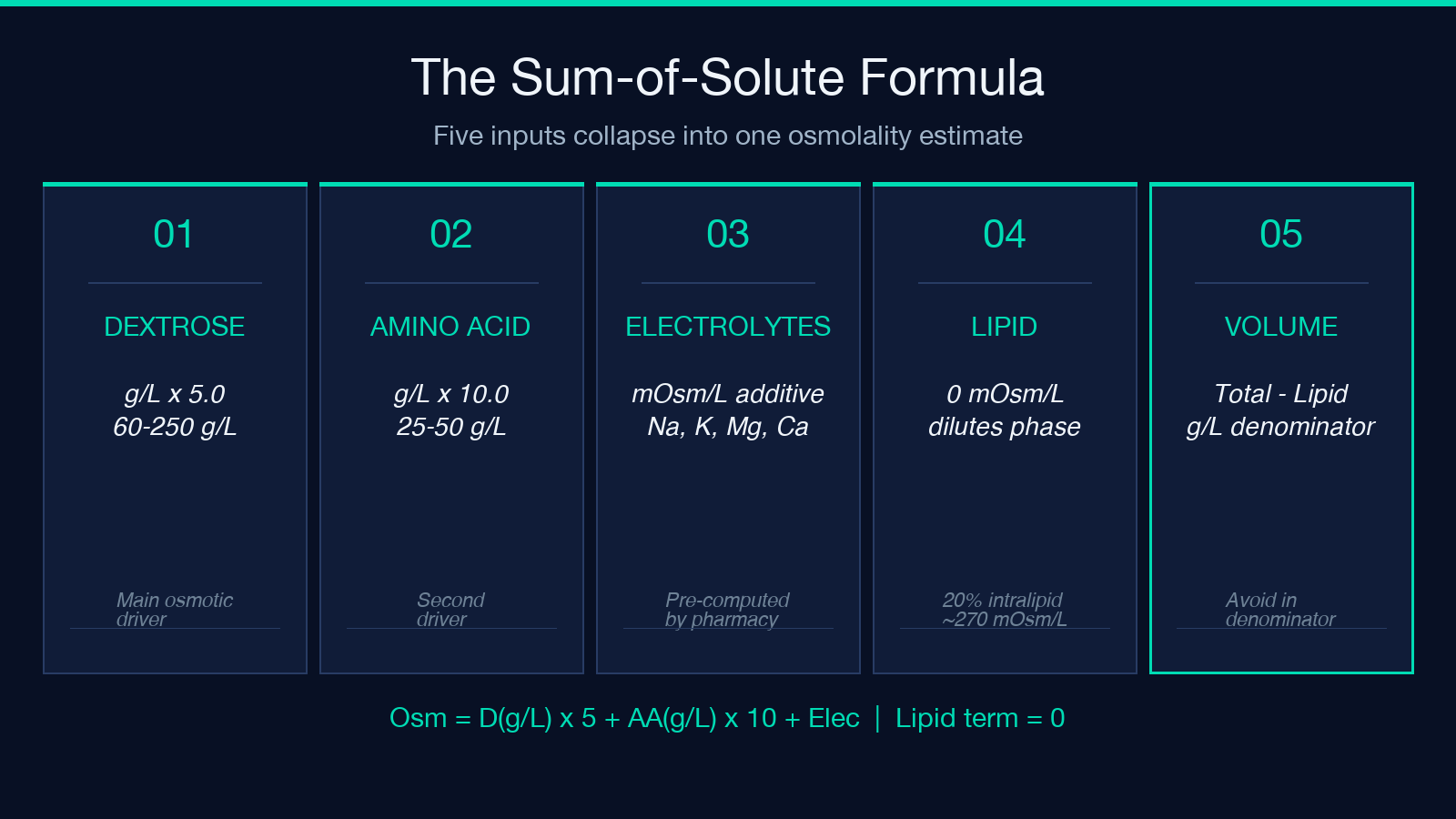
Osm (mOsm/L) ≈ Dextrose(g/L) × 5.0 + Amino acids(g/L) × 10.0 + Electrolyte additive (mOsm/L)Two simplifications are baked in. First, lipid emulsions are near-iso-osmolar (20% intralipid sits at ~270 mOsm/L), so their contribution is set to zero — but they do dilute the aqueous phase, which is why the dextrose and amino acid concentrations are computed on total volume minus lipid volume. Second, electrolytes are entered as a single additive in mOsm/L, which most institutional order-entry systems already pre-compute when the pharmacist signs off on the electrolyte package (Na, K, Mg, Ca, acetate, chloride, phosphate).
Where lipid sits in the math
Lipid emulsions are near-iso-osmolar — 20% intralipid sits at roughly 270 mOsm/L — so their osmotic contribution is set to zero in the sum-of-solute formula. Lipid’s real role is as a diluent: a 250-mL lipid volume pulls the aqueous phase’s effective volume down, which raises dextrose and amino acid concentrations per liter and slightly increases the osmotic load per mL of total admixture. The estimator handles this automatically by computing g/L on total volume minus lipid volume, so the lipid term never appears as an additive but its absence from the denominator is baked into every calculation.
Worked example 1 — Peripheral PN at 850 mOsm/L
A bag compounded from 1000 mL D10W, 500 mL of 5% amino acids, 250 mL 20% lipid, and a 350-mOsm/L electrolyte additive breaks down as follows. The non-lipid aqueous phase is 1500 mL, holding 100 g of dextrose (66.7 g/L) and 25 g of amino acids (16.7 g/L). The math runs:
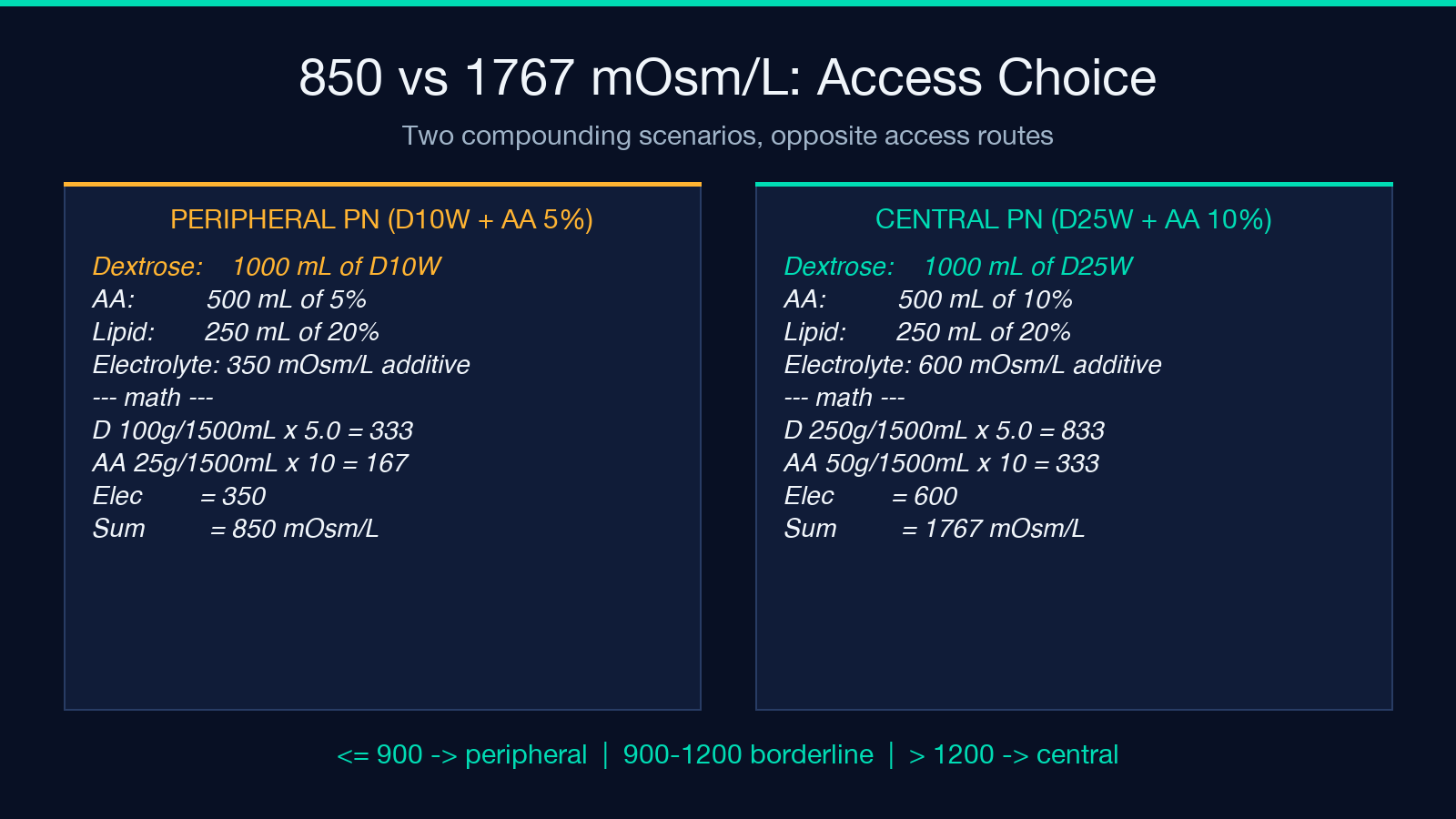
– Dextrose term: 66.7 × 5.0 = 333 mOsm/L – Amino acid term: 16.7 × 10.0 = 167 mOsm/L – Electrolyte additive: 350 mOsm/L – Total: 850 mOsm/L
The estimator tags this batch as Peripheral-tolerable (≤ 900 mOsm/L). A 22-gauge peripheral cannula with site rotation every 24 hours is clinically reasonable.
Worked example 2 — Central PN at 1767 mOsm/L
The same volume geometry, scaled up: 1000 mL D25W, 500 mL of 10% amino acids, 250 mL 20% lipid, 600 mOsm/L electrolytes. The aqueous phase (1500 mL) now holds 250 g of dextrose and 50 g of amino acids:
– Dextrose term: 166.7 × 5.0 = 833 mOsm/L – Amino acid term: 33.3 × 10.0 = 333 mOsm/L – Electrolyte additive: 600 mOsm/L – Total: 1767 mOsm/L
That number lands squarely in the central-only zone (>1200 mOsm/L). A peripheral infusion here would produce near-immediate endothelial injury; even a PICC line is marginal without aggressive dilution. The clinically expected route is a tunneled CVC or an implanted port, with the tip in the lower superior vena cava where flow rates approach 2 L/min.
How thresholds map to access devices
The three-tier output lines up with how clinicians actually decide:
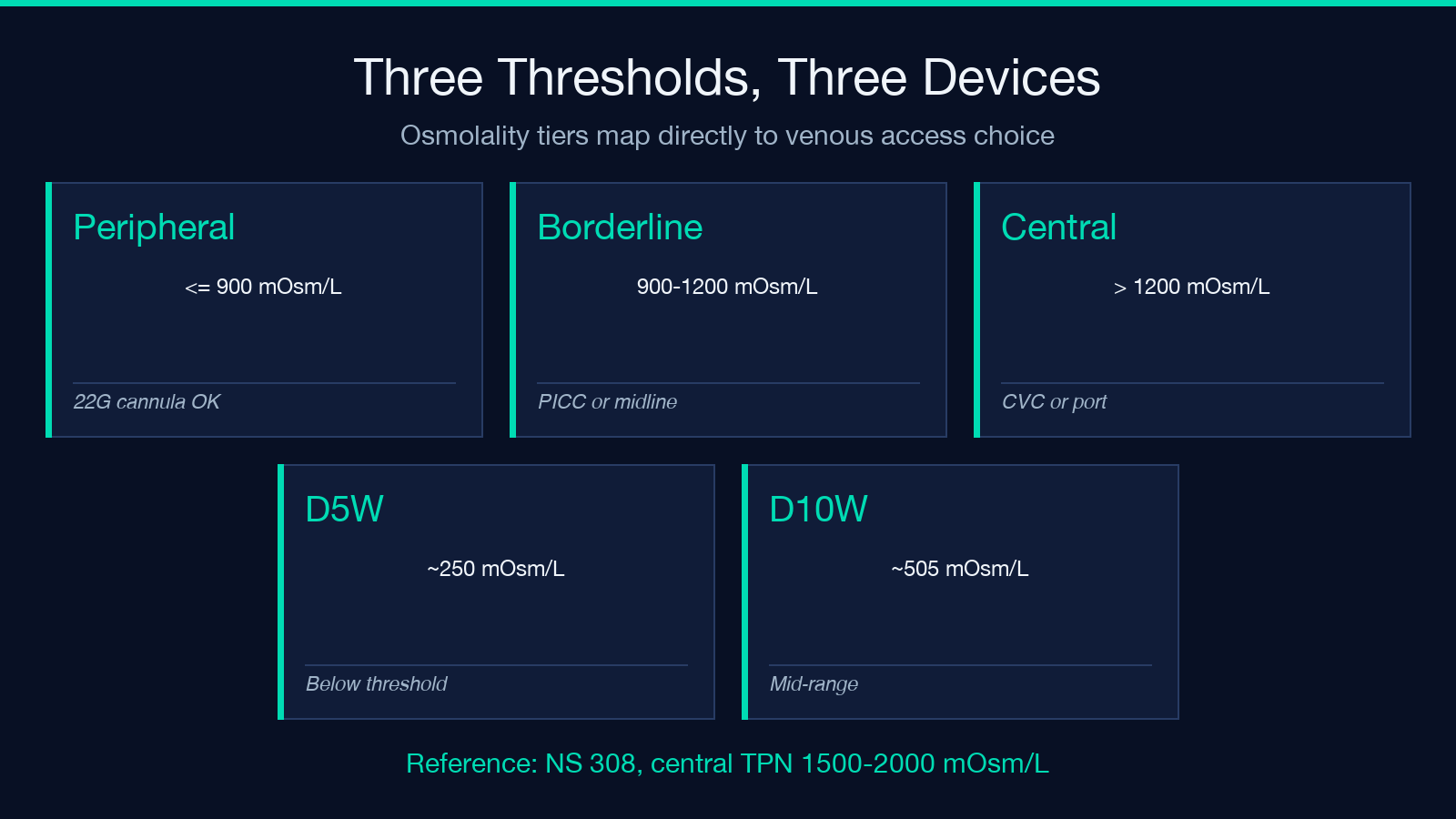
- ≤ 900 mOsm/L — peripheral cannula acceptable, with site rotation and osmolar-load monitoring
- 900–1200 mOsm/L — borderline; PICC or midline with dilution, or central if duration > 7–10 days
- > 1200 mOsm/L — central venous catheter required (tunneled CVC, implanted port, or PICC for short courses)
For reference: D5W (~250 mOsm/L) and normal saline (308 mOsm/L) sit well below the peripheral threshold; D10W (~505 mOsm/L) is mid-range; a typical 2-in-1 central TPN lands between 1500 and 2000 mOsm/L.
What the estimator does NOT capture
The sum-of-solute formula covers osmolality, but the calcium-phosphate solubility question is a separate chemical hazard. Ca²⁺ and PO₄³⁻ precipitate at high concentrations, and the resulting dibasic calcium phosphate crystals can occlude pulmonary capillaries — a complication invisible to an osmolality estimate. Institutional PN protocols typically apply a Ca × PO₄ solubility curve (often expressed as mEq/L × mg/dL product limits) layered on top of the osmolality threshold. Treat the estimator as one filter in a two-filter pipeline, not as a single gating number.
The formula also assumes a properly compounded admixture. Lab measurement by freezing-point depression (the gold standard) can return values 100–200 mOsm/L higher than the sum-of-solute estimate, particularly for neonatal and high-electrolyte formulas — pharmacy verification before infusion is non-optional.
When to use the estimator versus when to call the lab
Reach for the TPN Osmolality Estimator at the order-entry stage, before the admixture is compounded. It answers the question “is the proposed formula within the bounds of the access device we’re planning to use?” in under a second, which makes it useful for pharmacists screening new PN orders, dietitians drafting adult TPN recommendations, and clinicians deciding between escalating access for short-term PN trials. For high-stakes scenarios — neonatal PN, refeeding-syndrome initiations, electrolyte-heavy admixtures — confirm against a lab-measured freezing-point-depression value before infusion.
Explore more clinical and nutrition calculators at elysiatools.com.
